
SpaceX Valuation Surges Past $2.4 Trillion in First Week of Trading, Making Elon Musk the First Trillionaire
Following the largest initial public offering in history, the newly merged aerospace and AI conglomerate saw its shares jump 37%, cementing a new era of mega-cap tech.
By Factlen Editorial Team
- Tech Bulls & Retail Investors
- This camp views the valuation as justified by SpaceX's monopoly on space access and AI potential.
- Market Skeptics & Analysts
- This camp warns that the stock is priced for absolute perfection and carries significant integration risks.
- Economic Justice Advocates
- This camp focuses on the societal implications of a single individual amassing a $1 trillion fortune.
What's not represented
- · Competitors in the aerospace sector
- · Telecommunications regulators
Why this matters
SpaceX's public debut opens one of the world's most valuable and secretive companies to everyday investors, reshaping retirement portfolios as it enters major stock indexes. The massive capital raise also accelerates the development of next-generation space and AI infrastructure, potentially altering the future of global telecommunications and computing.
Key points
- SpaceX raised a record-breaking $75 billion in its IPO, pricing shares at $135.
- The stock surged 37% in its first week, pushing the company's market capitalization to $2.4 trillion.
- The massive valuation makes Elon Musk the world's first trillionaire, with an estimated net worth of $1.14 trillion.
- The public entity includes SpaceX's launch business, the Starlink satellite network, and the newly merged xAI division.
- In an unprecedented move, up to 30% of the IPO float was allocated directly to retail investors.
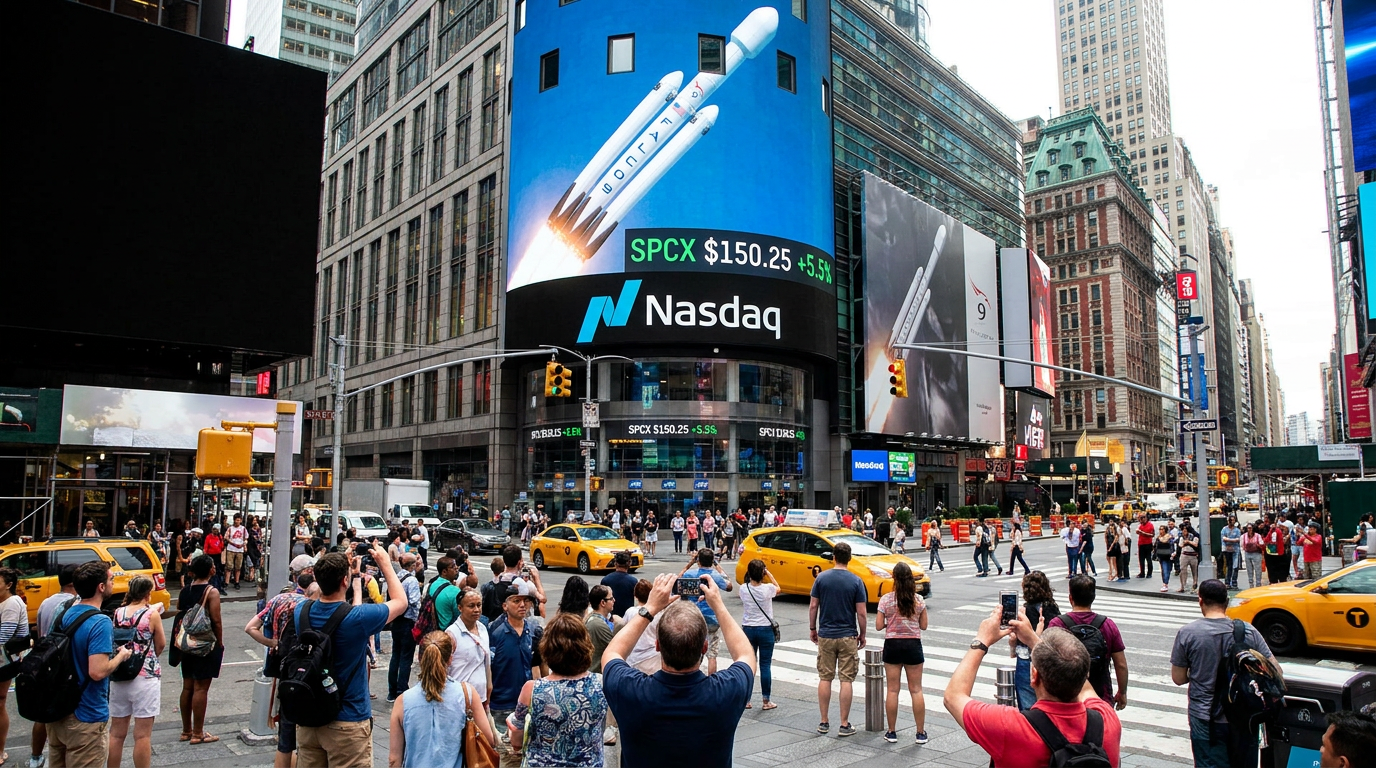
The long-awaited public debut of SpaceX has rewritten the record books of global finance. On June 12, 2026, the aerospace and artificial intelligence conglomerate listed on the Nasdaq under the ticker SPCX, executing the largest initial public offering in history. By offering 555.6 million shares at a fixed price of $135, the company raised a staggering $75 billion, shattering the previous $29.4 billion record set by Saudi Aramco in 2019.[7]
The market's appetite for the stock proved insatiable. Despite the sheer size of the float, SpaceX shares surged throughout their first week of trading. By the close of the week, the stock had climbed 37% above its IPO price, pushing the company's total market capitalization to $2.4 trillion.[1][2]
That valuation instantly minted SpaceX as the sixth-largest publicly traded company in the world, placing it in the elite ranks of the tech industry's mega-caps.[2]

The historic listing also triggered a personal financial milestone that had long been anticipated but never realized: the world's first trillionaire. Elon Musk, who retains roughly a 42% stake in the newly public entity, saw his personal net worth eclipse $1.14 trillion as the stock rallied.[3]
Musk's fortune grew by an estimated $326 billion in a matter of days, driven almost entirely by the market's validation of his space and AI ventures.[3]
Investors were not simply buying into a rocket manufacturer. In February 2026, SpaceX executed a massive all-stock merger with xAI, Musk's artificial intelligence venture, and the social media platform X.[4]
The resulting conglomerate was pitched to Wall Street as a "three-engine empire," combining orbital launch infrastructure, global satellite broadband, and gigawatt-scale AI compute into a single, unprecedented corporate structure.[4]

The financial engine of this new trinity is Starlink. The satellite internet service has grown into a formidable cash generator, surpassing 10 million global subscribers. In 2025, Starlink posted an estimated $11.39 billion in revenue with operating margins exceeding 60%.[4]
This reliable, recurring cash flow is viewed by Wall Street as the critical counterweight to the massive capital expenditures required by the company's other two divisions.[4][5]
The launch division, anchored by the workhorse Falcon 9 and the next-generation Starship program, continues to dominate the global aerospace market. SpaceX completed approximately 165 Falcon 9 launches in 2025, holding roughly 90% of the global commercial launch share by mass-to-orbit.[8]
The launch division, anchored by the workhorse Falcon 9 and the next-generation Starship program, continues to dominate the global aerospace market.
However, it is the newly integrated xAI division that has driven the most speculative fervor. By merging xAI's Grok language models and its massive Colossus data center with SpaceX's satellite network, the company is laying the groundwork for highly ambitious future projects.[4][5]

Chief among these is the proposed deployment of "orbital data centers"—server farms placed in space to leverage solar energy and the vacuum of space for cooling, while connecting directly to the Starlink mesh network.[5]
The IPO was also notable for its unconventional structure. Bypassing the traditional Wall Street playbook of building an institutional order book to determine a price range, SpaceX went straight to market with a fixed $135 price tag. Furthermore, the company allocated up to 30% of the offering to retail investors through consumer brokerages, roughly triple the standard retail allocation for a major public offering.[4][8]
The demand for the stock was overwhelming. Institutional and retail orders reportedly exceeded $250 billion, making the offering more than three times oversubscribed. The massive liquidity event also generated unprecedented internal wealth, with analysts estimating that the IPO created approximately 4,000 new millionaires among SpaceX's early employees, engineers, and executives who had held illiquid equity for years.[8]
Despite the euphoric debut, market analysts and institutional skeptics have urged caution. At a $2.4 trillion valuation, SpaceX is trading at nearly 100 times its projected combined revenue, a multiple that leaves zero room for execution errors.[4][5]
Analysts note that xAI is currently operating at a massive loss, effectively consuming the profits generated by Starlink to fund its ongoing AI infrastructure buildout. Corporate governance experts have also flagged the complexities of the merged entity, pointing out that concepts like orbital data centers remain entirely unproven.[5]
Beyond Wall Street, the sheer scale of the wealth generated by the IPO has prompted broader economic reflections. Organizations tracking global wealth noted the historic nature of a single individual's net worth eclipsing the economic output of many nations, pointing out that Musk's fortune now exceeds the combined net wealth of the poorest 46% of the global population.[6]
While advocates highlighted the milestone as a symbol of concentrated capital, tech proponents argued it reflects the massive value created by solving some of the hardest engineering challenges in aerospace and computing.[4][6]
Ultimately, the successful listing of SpaceX marks a definitive shift in the global technology landscape. By proving that public markets can absorb a $75 billion offering and support a $2.4 trillion valuation for a frontier-tech conglomerate, the IPO has set a new benchmark.[7]
As index funds begin the mandatory process of buying into the newly minted giant, SpaceX's performance will now directly impact the retirement portfolios of millions, cementing its transition from a private disruptor to a cornerstone of the global economy.[2][7]

How we got here
February 2026
SpaceX acquires xAI and X in an all-stock merger, creating a unified aerospace and AI conglomerate.
May 20, 2026
SpaceX publicly files its S-1 prospectus, revealing financials for the combined entity.
June 11, 2026
The IPO prices at a fixed $135 per share, bypassing the traditional price-range bookbuilding process.
June 12, 2026
SpaceX debuts on the Nasdaq under the ticker SPCX.
June 18, 2026
SPCX ends its first week of trading up 37%, pushing its market cap to $2.4 trillion.
Viewpoints in depth
Tech Bulls & Retail Investors
This camp views the valuation as justified by SpaceX's monopoly on space access and AI potential.
Proponents argue that SpaceX is no longer just a rocket company, but a foundational infrastructure layer for the 21st-century economy. By combining the cash-generating power of Starlink with the limitless potential of xAI's compute capabilities, they believe the $2.4 trillion valuation accurately reflects a company that has effectively monopolized commercial space access while positioning itself at the forefront of the artificial intelligence race. The massive retail participation is seen as a democratization of this wealth creation.
Market Skeptics & Analysts
This camp warns that the stock is priced for absolute perfection and carries significant integration risks.
Financial analysts and corporate governance experts caution that a $2.4 trillion market capitalization leaves zero margin for error. They point out that xAI is currently operating at a massive loss, consuming the profits generated by Starlink. Furthermore, skeptics argue that the synergies between launching rockets and training large language models remain unproven, and concepts like 'orbital data centers' are still entirely theoretical. They also flag the governance risks of merging three distinct companies under one volatile CEO.
Economic Justice Advocates
This camp focuses on the societal implications of a single individual amassing a $1 trillion fortune.
For organizations tracking global inequality, the SpaceX IPO is a stark symbol of concentrated capital. They note that Elon Musk's $1.14 trillion net worth now exceeds the economic output of many developed nations and surpasses the combined wealth of the poorest 46% of the global population. This perspective argues that such extreme wealth accumulation highlights structural flaws in the global economy and calls for renewed discussions on wealth taxation and corporate monopolies.
What we don't know
- Whether the proposed 'orbital data centers' are technologically and economically viable at scale.
- How the massive capital burn of the xAI division will impact SpaceX's long-term profitability.
- If regulatory bodies will intervene in the unprecedented convergence of aerospace, telecommunications, and artificial intelligence under one corporate umbrella.
Key terms
- Initial Public Offering (IPO)
- The process of offering shares of a private corporation to the public in a new stock issuance.
- Market Capitalization
- The total value of a publicly traded company's outstanding shares of stock, calculated by multiplying the share price by the number of shares.
- Orbital Data Centers
- A proposed infrastructure concept where server farms are placed in space to leverage solar energy and the vacuum of space for cooling, while connecting via satellite networks.
- xAI
- An artificial intelligence company founded by Elon Musk, known for the Grok language model and the Colossus data center, which merged with SpaceX in early 2026.
Frequently asked
Did retail investors get to buy SpaceX stock?
Yes, SpaceX broke convention by allocating up to 30% of its IPO float to retail investors through consumer brokerages like Robinhood and Fidelity.
Why did SpaceX merge with xAI?
The February 2026 merger aimed to combine SpaceX's global satellite connectivity (Starlink) with xAI's massive computing power, setting the stage for future projects like orbital data centers.
How much of SpaceX does Elon Musk own?
Following the IPO, Musk retains roughly a 42% equity stake in the company, which pushed his personal net worth past the $1 trillion mark.
Sources
Source coverage
8 outlets
3 viewpoints surfaced








[1]CNBCTech Bulls & Retail Investors
Musk's SpaceX stake is worth over $1 trillion. Here are the other billionaire shareholders
Read on CNBC →[2]BloombergMarket Skeptics & Analysts
SpaceX shares end first week of trading up 37% from IPO price
Read on Bloomberg →[3]The GuardianEconomic Justice Advocates
SpaceX going public has made Elon Musk a trillionaire
Read on The Guardian →[4]ForbesTech Bulls & Retail Investors
The Three-Engine Empire: SpaceX IPO
Read on Forbes →[5]MorningstarMarket Skeptics & Analysts
What Is SpaceX? How Will SpaceX's AI Business Make Money
Read on Morningstar →[6]OxfamEconomic Justice Advocates
Soon-to-be trillionaire Elon Musk's wealth grew by over $1 million per minute in the last year
Read on Oxfam →[7]ReutersMarket Skeptics & Analysts
SpaceX xAI IPO $75B Record
Read on Reuters →[8]Investing.comTech Bulls & Retail Investors
SpaceX xAI IPO: What Investors Need to Know
Read on Investing.com →
More in business
See all 5 stories →


Every angle. Every day.
Get business stories with full source coverage and perspective breakdowns delivered to your inbox.