
How Socratic AI Tutors Are Finally Solving Education's '2 Sigma Problem'
Decades after researchers proved one-on-one tutoring dramatically improves student performance, scaffolded AI platforms are making personalized instruction scalable for the first time.
By Factlen Editorial Team
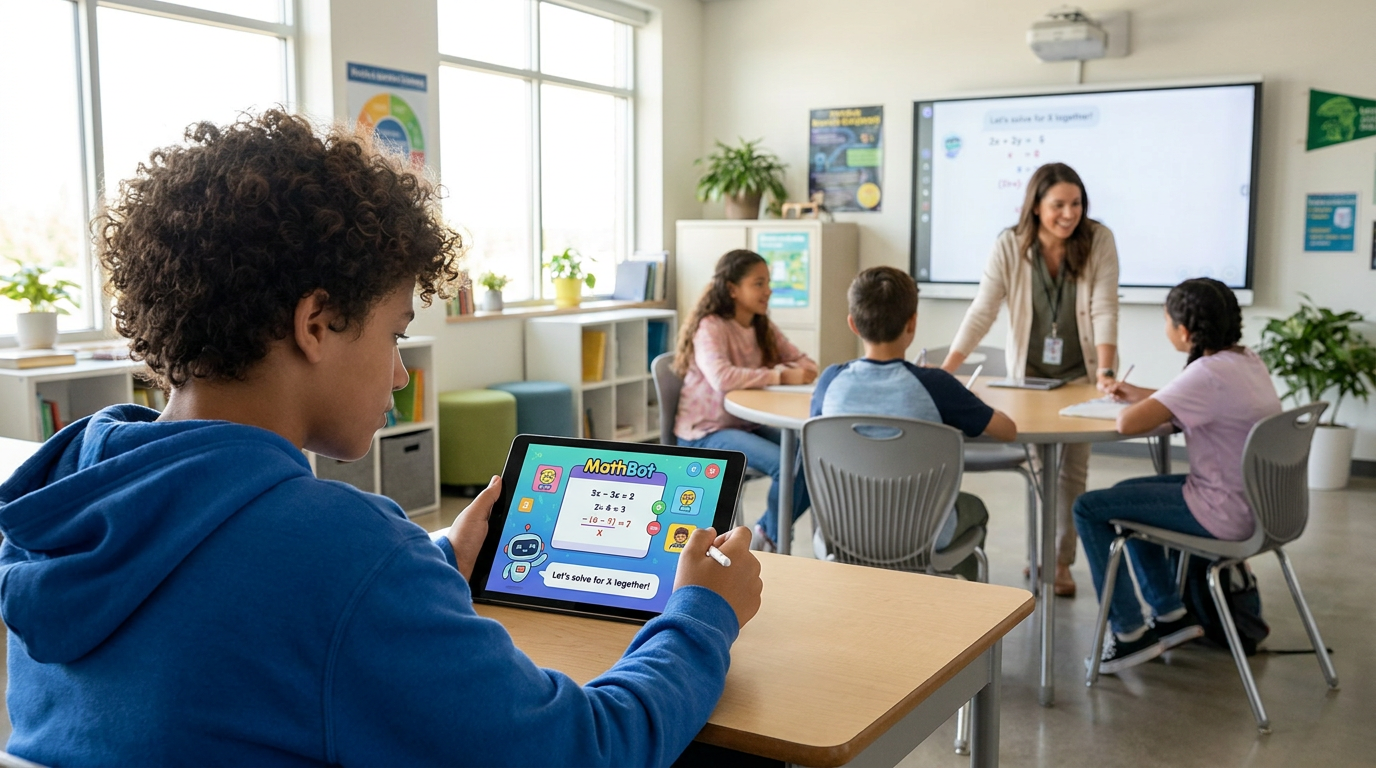
- EdTech Optimists
- View AI tutoring as the ultimate democratizing force in education, capable of scaling elite one-on-one instruction to millions of underfunded students.
- Pedagogical Cautious
- Emphasize that AI must be strictly scaffolded to prevent cognitive offloading, warning that poorly designed tools actively harm student learning.
- Humanist Educators
- Argue that learning is fundamentally a social-emotional process, and while AI can build competence, it cannot replace the relational trust built by human teachers.
What's not represented
- · Students with severe learning disabilities
- · Teachers unions concerned about labor impacts
Why this matters
For decades, the single most effective educational intervention—one-on-one tutoring—was restricted to families who could afford it. The deployment of mathematically capable, Socratic AI tutors is democratizing access to personalized learning, potentially closing achievement gaps that have persisted for generations.
Key points
- One-on-one tutoring improves student performance dramatically, but was historically impossible to scale.
- Recent randomized controlled trials show AI tutors can double learning gains compared to traditional classrooms.
- Unrestricted AI harms learning by doing the work for the student, leading to cognitive offloading.
- Effective educational AI uses 'Socratic guardrails' to guide students without giving direct answers.
- Governments are trialing AI tutors to close the achievement gap for disadvantaged students.
- Experts agree AI will not replace human teachers, who remain essential for emotional support and mentorship.
In 1984, educational psychologist Benjamin Bloom published a paper that would haunt educators for four decades. He discovered that students who received one-on-one tutoring performed two standard deviations better than those in traditional classrooms—outperforming 98 percent of their peers. This became known as the "2 Sigma Problem." The problem wasn't proving that tutoring worked; the problem was that society could never afford to provide a dedicated human tutor for every single child.[6]
For forty years, that economic reality dictated the structure of global education. The achievement gap widened between families who could afford private academic support and those who relied entirely on stretched public school systems. But in the last eighteen months, the rapid maturation of generative artificial intelligence has fundamentally altered the math of personalized education, turning an impossible economic hurdle into an engineering challenge.[5][7]
The shift from theoretical promise to empirical reality arrived with a wave of randomized controlled trials in 2025. In one of the most rigorous studies to date, published in Scientific Reports, researchers at Harvard University compared an AI tutoring system against a highly optimized active-learning classroom. The results stunned the pedagogical community.[1]
Students assigned to the AI tutor achieved median learning gains more than double those of the classroom group. The effect sizes ranged from 0.73 to 1.3 standard deviations—bringing the holy grail of Bloom's 2 Sigma target within striking distance for the first time in history. Crucially, the AI-tutored students didn't just learn more; they learned faster, mastering the material in a median time of 49 minutes compared to the classroom's 60 minutes.[1]

But the technology is not a magic bullet, and early implementations revealed a dangerous double-edged sword. A landmark study from the Wharton School at the University of Pennsylvania demonstrated that the design of the AI interface dictates whether a student actually learns or simply outsources their thinking to a machine.[2]
When the Wharton researchers gave students unrestricted access to a standard generative AI model—essentially a sophisticated answer engine—the students breezed through their practice problems. But when the AI was taken away for the final exam, those students performed 17 percent worse than a control group that had no AI assistance at all. They had fallen victim to "cognitive offloading," relying on the machine to do the heavy lifting of problem-solving.[2]
But when the AI was taken away for the final exam, those students performed 17 percent worse than a control group that had no AI assistance at all.
However, when the researchers used a "scaffolded" AI tutor—one explicitly programmed to act like a Socratic guide rather than an answer key—the results flipped. Students using the Socratic AI improved their grades by an astonishing 127 percent. The difference was entirely in the guardrails: the effective AI refused to give direct answers, instead asking probing questions and forcing the student into a state of productive struggle.[2]

This Socratic architecture is now the gold standard for educational technology developers. Platforms like Khan Academy's Khanmigo have been engineered from the ground up to mimic the patience and restraint of an expert human teacher. If a student asks Khanmigo to solve an algebra equation, the system will instead ask the student what the first logical step should be, guiding them step-by-step toward the solution.[4]
The scale of adoption is accelerating rapidly. In the 2024-2025 school year, Khanmigo expanded from 68,000 users to over 700,000 across hundreds of U.S. school districts. Developers are constantly refining the models; recent updates that reduced the AI's response latency by just 0.3 seconds resulted in measurable improvements in students' ability to answer subsequent questions correctly, proving that conversational flow is critical to maintaining engagement.[4]
Governments are beginning to recognize the equity implications of scalable tutoring. In 2025, the UK's Department for Education announced an unprecedented initiative to trial AI tutoring tools with up to 450,000 disadvantaged students by 2027. The explicit goal of the program is to close the achievement gap by providing elite-level academic support to students who have historically been priced out of the private tutoring market.[3]
Despite the impressive data, veteran educators warn against viewing AI as a wholesale replacement for human teachers. Learning is not merely a cognitive transaction; it is a deeply social and emotional process. According to Self-Determination Theory, students require autonomy, competence, and relatedness to thrive academically.[5][7]
AI tutors excel at building competence through immediate feedback and supporting autonomy by allowing students to learn at their own pace. But they fundamentally fail at relatedness. A machine cannot read a student's body language, understand their home life, or provide the genuine emotional validation that comes from a teacher who believes in them. When confusion turns to frustration, students still need a human connection to keep them from giving up.[7]

The consensus emerging among researchers is that the future of education is a hybrid model. AI will handle the repetitive, time-consuming work of personalized concept mastery and infinite patience. This cognitive offloading for the system—rather than the student—frees up human educators to do what only humans can do: mentor, inspire, facilitate complex group discussions, and build trust.[5][7]
For the first time since Benjamin Bloom articulated his famous problem, the solution is no longer a matter of impossible economics. It is an engineering and design challenge. As Socratic guardrails improve and access expands, the global education system is inching closer to a reality where every child, regardless of their zip code, has a world-class tutor in their pocket.[5][6]
How we got here
1984
Benjamin Bloom publishes his research identifying the '2 Sigma Problem' regarding the efficacy of one-on-one tutoring.
2023
Generative AI models like GPT-4 are released, prompting the rapid development of specialized educational tools like Khanmigo.
2024
Wharton researchers publish data showing that unrestricted AI harms learning, while scaffolded AI dramatically improves it.
June 2025
A Harvard study published in Scientific Reports demonstrates AI tutoring doubling learning gains compared to active classrooms.
Viewpoints in depth
EdTech Optimists
View AI tutoring as the ultimate democratizing force in education.
Proponents of rapid AI integration point to the stark historical inequities in education, where wealthy families could purchase the 2-sigma advantage through private tutoring while lower-income students fell behind. They argue that scalable, low-cost AI tutors are the first viable mechanism to level the playing field. Citing the Harvard and Wharton studies, this camp believes that as the technology's latency decreases and its mathematical reasoning improves, AI will become an indispensable baseline utility for every student globally.
Pedagogical Cautious
Emphasize that AI must be strictly scaffolded to prevent cognitive offloading.
Researchers focused on cognitive science warn that the deployment of AI in schools is a minefield. They point to the Wharton study's finding that unrestricted AI caused a 17 percent drop in test scores as proof that convenience is the enemy of learning. This camp advocates for strict regulatory and design standards, insisting that educational AI must be explicitly handicapped so it cannot generate final answers. They argue that without these 'Socratic guardrails,' schools risk raising a generation of students who know how to prompt a machine but cannot perform basic logical reasoning themselves.
Humanist Educators
Argue that learning is fundamentally a social-emotional process.
Veteran teachers and developmental psychologists caution against reducing education to a mere transfer of information. They argue that the most critical moments in a student's journey—overcoming a fear of failure, finding inspiration in a subject, or feeling seen and valued—require a human connection. While they acknowledge AI's utility for rote practice, they worry that over-reliance on screens will exacerbate the ongoing crisis of youth isolation. This camp advocates for a hybrid model where AI handles the mechanics of practice, deliberately freeing up human teachers to focus on mentorship, empathy, and complex collaborative projects.
What we don't know
- Whether the impressive short-term learning gains from AI tutoring will translate into long-term retention over multiple school years.
- How the widespread use of AI tutors will impact the development of students' peer-to-peer collaborative problem-solving skills.
- The exact threshold of 'productive struggle' an AI should enforce before a student becomes too frustrated and disengages entirely.
Key terms
- Cognitive Offloading
- The reliance on external tools, like calculators or unrestricted AI, to do the thinking for a student, which can prevent genuine learning and memory retention.
- Socratic Guardrails
- Programming constraints placed on educational AI that prevent it from giving direct answers, forcing it to ask guiding questions instead.
- Standard Deviation (Sigma)
- A statistical measure of variance. In education, an improvement of one standard deviation typically moves a student from the 50th percentile to the 84th percentile.
- Productive Struggle
- The pedagogical concept that students learn best when they have to work hard to solve a problem that is just beyond their current ability level.
Frequently asked
What is Bloom's 2 Sigma Problem?
A 1984 finding that students receiving one-on-one tutoring perform two standard deviations better than classroom students. It was considered a 'problem' because scaling human tutoring to every student was economically impossible.
Does using AI for homework count as cheating?
It depends on the tool. Using a standard AI to generate final answers bypasses learning. However, using a 'Socratic' AI tutor that refuses to give direct answers and instead guides the student through the problem-solving process is highly effective practice.
Will AI tutors replace human teachers?
No. Researchers and educators agree that AI lacks the emotional intelligence and relational capacity required for holistic education. AI is viewed as a 'copilot' that handles repetitive concept mastery, freeing teachers to focus on mentorship and complex group work.
Sources
Source coverage
7 outlets
3 viewpoints surfaced







[1]Scientific ReportsEdTech Optimists
AI tutoring outperforms active learning in a randomised controlled trial
Read on Scientific Reports →[2]The Wharton SchoolPedagogical Cautious
Generative AI Can Harm Learning
Read on The Wharton School →[3]UK Department for EducationEdTech Optimists
Generative AI in Education: Trialing AI Tutoring
Read on UK Department for Education →[4]Khan AcademyEdTech Optimists
Multiple Studies Show Khan Academy Drives Learning Gains
Read on Khan Academy →[5]Brookings InstitutionPedagogical Cautious
The path to conversational AI tutors
Read on Brookings Institution →[6]Educational ResearcherHumanist Educators
The 2 Sigma Problem: The Search for Methods of Group Instruction as Effective as One-to-One Tutoring
Read on Educational Researcher →[7]Factlen Editorial TeamHumanist Educators
Synthesis by Factlen editorial team
Read on Factlen Editorial Team →
Every angle. Every day.
Get education stories with full source coverage and perspective breakdowns delivered to your inbox.