
U.S. and Iran Sign Preliminary Agreement as Regional Tensions and Sanctions Hurdles Persist
The Trump administration has signed a preliminary diplomatic agreement with Iran featuring a proposed $300 billion investment fund, though the deal immediately faces legal hurdles from existing U.S. sanctions and ongoing Israeli military operations in Lebanon.
By Factlen Editorial Team
- U.S. Administration
- Views the agreement and the $300 billion fund as a necessary paradigm shift to stabilize the Middle East through economic integration.
- Israeli Security Establishment
- Deeply skeptical of the deal, arguing that economic relief for Iran will fund proxy groups like Hezbollah, necessitating continued military action.
- Iranian Leadership
- Frames the agreement as a diplomatic win to relieve economic pressure, but remains wary of the U.S.'s ability to bypass its own sanctions.
- Sanctions & Legal Analysts
- Warns that the proposed investment fund is legally unworkable under current U.S. law without unprecedented congressional or executive action.
What's not represented
- · Lebanese civilians affected by ongoing strikes
- · European Union diplomats involved in previous nuclear negotiations
Why this matters
A formalized U.S.-Iran agreement could fundamentally reshape Middle Eastern geopolitics and global energy markets. However, the immediate clash between the proposed $300 billion investment fund and existing U.S. sanctions laws, combined with ongoing regional conflicts, means the path to a lasting resolution remains highly volatile.
Key points
- The U.S. and Iran have signed a preliminary diplomatic agreement aimed at regional de-escalation.
- The deal includes a proposed $300 billion investment fund to revitalize the Iranian economy.
- Legal experts warn the fund may violate existing U.S. sanctions laws targeting the IRGC.
- Israel has continued bombing Hezbollah targets in Lebanon despite the agreement.
- Vice President JD Vance issued a blunt warning to Israel to avoid derailing the diplomatic progress.
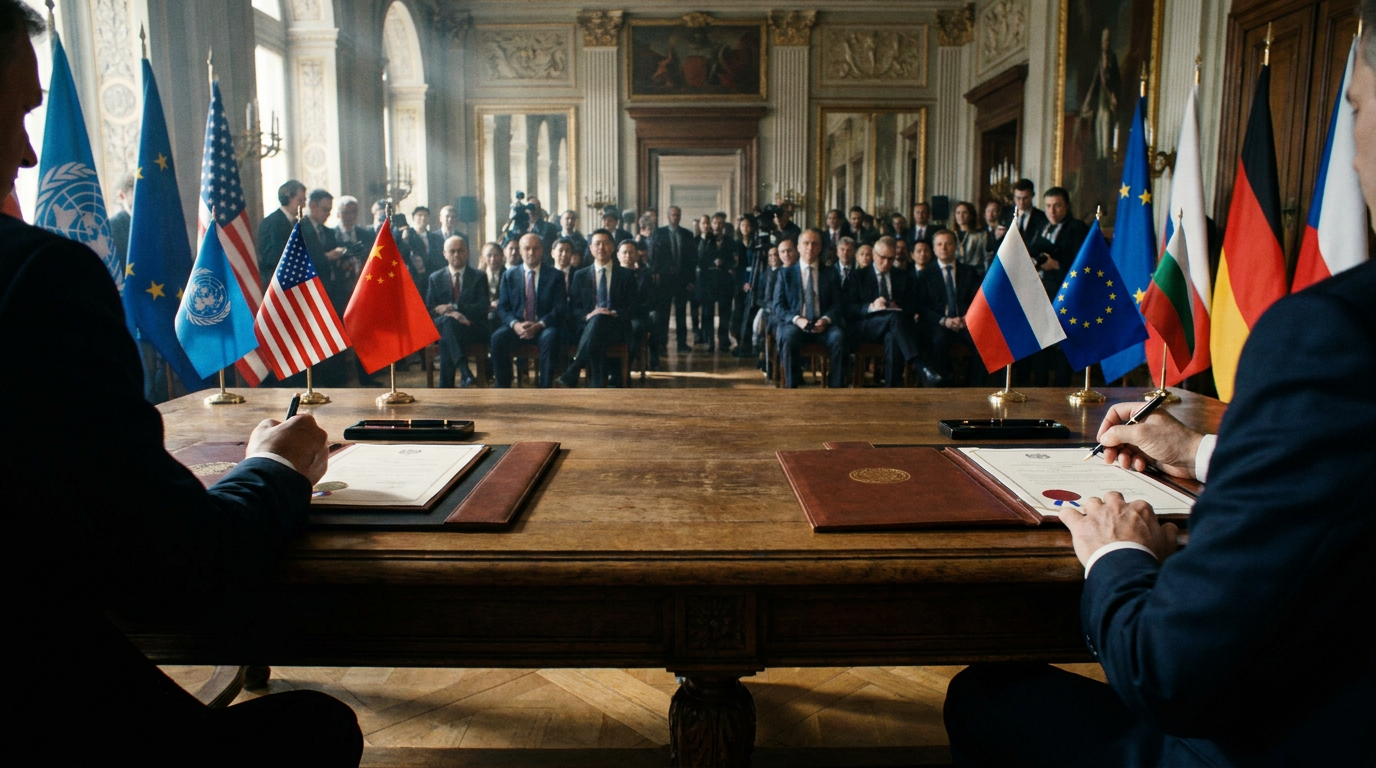
The Trump administration has officially signed a preliminary agreement with Iran, marking a historic and highly complex pivot in Middle Eastern diplomacy. The framework aims to de-escalate years of hostility by offering a pathway to economic normalization in exchange for regional security guarantees and a cessation of proxy hostilities. The signing represents a stark departure from previous diplomatic postures, signaling a willingness by the current administration to engage directly with Tehran on a grand scale.[1][5]
At the center of the diplomatic breakthrough is a proposed $300 billion investment fund designed to revitalize Iran's heavily sanctioned economy. The administration has pitched the fund as a mechanism to stabilize the region through economic interdependence, shifting the U.S. strategy from maximum pressure to financial incentivization. Proponents argue that integrating Iran into the global economy is the most effective way to ensure long-term compliance with security demands.[3][5]
However, the ambitious financial package faces immediate and severe legal roadblocks. Legal experts and sanctions analysts warn that executing a $300 billion investment into Iran is "close to impossible" under current U.S. law, specifically due to the pervasive influence of the Islamic Revolutionary Guard Corps (IRGC) over the Iranian construction, energy, and telecommunications sectors.[3]

Because the IRGC remains a designated Foreign Terrorist Organization, any foreign capital flowing into sectors it controls triggers automatic secondary sanctions. Bypassing these restrictions would require unprecedented executive waivers or acts of Congress, setting up a likely domestic political battle over the extent of the president's authority to unilaterally lift economic barriers without dismantling the underlying sanctions architecture.[1][3]
Beyond domestic legal hurdles, the agreement is already being tested by ongoing kinetic conflicts in the region. As the ink dried on the preliminary pact, Israeli military forces continued their bombing campaign against Hezbollah targets in Lebanon, a primary Iranian proxy. The strikes highlight the disconnect between the diplomatic progress in Washington and the volatile reality on the ground in the Levant.[2][6]

Beyond domestic legal hurdles, the agreement is already being tested by ongoing kinetic conflicts in the region.
The continued Israeli operations have prompted a sharp response from the White House. Vice President JD Vance issued a blunt warning to Israel, signaling that the administration expects its allies to align with the new diplomatic framework and avoid actions that could derail the fragile U.S.-Iran détente. The public friction underscores the tension between America's broader regional strategy and Israel's immediate security imperatives.[4]
The Israeli security establishment views the U.S.-Iran agreement with deep skepticism, prioritizing the immediate neutralization of threats on its northern border. From Israel's perspective, any economic relief granted to Tehran will inevitably be funneled to proxy groups like Hezbollah, making the cessation of military operations in Lebanon a non-starter without ironclad, verifiable security guarantees that go beyond preliminary signatures.[2][6]
In Tehran, state media has framed the preliminary agreement as a diplomatic victory and a necessary step toward lifting the economic siege that has crippled the nation's currency and sparked domestic unrest. Iranian officials have indicated a willingness to engage with the investment fund but remain cautious about Washington's ability to deliver on its financial promises given the entrenched sanctions laws and domestic U.S. opposition.[7]

The juxtaposition of high-level diplomacy and ongoing airstrikes underscores the fragility of the current moment. Middle Eastern analysts note that while the preliminary agreement establishes a theoretical framework for peace, the reality on the ground remains dictated by proxy warfare, deep-seated mistrust, and the complex web of international sanctions that cannot be undone with a single signature.[1][2]
The coming weeks will determine whether the preliminary agreement can evolve into a binding, executable treaty. The administration must simultaneously navigate a skeptical Congress, reassure an anxious Israeli government, and establish verifiable mechanisms to ensure that the proposed $300 billion fund does not run afoul of its own anti-terrorism laws, all while keeping Tehran engaged at the negotiating table.[1][3][4]
How we got here
Early 2026
Secret backchannel negotiations between U.S. and Iranian officials accelerate in Oman.
June 18, 2026
Israel intensifies its bombing campaign against Hezbollah targets in southern Lebanon.
June 19, 2026
The Trump administration officially signs the preliminary U.S.-Iran agreement.
June 19, 2026
Vice President JD Vance issues a public warning to Israel regarding its ongoing military operations.
Viewpoints in depth
U.S. Administration's View
The administration believes economic integration is the key to long-term Middle Eastern stability.
Proponents within the administration argue that decades of 'maximum pressure' sanctions have failed to alter Tehran's regional behavior or curb its proxy networks. By offering a massive $300 billion economic incentive, the U.S. hopes to create a scenario where Iran has too much to lose financially by continuing its hostile posture. This approach relies on the theory that economic interdependence will force the Iranian leadership to prioritize domestic growth over regional military expansion.
Israeli Government's View
Israel views the economic relief as a direct threat that will inevitably fund hostile proxy groups.
The Israeli security establishment maintains that any unfreezing of assets or new foreign investment into Iran will ultimately trickle down to groups like Hezbollah, Hamas, and the Houthis. From Jerusalem's perspective, the U.S. is prioritizing a diplomatic win over the physical security of its allies. Consequently, Israel feels compelled to continue its preemptive military strikes in Lebanon to degrade Hezbollah's capabilities before Iranian funds can replenish them.
Sanctions Experts' View
Legal analysts argue the proposed fund is fundamentally incompatible with existing U.S. law.
Sanctions experts point out that the Islamic Revolutionary Guard Corps (IRGC) controls vast swaths of the Iranian economy, including construction, telecommunications, and energy. Because the IRGC is designated as a Foreign Terrorist Organization, any foreign entity investing in these sectors is subject to severe U.S. secondary sanctions. Experts warn that unless Congress passes new legislation explicitly exempting the $300 billion fund—a highly unlikely scenario—the investment plan is legally unexecutable.
Iranian Leadership's View
Tehran welcomes the prospect of economic relief but remains highly skeptical of U.S. follow-through.
For the Iranian government, the preliminary agreement offers a desperately needed lifeline for an economy battered by inflation and sanctions. However, Iranian officials remember the U.S. withdrawal from the 2015 JCPOA and are acutely aware of the domestic political opposition the new deal faces in Washington. Tehran is demanding concrete, irreversible financial mechanisms before fully committing to the security concessions outlined in the preliminary pact.
What we don't know
- Whether the U.S. Congress will attempt to block the $300 billion investment fund.
- How Israel will adjust its military strategy in Lebanon in response to JD Vance's warnings.
- What specific mechanisms will be used to bypass existing IRGC-related sanctions.
Key terms
- IRGC (Islamic Revolutionary Guard Corps)
- A major branch of the Iranian Armed Forces that also controls significant portions of Iran's domestic economy and is designated as a Foreign Terrorist Organization by the U.S.
- Secondary Sanctions
- Economic penalties applied by the U.S. to third-party countries or foreign entities that do business with a sanctioned nation like Iran.
- Proxy Warfare
- A conflict where major powers instigate or support fighting by other groups or nations without directly engaging each other militarily.
Frequently asked
What is the $300 billion investment fund?
It is a proposed financial package designed to revitalize Iran's economy in exchange for regional security guarantees and de-escalation.
Why is the fund legally difficult to implement?
Current U.S. law imposes strict secondary sanctions on any foreign capital entering sectors controlled by the Islamic Revolutionary Guard Corps (IRGC), which holds significant sway over Iran's economy.
How has Israel responded to the agreement?
Israel has maintained its military operations against Iranian proxies like Hezbollah in Lebanon, prompting warnings from the U.S. administration to align with the new diplomatic framework.
Sources
Source coverage
7 outlets
4 viewpoints surfaced







[1]NPRU.S. Administration
What you need to know about the preliminary U.S.-Iran agreement signed by Trump
Read on NPR →[2]Al JazeeraIsraeli Security Establishment
Can US-Iran peace ‘deal’ survive Israeli bombing of Lebanon?
Read on Al Jazeera →[3]Fox NewsSanctions & Legal Analysts
Trump's $300B Iran investment fund may be 'close to impossible' due to IRGC sanctions law, expert warns
Read on Fox News →[4]NYTU.S. Administration
JD Vance’s Blunt Warning to Israel
Read on NYT →[5]ReutersU.S. Administration
Trump signs preliminary US-Iran pact, proposing $300 billion investment fund
Read on Reuters →[6]The Times of IsraelIsraeli Security Establishment
Israel strikes Hezbollah targets in Lebanon as US-Iran deal signed, defying Vance warning
Read on The Times of Israel →[7]IRNAIranian Leadership
Iran and US sign preliminary agreement, paving way for economic relief
Read on IRNA →


Every angle. Every day.
Get news politics stories with full source coverage and perspective breakdowns delivered to your inbox.