
How Precision Fermentation is Brewing the Future of Dairy-Free Ice Cream
Food scientists are using engineered microbes to brew real dairy proteins without cows, creating sustainable ice cream that melts and tastes exactly like the original.
By Factlen Editorial Team
- Biotech Innovators
- Argues that precision fermentation is the only way to replicate the exact sensory experience of dairy without the environmental cost.
- Environmental & Climate Advocates
- Focuses on the massive reductions in greenhouse gas emissions and water usage compared to traditional animal agriculture.
- Mainstream CPG Brands
- Views animal-free dairy as a scalable, sustainable ingredient that meets consumer demand for climate-friendly indulgence without sacrificing taste.
- Scientific Researchers
- Emphasizes the underlying synthetic biology and the need for rigorous life cycle assessments to verify sustainability claims.
What's not represented
- · Traditional Dairy Farmers
- · Allergy Advocacy Groups
Why this matters
Precision fermentation allows us to enjoy the exact taste and texture of real dairy ice cream without the massive environmental footprint of raising cows. As this technology hits mainstream supermarket aisles, it offers a viable, climate-friendly alternative that doesn't force consumers to compromise on flavor.
Key points
- Precision fermentation uses engineered microbes to brew real dairy proteins, like whey, without using animals.
- The resulting protein is molecularly identical to cow's whey, providing the exact creamy texture and melt of traditional ice cream.
- Life cycle assessments show the process uses up to 99% less water and emits 97% fewer greenhouse gases than conventional dairy.
- Major brands like Unilever are now adopting the technology, launching animal-free Breyers ice cream in supermarkets nationwide.
- Because the protein is real dairy, it is not suitable for people with milk allergies, creating unique labeling challenges.
The holy grail of dairy-free desserts has always been texture. For decades, food scientists have tried to coax almonds, oats, and soybeans into mimicking the rich, slow-melting indulgence of traditional ice cream. Yet, plant-based alternatives frequently fall short, often yielding icy, thin, or overly sweet results. The missing ingredient is not fat or sugar, but the unique architecture of dairy proteins.[1][7]
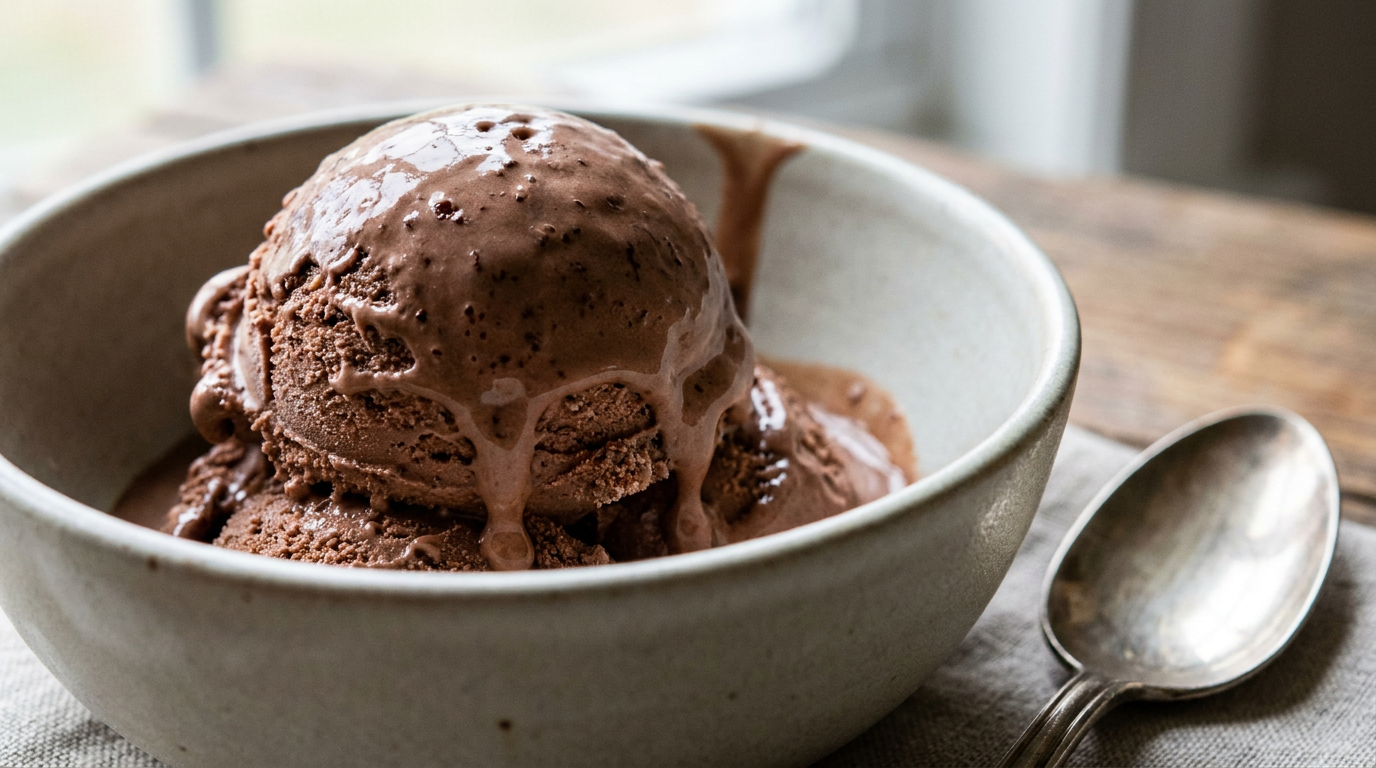
Now, a breakthrough in biotechnology is allowing ice cream makers to use real dairy proteins without ever involving a cow. The process is called precision fermentation, and it is quietly reshaping the future of the dessert industry. By brewing proteins in stainless steel tanks rather than raising livestock, food tech companies are promising a product that melts, whips, and tastes exactly like conventional dairy.[1][4]
To understand how this works, it helps to look at the science of milk. Cow's milk owes its functional magic primarily to two proteins: casein and whey. Casein provides the stretch and melt crucial for cheese, while whey—specifically a protein called beta-lactoglobulin—delivers the creaminess, aeration, and structural body required for premium ice cream.[1][6]
Precision fermentation sidesteps the animal entirely by turning microorganisms into microscopic factories. Scientists take the specific genetic sequence responsible for producing whey in cows and insert it into the DNA of microflora, such as the fungus Trichoderma reesei or specific strains of yeast.[3][4]

These engineered microbes are then placed into large fermentation tanks, similar to those used for brewing beer. Fed a steady diet of plant-based sugars and nutrients, the microbes multiply and naturally excrete the target dairy protein.[1][7]
Once the fermentation cycle is complete, the liquid is filtered and purified. The microbes are entirely removed, leaving behind a pure whey protein isolate that is molecularly identical to the whey found in a glass of cow's milk. Because the final ingredient contains no genetically modified organisms—only the protein they produced—it functions identically in culinary applications.[1][3]
The technology itself is not entirely new. The food and medical industries have relied on precision fermentation for decades. Since the 1980s, human insulin for diabetics has been brewed using engineered bacteria. Similarly, over 90% of modern cheese is made using chymosin—a coagulating enzyme produced via precision fermentation that replaced the traditional use of calf stomach linings.[1][7]
What is new is the scale and application of this technology to bulk macronutrients like whey and casein. Perfect Day, a California-based startup founded in 2014, pioneered the commercialization of animal-free whey. After years of research, they successfully scaled their beta-lactoglobulin production, paving the way for a new category of "animal-free dairy" products.[2][3]
The environmental implications of shifting dairy production from farms to fermentation tanks are staggering. Traditional dairy agriculture is highly resource-intensive, accounting for a massive global footprint in land, water, and methane emissions. Producing a single liter of conventional milk can require over 600 liters of water.[6][7]
The environmental implications of shifting dairy production from farms to fermentation tanks are staggering.
By contrast, an ISO-compliant life cycle assessment of Perfect Day's precision-fermented whey found that it reduces greenhouse gas emissions by up to 97%. Furthermore, the process cuts blue water consumption by up to 99% and non-renewable energy use by up to 60% compared to conventional dairy production.[2][4]

Other startups globally are echoing these metrics. In New Zealand, a country famous for its traditional dairy exports, a startup named Daisy Lab is utilizing precision fermentation to create identical dairy proteins. The company reports that their process produces up to 90% fewer emissions per unit of protein, offering a lifeline to an industry under pressure to meet strict climate goals.[5][7]
For consumers, the primary appeal remains taste and texture. Because the protein is identical to cow's whey, it does not require heavy masking agents or artificial flavorings to hide the "beany" or "nutty" off-notes common in plant-based milks. In recent taste tests with artisanal ice cream makers, the animal-free whey performed flawlessly, delivering the mild flavor and creamy mouthfeel expected of premium gelato.[5][6]
This lack of compromise has attracted the attention of major multinational consumer packaged goods (CPG) companies. In February 2024, Unilever—one of the world's largest ice cream manufacturers—partnered with Perfect Day to launch a lactose-free chocolate frozen dessert under its historic Breyers brand.[3][4]
The Breyers launch marks a significant milestone: the transition of precision fermentation from niche, direct-to-consumer vegan brands to mainstream supermarket aisles. Priced competitively between $4 and $8 for a 48-ounce tub, the product signals that animal-free dairy is approaching the scale necessary to compete on price with conventional premium ice creams.[3][4]

Despite the optimism, the precision fermentation industry faces substantial hurdles. The most pressing bottleneck is manufacturing capacity. Building commercial-scale bioreactors requires massive capital investment, and there is currently a global shortage of food-grade fermentation facilities capable of producing these proteins by the metric ton.[3][7]
Labeling and consumer education also present complex challenges. Because the brewed whey is molecularly identical to cow's whey, it triggers the exact same allergic reactions in people with dairy allergies. Consequently, regulatory bodies require these products to carry a milk allergy warning, even though no animal was involved in their creation.[4][7]
Companies are still experimenting with the best terminology to communicate this nuance. Terms like "animal-free dairy," "recombinant whey," and "fermented whey isolate" are all being tested on packaging. Brands must walk a fine line: assuring vegans that the product is cruelty-free while explicitly warning dairy-allergic consumers of the biological reality of the protein.[3][4]
Additionally, the nutritional profile of the final dessert depends entirely on the manufacturer. While the precision-fermented whey is inherently free of lactose and cholesterol, ice cream remains an indulgent treat. Brands must still add fats—often coconut or sunflower oil—and sugars to complete the recipe, meaning the health benefits are primarily environmental and ethical rather than dietary.[4][7]

Looking ahead, the next frontier for precision fermentation in dairy is casein. While whey is relatively straightforward to brew, casein proteins form complex structures called micelles, which are notoriously difficult to replicate in a tank. Successfully brewing casein at scale would unlock the holy grail of alternative dairy: animal-free cheese that stretches, melts, and ages exactly like traditional cheddar or mozzarella.[1][6]
As the technology matures, scientists are also exploring ways to integrate precision fermentation into a circular economy. Future bioreactors could potentially be fed using agricultural waste, such as leftover plant material from sugarcane farming, further driving down costs and environmental impact. For now, the arrival of animal-free whey in mainstream ice cream proves that the future of dessert may be brewed, not milked.[1][7]
How we got here
1990
Precision fermentation is first widely used to produce chymosin (rennet) for cheese-making, replacing calf stomachs.
2014
Perfect Day is founded with the goal of brewing dairy proteins without cows.
2020
The first animal-free dairy ice cream, Brave Robot, debuts in the United States.
Feb 2024
Unilever launches Breyers Lactose-Free Chocolate, marking the first major multinational adoption of animal-free whey.
Viewpoints in depth
Biotech Innovators
Startups and food scientists argue that precision fermentation is the only way to replicate the exact sensory experience of dairy without the environmental cost.
Innovators in this space, such as Perfect Day and Daisy Lab, view precision fermentation as a necessary evolution of the food system. They argue that consumers are largely unwilling to compromise on the taste and texture of their favorite foods, making plant-based alternatives a tough sell for the mainstream. By brewing the exact molecular proteins found in milk, these companies believe they can offer a "no-compromise" solution that satisfies both culinary expectations and ethical concerns.
Environmental & Climate Advocates
Climate groups focus on the massive reductions in greenhouse gas emissions and water usage compared to traditional animal agriculture.
For environmental advocates, the appeal of animal-free dairy lies entirely in the math. Traditional dairy farming is a leading driver of methane emissions, deforestation, and water consumption. Life cycle assessments showing 97% fewer emissions and 99% less water use make precision fermentation a critical tool for meeting global climate targets. These groups emphasize that shifting even a fraction of global dairy consumption to fermented proteins could have a profound impact on the planet's ecological health.
Mainstream CPG Brands
Large food corporations view animal-free dairy as a scalable, sustainable ingredient that meets consumer demand for climate-friendly indulgence.
Multinational brands like Unilever are adopting precision fermentation not just for ethical reasons, but as a strategic business move to future-proof their supply chains. As corporate sustainability mandates become stricter, CPG companies need ways to drastically cut their Scope 3 emissions (emissions from their supply chain). Animal-free whey allows them to maintain the legacy taste of historic brands like Breyers while simultaneously hitting aggressive net-zero climate targets.
What we don't know
- How quickly the industry can build enough commercial-scale bioreactors to meet global CPG demand.
- Whether the cost of precision-fermented proteins can drop low enough to compete with heavily subsidized traditional dairy.
- How regulatory bodies will ultimately standardize the labeling of 'animal-free dairy' to prevent allergy confusion.
Key terms
- Precision Fermentation
- A high-tech brewing process that uses genetically engineered microorganisms to produce specific complex molecules, like dairy proteins.
- Recombinant Protein
- A protein produced by a host organism (like yeast) that has been given genetic instructions from another organism (like a cow).
- Beta-lactoglobulin
- The primary whey protein found in cow's milk, responsible for the creamy texture, aeration, and structural body in desserts.
- Microflora
- Microscopic organisms, such as yeast, fungi, or bacteria, used as the "cell factories" in fermentation tanks.
Frequently asked
Is precision-fermented ice cream vegan?
Yes, in the sense that no animals are used or harmed in its production. However, because it contains identical dairy proteins, it is often labeled "animal-free dairy" rather than strictly vegan to avoid confusion.
Can people with dairy allergies eat it?
No. Because the brewed whey protein is molecularly identical to cow's milk, it triggers the exact same dairy allergies and must carry a milk allergy warning.
Is animal-free dairy lactose-free?
Yes. The microbes are programmed to produce only specific proteins like whey or casein, not lactose (milk sugar), making the final product naturally lactose-free.
Sources
Source coverage
7 outlets
4 viewpoints surfaced







[1]CSIROScientific Researchers
What is precision fermentation and how does it work?
Read on CSIRO →[2]Fast CompanyEnvironmental & Climate Advocates
This animal-free whey is identical to the protein made by a cow
Read on Fast Company →[3]AgFunderNewsMainstream CPG Brands
Unilever partners with Perfect Day to launch ‘animal-free dairy’ Breyers ice cream
Read on AgFunderNews →[4]Green QueenEnvironmental & Climate Advocates
Unilever Taps Perfect Day’s Precision Fermentation Whey for Breyers Lactose-Free Ice Cream
Read on Green Queen →[5]Callaghan InnovationBiotech Innovators
Daisy Lab puts precision fermentation ice-cream to the taste test
Read on Callaghan Innovation →[6]Mother Murphy'sMainstream CPG Brands
Crafting Dairy, Chocolate, and Umami Without Farms
Read on Mother Murphy's →[7]Factlen Editorial TeamBiotech Innovators
Synthesis by Factlen editorial team
Read on Factlen Editorial Team →
Every angle. Every day.
Get food drink stories with full source coverage and perspective breakdowns delivered to your inbox.