
How Solid-State Batteries Work: The Tech Reshaping the EV Industry in 2026
Automakers like Toyota and Honda are finalizing production plans for solid-state batteries, a breakthrough technology that replaces flammable liquid electrolytes with solid materials. The shift promises to double EV ranges, slash charging times to 10 minutes, and virtually eliminate fire risks.
By Factlen Editorial Team
- Solid-State Developers
- Argue that their proprietary solid electrolytes and lithium-metal anodes represent a fundamental technological leap that will soon render traditional lithium-ion obsolete.
- Legacy Automakers
- Focus on the rigorous stress-testing required for automotive integration and the strategic necessity of launching the expensive technology in premium vehicles first.
- Industry Analysts
- Emphasize the immense manufacturing hurdles, the high initial costs, and the reality that traditional lithium-ion will remain the dominant mass-market technology for the rest of the decade.
What's not represented
- · Lithium-ion Gigafactory Operators
- · Raw Material Miners
Why this matters
Solid-state batteries represent the biggest leap in energy storage in decades. By enabling electric vehicles that can drive 600 miles and recharge in the time it takes to pump gas, this technology is poised to eliminate the final barriers to mass EV adoption and reshape the global automotive supply chain.
Key points
- Solid-state batteries replace flammable liquid electrolytes with stable solid materials like ceramics or polymers.
- The technology eliminates the risk of thermal runaway fires and allows for the use of energy-dense lithium-metal anodes.
- QuantumScape recently signed a major joint research agreement with Honda to bring its solid-state platform to mass production.
- Toyota is targeting 2027 to 2028 for its first commercial solid-state vehicles, aiming for a 1,000-kilometer range.
- Manufacturing the cells at scale remains a significant hurdle, requiring unprecedented precision and new factory equipment.
The electric vehicle industry is standing on the precipice of a generational technological leap. For more than a decade, solid-state batteries have been widely regarded as the "holy grail" of energy storage—a theoretical breakthrough promising to double driving ranges, slash charging times to mere minutes, and virtually eliminate the risk of battery fires. Yet, for years, the technology remained trapped in a cycle of laboratory breakthroughs and perpetually delayed commercial timelines, leading to skepticism about whether it could ever be manufactured at a global scale. Now, in the summer of 2026, the horizon has finally shifted from distant promises to concrete production roadmaps.
That transition took a massive step toward commercial reality in June 2026, when QuantumScape, a leading solid-state battery developer, signed a sweeping joint research agreement with Honda. The multi-year pact is designed to bring QuantumScape’s proprietary lithium-metal battery platform out of the testing phase and into mass production. The agreement was not a speculative handshake; it followed an exhaustive period of hands-on technical benchmarking and stress testing by Honda's research and development arm, which concluded that the technology demonstrated compelling and unique advantages over existing systems.[3][4]
The partnership, which follows a similar manufacturing pact between QuantumScape and Volkswagen's battery division, sent immediate ripples through the automotive and financial sectors, driving a sharp surge in the developer's stock. Beyond the financial markets, the deal signals a critical inflection point for the broader industry: major global automakers are no longer just evaluating lab samples. They are actively retooling their supply chains and committing billions of dollars to ensure they are not left behind when the solid-state era officially begins.[4][5]
Honda is far from the only automotive giant racing toward this finish line. Toyota, which holds over a thousand patents in solid-state technology, has been quietly building out its own manufacturing ecosystem. Despite viral rumors claiming the company has already launched a solid-state vehicle, Toyota's official roadmap targets 2027 to 2028 for its first commercial rollout. To meet that deadline, the automaker has partnered with petroleum giant Idemitsu Kosan to construct a large-scale pilot plant dedicated to producing the specialized solid electrolytes required for these next-generation power cells.[2]
But what exactly makes this technology so revolutionary, and why has it taken so long to perfect? To understand the magnitude of the solid-state breakthrough, one must first look at the fundamental architecture and inherent limitations of the conventional lithium-ion batteries that currently power everything from smartphones and laptops to the vast majority of electric vehicles on the road today.[1][8]
A standard lithium-ion battery consists of three primary components: an anode (the negative electrode), a cathode (the positive electrode), and a liquid electrolyte that sits between them. When a device is drawing power, or when an electric vehicle is plugged into a charger, lithium ions swim back and forth between the anode and the cathode through this liquid medium. A porous plastic separator is also submerged in the liquid to keep the two electrodes from touching and short-circuiting the system.[1][8]

While this liquid soup has proven highly effective and scalable, it possesses inherent chemical flaws. The organic liquid electrolytes used in today's batteries are highly volatile and flammable. If a battery is physically punctured in a car crash, or if a manufacturing defect causes a short circuit, the liquid can ignite, leading to a dangerous chain reaction known as thermal runaway. Furthermore, the liquid limits how fast a battery can safely charge, as rapid charging generates intense heat that the fluid struggles to dissipate without degrading the battery's lifespan.[1][8]
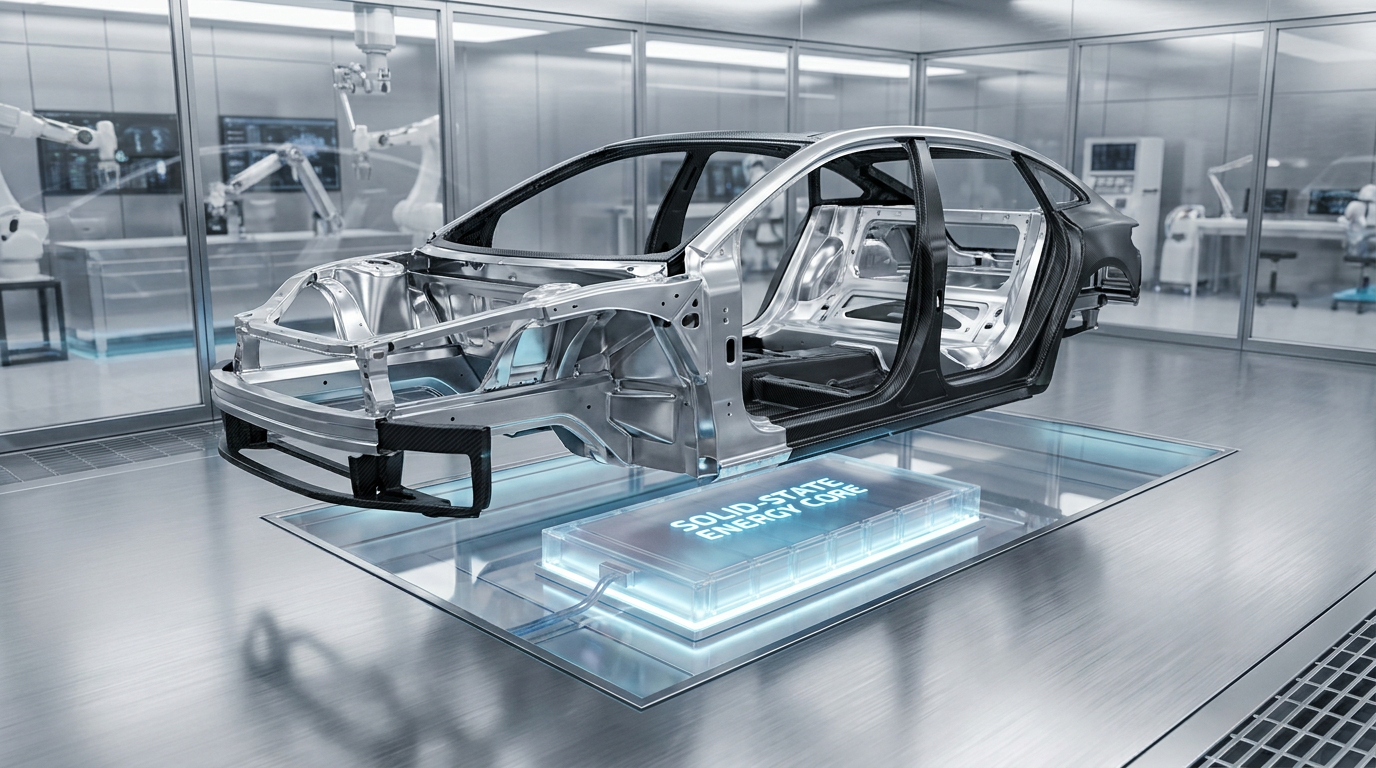
Solid-state batteries, as the name implies, completely eliminate this liquid medium. Instead, they replace the volatile fluid with a dense, stable solid material—typically a specialized ceramic, glass, or sulfide-based polymer. This solid layer acts as both the electrolyte that conducts the lithium ions and the physical separator that keeps the electrodes apart. In practical terms, it is the equivalent of swapping a fragile, squishy juice box for a rigid, stable snack bar.[1][7]
Solid-state batteries, as the name implies, completely eliminate this liquid medium.
This simple material substitution unlocks a cascading series of engineering benefits, beginning with safety. Without a flammable liquid inside the cell, the risk of thermal runaway is virtually eradicated. Solid-state batteries can safely operate at much higher temperatures, meaning they require far less heavy, complex cooling infrastructure within the vehicle's chassis. If a solid-state cell is punctured or crushed, it simply stops working rather than bursting into flames, fundamentally altering the safety profile of electric transportation.[1][7]
Beyond safety, the solid electrolyte enables a massive leap in energy density. Because the solid barrier is physically robust, it allows battery engineers to completely redesign the anode. In traditional batteries, the anode is made of bulky graphite, which acts as a sponge to hold the lithium ions. In a solid-state battery, the graphite can be entirely removed and replaced with a pure lithium-metal anode. Lithium metal can store vastly more energy in the exact same physical footprint, dramatically increasing the battery's overall capacity.[1][7]
The performance metrics emerging from the latest prototypes highlight exactly why automakers are so eager to secure this technology. QuantumScape's recent QSE-5 sample cells, which are currently being evaluated by automotive partners, boast an astonishing energy density of 844 watt-hours per liter. In real-world terms, this allows the cells to fast-charge from a 10 percent state of charge to 80 percent in just 12.2 minutes—a speed that begins to rival the time it takes to fill a traditional car with gasoline.[3][4]

Toyota's internal engineering targets are equally ambitious. By leveraging the increased energy density of solid sulfide electrolytes, the Japanese automaker is aiming to deliver a driving range of over 1,000 kilometers (roughly 620 miles) on a single charge. Combined with an 800-volt high-voltage vehicle architecture, Toyota expects its future solid-state vehicles to achieve recharge times of around 10 minutes, effectively eliminating the range anxiety that still deters many consumers from adopting electric vehicles.[2]
Yet, despite these staggering laboratory achievements, transitioning from pristine research environments to the chaotic reality of a global gigafactory remains the industry's most daunting hurdle. Manufacturing solid-state cells requires entirely new assembly techniques. The solid materials must be pressed together with immense, uniform pressure to ensure the ions can flow freely across the microscopic boundaries between the electrolyte and the electrodes. Achieving this perfect contact at a scale of millions of cells per year requires unprecedented precision.[2][7]
Engineers must also conquer the persistent threat of dendrites. These are microscopic, needle-like structures of lithium metal that can grow unevenly during repeated charging cycles. If left unchecked, dendrites can physically pierce the solid electrolyte and cause a short circuit. While modern ceramics and polymers are far more resistant to dendrites than liquid separators, ensuring that a battery can survive thousands of rapid charge cycles over a 15-year lifespan without dendrite failure remains a rigorous engineering challenge.[1][7]

Finally, there is the inescapable barrier of cost. Because the manufacturing processes are entirely new and the supply chains for specialized solid electrolytes are still in their infancy, early solid-state batteries will be significantly more expensive to produce than mature lithium-ion cells. Automakers are acutely aware of this economic reality. Toyota has explicitly stated that its first solid-state applications will debut in high-end Lexus models, where premium sticker prices can absorb the initial battery costs before economies of scale eventually drive prices down for mass-market vehicles.[2]
To bridge the gap between today's technology and the fully solid future, several manufacturers are rolling out "semi-solid" batteries. These hybrid designs use a gel-like polymer electrolyte, offering a middle ground that improves safety and energy density while remaining largely compatible with existing lithium-ion factory equipment. These transitional batteries are already finding their way into niche applications and early-stage electric vehicles, serving as a vital stepping stone for the industry's manufacturing base.[7]

While the automotive sector dominates the headlines, the implications of solid-state technology stretch far beyond passenger cars. Because they are lighter, safer, and more energy-dense, these batteries are highly sought after by the aerospace and defense industries. Developers like QuantumScape are actively exploring applications in commercial drones, military hardware, and even artificial intelligence data centers, where maximizing energy storage in confined, heat-sensitive spaces is an absolute necessity.[6]
The internal combustion engine dominated the 20th century precisely because liquid gasoline is incredibly energy-dense and easy to refuel. Solid-state batteries represent the first electrical storage medium capable of truly rivaling that convenience and density, without the devastating carbon footprint. As 2026 marks the definitive shift from theoretical research to pilot production, the electric vehicle's final, most capable form is finally coming into focus.[2][3][7]
How we got here
2020
Toyota demonstrates an early prototype solid-state vehicle, though cycle life and cost prevent immediate commercialization.
Jan 2025
Honda begins pilot production of solid-state batteries at its Sakura plant in Japan.
Jan 2026
Idemitsu Kosan breaks ground on a large-scale solid electrolyte pilot plant in collaboration with Toyota.
Jun 2026
QuantumScape and Honda sign a multi-year joint research agreement to bring solid-state technology to mass production.
2027-2028
Toyota's targeted window for launching its first commercial solid-state EVs under the premium Lexus brand.
Viewpoints in depth
Solid-State Developers
Argue that their proprietary solid electrolytes and lithium-metal anodes represent a fundamental technological leap that will soon render traditional lithium-ion obsolete.
Companies like QuantumScape and Solid Power view the current lithium-ion architecture as having reached the top of its developmental S-curve. They argue that incremental tweaks to liquid electrolytes and graphite anodes yield diminishing returns. By completely removing the liquid and substituting pure lithium metal on the anode, these developers claim they have unlocked a new paradigm of energy density and safety. Their business models often rely on licensing this core technology to established automakers rather than building their own vehicles, positioning themselves as the indispensable architects of the next-generation EV ecosystem.
Legacy Automakers
Focus on the rigorous stress-testing required for automotive integration and the strategic necessity of launching the expensive technology in premium vehicles first.
For global giants like Toyota, Honda, and Volkswagen, solid-state technology is viewed through the lens of mass manufacturing and consumer reliability. While they acknowledge the staggering laboratory performance of solid-state cells, their primary concern is ensuring these batteries can survive a 15-year lifespan of extreme temperatures, rapid charging, and physical vibration without failing. Because the initial manufacturing costs will be astronomically high compared to mature lithium-ion lines, automakers are universally planning a top-down rollout strategy. The technology will debut in flagship luxury models, where premium pricing can absorb the battery costs, before eventually trickling down to affordable commuter cars.
Industry Analysts
Emphasize the immense manufacturing hurdles, the high initial costs, and the reality that traditional lithium-ion will remain the dominant mass-market technology for the rest of the decade.
Market researchers and battery analysts offer a more tempered view of the solid-state revolution. While they agree the technology works, they point out that building a pristine laboratory prototype is vastly different from operating a gigafactory that produces millions of flawless cells a day. Analysts highlight that the solid-solid interface between the electrolyte and the electrodes requires immense, uniform pressure during manufacturing—a process that is difficult and expensive to scale. Consequently, they forecast that while solid-state EVs will hit the roads in the late 2020s, traditional and semi-solid lithium-ion batteries will continue to dominate global sales well into the 2030s due to their established supply chains and unbeatable cost efficiency.
What we don't know
- Exactly how much the first generation of commercial solid-state replacement batteries will cost consumers.
- Whether gigafactories can maintain the microscopic precision required to mass-produce solid electrolytes without high defect rates.
- How well the solid-state cells will maintain their capacity after a decade of real-world winter and summer temperature extremes.
Key terms
- Electrolyte
- The medium inside a battery that allows ions to flow back and forth between the anode and cathode during charging and discharging.
- Anode
- The negative electrode of a battery. In solid-state designs, this is often made of pure lithium metal rather than the bulky graphite used today.
- Cathode
- The positive electrode of a battery, which largely determines the cell's overall capacity and voltage.
- Energy Density
- The amount of electrical energy a battery can store relative to its physical size or weight.
- Thermal Runaway
- A dangerous, self-sustaining chain reaction within a battery where overheating causes further temperature increases, often resulting in fires.
Frequently asked
What is a solid-state battery?
A battery that uses a solid material, such as ceramic or polymer, to conduct ions between electrodes, replacing the liquid electrolyte found in standard lithium-ion cells.
Why are solid-state batteries safer?
They eliminate the highly flammable organic liquid electrolytes used today, drastically reducing the risk of fires or thermal runaway if the battery is damaged or overheated.
When will solid-state EVs be available to buy?
Major automakers like Toyota and Honda are targeting 2027 to 2028 for their first commercial rollouts, which will likely debut in high-end, premium vehicles before scaling to mass-market models.
What is a dendrite?
A microscopic, needle-like buildup of lithium metal that can grow inside a battery over repeated charging cycles, potentially piercing internal components and causing a short circuit.
Sources
Source coverage
8 outlets
3 viewpoints surfaced





[1]OssilaIndustry Analysts
Solid-State Battery vs Lithium-ion | Differences
Read on Ossila →[2]EVWorldLegacy Automakers
Toyota's Solid-State Battery Roadmap: Reality vs. Rumor
Read on EVWorld →[3]ElectrekLegacy Automakers
Honda and QuantumScape (QS) team up to make 'game-changing' solid-state batteries
Read on Electrek →[4]GlobeNewswireSolid-State Developers
QuantumScape Announces Agreement with Honda on Solid-State Battery Technology
Read on GlobeNewswire →[5]24/7 Wall St.Solid-State Developers
QuantumScape Advances 11% on Honda Solid-State Battery Pact
Read on 24/7 Wall St. →[6]Battery TechnologySolid-State Developers
QuantumScape Updates Solid-State Battery Strategy
Read on Battery Technology →[7]IDTechExIndustry Analysts
Solid-State Batteries 2026-2036: Technology, Forecasts, Players
Read on IDTechEx →[8]PatSnapIndustry Analysts
Lithium-ion vs Solid-State Batteries: Key Differences Explained
Read on PatSnap →


Every angle. Every day.
Get guides stories with full source coverage and perspective breakdowns delivered to your inbox.