
How All-Weather Snowmaking is Saving the Ski Industry from Climate Change
Breakthrough temperature-independent snowmaking technology is allowing resorts to produce high-quality snow in weather as warm as 77°F, guaranteeing ski seasons and protecting local economies.
By Factlen Editorial Team
- Ski Resort Operators
- View the technology as an essential economic insurance policy to guarantee opening dates.
- Climate Tech Innovators
- Focus on engineering highly efficient, closed-loop refrigeration systems to adapt to warming.
- Environmental Researchers
- Advocate for pairing snowmaking with renewable energy and heat-recovery to prevent emissions.
What's not represented
- · Local water conservation authorities managing drought conditions
- · Small independent ski hills priced out of the technology
Why this matters
Winter sports generate billions of dollars globally and support entire mountain communities. By decoupling snow production from freezing temperatures, this technology provides an existential insurance policy for an industry threatened by climate change.
Key points
- Traditional snowmaking requires sub-freezing temperatures, leaving resorts vulnerable to warm winters.
- New all-weather systems use vacuum and refrigeration technology to make snow in temperatures up to 77°F.
- The machines are housed in climate-controlled containers and produce snow without chemical additives.
- Resorts are using the technology to guarantee early-season opening dates and protect local economies.
- To offset high energy demands, new designs capture the exhaust heat to warm nearby buildings.
For decades, the ski industry has operated at the mercy of the thermometer. Traditional snowmaking—the process of blasting pressurized water and compressed air into the atmosphere—relies entirely on sub-freezing temperatures. If the "wet bulb" temperature (a metric combining heat and humidity) creeps above 28 degrees Fahrenheit, the water droplets simply fall to the ground as rain. As global winters grow warmer and more erratic, this fundamental limitation has threatened the survival of ski resorts, winter sports competitions, and the mountain economies that depend on them.[3][6]
But a quiet revolution in refrigeration and vacuum technology is rewriting the rules of winter. A new generation of "all-weather" or temperature-independent snowmaking (TIS) systems is allowing resorts to produce high-quality snow in environments far above freezing. By moving the snowmaking process inside self-contained, climate-controlled units, these systems are decoupling the ski season from the unpredictability of natural weather patterns.[2][6]
The shift represents an existential insurance policy for the winter sports industry. Rather than hoping for a cold snap in November or December, mountain operators can now guarantee their opening dates months in advance. This certainty is crucial for securing holiday bookings, hiring seasonal staff, and maintaining the economic engine of ski towns that would otherwise face devastating revenue losses during a "green winter."[3][6]
To understand how all-weather snowmaking works, it helps to look at the mechanics of the Vacuum Ice Maker (VIM), a technology originally developed for seawater desalination and cooling deep gold mines. Inside a VIM unit, water is exposed to a deep vacuum. The extreme drop in pressure forces a small portion of the water to evaporate rapidly. This evaporation process absorbs heat from the surrounding water, causing the remainder to freeze instantly into a water-ice slurry.[1][6]

Once the slurry is formed, it is pumped into an ice concentrator that separates the pure ice crystals from the remaining water. The result is a high-volume output of snow that closely mimics the texture of natural "spring corn" snow. Because the entire phase change happens inside a sealed vacuum chamber, the outside air temperature is completely irrelevant. The system requires only a steady supply of water and electricity to power the vacuum compressors and chillers.[1]
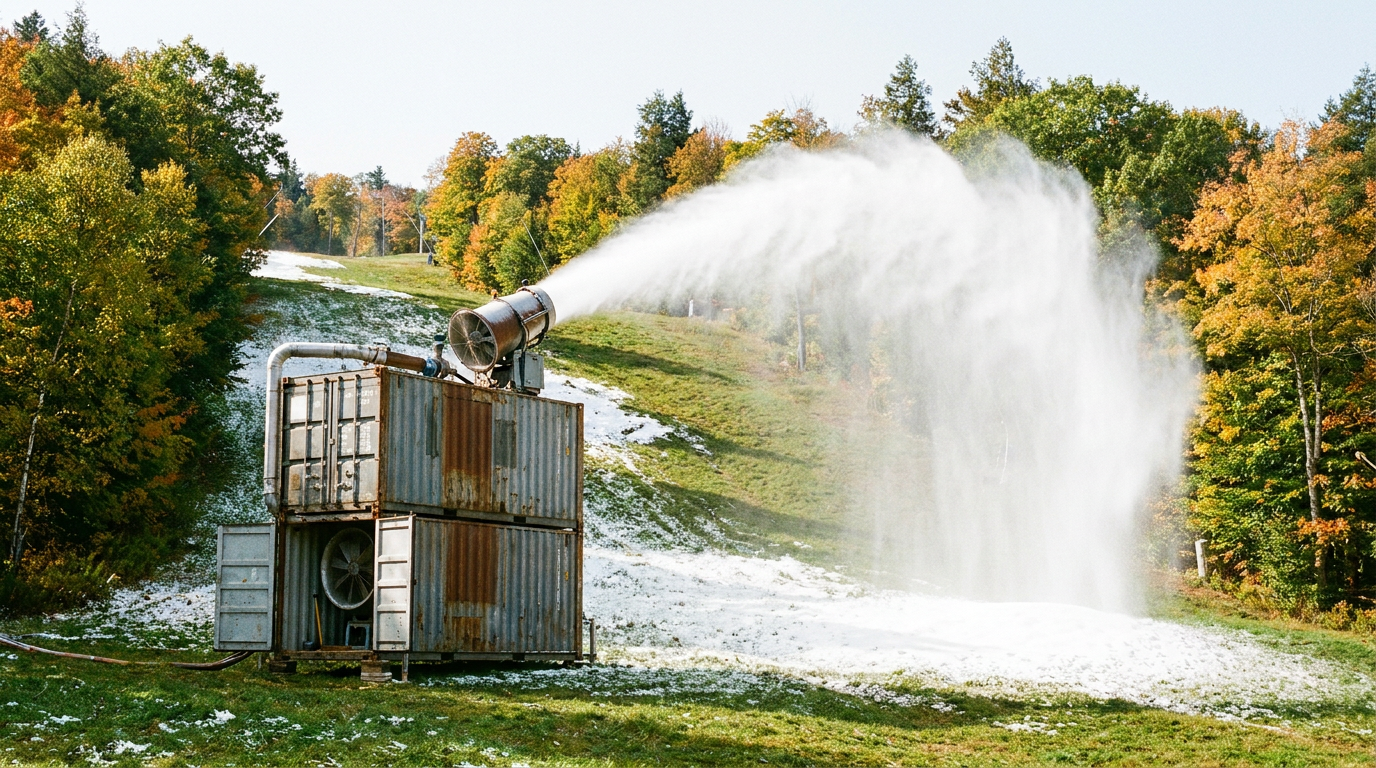
Other manufacturers utilize advanced plate-refrigeration systems. In these setups, water is sprayed onto super-cooled plates inside a shipping container. The water freezes instantly, is mechanically scraped off the plates, and then ground into fine, snow-like particles by an auger. The snow is then propelled out of the container through flexible pipes, allowing operators to distribute it exactly where it is needed on the mountain.[2][3]
The real-world applications of this technology are already reshaping the global ski map. In central Massachusetts, the Ski Ward resort fired up a Latitude 90 all-weather machine in October 2023. Despite ambient temperatures exceeding 80 degrees Fahrenheit, the system generated a massive mound of snow, allowing the resort to open its beginner slope and offer learn-to-ski packages a full month before traditional winter weather arrived.[3]
The real-world applications of this technology are already reshaping the global ski map.
In Australia, where lower-elevation resorts are particularly vulnerable to warm early-season conditions, Thredbo Resort recently installed a Demaclenko Snowpro 210 unit. Capable of producing 210 cubic meters of snow per day in temperatures up to 68 degrees Fahrenheit, the containerized system was deployed specifically to guarantee the resort's opening for the lucrative King's Birthday long weekend in June. The unit integrates directly into Thredbo's existing underground pipe network, allowing operators to target the critical Friday Flat beginner zone.[4]

European resorts, which adopted the technology earlier than their North American counterparts, have pushed the boundaries even further. At the Zermatt resort in Switzerland, the integration of IDE Technologies' VIM systems has allowed operators to maintain a snow-covered ski pass 365 days a year. By supplementing natural snowfall and traditional snow guns with temperature-independent production, Zermatt has effectively eliminated the concept of an "off-season."[1][3]
Despite the operational triumphs, the rise of all-weather snowmaking introduces a complex environmental paradox. Creating snow in warm weather requires significant energy, primarily to power the industrial compressors and refrigeration units. Critics point out that using massive amounts of electricity to artificially cool a warming planet is a cyclical trap, especially if that electricity is generated from fossil fuels.[5][6]
To address this, researchers and manufacturers are aggressively pursuing energy-efficient, closed-loop systems. Modern all-weather units are designed to operate without chemical additives, using only pure water. Furthermore, the industry is increasingly pairing these high-demand machines with renewable energy grids, ensuring that the carbon footprint of the snow production remains as close to zero as possible.[2][5]
The most promising sustainability breakthrough comes from Norway, where the SINTEF research institute is spearheading the "Snow for the Future" project. Their approach reimagines the snowmaking machine as a massive heat pump. Every refrigeration process has a "cold side" and a "hot side." While traditional systems simply vent the exhaust heat into the atmosphere, the SINTEF model captures it.[5]

By utilizing climate-friendly natural refrigerants, the Norwegian system uses the cold side of the heat pump to manufacture snow, while routing the surplus thermal energy from the hot side to heat nearby resort buildings, hotels, or municipal swimming pools. In this integrated setup, the snow effectively becomes a highly useful byproduct of the community's heating system, drastically reducing the overall energy demand.[5]
As the technology scales, the cost of all-weather snowmaking is expected to drop, making it accessible to smaller, independent ski hills that currently cannot afford the multi-million-dollar container units. For now, these machines are not intended to replace traditional snow guns, which remain highly efficient when temperatures plummet. Instead, they serve as a strategic complement—a specialized tool to build base layers, patch high-traffic areas, and bridge the gaps in an increasingly unpredictable climate.[2][3]
The survival of skiing in the 21st century will require a profound adaptation to the realities of a warming world. While reducing global emissions remains the ultimate necessity, temperature-independent snowmaking ensures that the cultural heritage, athletic pursuit, and economic vitality of winter sports can endure the transition. By engineering their own winter, mountain communities are refusing to let the snow simply melt away.[5][6]
How we got here
1990s
Vacuum Ice Maker (VIM) technology is initially developed for seawater desalination and cooling deep gold mines.
2009
The Pitztal glacier in Austria becomes one of the first major ski areas to install an IDE All Weather Snowmaker to combat receding ice.
2013
European distributors begin widespread commercialization of containerized all-weather snowmaking systems for ski resorts.
2021
Norway's SINTEF institute launches Phase II of 'Snow for the Future,' focusing on integrating snowmaking heat pumps with municipal heating.
2023
North American adoption accelerates, with resorts like Ski Ward in Massachusetts successfully making snow in 80-degree October weather.
Viewpoints in depth
Ski Resort Operators
Focused on economic survival and operational certainty in a warming climate.
For mountain operators, all-weather snowmaking is fundamentally an economic insurance policy. The financial viability of a ski resort often hinges on key holiday periods, such as Christmas or early-season long weekends. When natural snow fails to arrive, the loss of lodging, lift ticket, and food-and-beverage revenue can be devastating. Operators view temperature-independent systems as a necessary capital investment to guarantee opening dates, protect local jobs, and maintain consumer confidence in booking advance trips.
Climate Tech Innovators
Driven by the engineering challenge of decoupling snow production from ambient weather.
Engineers and manufacturers in this space are focused on pushing the thermodynamic limits of refrigeration and vacuum technology. Their goal is to maximize the volume of snow produced while minimizing the energy required per cubic meter. Innovators view the ski industry as a high-visibility testing ground for advanced heat-exchange and closed-loop cooling systems, which can eventually be adapted for other industrial applications, such as mine cooling or emergency desalination.
Environmental Researchers
Concerned with balancing climate adaptation against the energy costs of artificial cooling.
While acknowledging the cultural and economic importance of winter sports, environmental scientists caution against "maladaptation"—solving a climate problem with a solution that generates more carbon emissions. They argue that all-weather snowmaking is only sustainable if it is strictly powered by renewable energy grids. Furthermore, researchers advocate for mandatory heat-recovery systems, ensuring that the massive thermal exhaust generated by these refrigeration units is captured and repurposed rather than wasted.
What we don't know
- Whether the high capital cost of these containerized units will eventually drop enough to be accessible to small, independent ski hills.
- How local water rights and drought conditions will impact the widespread adoption of high-volume all-weather snowmaking.
- The long-term ecological impact of maintaining artificial snowpacks on mountain terrain during naturally warm seasons.
Key terms
- Temperature-Independent Snowmaking (TIS)
- Technology that produces snow inside a climate-controlled environment, allowing it to operate regardless of the outside air temperature.
- Vacuum Ice Maker (VIM)
- A system that exposes water to a deep vacuum, forcing rapid evaporation that freezes the remaining water into an ice slurry.
- Wet Bulb Temperature
- A metric that combines ambient air temperature and relative humidity, used to determine if traditional snowmaking is physically possible.
- Heat Pump
- A device that transfers thermal energy from one place to another, featuring a 'cold side' (used here to make snow) and a 'hot side' (used to generate heat).
Frequently asked
Can these machines really make snow in the summer?
Yes. Because the freezing process happens entirely inside a sealed, refrigerated container or vacuum chamber, the machines can produce snow in ambient temperatures as high as 77°F (25°C).
Is the snow real or artificial?
The snow is real frozen water, produced without any chemical additives. It typically has a texture similar to natural 'spring corn' snow, which is highly durable and melts slowly.
Doesn't this use a massive amount of electricity?
Yes, powering the industrial compressors and chillers requires significant energy. To make the process sustainable, resorts are increasingly powering them with renewable energy and capturing the exhaust heat to warm nearby buildings.
Will this replace traditional snow guns?
No. Traditional snow guns remain much cheaper and highly efficient when temperatures are below freezing. All-weather machines are used as a specialized complement to guarantee base layers and secure opening dates.
Sources
Source coverage
6 outlets
3 viewpoints surfaced






[1]IDE TechnologiesClimate Tech Innovators
IDE VIM All Weather Snow Maker: Helping Snow-Based Businesses at All Temperatures
Read on IDE Technologies →[2]TechnoAlpinClimate Tech Innovators
Snowfactory - guaranteeing a secure start to the season
Read on TechnoAlpin →[3]SAM MagazineSki Resort Operators
The Future of All-Weather Snowmaking
Read on SAM Magazine →[4]SnowBrainsSki Resort Operators
Thredbo Resort Switches on New All-Weather Snowmaking Unit
Read on SnowBrains →[5]SINTEFEnvironmental Researchers
Snow for the Future – Phase II: Climate-friendly technology for snowmaking
Read on SINTEF →[6]Factlen Editorial TeamEnvironmental Researchers
Synthesis by Factlen editorial team
Read on Factlen Editorial Team →



Every angle. Every day.
Get sports stories with full source coverage and perspective breakdowns delivered to your inbox.