
Evidence Pack: Do Nonpartisan Open Primaries Actually Reduce Political Polarization?
As more states consider overhauling their election systems for 2026, a growing body of academic research suggests that nonpartisan open primaries measurably decrease legislative extremity, though the effects compound slowly over time.
By Factlen Editorial Team
- Electoral Reform Advocates
- Argue that structural changes to primaries are the most effective way to break partisan gridlock.
- Academic Researchers
- Focus on the empirical measurement of legislator voting records before and after reform implementation.
- Institutional Skeptics
- Argue that primary reforms have only modest effects and that polarization is driven by deeper societal factors.
What's not represented
- · Major Political Party Leadership
- · Grassroots Partisan Activists
Why this matters
Partisan gridlock often feels like an unsolvable cultural problem, but structural election reforms offer a mechanical fix. Understanding how primary systems shape politician behavior empowers voters to evaluate the ballot measures reshaping elections across the country.
Key points
- Closed partisan primaries incentivize candidates to cater to ideological extremes due to low, highly partisan turnout.
- Nonpartisan open primaries place all candidates on a single ballot, allowing all registered voters to participate.
- USC research shows lawmakers elected under top-two systems cast measurably less extreme votes than those in closed systems.
- California depolarized over a decade under a top-two system, bucking the national trend of increasing polarization.
- Alaska's top-four system incentivized accommodative campaigning and elected centrists willing to build bipartisan coalitions.
- Skeptics note the effects can be modest and are often intertwined with other reforms like independent redistricting.
For decades, political polarization in the United States has been treated as a cultural inevitability—a symptom of a divided public, nationalized media, and geographic sorting. But a growing consensus among political scientists and election reformers points to a more mechanical culprit: the partisan primary system. Because primary elections typically draw low turnout dominated by the most ideologically committed voters, candidates are heavily incentivized to cater to their party's fringes rather than the broader electorate.[8]
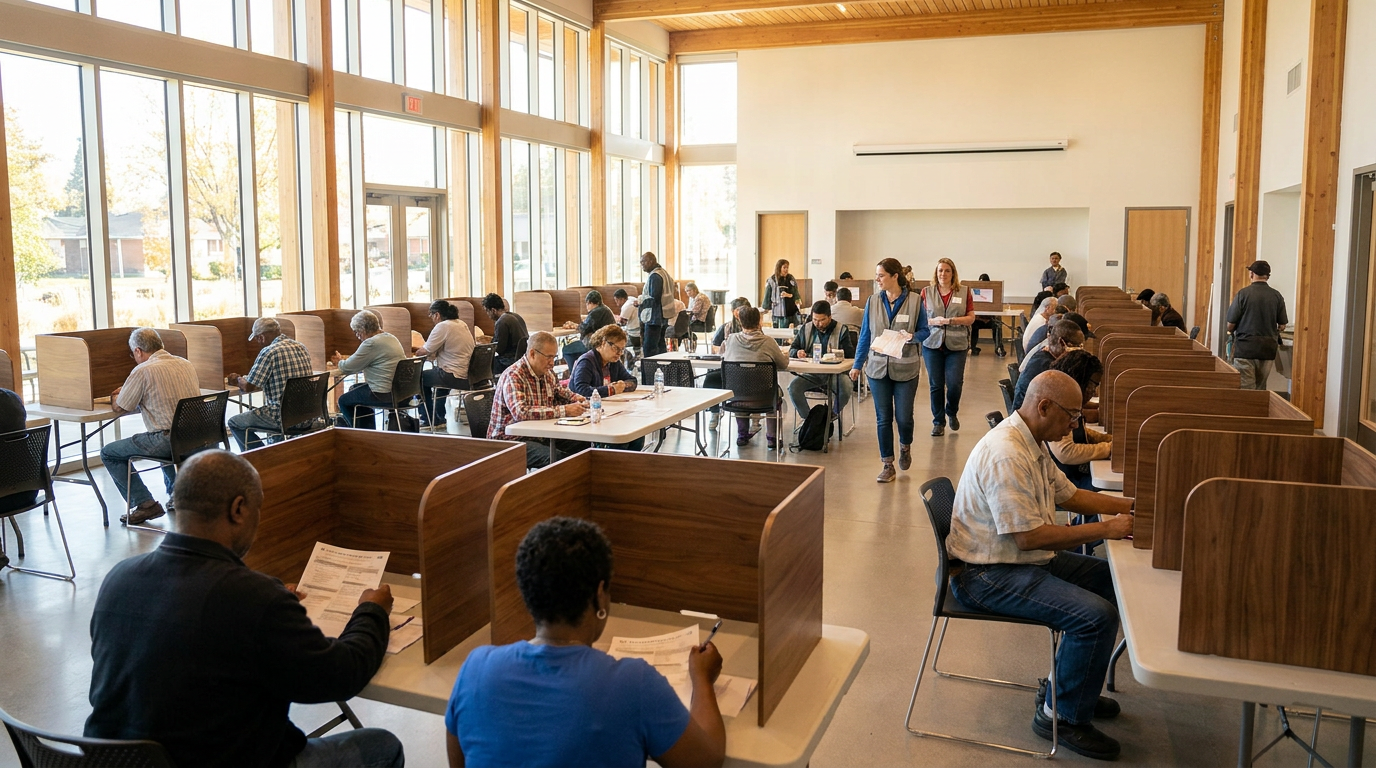
To solve this "primary problem," a handful of states have fundamentally rewired how they nominate candidates, replacing closed, party-run primaries with nonpartisan open primaries. In these systems, all candidates, regardless of party affiliation, appear on a single ballot. Every registered voter can participate, and the top vote-getters—usually the top two or top four—advance to the general election. The theory is straightforward: if politicians must answer to the entire electorate rather than just their party's base, they will govern more collaboratively.[7][8]

As the 2026 election cycle accelerates, with several states debating ballot measures to adopt similar reforms, researchers finally have enough longitudinal data to test whether these systems actually work. The evidence, drawn from over a decade of elections in California and Washington, and newer data from Alaska, suggests that nonpartisan primaries do measurably reduce legislative extremity, though the transformation is gradual rather than instantaneous.[1][3]
The most comprehensive evidence comes from the USC Schwarzenegger Institute, which analyzed the voting behavior of U.S. House members over a 15-year period. Using DW-NOMINATE scores—a rigorous academic metric that maps a legislator's ideology based on their actual roll-call votes, rather than their campaign rhetoric—the study compared lawmakers elected in top-two primary states against those in closed primary states.[1]
The USC findings were unambiguous. Lawmakers elected under top-two systems cast significantly less extreme ideological votes than their counterparts in closed systems. Crucially, this moderating effect was nearly double the effect seen in standard "open" partisan primaries (where voters can choose which party's ballot to pull, but the ballots remain segregated). The research demonstrated that the structural shift of putting all candidates on one ballot forces a tangible change in how those candidates legislate once in office.[1]

California provides the clearest long-term case study. After adopting the top-two primary in 2010, the state's political trajectory diverged from national trends. A 2023 analysis by the Unite America Institute found that during the decade following the reform, the California legislature depolarized. This occurred during a period when nearly every other western state, and the U.S. Congress as a whole, became measurably more polarized.[3]
After adopting the top-two primary in 2010, the state's political trajectory diverged from national trends.
However, institutional skeptics caution against viewing nonpartisan primaries as a silver bullet. Research published by Cambridge University Press and analyzed by the University of Chicago's Center for Effective Government notes that the effects can be inconsistent. These researchers point out that California's depolarization coincided with the adoption of an independent redistricting commission and changes to term limits, making it difficult to isolate the top-two primary as the sole cause of the state's political cooling.[4][5]
The UChicago analysis also highlights a mechanical reality of the top-two system: most first-round elections still result in a traditional Democrat-versus-Republican matchup in the general election. While the system allows for same-party matchups (e.g., two Democrats facing off in a deep-blue district), these remain relatively rare. When they do occur, however, out-party voters (like Republicans in a Democrat-only race) tend to vote for the more moderate candidate, successfully pulling the winner toward the center.[5]
Alaska's recent adoption of a "Top-Four" primary combined with ranked-choice voting in the general election offers a newer, highly scrutinized model. First implemented in 2022, the Alaskan system was designed to give voters even more choices while retaining the moderating incentives of a nonpartisan primary. Early assessments published in the California Journal of Politics and Policy indicate the reform was largely beneficial.[2]

The Alaska study found that the new rules promoted more accommodative campaigning. Because candidates in the general election needed to secure second- and third-choice votes from their opponents' supporters to win a ranked-choice tabulation, they were financially and strategically incentivized to avoid scorched-earth attacks. The result was a campaign environment that rewarded coalition-building over base-mobilization.[2][6]
Furthermore, the Alaska data showed that while the open primary allowed more extreme candidates to make it onto the ballot, the eventual winners were more likely to be centrists willing to work across the aisle. State legislators from across the political spectrum have noted that the system provides them with "political cover" to negotiate bipartisan compromises without the constant threat of being ousted by a radical challenger in a low-turnout closed primary.[2][6]
This concept of "political cover" is central to the reform's success. In a closed primary system, a lawmaker who votes for a bipartisan compromise risks facing a primary challenger funded by ideological purists. Because the primary electorate is small and highly partisan, that challenge is often fatal. In a nonpartisan open primary, the lawmaker can defend their compromise to the entire district, relying on independent and moderate voters to survive the primary round.[7][8]

The compounding nature of these reforms is perhaps the most encouraging finding for democracy advocates. The USC study noted that the moderating effect was evident among incumbent lawmakers who adapted to the new rules, but it was even stronger among newly elected members who had never run under the old closed system. This suggests that as the "rules of the game" change, a different profile of candidate—one more inclined toward governance than grandstanding—chooses to run for office.[1]
While nonpartisan open primaries cannot single-handedly erase decades of cultural division, the evidence pack is clear: institutions matter. By aligning the electoral incentives of politicians with the preferences of the general electorate rather than the partisan fringes, these structural reforms offer a proven, mechanical pathway to a more functional and representative government.[1][3][8]
How we got here
2004
Washington state voters pass Initiative 872, establishing a top-two nonpartisan primary system.
2010
California voters approve Proposition 14, replacing the state's closed primary with a top-two system.
2020
Alaska voters pass Ballot Measure 2, creating a top-four nonpartisan primary paired with ranked-choice voting.
2022
Alaska holds its first elections under the new system, resulting in bipartisan coalitions in the state legislature.
2026
Multiple states debate ballot measures to adopt nonpartisan open primaries ahead of the midterm elections.
Viewpoints in depth
Electoral Reform Advocates
Argue that structural changes to primaries are the most effective way to break partisan gridlock.
Organizations like Unite America and the Center for American Progress view the partisan primary as the root cause of legislative dysfunction. They argue that because closed primaries are dominated by a small fraction of highly ideological voters, politicians are effectively punished for compromising. By opening the primary to all voters, they believe the system forces candidates to appeal to the political center, thereby electing leaders who are more representative of the general public and more willing to govern collaboratively.
Institutional Skeptics
Argue that primary reforms have only modest effects and that polarization is driven by deeper societal factors.
Researchers from institutions like the University of Chicago caution against overstating the impact of primary reform. They point out that polarization is a complex phenomenon driven by nationalized media ecosystems, geographic sorting, and partisan gerrymandering. While they acknowledge that top-two systems can produce marginal moderation—particularly in same-party general election matchups—they argue that the effects are often inconsistent and heavily dependent on other simultaneous reforms, such as independent redistricting commissions.
Academic Researchers
Focus on the empirical measurement of legislator voting records before and after reform implementation.
Political scientists utilizing tools like DW-NOMINATE scores focus strictly on the data: how do politicians actually vote when the electoral rules change? Their research, such as the comprehensive USC study, confirms a statistically significant reduction in ideological extremity among lawmakers elected in top-two systems. They emphasize that the most profound effects are seen in newly elected members, suggesting that the primary benefit of these reforms is changing the type of candidate who chooses to run in the first place.
What we don't know
- Whether the moderating effects seen in western states like California and Washington will replicate identically in highly polarized southern or midwestern states.
- The exact degree to which independent redistricting commissions, rather than primary reforms alone, contributed to California's depolarization.
- How national political parties will adapt their funding and endorsement strategies if nonpartisan primaries become the national standard.
Key terms
- Nonpartisan Open Primary
- An election where all candidates, regardless of party, appear on the same ballot, and all registered voters can participate.
- Closed Primary
- A primary election restricted only to voters who are officially registered with that specific political party.
- Top-Two System
- A primary format where the two candidates who receive the most votes advance to the general election, even if they belong to the same party.
- DW-NOMINATE
- A widely used academic scoring system that measures a legislator's ideology based on their actual roll-call voting record.
- Ranked-Choice Voting
- An electoral system where voters rank candidates by preference; if no one wins a majority, the lowest vote-getter is eliminated and their votes are reallocated.
Frequently asked
Can two Democrats or two Republicans face each other in the general election?
Yes. In a top-two system, the two candidates with the most votes advance regardless of party. In heavily partisan districts, this often results in a same-party matchup in November.
Does a nonpartisan primary eliminate political parties?
No. Candidates still list their party preference on the ballot, and parties continue to endorse, fundraise, and campaign for their preferred candidates.
How does this affect independent voters?
It fully enfranchises them. In closed primary states, independent voters are often barred from participating in the first round of voting. Nonpartisan primaries allow them to vote for any candidate.
Do these systems increase voter turnout?
Evidence is mixed, but generally, allowing independent voters to participate and making general elections more competitive tends to marginally increase overall civic engagement.
Sources
Source coverage
8 outlets
3 viewpoints surfaced








[1]USC Schwarzenegger InstituteAcademic Researchers
Reducing Legislative Polarization: Top-Two and Open Primaries Are Associated with More Moderate Legislators
Read on USC Schwarzenegger Institute →[2]California Journal of Politics and PolicyAcademic Researchers
Alaska's New Electoral System: Countering Polarization or 'Crooked as Hell'?
Read on California Journal of Politics and Policy →[3]Unite AmericaElectoral Reform Advocates
California's Top-Two Primary: Impact on Electoral Politics and Governance
Read on Unite America →[4]Cambridge University PressInstitutional Skeptics
The Top Two Primary and Legislator Behavior
Read on Cambridge University Press →[5]University of Chicago Center for Effective GovernmentInstitutional Skeptics
Top-Two System and Polarization: Evidence and Analysis
Read on University of Chicago Center for Effective Government →[6]Center for American ProgressElectoral Reform Advocates
The Impact of Alaska's Electoral Reform
Read on Center for American Progress →[7]R Street InstituteElectoral Reform Advocates
Evaluating Blanket Primaries as a Solution to Polarization
Read on R Street Institute →[8]Factlen Editorial Team
Synthesis by Factlen editorial team
Read on Factlen Editorial Team →


Every angle. Every day.
Get news politics stories with full source coverage and perspective breakdowns delivered to your inbox.