
How Engineered Wood is Replacing Steel and Concrete in the World's Newest Skyscrapers
Cross-laminated timber is transforming urban skylines with buildings that sequester carbon and rival the strength of steel. As a new 31-story record-holder rises in Milwaukee, architects are proving that mass timber can be both fire-safe and environmentally restorative.
By Factlen Editorial Team
- Sustainable Architects & Engineers
- Advocates for mass timber as a critical tool for decarbonizing the built environment.
- Urban Developers & Contractors
- Prioritizes the economic and logistical advantages of prefabricated construction.
- Forestry & Land Managers
- Focuses on the ecological impact of timber sourcing and the health of working forests.
- Editorial Synthesis
- Evaluates the broad trajectory of mass timber adoption and its climate implications.
What's not represented
- · Concrete and steel industry representatives facing market disruption from alternative materials.
- · Affordable housing advocates questioning if the premium material will lower overall urban housing costs.
Why this matters
The built environment is responsible for a massive share of global carbon emissions. Transitioning from concrete and steel to renewable mass timber offers a rare opportunity to turn skyscrapers from climate liabilities into active carbon sinks, fundamentally changing how our cities impact the planet.
Key points
- Cross-laminated timber (CLT) is an engineered wood product that rivals the structural strength of steel and concrete.
- Mass timber buildings act as carbon sinks, storing the CO2 that trees absorbed during their lifetime.
- Substituting mass timber for traditional materials can reduce a building's embodied carbon footprint by up to 50%.
- During a fire, thick timber panels char on the outside, creating an insulating layer that maintains structural integrity for over 90 minutes.
- A new 31-story mass timber tower in Milwaukee, The Edison, is currently under construction and will become the world's tallest upon completion.
The skyline of Milwaukee is changing, not with the familiar sparks of welding steel or the continuous pour of concrete, but with the quiet assembly of engineered wood. The Edison, a 31-story tower currently under construction, is set to become the tallest mass timber building in the world when it tops out in 2026.[1][2]
It represents a quiet revolution in architecture. For over a century, high-rise construction has relied almost exclusively on steel and concrete—materials that are incredibly strong but environmentally taxing. Now, a material known as cross-laminated timber (CLT) is challenging that dominance, offering a renewable alternative that could fundamentally alter how cities are built.[3][4]
What exactly is CLT? It is often described by architects as "super plywood." Manufacturers take layers of kiln-dried lumber and glue them together, with each layer oriented at a 90-degree angle to the one below it. This crosswise arrangement gives the panels exceptional strength, stiffness, and structural rigidity in both directions.[3][5]
These engineered panels can be massive—often manufactured up to 10 feet wide and 60 feet long—and are used to form the major structural elements of a building, including floors, walls, and roofs. When paired with glue-laminated timber (glulam) for columns and beams, the resulting "mass timber" system can support immense vertical loads and span significant distances without the need for traditional framing.[4][5]

The environmental stakes driving this shift are massive. The traditional materials of high-rise construction are produced by extractive industries that mine and heat raw materials, consuming vast amounts of energy in the process. Concrete production alone is responsible for an estimated 5% to 8% of all human-generated carbon dioxide emissions globally.[4]
Mass timber, by contrast, acts as an active carbon sink. Trees naturally sequester carbon dioxide from the atmosphere during photosynthesis. When those trees are harvested and engineered into CLT, that carbon remains locked inside the wood for the entire lifespan of the building—a phenomenon known as biogenic carbon sequestration.[6]
Studies indicate that substituting mass timber for concrete and steel can reduce a building's embodied carbon footprint by 35% to 50%. A single mass timber high-rise can sequester thousands of metric tons of carbon, an impact roughly equivalent to taking hundreds of gas-powered vehicles off the road for an entire year.[6]

But building skyscrapers out of wood inevitably raises a critical question: what about fire? The idea of a combustible high-rise instinctively alarms both the general public and regulators. However, mass timber behaves very differently in a fire than the light-frame wood used in traditional single-family homes.[4]
But building skyscrapers out of wood inevitably raises a critical question: what about fire?
During a fire, the thick, solid panels of mass timber char on the outside. This charred layer acts as a natural insulator, protecting the structural integrity of the inner wood and drastically slowing the burn rate. Extensive performance-based testing has shown that CLT structures can withstand over 90 minutes of intense burning without collapsing, meeting or exceeding the safety standards required of concrete.[4]
This proven safety profile has prompted major regulatory shifts worldwide. In recent years, the International Building Code (IBC) was updated to officially approve mass timber for buildings up to 18 stories in the United States, ushering in a new era of architectural possibility and giving developers the green light to scale up.[4][5]
Beyond the environmental and safety metrics, urban developers are drawn to the sheer efficiency of the material. Because CLT panels are prefabricated in controlled factory settings using precise CNC machines, they arrive at the construction site ready to be slotted directly into place, much like a massive piece of furniture.[3][4]
This off-site manufacturing significantly reduces on-site build times. With the right logistical planning, construction crews can install over 1,000 square meters of CLT per day. The material is also up to five times lighter than concrete, which translates to smaller, less expensive foundations and reduced transportation costs.[3]

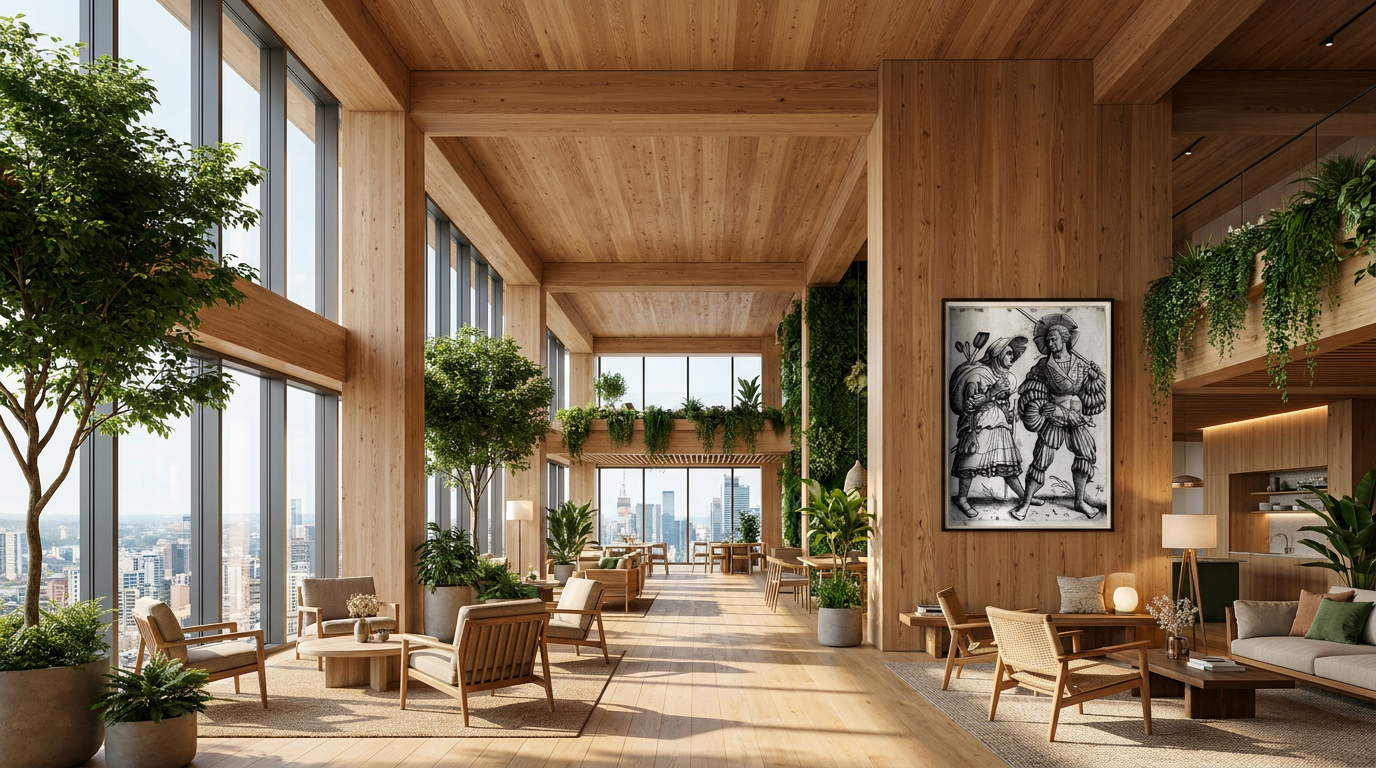
The aesthetic appeal is another major driver for the real estate market. Architects frequently choose to leave the structural timber exposed on the interior, creating warm, biophilic environments that connect occupants with nature. This visible wood has been shown to improve indoor air quality and tenant well-being, allowing developers to command premium rents.[3]
The Edison in Milwaukee, which will feature 350 residential units, is a prime example of this modern approach. It utilizes a hybrid structural system, combining a concrete core with CLT and glulam elements for the floors and framing, proving that mass timber can scale to unprecedented heights when engineered creatively.[1][2]
Yet, the mass timber movement is not without its long-term challenges. The true sustainability of the material depends entirely on responsible forestry practices. If the timber is sourced from clear-cut old-growth forests or monoculture tree farms, the ecological damage and loss of biodiversity can easily outweigh the carbon benefits.[6]
Forestry experts emphasize the critical need for a "circular economy" approach. By sourcing wood from sustainably managed forests—where harvest rates are carefully balanced by new growth—the industry can create economic incentives for private landowners to conserve working forests rather than selling them for commercial development.[3]

Additionally, the industry must grapple with the end-of-life treatment of these buildings. To maintain the carbon sequestration benefits indefinitely, the timber must be reused, recycled, or repurposed when a building is eventually decommissioned, rather than being sent to a landfill where it would decompose and release its stored carbon back into the atmosphere.[6]
As supply chains mature and manufacturing capacity expands across North America and Europe, the cost of mass timber is expected to reach full parity with traditional materials. For now, the rise of the "plyscraper" stands as one of the most promising developments in the fight to decarbonize the built environment, proving that the sustainable cities of the future might just be grown in the forest.[7]
How we got here
1990s
Cross-laminated timber (CLT) is first researched and developed in Austria, establishing the foundation for modern mass timber.
2015
The International Building Code (IBC) officially recognizes CLT as a structural building component in the United States.
2021
The IBC updates its standards to allow mass timber buildings to reach up to 18 stories, sparking a boom in high-rise timber construction.
2022
Ascent MKE is completed in Milwaukee, setting the record for the world's tallest mass timber building at 25 stories.
2025
Construction begins on The Edison in Milwaukee, designed to reach 31 stories and claim the new height record upon completion.
Viewpoints in depth
Sustainable Architects & Engineers
Advocates for mass timber as a critical tool for decarbonizing the built environment.
This camp argues that the construction industry cannot meet global climate goals while relying on concrete and steel. They point to life-cycle assessments showing that mass timber buildings reduce embodied carbon by up to 50%. Beyond emissions, architects emphasize the biophilic benefits of exposed wood, noting that natural materials improve occupant well-being and air quality.
Forestry & Land Managers
Focuses on the ecological impact of timber sourcing and the health of working forests.
Forestry experts caution that mass timber is only sustainable if the wood is harvested responsibly. They advocate for sourcing from certified forests where growth outpaces harvesting. By creating a high-value market for surplus timber, they argue, mass timber provides private landowners with the economic incentive to keep their land forested rather than selling it for agricultural or commercial development.
Urban Developers & Contractors
Prioritizes the economic and logistical advantages of prefabricated construction.
For developers, the appeal of mass timber lies in the balance sheet. Because cross-laminated timber panels are precision-cut in factories, on-site assembly is significantly faster and requires smaller crews. The material's lighter weight also reduces foundation costs. While the raw material can sometimes carry a premium, developers argue that the speed of construction and the ability to charge higher rents for unique, timber-exposed spaces make it highly competitive.
Fire & Safety Regulators
Ensures that new timber technologies meet rigorous life-safety standards.
Regulators approach combustible building materials with inherent skepticism. However, extensive performance-based fire testing has demonstrated that thick mass timber panels char predictably, creating an insulating layer that protects the structural core. This camp focuses on establishing strict building codes—such as the recent IBC updates—to ensure that mass timber high-rises incorporate proper encapsulation, sprinkler systems, and hybrid concrete cores for maximum safety.
What we don't know
- How the end-of-life decommissioning of mass timber skyscrapers will be handled to ensure the sequestered carbon is not released back into the atmosphere.
- Whether the global supply chain for sustainably harvested timber can scale rapidly enough to meet surging demand without incentivizing harmful monoculture farming.
- How long it will take for mass timber to reach strict cost parity with concrete and steel across all regional markets, particularly in areas without local timber industries.
Key terms
- Cross-Laminated Timber (CLT)
- An engineered wood panel made by gluing layers of solid lumber at alternating 90-degree angles for immense strength.
- Glulam (Glue-Laminated Timber)
- Structural beams and columns made by gluing layers of wood with the grain all running in the same direction.
- Embodied Carbon
- The total greenhouse gas emissions generated by the manufacturing, transportation, and installation of building materials.
- Biogenic Carbon Sequestration
- The process by which trees absorb carbon dioxide from the atmosphere and store it in their biological mass, keeping it locked away when used as timber.
- Char Rate
- The predictable speed at which thick timber burns on the outside, creating a protective layer of charcoal that insulates the unburned wood inside.
Frequently asked
Is mass timber safe in a fire?
Yes. Mass timber chars on the outside during a fire, which insulates the inner wood and maintains structural integrity for over 90 minutes, meeting strict building codes.
How does mass timber help the environment?
It replaces carbon-intensive concrete and steel, and the wood itself acts as a carbon sink, storing the CO2 the trees absorbed during their lifetime.
Is cross-laminated timber the same as plywood?
It uses a similar cross-directional concept but on a massive scale. Instead of thin veneers, CLT uses thick boards of solid lumber, creating panels strong enough to support skyscrapers.
What is the tallest mass timber building?
As of 2026, The Edison in Milwaukee is under construction to reach 31 stories (362 feet), surpassing the previous record-holder, Ascent MKE (25 stories).
Sources
Source coverage
7 outlets
4 viewpoints surfaced







[1]Construction DiveUrban Developers & Contractors
Contractor breaks ground on world's tallest mass timber building
Read on Construction Dive →[2]Construction BriefingUrban Developers & Contractors
Construction starts on world's tallest mass timber building
Read on Construction Briefing →[3]Texas A&M UniversityForestry & Land Managers
Mass timber takes root in Texas architecture
Read on Texas A&M University →[4]The Skyscraper MuseumSustainable Architects & Engineers
Mass Timber 101
Read on The Skyscraper Museum →[5]WoodWorksForestry & Land Managers
What are the common mass timber products and systems?
Read on WoodWorks →[6]Lever ArchitectureSustainable Architects & Engineers
Myth vs Fact: Mass Timber and Carbon Sequestration
Read on Lever Architecture →[7]Factlen Editorial TeamEditorial Synthesis
Synthesis by Factlen editorial team
Read on Factlen Editorial Team →

Every angle. Every day.
Get home stories with full source coverage and perspective breakdowns delivered to your inbox.