
Tiki-Taka 2.0: Inside Spain's Tactical Evolution for the 2026 World Cup
Under Luis de la Fuente, Spain has transformed its legendary possession game into a lethal, vertical system built around explosive wingers and aggressive counter-pressing.
By Factlen Editorial Team
- System Proponents
- Argue that Spain's blend of possession and verticality makes them the most complete and dangerous team in the tournament.
- Structural Skeptics
- Warn that Spain's aggressive high line and reliance on a teenager for offensive spark leave them vulnerable to elite counter-attacks.
- Analytical Observers
- Focus on the underlying metrics, noting that Spain controls games territorially to minimize the need for traditional defensive actions.
What's not represented
- · Opposing managers tasked with devising specific low-block strategies against Spain.
- · Fitness and conditioning experts analyzing the physical toll of the counter-press in a summer tournament.
Why this matters
Understanding Spain's tactical setup reveals the blueprint for modern international football, demonstrating how teams must blend traditional possession with explosive verticality to succeed at the highest level.
Key points
- Luis de la Fuente has evolved Spain's traditional possession game into a more direct, vertical system dubbed "Tiki-Taka 2.0."
- The tactical setup relies heavily on isolating wingers Lamine Yamal and Nico Williams in one-on-one scenarios.
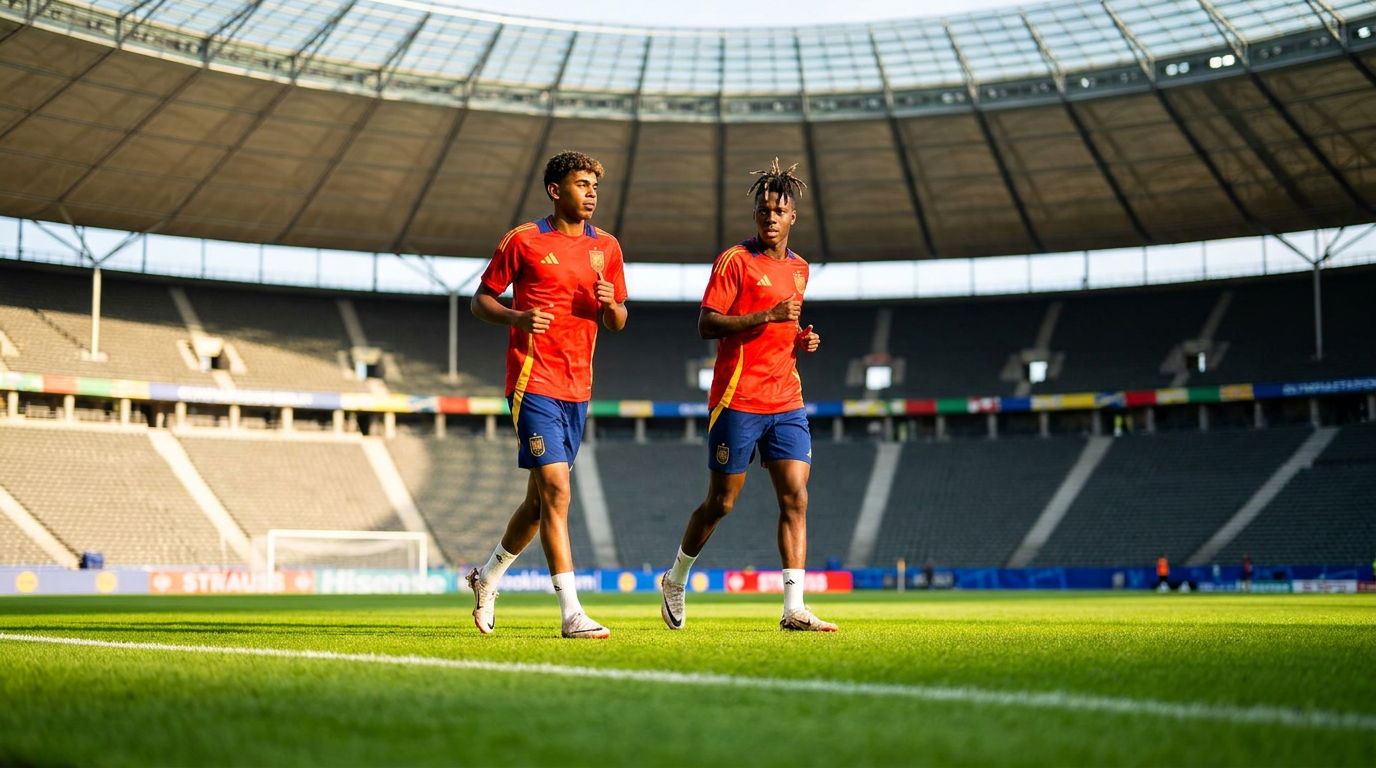
- Both Yamal and Williams returned to full training on June 11, easing injury concerns ahead of the World Cup opener.
- Spain utilizes an aggressive counter-press to win the ball high up the pitch, minimizing traditional defensive actions.
- Critics warn that Spain's high defensive line leaves them vulnerable to quick, direct counter-attacks.
As the 2026 FIFA World Cup kicks off across North America, the reigning European champions arrive in Atlanta not just as tournament favorites, but as the architects of a modernized footballing philosophy. Under the guidance of manager Luis de la Fuente, Spain has systematically dismantled the ghosts of their recent past. Gone is the rigid, slow-paced suffocation that characterized their early 2020s campaigns, replaced by a dynamic, youth-fueled system that has taken the international stage by storm.[2][5]
The evolution is widely being dubbed "Tiki-Taka 2.0." While the legendary Spanish sides of 2008 to 2012 relied on endless, patient circulation to exhaust opponents, the 2026 iteration operates with a ruthless verticality. De la Fuente has not abandoned possession—Spain still averaged a commanding 64 percent of the ball during their unbeaten World Cup qualifying campaign—but the ultimate purpose of that possession has fundamentally shifted.[1][5]
In this modernized setup, passing is no longer the end goal; it is the mechanism used to manipulate the opponent's defensive block. The Spanish midfield uses intricate, short-passing triangles to draw defenders into the center of the pitch, intentionally creating pockets of space on the flanks. Once the opposition compresses, the ball is rapidly switched to the wide channels, unleashing quick attacking transitions before the defense can recover.[1][5]

The entire system is predicated on the explosive gravity of two young wingers: Lamine Yamal and Nico Williams. Unlike the inverted playmakers of Spain's past, Yamal and Williams are traditional, chalk-on-the-boots wide forwards who excel in one-on-one isolation. Their ability to stretch the pitch horizontally forces fullbacks into agonizing decisions, and underlying metrics suggest Spain's expected goals (xG) output surges by 40 percent when both wingers are on the pitch together.[2][5]
The health of these two wide players is the linchpin of Spain's tournament hopes, which made the events of June 11 a massive relief for the Spanish camp. After managing minor muscular issues in the build-up to the tournament, both Yamal and Williams returned to full training in Chattanooga. Their presence on the grass, moving freely and participating in full-contact drills, eased national anxiety ahead of their Group H opener against Cape Verde.[3]
Behind the explosive forward line sits the undisputed engine of the Spanish system: Rodri. Operating as the lone pivot in a fluid 4-3-3 structure, the midfielder dictates the tempo with unparalleled spatial awareness. He is the metronome who decides when to apply the brakes with "la pausa"—holding the ball for an extra half-second to draw a defender—and when to accelerate the attack with sweeping diagonal passes to the wingers.[1][4]
Behind the explosive forward line sits the undisputed engine of the Spanish system: Rodri.
Flanking Rodri in the midfield are two advanced number eights, typically Pedri and Fabian Ruiz, who operate primarily in the half-spaces. Their role is to provide the connective tissue between the defensive pivot and the attacking wingers. By making underlapping runs into the penalty area, they force opposing center-backs to step out of position, creating the exact chaotic scenarios where Spain's forwards thrive.[5]

De la Fuente's tactical ingenuity is perhaps most evident in his use of asymmetrical fullbacks. On the left side, Marc Cucurella frequently acts as a tactical disruptor. Out of possession, he is a combative presser; in possession, he often inverts, tucking inside to sit next to Rodri. This creates a temporary double pivot that fortifies the center of the pitch against counter-attacks while allowing the rest of the team to push forward.[5]
Conversely, the right flank features a highly aggressive, overlapping fullback—often Pedro Porro or Alejandro Grimaldo. When Yamal receives the ball out wide, the fullback immediately sprints past him on the outside. This overlapping run drags a defender away, either gifting Yamal the space to cut inside onto his favored foot or providing the fullback with a clear lane to deliver a cut-back cross from the byline.[5]
Spain's dominance is not solely derived from what they do with the ball, but how they react the moment they lose it. Rather than retreating into a structured defensive block, La Roja executes a ferocious, high-intensity counter-press. The attacking line and advanced midfielders immediately swarm the ball carrier, attempting to win possession back in the final third while the opponent is still disorganized.[7]

This proactive approach to defending is reflected in the tournament's underlying data. Analytical models show that Spain ranks toward the lower end of the spectrum among European contenders for traditional defensive actions like tackles and interceptions. This is not a sign of weakness, but rather an indication of territorial control; Spain's defensive strength is built on preventing opponents from launching attacks in the first place.[7]
However, this high-wire act is not without its vulnerabilities. The commitment to a high defensive line and aggressive counter-pressing leaves vast tracts of empty space behind the Spanish center-backs. Teams with direct, pacy forwards have found ways to exploit this, as seen during a 2-2 qualifying draw against Turkey where quick balls over the top repeatedly bypassed Spain's midfield structure.[4]

Furthermore, structural skeptics point to a potential over-reliance on Yamal's individual brilliance. If an elite defensive side successfully double-teams the teenager and cuts off the passing lanes to the wings, Spain runs the risk of reverting to the sterile, horizontal possession of their past. Without the threat of vertical penetration, the intricate midfield passing can quickly become toothless.[4]
As they prepare to face Cape Verde at Mercedes-Benz Stadium, Spain's tactical identity is fully crystallized. They are a team that marries the technical perfection of their golden era with the athletic verticality demanded by modern football. Whether this "Tiki-Taka 2.0" system can withstand the grueling, seven-match marathon of a World Cup remains to be seen, but it undoubtedly makes La Roja the tournament's most compelling tactical study.[2][6]
How we got here
Dec 2022
Luis de la Fuente takes over as senior manager, initiating a shift away from rigid possession tactics.
Jul 2024
Spain wins Euro 2024, validating the new vertical 'Tiki-Taka 2.0' system on the international stage.
Nov 2025
La Roja concludes an unbeaten World Cup qualifying campaign, scoring 21 goals in six matches.
Jun 11, 2026
Lamine Yamal and Nico Williams return to full training, easing injury concerns ahead of the World Cup opener.
Viewpoints in depth
System Proponents
Argue that Spain's blend of possession and verticality makes them the most complete team in the tournament.
Analysts in this camp believe Luis de la Fuente has successfully cured the 'sterile possession' disease that plagued Spain in recent tournaments. By integrating explosive wingers like Lamine Yamal and Nico Williams into a foundation of technical midfield dominance, they argue Spain can now break down deep defensive blocks while remaining immune to being starved of the ball themselves. They point to the 21 goals scored in qualifying as proof that the system is functioning at peak lethality.
Structural Skeptics
Warn that Spain's aggressive high line and reliance on youth leave them vulnerable to elite counter-attacks.
Critics of the current system highlight the inherent risks of Spain's asymmetrical fullbacks and high defensive line. When the team commits numbers forward to execute their counter-press, vast spaces open up behind the center-backs. Skeptics point to the 2-2 qualifying draw against Turkey as a blueprint for how direct, pacy opponents can bypass the Spanish midfield entirely. Furthermore, they argue that placing the creative burden so heavily on a teenager like Yamal is a fragile strategy for a seven-match tournament.
What we don't know
- How effectively Spain's high defensive line will hold up against the elite, pacy forwards of top-tier contenders.
- Whether Lamine Yamal and Nico Williams can sustain their explosive output across a physically demanding seven-match tournament.
- How Luis de la Fuente will adjust his system if opponents successfully double-team the wingers and force play inside.
Key terms
- Tiki-Taka 2.0
- A modernized evolution of Spain's traditional passing game that uses possession to create quick, direct attacking opportunities rather than just controlling the clock.
- Double Pivot
- A tactical setup where two midfielders sit deep to protect the defense, often formed dynamically by an inverting fullback.
- Counter-Press
- An aggressive defensive strategy where a team immediately attempts to win the ball back high up the pitch the moment they lose possession.
- Half-Space
- The vertical attacking channels on the pitch located between the center and the wide wings, heavily utilized by advanced midfielders.
Frequently asked
How does Spain's current style differ from their 2010 team?
While the 2010 World Cup-winning team relied on slow, suffocating possession to control games, the 2026 squad uses possession to create quick, direct attacking opportunities for their wingers.
Are Lamine Yamal and Nico Williams fit to play?
Yes, both wingers returned to full training on June 11 after managing minor injuries, though the coaching staff may carefully manage their minutes in the opening matches.
What is Spain's biggest tactical weakness?
Their aggressive high press and overlapping fullbacks can leave space behind the defensive line, making them vulnerable to quick, direct counter-attacks over the top.
Sources
Source coverage
7 outlets
3 viewpoints surfaced







[1]The IndependentSystem Proponents
How Spain have developed 'tiki-taka 2.0' in pursuit of World Cup glory
Read on The Independent →[2]The GuardianSystem Proponents
Spain World Cup 2026 team guide
Read on The Guardian →[3]GoalAnalytical Observers
Lamine Yamal & Nico Williams return to full training with Spain in major boost ahead of World Cup opener vs Cape Verde
Read on Goal →[4]TribunaStructural Skeptics
Why Spain's 'perfect team' will collapse at the 2026 World Cup
Read on Tribuna →[5]The Hard TackleSystem Proponents
FIFA World Cup 2026 Team Spotlight: Spain – Can Luis de la Fuente's youth-fueled squad go the distance?
Read on The Hard Tackle →[6]Sports MoleAnalytical Observers
Spain vs. Cape Verde World Cup 2026 Match Preview
Read on Sports Mole →[7]Football Data AnalysisAnalytical Observers
FIFA World Cup 2026: Europe's Tactical Systems – Analysis
Read on Football Data Analysis →

Every angle. Every day.
Get sports stories with full source coverage and perspective breakdowns delivered to your inbox.