
How Parametric Insurance is Rewiring Climate Resilience with Instant Payouts
By replacing subjective claims adjusters with automated data triggers, parametric insurance is delivering instant financial relief to farmers, governments, and renewable energy grids.
By Factlen Editorial Team
- Insurance Industry Innovators
- Highlight the technological leap of using AI, satellites, and IoT sensors to underwrite previously uninsurable risks, viewing parametric models as the future of the industry.
- Climate Resilience Advocates
- Focus on how rapid liquidity prevents vulnerable communities from falling into poverty after a shock, emphasizing the humanitarian impact of bypassing traditional claims processes.
- Market Analysts
- Track the explosive growth of the sector, noting that while basis risk remains a hurdle, the demand for transparent, automated payouts is driving billions in new premiums.
What's not represented
- · Traditional Claims Adjusters
- · Smallholder Farmers (Direct Voices)
Why this matters
As climate extremes increase, traditional insurance is failing to pay out fast enough to prevent financial ruin. Parametric policies ensure that vulnerable communities and critical infrastructure receive immediate liquidity to recover and rebuild the moment a disaster strikes.
Key points
- Traditional indemnity insurance is struggling to keep pace with climate volatility, often taking months to process disaster claims.
- Parametric insurance solves this by triggering automatic payouts based on objective data, such as wind speed or rainfall levels.
- The model is successfully protecting smallholder farmers in Ecuador and Indonesia, providing funds in time for the next planting cycle.
- The global parametric insurance market is projected to reach $23.85 billion in 2026, driven by advances in AI and satellite data.
The aftermath of a natural disaster is often defined by a second, quieter crisis: the agonizing wait for financial relief. Traditional indemnity insurance requires a small army of claims adjusters to physically wade through floodwaters, assess structural damage, and argue over subjective valuations before a check is ever cut. In an era of escalating climate volatility, this analog process is fundamentally breaking down. Insured natural catastrophe losses have exceeded $100 billion globally for five consecutive years, straining the traditional model and leaving vulnerable communities waiting months—sometimes years—for the capital they need to rebuild. The protection gap is widening, as legacy risk models fail to keep pace with the frequency and severity of modern weather events, forcing the industry to seek a radically different approach to risk transfer.[5]
Enter parametric insurance, a data-driven alternative that is rewiring how the world recovers from climate shocks. Instead of paying out based on a subjective, post-event assessment of physical damage, parametric policies pay out automatically when a predefined, objective metric is met. The mechanism is elegantly simple: a policy is tied to a specific environmental data point, such as a Category 3 hurricane wind speed, a specific flood depth measured by a river gauge, or a prolonged lack of rainfall over a designated agricultural zone. If that exact threshold is crossed, the smart contract triggers an immediate payout. "Claim settlement is quicker and more transparent than traditional insurance solutions since the triggering event occurrence is binary," notes risk management firm Aon. Coverage is often confirmed within days, and funds arrive within weeks, bypassing the costly and adversarial dispute phase entirely.[5][7]

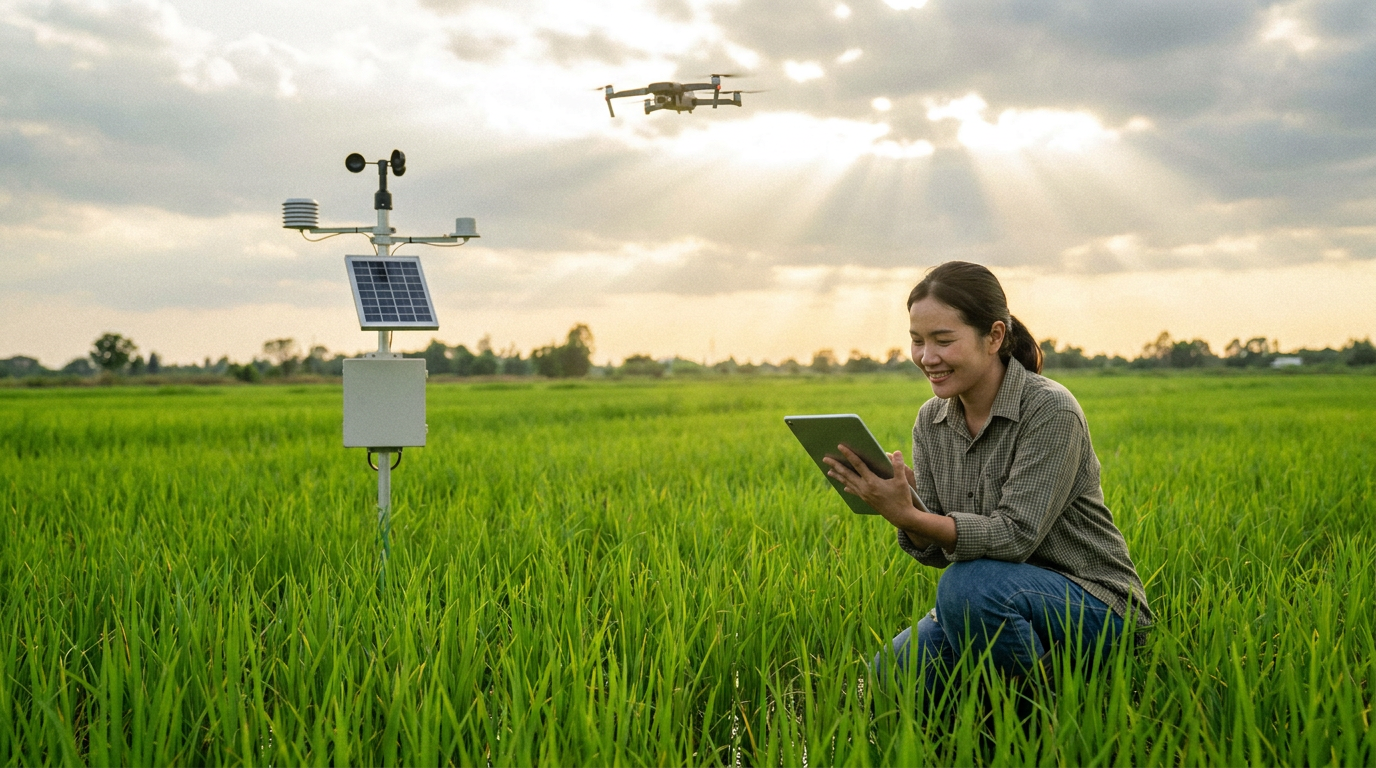
This unprecedented speed is proving to be a lifeline for some of the world's most vulnerable populations. In early 2026, Ecuador launched its first parametric agricultural insurance program, specifically designed to protect 2,800 smallholder rice and maize farmers against extreme rainfall and drought. Backed by the United Nations Development Programme (UNDP) and AXA Climate, the initiative uses advanced satellite imagery and local weather station data to monitor conditions across climate-vulnerable provinces like Guayas and Manabí. If a drought exceeds the agreed-upon severity threshold, the system automatically triggers a payout. Crucially, farmers receive these funds in time to purchase seeds for the next planting cycle, preventing a single bad season from spiraling into permanent financial ruin and protecting the broader domestic food supply.[2]
Similar data-driven models are scaling rapidly across the globe to protect agricultural supply chains. In Indonesia, CelsiusPro Group and ECOM Agroindustrial formed a strategic partnership in January 2026 to design parametric products specifically for smallholder coffee farmers. Changing rainfall patterns and extreme weather events have severely impacted coffee yields in the region, and traditional indemnity insurance was either entirely unavailable or prohibitively expensive due to the high costs of underwriting and claims adjustment in remote areas. By shifting to a parametric model, insurers can offer affordable, scalable coverage that relies on satellite verification rather than physical farm visits, ensuring that farmers have a financial safety net when climate volatility threatens their livelihoods.[4]
Similar data-driven models are scaling rapidly across the globe to protect agricultural supply chains.
At a macro level, entire nations are leveraging this technology to ensure sovereign financial stability in the face of natural disasters. The Caribbean Catastrophe Risk Insurance Facility (CCRIF) operates as a multi-country risk pool, maintaining over $1.44 billion in parametric coverage for 35 member governments and utility companies across the Caribbean and Central America. When Hurricane Melissa devastated parts of the northern Caribbean in 2025, CCRIF disbursed nearly $92 million to Jamaica within its strictly mandated 14-day window. This rapid injection of liquidity allowed the Jamaican government to immediately stabilize essential services, clear debris, and support vulnerable populations, rather than waiting months for international aid packages or traditional reinsurance claims to process.[3]

The applications of parametric insurance extend far beyond agriculture and sovereign disaster relief, increasingly serving as a critical financial tool for the renewable energy sector. Clean energy infrastructure is uniquely vulnerable to weather variability that doesn't necessarily cause physical damage but absolutely destroys revenue. For example, a wind farm might experience a month of historically low wind speeds, or a utility-scale solar facility might suffer through weeks of unexpected cloud cover. Traditional insurance policies offer zero protection against these generation shortfalls. However, a parametric policy can be structured to trigger a payout if average wind speeds or solar irradiance fall below a specific threshold, providing clean energy operators with the financial predictability required to secure long-term investment and service their debt.[6]
The engine powering this shift away from traditional indemnity is the explosion of real-time, high-fidelity environmental data. The modern parametric ecosystem relies on a vast network of low-earth orbit satellites, internet-of-things (IoT) sensors, seismographs, and AI-driven predictive models that provide the granular, tamper-proof data required to execute these contracts reliably. Advancements in artificial intelligence are allowing insurers to calibrate triggers with unprecedented accuracy, analyzing decades of historical weather patterns to price risk fairly. This technological leap transforms insurance from a reactive, paper-heavy industry into a proactive, automated financial technology, capable of deploying capital exactly when and where it is needed most.[7]

Despite its rapid adoption, the parametric model is not without its structural challenges. The primary hurdle facing the industry is "basis risk"—the possibility that a policyholder suffers a genuine financial loss, but the predefined data trigger is not met, resulting in no payout. To combat this, insurers are moving away from simplistic single-trigger models and developing sophisticated multi-trigger policies. Instead of relying solely on wind speed at a single weather station, a modern parametric policy might require a combination of wind intensity, localized floodwater levels, and satellite-verified storm radius to activate. By layering these parameters, insurers can ensure that automatic payouts align much more closely with the actual ground-level damage experienced by the policyholder.[5][7]
Even with the complexities of basis risk, the financial trajectory of the sector is remarkably clear. The global parametric insurance market is projected to reach $23.85 billion in 2026, and is expected to grow at a compound annual rate of nearly 13% to approach $39 billion by 2030. By stripping away the friction, delay, and administrative bloat of traditional claims adjustment, parametric insurance is transforming climate risk from a source of prolonged anxiety into a manageable, mathematical certainty. As extreme weather events become the new normal, the ability to deliver instant, data-driven financial resilience is no longer just a clever financial innovation—it is rapidly becoming a mandatory tool for global adaptation and survival.[1][7]

How we got here
2024
Insured natural catastrophe losses exceed $100 billion for the fifth consecutive year, straining traditional insurance models.
2025
The Caribbean Catastrophe Risk Insurance Facility (CCRIF) disburses a record $91.9 million to Jamaica within 14 days following Hurricane Melissa.
Jan 2026
CelsiusPro Group partners with ECOM to launch parametric climate insurance for vulnerable coffee farmers in Indonesia.
Feb 2026
Ecuador launches its first parametric agricultural insurance program, covering thousands of smallholder farmers against extreme weather.
Viewpoints in depth
Climate Resilience Advocates
Focus on how rapid liquidity prevents vulnerable communities from falling into poverty after a shock.
Organizations like the United Nations Development Programme and regional risk pools argue that the true value of parametric insurance lies in its humanitarian impact. By bypassing the traditional claims process, these policies ensure that capital reaches disaster-stricken areas before secondary crises—such as food shortages or disease outbreaks—can take hold. For these advocates, the speed of the payout is just as important as the amount.
Insurance Industry Innovators
Highlight the technological leap of using AI, satellites, and IoT sensors to underwrite previously uninsurable risks.
Platforms like Arbol and CelsiusPro view parametric models as the inevitable future of the insurance industry. They point out that legacy indemnity models are too slow and expensive to scale in remote or highly volatile regions. By leveraging smart contracts and real-time environmental data, these innovators argue that the industry can finally close the global protection gap and offer affordable coverage for risks that were previously considered untouchable.
Market Analysts
Track the explosive growth of the sector, noting that demand for transparent, automated payouts is driving billions in new premiums.
Financial researchers emphasize the sheer scale of the parametric boom, projecting a market size approaching $39 billion by 2030. However, analysts also caution that the industry must solve the 'basis risk' problem to maintain trust. If policyholders consistently suffer losses that fail to trigger payouts due to poorly calibrated data thresholds, the rapid adoption of parametric models could stall.
What we don't know
- How effectively the industry will minimize 'basis risk'—the gap between the data trigger and the actual financial loss experienced on the ground.
- Whether regulatory frameworks in developing nations can evolve quickly enough to support the widespread adoption of smart-contract insurance.
Key terms
- Parametric Insurance
- A policy that pays a set amount based on the occurrence of a triggering event, rather than the value of the physical loss.
- Basis Risk
- The mismatch between the actual loss a policyholder experiences and the payout triggered by the parametric index.
- Smart Contract
- A self-executing digital contract where the terms are written into code, often used to automate parametric payouts when data thresholds are met.
- Indemnity Insurance
- Traditional insurance that reimburses the policyholder for the exact amount of the assessed loss or damage.
Frequently asked
What is parametric insurance?
It is a type of insurance that pays out a predefined amount automatically when a specific, measurable event occurs (like a certain wind speed or rainfall level), rather than reimbursing for assessed physical damage.
How fast are parametric payouts?
Because there is no need for a claims adjuster to assess the damage, payouts are typically triggered within days and disbursed within a few weeks.
What is 'basis risk' in insurance?
Basis risk is the chance that a policyholder suffers actual damage, but the specific data trigger (e.g., wind speed was slightly below the threshold) is not met, resulting in no payout.
Who uses parametric insurance?
It is used by governments for disaster relief, renewable energy companies hedging against weather variability, and increasingly by agricultural programs protecting smallholder farmers.
Sources
Source coverage
7 outlets
3 viewpoints surfaced






[1]The Business Research CompanyMarket Analysts
Parametric Insurance Market Size and Share 2026
Read on The Business Research Company →[2]United Nations Development ProgrammeClimate Resilience Advocates
Ecuador contracts first parametric agricultural insurance policies
Read on United Nations Development Programme →[3]CCRIF SPCClimate Resilience Advocates
CCRIF 2026 Update: Expanding Parametric Coverage
Read on CCRIF SPC →[4]CelsiusProInsurance Industry Innovators
CelsiusPro Group and ECOM partner to build climate resilience for Indonesian coffee farmers
Read on CelsiusPro →[5]AonInsurance Industry Innovators
Parametric: An Alternative Risk Solution
Read on Aon →[6]ArbolInsurance Industry Innovators
How Parametric Insurance Protects Renewable Energy
Read on Arbol →[7]Factlen Editorial Team
Synthesis by Factlen editorial team
Read on Factlen Editorial Team →



Every angle. Every day.
Get finance stories with full source coverage and perspective breakdowns delivered to your inbox.