
The Rise of 'Plyscrapers': How Mass Timber is Rewriting the Rules of Global Construction
Engineered wood is replacing concrete and steel in high-rises worldwide, offering a structural solution that locks away carbon rather than emitting it.
By Factlen Editorial Team
- Sustainable Architects & Urban Planners
- Advocates for mass timber as a primary tool for decarbonizing the built environment.
- Forestry & Conservation Advocates
- Supporters who caution that the climate benefits depend entirely on responsible sourcing.
- Traditional Construction & Code Officials
- Stakeholders focused on structural integrity, fire safety, and standardized regulation.
What's not represented
- · Steel and concrete industry representatives defending traditional materials
- · Local community groups affected by the expansion of timber manufacturing facilities
Why this matters
The built environment is responsible for nearly 40% of global carbon emissions. Transitioning to mass timber could turn future cities into massive carbon sinks, fundamentally altering the climate math of urban development.
Key points
- Mass timber, particularly Cross-Laminated Timber (CLT), is replacing concrete and steel in high-rise construction.
- Using timber locks away carbon absorbed by trees, potentially reducing a building's lifetime emissions by 40%.
- CLT panels are prefabricated, allowing for faster, quieter, and less labor-intensive construction.
- In a fire, thick timber panels char on the outside, creating an insulating layer that protects the structural core.
- The 2021 and 2024 International Building Code updates permit mass timber buildings up to 18 stories tall.
- The environmental benefits rely heavily on sustainable forestry practices to prevent deforestation.
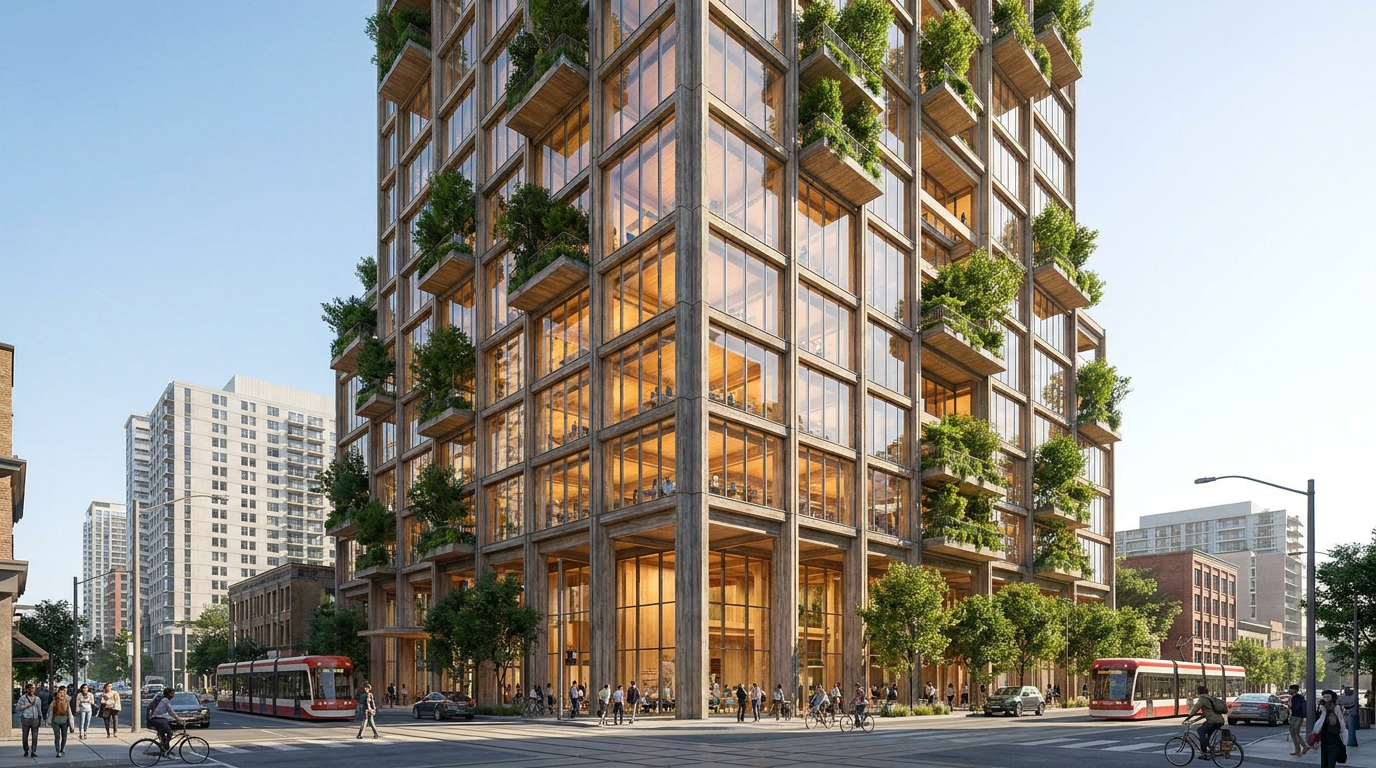
For over a century, the recipe for a city skyline has remained largely unchanged: pour concrete, erect steel, and repeat. But a quiet revolution is taking root in global real estate. Architects and developers are increasingly turning to a material that grows from the ground up, giving rise to a new generation of high-rises affectionately dubbed 'plyscrapers.'[4][6]
This shift is driven by the advent of mass timber, a category of advanced engineered wood products designed to match or exceed the structural capabilities of traditional building materials. The most prominent of these is Cross-Laminated Timber (CLT). Manufactured by gluing layers of solid-sawn lumber together at right angles, this orthogonal lamination process creates massive, highly stable panels that boast exceptional load-bearing capacity.[3][6]
The primary catalyst for the mass timber boom is the urgent need to decarbonize the built environment. Construction materials currently account for roughly 9 percent of global greenhouse gas emissions, with concrete and steel production being the primary culprits due to their energy-intensive, fossil-fuel-reliant manufacturing processes.[1][5]
Mass timber flips this equation. As trees grow, they naturally sequester carbon dioxide from the atmosphere through photosynthesis. When that wood is harvested and engineered into structural panels, the carbon remains locked inside the building for decades, if not centuries. According to researchers at the MIT Environmental Solutions Initiative, substituting concrete and steel with CLT can lower the lifetime carbon emissions of large buildings by roughly 40 percent.[1][6]

Beyond the carbon math, mass timber is fundamentally changing the economics and logistics of construction. Because CLT panels are prefabricated in factories to exact millimeter dimensions, they arrive on-site ready to be slotted into place—much like a giant piece of flat-pack furniture. This precision drastically accelerates construction timelines.[4][5]
The speed of assembly translates directly to lower financing costs for developers. Furthermore, because timber is significantly lighter than concrete, buildings require smaller foundations, less excavation, and fewer heavy goods vehicles rumbling through urban neighborhoods. For instance, a nine-story timber housing block in London required only 100 truck deliveries, compared to an estimated 900 had it been built with concrete.[4][6]

The speed of assembly translates directly to lower financing costs for developers.
Despite these advantages, the most common question raised by the public and policymakers alike is one of safety: What happens when a wooden skyscraper catches fire? The answer lies in the unique thermal properties of engineered wood.[4][6]
Counterintuitively, mass timber performs exceptionally well under severe fire conditions. When exposed to intense heat, the exterior of a thick timber panel chars at a slow and highly predictable rate. This charred layer acts as a natural insulator, protecting the structural integrity of the unburned wood inside. In contrast, steel begins to lose its strength and buckle at temperatures around 550 degrees Celsius.[4][6]

Recognizing this resilience, regulatory bodies are rewriting the rules of urban development. A major turning point occurred with the 2021 and 2024 updates to the International Building Code (IBC), which introduced new construction types allowing mass timber structures to reach up to 18 stories in the United States, provided specific encapsulation measures are met.[2][6]
This regulatory green light has unlocked the high-density commercial and residential real estate sectors. Over two dozen U.S. states have already adopted these tall mass timber provisions, while European nations like Germany and Sweden are heavily subsidizing low-carbon housing projects ring-fenced specifically for CLT construction.[2][3]
The market is responding aggressively to these incentives. The global cross-laminated timber market is projected to expand at a compound annual growth rate of over 11.5 percent through the early 2030s. Developers are increasingly motivated by a combination of ESG (Environmental, Social, and Governance) mandates, carbon-removal certifications, and the aesthetic appeal of exposed wood, which has been linked to improved occupant well-being.[3][6]

However, the widespread adoption of plyscrapers is not without its challenges. The environmental benefits of mass timber are entirely dependent on sustainable forestry practices. If the surge in demand leads to irresponsible logging or threatens biodiversity, the carbon-negative promise of the material collapses. Sourcing must be strictly tied to forests that are continuously replanted and managed for long-term ecological health.[1][5]
Additionally, the industry faces acute supply chain bottlenecks. The specialized expertise required for moisture protection, acoustic detailing, and the sequencing of prefabricated assembly is currently concentrated in a small network of engineering firms. Ramping up domestic manufacturing capacity for CLT panels remains a critical hurdle for markets outside of Europe.[3][6]
As these growing pains are addressed, the trajectory of global real estate appears increasingly wooden. By transforming cities from major carbon emitters into vast, habitable carbon sinks, mass timber offers one of the most tangible and scalable solutions to the climate crisis currently available to the construction industry.[1][6]
How we got here
2016
Australia updates its National Construction Code to increase the allowed height of timber buildings to eight stories.
2021
The International Building Code (IBC) introduces new construction types allowing mass timber structures up to 18 stories in the U.S.
2024
Further IBC updates expand allowances for exposed mass timber ceilings and integral beams in mid-rise construction.
2025
The global cross-laminated timber market reaches an estimated $1.96 million cubic meters in volume.
2026
Over 28 U.S. states have formally adopted the tall mass timber provisions, accelerating commercial real estate adoption.
Viewpoints in depth
Sustainable Architects & Urban Planners
Advocates for mass timber as a primary tool for decarbonizing the built environment.
This camp views the transition away from concrete and steel as an existential necessity for the climate. They emphasize that cities are currently massive carbon emitters, but through the widespread adoption of biogenic materials like timber, urban centers could be transformed into vast carbon sinks. Beyond emissions, they highlight the biophilic benefits of exposed wood, citing studies that show natural materials in offices and homes reduce stress and improve occupant well-being.
Forestry & Conservation Advocates
Supporters who caution that the climate benefits depend entirely on responsible sourcing.
While generally supportive of replacing fossil-fuel-intensive materials, conservationists warn against treating mass timber as a panacea. They argue that if the booming demand for CLT leads to the clear-cutting of old-growth forests or the replacement of biodiverse ecosystems with monoculture tree plantations, the net environmental impact will be negative. This group insists that mass timber must be strictly coupled with rigorous, certified sustainable forestry practices to ensure true carbon negativity.
Traditional Construction & Code Officials
Stakeholders focused on structural integrity, fire safety, and standardized regulation.
Building officials and traditional engineers approach mass timber through the lens of risk management and code compliance. Their primary concerns have historically centered on fire performance, moisture control, and acoustic isolation. However, extensive full-scale burn tests and seismic simulations have largely satisfied this camp, leading to the recent updates in the International Building Code. They now focus on ensuring that local municipalities properly adopt these codes and that contractors are adequately trained in specialized timber assembly techniques.
What we don't know
- Whether global sustainable forestry operations can scale fast enough to meet the surging demand for mass timber without harming biodiversity.
- How quickly local municipalities and city councils will adopt the updated International Building Code provisions allowing taller timber structures.
- The long-term feasibility and standardized methods for repairing mass timber buildings after a severe fire event.
Key terms
- Mass Timber
- A category of engineered wood products made by binding layers of wood together to create large, solid structural panels and beams.
- Cross-Laminated Timber (CLT)
- A specific type of mass timber manufactured by gluing layers of solid-sawn lumber at right angles to one another, providing exceptional strength and stability.
- Biogenic Carbon
- Carbon that is absorbed from the atmosphere by living organisms, such as trees, and stored in their biomass.
- Embodied Carbon
- The total greenhouse gas emissions generated during the extraction, manufacturing, transportation, and assembly of building materials.
- Plyscraper
- A colloquial term for a high-rise building constructed primarily using engineered wood products instead of steel and concrete.
- Char Rate
- The predictable speed at which the outer layer of a thick piece of wood burns and turns to charcoal, which acts as an insulator during a fire.
Frequently asked
Is mass timber safe in a fire?
Yes. Unlike light-frame wood used in residential homes, thick mass timber panels char on the outside when exposed to fire. This char layer insulates the unburned wood inside, allowing the building to maintain its structural integrity longer than steel, which can buckle under extreme heat.
How does building with wood help the climate?
Trees absorb carbon dioxide as they grow. When harvested and used in long-lasting structures, that carbon remains locked away. Additionally, using wood avoids the massive carbon emissions associated with manufacturing concrete and steel.
Are we going to run out of trees?
The sustainability of mass timber depends on responsible forestry. When sourced from certified, sustainably managed forests where trees are continuously replanted, the supply is renewable. However, conservationists warn that unregulated demand could threaten vulnerable ecosystems.
How tall can a timber building be?
Recent updates to the International Building Code allow mass timber buildings to reach up to 18 stories, provided they meet specific fire-resistance and encapsulation requirements. Some experimental structures and hybrid buildings aim even higher.
Sources
Source coverage
6 outlets
3 viewpoints surfaced






[1]MIT Environmental Solutions InitiativeSustainable Architects & Urban Planners
Substituting steel and concrete with timber and engineered woods
Read on MIT Environmental Solutions Initiative →[2]WoodWorksTraditional Construction & Code Officials
Status of Building Code Allowances for Tall Mass Timber in the IBC
Read on WoodWorks →[3]Mordor IntelligenceTraditional Construction & Code Officials
Cross Laminated Timber Market Size & Share Analysis
Read on Mordor Intelligence →[4]UNSW SydneyTraditional Construction & Code Officials
The rise of the plyscraper
Read on UNSW Sydney →[5]APA – The Engineered Wood AssociationForestry & Conservation Advocates
Engineered Wood Products and Embodied Carbon
Read on APA – The Engineered Wood Association →[6]Factlen Editorial TeamSustainable Architects & Urban Planners
Synthesis by Factlen editorial team
Read on Factlen Editorial Team →

Every angle. Every day.
Get real estate stories with full source coverage and perspective breakdowns delivered to your inbox.