
The Dawn of Stratospheric Balloon Tourism: How Luxury Capsules Are Redefining Space Travel
In 2026, a new wave of aerospace companies will begin lifting passengers to the edge of space in luxury stratospheric balloons, offering breathtaking views without the physical toll of rocket flight.
By Factlen Editorial Team
- Stratospheric Tourism Operators
- Companies building balloon systems argue they are democratizing the edge of space.
- Luxury Travel Industry
- Travel experts view the flights as the ultimate evolution of experiential luxury.
- Aerospace Analysts
- Industry watchers focus on the financial viability and consolidation of the sector.
What's not represented
- · Environmental Scientists
- · Aviation Regulators
Why this matters
This emerging industry makes the life-changing 'Overview Effect' accessible to a broader demographic without the extreme physical demands or environmental damage of traditional rocket launches, signaling a major shift in how humanity experiences the cosmos.
Key points
- A new class of space tourism utilizing stratospheric balloons is preparing to launch commercial flights in 2026.
- Passengers will ascend to 100,000 feet in pressurized luxury capsules, offering views of Earth's curvature without G-forces.
- Tickets range from $125,000 to $250,000, significantly less than the cost of suborbital rocket flights.
- The gentle six-hour journeys feature luxury amenities including panoramic windows, fine dining, and Wi-Fi.
- Balloon flights offer a low-carbon, sustainable alternative to the heavy emissions of traditional rocket launches.
The image of spaceflight has long been defined by roaring rockets, intense G-forces, and rigorous physical training. But as the commercial space industry matures, a radically different approach is preparing for liftoff.
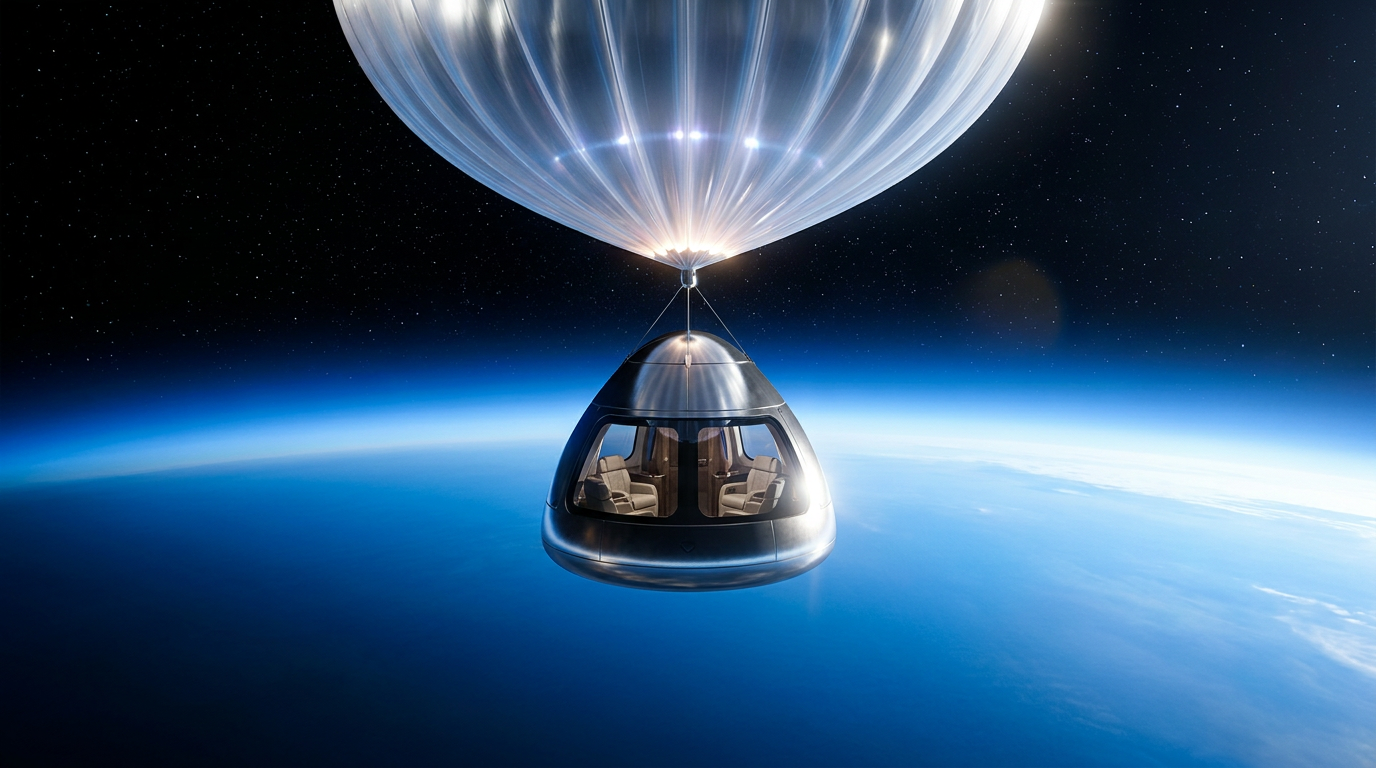
In 2026, a new class of aerospace companies plans to inaugurate the era of stratospheric balloon tourism. Instead of blasting through the atmosphere atop columns of fire, passengers will ascend in pressurized luxury capsules lifted by massive, gas-filled balloons.[1][3]
The promise is a gentle, six-hour journey to the edge of space, offering the life-changing vistas of orbital flight without the physical toll or the astronomical carbon footprint. It is an experience that industry executives are comparing more to high-end "glamping" than to traditional astronaut missions.[4][6]
The mechanics of these flights stand in stark contrast to the suborbital rockets operated by Blue Origin and Virgin Galactic. A typical stratospheric balloon flight is divided into three distinct phases: a two-hour ascent, a two-hour cruise at maximum altitude, and a two-hour descent.[8]

Lifted by helium or hydrogen, the balloons climb at a leisurely pace of roughly 12 miles per hour. Because the ascent is so gradual, passengers experience no heavy acceleration or G-forces, eliminating the need for specialized spacesuits or pre-flight centrifuge training.[3][8]
The cruising altitude for these vessels is approximately 100,000 feet, or nearly 19 miles above sea level. While this falls short of the Kármán line—the internationally recognized boundary of space at 62 miles—it places passengers above 99 percent of Earth's atmosphere.[1][5]
At this height, the sky transitions from daytime blue to the star-studded blackness of the cosmos. Travelers can clearly see the curvature of the Earth and the thin, glowing blue halo of the atmosphere that protects it.[1][3]
This vantage point is known to trigger the "Overview Effect," a profound cognitive shift reported by astronauts who witness the fragility and unity of the planet from the void. Stratospheric operators are betting that wealthy travelers will pay a premium for this psychological transformation.[6]
To cater to this demographic, the capsules are being designed with uncompromising luxury. Interiors feature 360-degree panoramic windows, plush lounge seating, ambient lighting, and fully equipped restrooms.[8]

To cater to this demographic, the capsules are being designed with uncompromising luxury.
The in-flight experience is curated to match the surroundings. Companies are promising Michelin-starred dining, premium wine and cocktail bars, and Wi-Fi connectivity so passengers can livestream their journey to the edge of space.[5][6]
Several key players are racing to be the first to launch commercial operations in 2026. Among the most prominent is Space Perspective, a Florida-based pioneer that recently underwent a major corporate restructuring.[2][7]
After facing financial headwinds earlier in the year, Space Perspective was acquired by EOS-X Space, a European aerospace firm. The merger aims to combine their technologies and launch manned flights from both the United States and international spaceports, with tickets priced at $125,000.[1][2][7]
Another major contender is Madrid-headquartered Halo Space. The company recently unveiled its Aurora capsule, featuring an interior crafted by former Ferrari designer Frank Stephenson.[3][4]
Halo Space plans to charge roughly $164,000 per seat and intends to operate from bases in Spain, the U.S., Australia, and Saudi Arabia. The company has already conducted multiple uncrewed test flights and aims to fly 10,000 passengers by the end of the decade.[1][3]

In France, Zephalto is taking a distinctly European approach to the market. Its Céleste capsule, designed to reach an altitude of 25 kilometers (about 82,000 feet), emphasizes minimalist French refinement and sustainability.[5][6]
Zephalto has even partnered with luxury travel agencies to offer $250,000 packages that include pre-flight transformational coaching from astronauts and philosophers, ensuring passengers are mentally prepared to process the Overview Effect.[6]
Beyond comfort, the stratospheric balloon model offers a compelling environmental argument. Traditional rocket launches emit significant amounts of greenhouse gases and black carbon directly into the upper atmosphere.[3][5]
In contrast, balloon operators utilize renewable gases and zero-emission capsule systems. This low-carbon footprint appeals to a new generation of high-net-worth individuals who are increasingly prioritizing regenerative and sustainable travel options.[5][8]

Despite the optimism, the industry still faces significant hurdles before its 2026 launch targets. The technology must pass rigorous safety certifications from aviation authorities, and the massive balloons are highly sensitive to weather conditions, which could lead to frequent launch delays.[8]
Furthermore, the financial turbulence experienced by Space Perspective underscores the immense capital required to bring these aerospace projects to fruition. Yet, if these companies succeed, they will democratize access to the cosmos—or at least its breathtaking views—transforming the edge of space into the ultimate luxury destination.[2][7]
How we got here
2021
Halo Space is founded with the goal of developing zero-emission stratospheric commercial flights.
2023
French company Zephalto announces plans for its Céleste capsule, promising Michelin-starred dining at the edge of space.
Sept 2024
Space Perspective successfully completes an uncrewed test flight of its Spaceship Neptune capsule to 100,000 feet.
July 2025
European aerospace firm EOS-X Space acquires Space Perspective following financial difficulties, merging their operations.
2026
The targeted launch window for the first commercial passenger flights by multiple stratospheric balloon operators.
Viewpoints in depth
Stratospheric Tourism Operators
Companies building balloon systems argue they are democratizing the edge of space.
Executives at companies like Halo Space and EOS-X Space view their platforms as the ultimate democratization of the 'Overview Effect.' By removing the physical barriers of G-forces and the extreme costs associated with rocket fuel, they argue that stratospheric balloons open the edge of space to anyone fit enough to fly on a commercial airliner. They emphasize that the slow, six-hour journey allows for genuine contemplation and psychological transformation, contrasting their 'glamping' approach with the brief, adrenaline-fueled minutes offered by suborbital rockets.
Traditional Aerospace Advocates
Proponents of rocket-based tourism emphasize the necessity of crossing the Kármán line.
For traditional spaceflight purists and operators of suborbital rockets, the definition of 'space tourism' requires actually reaching space. They point out that stratospheric balloons, cruising at 19 miles above sea level, fall well short of the 62-mile Kármán line. From this perspective, true spaceflight must include the visceral thrill of rocket propulsion and the experience of true weightlessness—elements that a gentle balloon ascent fundamentally cannot provide, regardless of how luxurious the cabin might be.
Sustainable Travel Proponents
Eco-conscious travelers and analysts praise the low-emission profile of balloon flights.
As the luxury travel market increasingly shifts toward regenerative and sustainable practices, environmental advocates highlight the stark contrast between rockets and balloons. Suborbital rocket launches inject black carbon and greenhouse gases directly into the fragile upper atmosphere. In contrast, stratospheric balloons rely on lighter-than-air gases and zero-emission capsule systems. For high-net-worth individuals concerned about their carbon footprint, this low-impact approach makes balloon tourism a far more ethically palatable way to experience the cosmos.
What we don't know
- How commercial airspace regulators will manage the integration of massive, slow-moving balloons into flight corridors.
- Whether the companies can successfully scale operations to meet their ambitious targets of flying thousands of passengers annually.
- How sensitive the commercial launch schedules will be to high-altitude weather patterns and wind conditions.
Key terms
- Stratosphere
- The second major layer of Earth's atmosphere, located above the troposphere, where the air is extremely thin and commercial jets rarely fly.
- Overview Effect
- A profound cognitive shift reported by astronauts when viewing the Earth from space, characterized by a deep sense of planetary unity and fragility.
- Kármán line
- The internationally recognized boundary of outer space, located approximately 62 miles (100 kilometers) above mean sea level.
- SpaceBalloon
- A massive, high-altitude balloon filled with lighter-than-air gas (like helium or hydrogen) used to lift payloads and passenger capsules into the stratosphere.
Frequently asked
Do passengers experience zero gravity on these flights?
No. Because the capsule ascends slowly and does not reach orbital speeds or enter freefall, passengers experience normal Earth gravity throughout the entire six-hour journey.
How high do the stratospheric balloons actually go?
The balloons cruise at an altitude of approximately 100,000 feet (about 19 miles or 30 kilometers) above sea level, placing them above 99 percent of Earth's atmosphere.
Is specialized astronaut training required?
No. The ascent is gentle, climbing at roughly 12 miles per hour with no heavy G-forces. Anyone who is medically fit to fly on a standard commercial airplane can participate.
How does the capsule safely return to Earth?
The capsule performs a controlled descent by gradually releasing gas from the balloon. Depending on the company, it either splashes down in the ocean for boat recovery or uses a steerable parachute for a land touchdown.
Sources
Source coverage
8 outlets
3 viewpoints surfaced








[1]Space.comStratospheric Tourism Operators
HALO Space unveils 'glamping' capsule for balloon flights to the stratosphere
Read on Space.com →[2]Travel WeeklyAerospace Analysts
European acquisition revives Space Perspective's space tourism ambitions
Read on Travel Weekly →[3]Business InsiderLuxury Travel Industry
This space tourism company wants to take people to the stratosphere with a helium balloon for $150,000
Read on Business Insider →[4]National PostLuxury Travel Industry
Balloon-powered 'space glamping' for only US$164,000 could start by 2026
Read on National Post →[5]ObserverLuxury Travel Industry
Zephalto Wants to Take You to Space in a Low-Carbon Luxury Balloon
Read on Observer →[6]GlobeTrenderLuxury Travel Industry
Sabbatical.Travel partners with Zephalto on stratospheric balloon flights
Read on GlobeTrender →[7]Universe MagazineAerospace Analysts
Spanish company Eos X Space announced the acquisition of American startup Space Perspective
Read on Universe Magazine →[8]TravelPulseStratospheric Tourism Operators
Space Perspective Offers Accessible, Luxury Spaceflight
Read on TravelPulse →
Every angle. Every day.
Get travel stories with full source coverage and perspective breakdowns delivered to your inbox.