
How 'Longevity Homes' Are Rewriting the Rules of Luxury Real Estate
Wealthy buyers are increasingly demanding homes engineered for health and lifespan extension, driving the wellness real estate market toward a projected $1.8 trillion by 2030.
By Factlen Editorial Team
- Longevity Optimizers
- Buyers and biohackers who view the home as an active medical instrument to extend lifespan.
- Real Estate Developers
- Industry professionals focused on the financial premiums and shifting market demographics.
- Wellness Researchers
- Designers and scientists emphasizing evidence-based environmental psychology and sustainability.
What's not represented
- · Affordable Housing Advocates
- · Traditional Tradespeople & Builders
Why this matters
As the built environment becomes recognized as a primary driver of human health, the innovations pioneered in ultra-luxury longevity homes are setting new standards for construction. These wellness-focused building practices are beginning to trickle down to the broader market, fundamentally changing how we design communities for physical and mental well-being.
Key points
- The wellness real estate market reached $876 billion in 2025 and is projected to hit $1.8 trillion by 2030.
- Luxury buyers are shifting focus from aesthetic amenities to health-optimizing features like hospital-grade air filtration and circadian lighting.
- Homes incorporating wellness and longevity features command a 10% to 25% price premium over standard luxury properties.
- The trend is beginning to democratize, with wellness principles expanding into middle-market master-planned communities.
The definition of luxury real estate is undergoing a radical transformation. For decades, the ultimate status symbols were sprawling square footage, gold-leaf finishes, and private cinemas. Today, the world's most discerning buyers are looking for something entirely different: a home that actively extends their lifespan.
Welcome to the era of the "longevity home." Driven by a growing cultural obsession with health optimization and biohacking, wealthy buyers are transforming their residences into medical-grade sanctuaries. The home is no longer just a place to shelter; it is a highly engineered instrument designed to optimize human biology.[3][8]
The financial data behind this shift is staggering. According to the Global Wellness Institute (GWI), the wellness real estate market reached $876 billion in 2025, representing an explosive 23.5% average annual growth rate since 2019. This vastly outpaces the growth of the overall global construction industry.[4]
The trajectory shows no signs of slowing. GWI projects the sector will more than double to $1.8 trillion by 2030. This surge is fueled by a demographic shift: younger, health-conscious millionaires are entering the market, and older buyers are prioritizing "aging in place" with environments that support their vitality rather than just their comfort.[2][4]

Sotheby's International Realty's 2026 Mid-Year Luxury Outlook confirms that longevity is rewriting the luxury wishlist. Buyers are increasingly selecting properties based on their staying power and health benefits rather than pure resale potential, marking a departure from the traditional generational churn of the property market.[2]
So, what exactly makes a house a longevity home? It begins with the invisible infrastructure: air and water. Standard HVAC systems are being replaced by hospital-grade HEPA filtration and dedicated outdoor air systems that continuously scrub the indoor environment of particulate matter, volatile organic compounds, and allergens.[6][7]
Water quality receives the same obsessive attention. Whole-home filtration systems are now standard specifications in these builds, engineered to remove not just chlorine and heavy metals, but microplastics and pharmaceutical residues from every tap and showerhead in the house.[6]
Light is another critical biological lever. Longevity homes utilize tunable circadian lighting systems hidden within ceiling coves. These systems mimic the natural solar arc, shifting from a cool, alertness-promoting 6,000 Kelvin at midday to a warm, melatonin-inducing 2,200 Kelvin at sunset.[7]

Longevity homes utilize tunable circadian lighting systems hidden within ceiling coves.
This precise control over the light spectrum aligns the residents' biological clocks, ensuring deep REM sleep cycles—a critical factor in cognitive performance and cellular repair. Bedrooms are treated as acoustic and electromagnetic sanctuaries, often featuring EMF shielding and soundproofing to guarantee uninterrupted rest.[7]
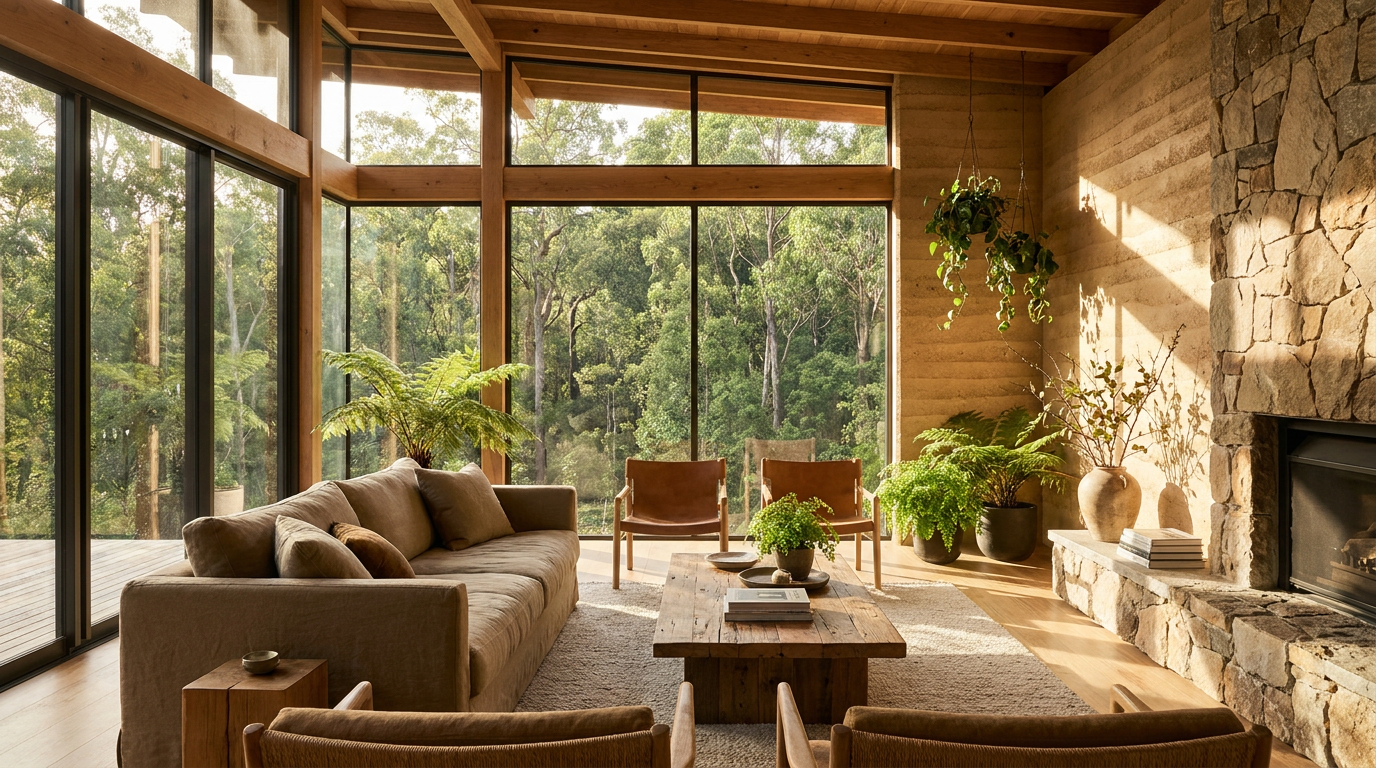
Beyond the invisible systems, the physical architecture of these homes is heavily influenced by biophilic design—the deliberate incorporation of natural elements into the built environment. This is not merely an aesthetic choice; it is an evidence-backed strategy to reduce stress and lower blood pressure.[1][6]
Architects are utilizing materials like natural stone, reclaimed wood, and non-toxic finishes to create haptic, sensory-rich environments. Expansive windows dissolve the barrier between the indoors and the surrounding landscape, maximizing natural light and reinforcing the connection to nature.[6][7]
The traditional amenity package has also been completely reimagined. The wine cellar and the home theater are making way for dedicated biohacking suites. These private wellness centers often include hyperbaric oxygen chambers, infrared saunas, cold plunge pools, and red-light therapy rooms.[3][5][7]

For the buyers investing in these features, the return on investment is measured in vitality as much as in currency. However, the financial ROI is also highly compelling. Real estate developers and agents report that wellness-oriented homes consistently command a 10% to 25% price premium over standard luxury properties.[3][6]
This premium reflects a broader understanding that wellbeing and wealth are inseparable. As Unica Capital notes, a well-designed home holds value that transcends generations. For modern investors, the question is no longer how impressive a property appears, but how deeply it enhances the daily life of its occupants.[6]
While the longevity home trend originated in the ultra-luxury segment, a shift known as "The Great Rebalance" is beginning to take hold. The principles of wellness real estate are slowly democratizing, finding their way into the middle market through master-planned communities that prioritize pedestrian access, community gardens, and non-toxic building materials.[1]

The Global Wellness Institute identifies this middle-market expansion as the sector's biggest unmet opportunity. As the global housing supply gap persists, there is massive consumer demand for healthy homes at attainable price points, proving that the desire for a health-promoting environment is universal.[1][4]
Ultimately, the rise of the longevity home represents a fundamental rethink of the relationship between humans and their habitats. By merging organic architectural principles with high-performance medical engineering, these properties offer a glimpse into a future where our built environments actively participate in our health and healing.[8]
How we got here
2014
The Wellness Architecture and Design Initiative is founded, formalizing the intersection of health and the built environment.
2019
The global wellness real estate market is valued at $225 billion, beginning a period of rapid acceleration.
2024
Consumer demand for health-focused home features surges, with 60% of buyers citing wellness as a top priority.
2025
The wellness real estate sector reaches $876 billion, vastly outpacing standard global construction growth.
2030 (Projected)
The market is forecast to hit $1.8 trillion as longevity-focused living becomes a mainstream standard.
Viewpoints in depth
Longevity Optimizers
Buyers and biohackers who view the home as an active medical instrument to extend lifespan.
For this demographic, a home is not a passive shelter but a proactive tool for biological optimization. They prioritize measurable health outcomes, integrating clinical-grade technologies like hyperbaric oxygen chambers, red-light therapy, and continuous air quality monitoring into their daily routines. Their focus is on environments that actively reduce biological age, enhance recovery, and support peak cognitive and physical performance.
Real Estate Developers & Investors
Industry professionals focused on the financial premiums and shifting market demographics.
Developers recognize that wellness is no longer a niche amenity but a core driver of asset value. With wellness-certified homes commanding a 10% to 25% price premium, the financial incentive to integrate these features is massive. They view the trend as a structural shift in global wealth storage, catering to a younger generation of millionaires and older buyers looking to age in place without compromising their lifestyle.
Wellness Architecture Researchers
Designers and scientists emphasizing evidence-based environmental psychology and sustainability.
This camp focuses on the intersection of human health and ecological responsibility. They advocate for biophilic design, non-toxic materials, and passive energy strategies, arguing that true wellness real estate must be sustainable. They also champion 'The Great Rebalance,' pushing for these health-promoting design principles to be democratized and applied to middle-market housing and master-planned communities.
What we don't know
- The long-term clinical efficacy of residential biohacking amenities compared to traditional medical interventions.
- How quickly high-end wellness technologies like hospital-grade filtration and circadian lighting will scale down to affordable housing.
- Whether the 10% to 25% price premium for wellness-certified homes will hold as these features become standard industry practice.
Key terms
- Biophilic Design
- An architectural approach that connects occupants to the natural environment through the use of natural light, organic materials, and vegetation.
- Circadian Lighting
- Smart lighting systems that adjust their color temperature and intensity throughout the day to mimic natural sunlight and support the body's internal clock.
- Biohacking
- The practice of making incremental changes to one's body, diet, and environment to optimize health, performance, and longevity.
- HEPA Filtration
- High-Efficiency Particulate Air filters capable of trapping microscopic pollutants, allergens, and pathogens to create hospital-grade indoor air quality.
Frequently asked
What is a longevity home?
A longevity home is a residence specifically designed and engineered to support the health, well-being, and lifespan of its occupants, often featuring advanced air filtration, circadian lighting, and dedicated wellness spaces.
How much more do wellness homes cost?
Real estate data indicates that homes with integrated wellness and longevity features typically command a 10% to 25% price premium over standard luxury properties.
Are these features only available to the ultra-rich?
While current cutting-edge technologies are concentrated in the luxury market, developers are increasingly applying foundational wellness principles—like non-toxic materials and biophilic design—to middle-market and master-planned communities.
Sources
Source coverage
8 outlets
3 viewpoints surfaced








[1]ForbesWellness Researchers
Five Wellness Community And Real Estate Trends For Your Next Home Search
Read on Forbes →[2]InmanReal Estate Developers
Longevity is rewriting the luxury wishlist
Read on Inman →[3]MoneywiseLongevity Optimizers
Wellness real estate is trending among the rich — and they're happy to pay a 25% premium
Read on Moneywise →[4]Global Wellness InstituteWellness Researchers
Wellness Real Estate Market Reaches $876 Billion—Forecast to Hit $1.8 Trillion by 2030
Read on Global Wellness Institute →[5]Engel & VölkersReal Estate Developers
Luxury real estate trends 2026: The Home as a sanctuary
Read on Engel & Völkers →[6]Unica CapitalReal Estate Developers
The New Luxury: Wellness as Status
Read on Unica Capital →[7]Green Living MagazineLongevity Optimizers
Ultra-wellness designed interiors embody longevity, vitality, and purpose
Read on Green Living Magazine →[8]Vera Iconica ArchitectureWellness Researchers
The Vera Iconica Longevity Home™
Read on Vera Iconica Architecture →
Every angle. Every day.
Get real estate stories with full source coverage and perspective breakdowns delivered to your inbox.