
The Science of Heat Pump Maintenance: How to Protect Your Electrified Home
As heat pumps become the standard for year-round home comfort, proactive maintenance is essential to prevent a 25% drop in energy efficiency. From monthly filter changes to annual professional tune-ups, proper care can extend a system's lifespan by nearly a decade.
By Factlen Editorial Team
- HVAC Industry Standards
- Emphasizes strict adherence to technical protocols and professional servicing to prevent mechanical failure.
- Energy & Climate Researchers
- Focuses on the macro-level impacts of system efficiency on the electrical grid and carbon emissions.
- Consumer Advocates
- Prioritizes the financial return on investment and practical upkeep for homeowners.
What's not represented
- · Real estate developers balancing upfront installation costs with long-term maintenance requirements.
- · Renters who rely on landlords to perform necessary heat pump maintenance to keep utility bills low.
Why this matters
A neglected heat pump can quietly inflate your monthly utility bills by up to 25% and shave years off the equipment's lifespan. Understanding how to maintain these continuous-duty systems ensures you actually reap the financial and environmental benefits of home electrification.
Key points
- Heat pumps operate year-round, accumulating wear and tear much faster than traditional seasonal furnaces.
- Neglected maintenance can reduce a heat pump's energy efficiency by 10% to 25%, erasing the financial benefits of electrification.
- Homeowners should replace indoor air filters every one to three months and keep the outdoor unit clear of debris.
- Professional annual servicing is required to check refrigerant levels, clean coils, and prevent expensive compressor failures.
As millions of households transition away from fossil fuels, the air-source heat pump has become the centerpiece of the modern, electrified home. Unlike traditional gas furnaces or standalone air conditioners that sit dormant for half the year, heat pumps operate continuously, providing both winter heating and summer cooling. This year-round duty cycle means that heat pumps accumulate wear and tear much faster than the seasonal HVAC systems they replace. While they are celebrated for their remarkable efficiency—often delivering up to three times more heat energy to a home than the electrical energy they consume—that peak performance is highly fragile and dependent on unrestricted airflow.[3][4]
The mechanism behind a heat pump explains why meticulous maintenance is so critical to its operation. Rather than burning a fuel source to create heat, these systems use electricity and a circulating chemical refrigerant to move ambient heat from one place to another. In the winter, they extract latent heat from the outside air and pump it indoors; in the summer, they reverse the process to expel indoor heat outside. Because the system relies entirely on heat exchange across its coils, any physical obstruction directly disrupts the thermodynamics of the transfer, forcing the mechanical components to compensate.[1][4][6]
The financial penalty for ignoring this reality is steep. According to the U.S. Department of Energy, the difference in energy consumption between a well-maintained heat pump and a severely neglected one ranges from 10% to 25%. A system choked by dust or starved of refrigerant must work exponentially harder to condition the air, quietly inflating monthly utility bills and erasing the financial benefits of home electrification. Over the course of a harsh winter or a sweltering summer, that drop in efficiency can cost homeowners hundreds of dollars in wasted electricity.[1][5]

The single most impactful maintenance task a homeowner can perform to protect this delicate heat exchange is replacing the indoor air filter every one to three months. Dirty filters are responsible for roughly one-third of all HVAC service calls, as they restrict airflow and force the blower motor to overwork. If the airflow drops too low during the cooling season, the indoor coil can literally freeze solid in a block of ice, halting the system entirely and risking severe water damage when the ice eventually thaws.[1][4]
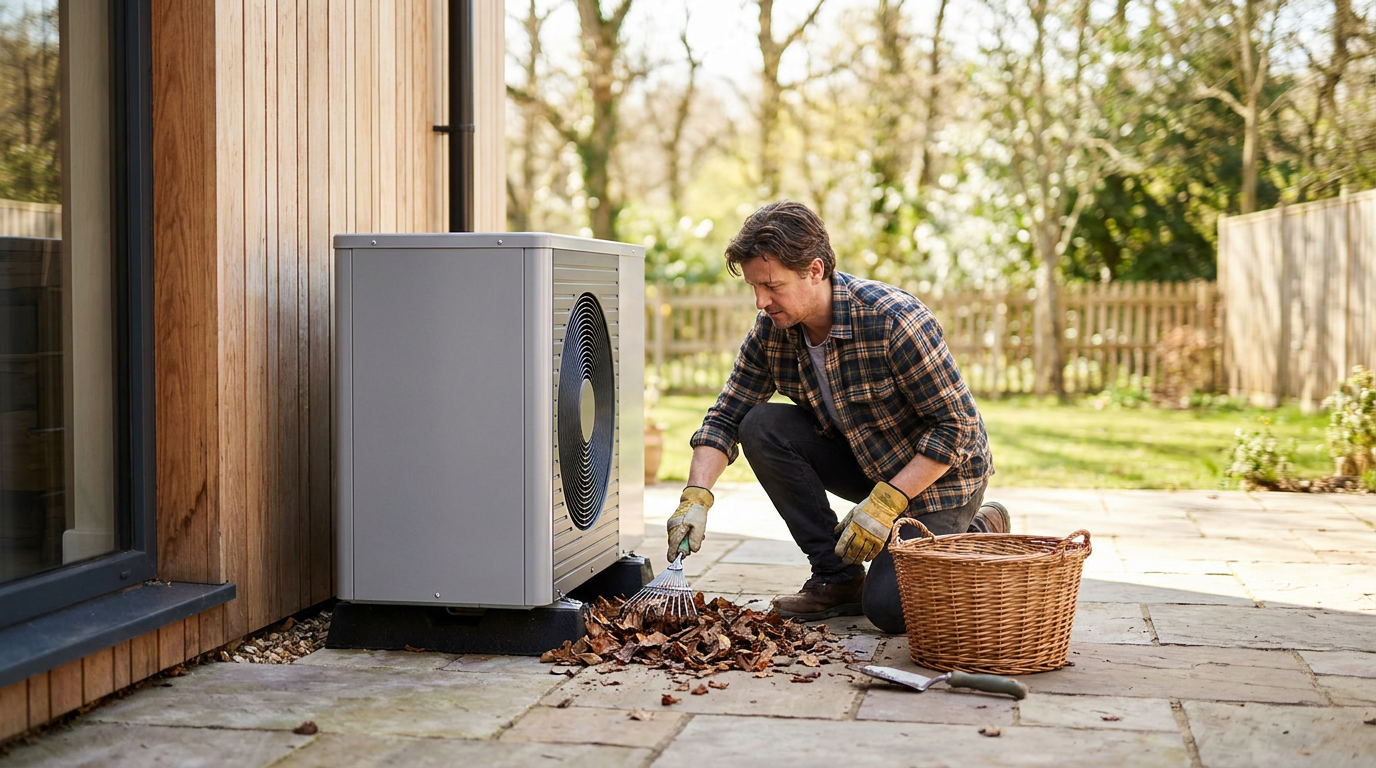
The outdoor unit, known as the condenser, requires equal vigilance from the homeowner to ensure it can effectively breathe. It must remain clear of vegetation, fallen leaves, snowdrifts, and general yard debris to ensure adequate airflow across its fins. Experts recommend maintaining at least two feet of clearance around the entire unit and periodically washing the exterior fins with a gentle hose stream to remove accumulated pollen, dirt, and grass clippings that act as an unwanted insulating blanket.[1][2]
The outdoor unit, known as the condenser, requires equal vigilance from the homeowner to ensure it can effectively breathe.
However, do-it-yourself upkeep only goes so far in protecting a complex mechanical system. The Air Conditioning Contractors of America (ACCA) Standard 4 outlines strict protocols for professional residential HVAC maintenance, recommending a comprehensive tune-up at least once—and ideally twice—a year. During a professional service visit, technicians use specialized manifold gauges to verify the exact refrigerant charge. Even a minor refrigerant leak can drastically reduce a heat pump's heating and cooling capacity, forcing the compressor to run continuously to meet the thermostat's demands.[1][2]

Because replacing a burned-out compressor can cost upwards of $2,000, catching pressure anomalies early is the primary goal of professional maintenance. Beyond refrigerant checks, technicians also inspect electrical terminals, lubricate moving motors, and clean the delicate indoor and outdoor coils with specialized chemical solutions that homeowners cannot safely access. They also verify that the thermostat is correctly communicating with the reversing valve—the critical component that switches the system between heating and cooling modes.[2][5]
The stakes of this rigorous maintenance schedule extend far beyond monthly energy bills; they dictate the total lifespan of the equipment. A properly sized and meticulously maintained heat pump can operate reliably for 15 to 20 years, providing decades of comfortable, low-cost climate control. Conversely, a neglected system operating under constant mechanical strain typically requires a full, expensive replacement after just 10 to 12 years, destroying the long-term return on investment that homeowners expect when upgrading their HVAC systems.[5]

From a broader environmental perspective, the global shift toward heat pumps is a cornerstone of residential decarbonization efforts. Consumer Reports notes that switching to an air-source heat pump reduces a household's carbon dioxide emissions by about 40% compared to a traditional gas furnace, depending on how the local electrical grid generates its power. Yet, those vital climate benefits are only realized if the millions of units being installed globally continue to operate at peak efficiency.[3]
As the technology becomes the standard in homes across the world, treating the heat pump as a continuous-duty appliance—requiring consistent, proactive care—is essential. Homeowners who embrace the rhythm of regular filter changes and annual professional tune-ups will not only protect their household budgets but also contribute to the broader global energy goals that make heat pumps so revolutionary in the first place.[3][4][5]
Viewpoints in depth
HVAC Professionals
Focus on technical standards, refrigerant management, and preventing catastrophic component failure.
For licensed technicians and organizations like the Air Conditioning Contractors of America (ACCA), heat pump maintenance is governed by strict technical protocols, such as the ANSI/ACCA 4 QM standard. Industry professionals emphasize that modern heat pumps are highly calibrated machines where a minor deviation—such as a slight drop in refrigerant pressure or a failing capacitor—can trigger a cascade of mechanical stress. Their primary concern is preventing premature compressor failure, which is often the most expensive repair on a system, by ensuring optimal airflow and precise electrical performance.
Energy & Climate Researchers
Focus on macro-level grid efficiency, decarbonization, and realized performance.
Agencies like the Department of Energy and the EPA view heat pump maintenance through the lens of national energy consumption and climate goals. Because heat pumps are central to reducing residential carbon emissions, researchers stress that the 'nameplate efficiency' of a unit is meaningless if it is poorly maintained. A nationwide fleet of neglected heat pumps drawing 25% more power than necessary places immense, avoidable strain on the electrical grid during peak winter and summer months, undermining the environmental benefits of electrification.
Consumer Advocates
Focus on return on investment, operating costs, and practical homeowner guidance.
Consumer protection groups and financial analysts focus on the total cost of ownership. Heat pumps require a significant upfront investment, often costing thousands of dollars more than a standard furnace and air conditioner pairing. Advocates stress that this premium is only recouped through long-term energy savings, making routine maintenance a strict financial necessity. They advocate for clear, accessible DIY maintenance guidelines—like simple filter changes—while warning homeowners against skipping annual professional servicing, which voids warranties and shortens the equipment's lifespan.
What we don't know
- How the increasing frequency of extreme weather events will impact the long-term wear and tear on continuous-duty heat pumps.
- Whether future smart-diagnostic technologies will eventually eliminate the need for scheduled professional maintenance by alerting homeowners to specific component degradation.
Key terms
- Air-Source Heat Pump
- An HVAC system that provides both heating and cooling by moving heat between the indoor air and the outdoor air, rather than generating heat through combustion.
- Refrigerant
- The chemical fluid circulating inside a heat pump that absorbs, transports, and releases heat as it changes between liquid and gas states.
- Condenser Coil
- The network of tubes in the outdoor unit where the refrigerant releases or absorbs heat from the outside air.
- Reversing Valve
- A crucial component in a heat pump that changes the direction of the refrigerant flow, allowing the system to switch between heating and cooling modes.
- Compressor
- The engine of the heat pump that pressurizes the refrigerant, enabling it to flow through the system and transfer heat.
Frequently asked
How often should I change my heat pump's air filter?
The Department of Energy recommends cleaning or replacing the indoor air filter every one to three months, depending on the filter's thickness and your home's dust levels.
Do heat pumps need to be serviced every year?
Yes. Because heat pumps operate year-round for both heating and cooling, industry standards recommend a professional inspection at least once, and ideally twice, per year.
Can a dirty filter really increase my energy bill?
Absolutely. Neglected maintenance, including dirty filters and clogged coils, can increase a heat pump's energy consumption by 10% to 25%.
What is the lifespan of a heat pump?
A properly installed and meticulously maintained heat pump can last 15 to 20 years, whereas a neglected system may fail in 10 to 12 years.
Sources
Source coverage
6 outlets
3 viewpoints surfaced






[1]Department of EnergyEnergy & Climate Researchers
Operating and Maintaining Your Heat Pump
Read on Department of Energy →[2]Air Conditioning Contractors of AmericaHVAC Industry Standards
ACCA/ANSI Quality Standards: Quality Maintenance of Residential HVAC Systems
Read on Air Conditioning Contractors of America →[3]Consumer ReportsConsumer Advocates
4 Reasons You Might Consider a Heat Pump (Plus a Few Caveats)
Read on Consumer Reports →[4]Energy StarEnergy & Climate Researchers
Air-Source Heat Pumps
Read on Energy Star →[5]Factlen Editorial TeamConsumer Advocates
Synthesis by Factlen editorial team
Read on Factlen Editorial Team →[6]Natural Resources CanadaEnergy & Climate Researchers
Heating and cooling with a heat pump
Read on Natural Resources Canada →


Every angle. Every day.
Get home stories with full source coverage and perspective breakdowns delivered to your inbox.