
The Rule of Four: How the Supreme Court Actually Chooses Its Cases
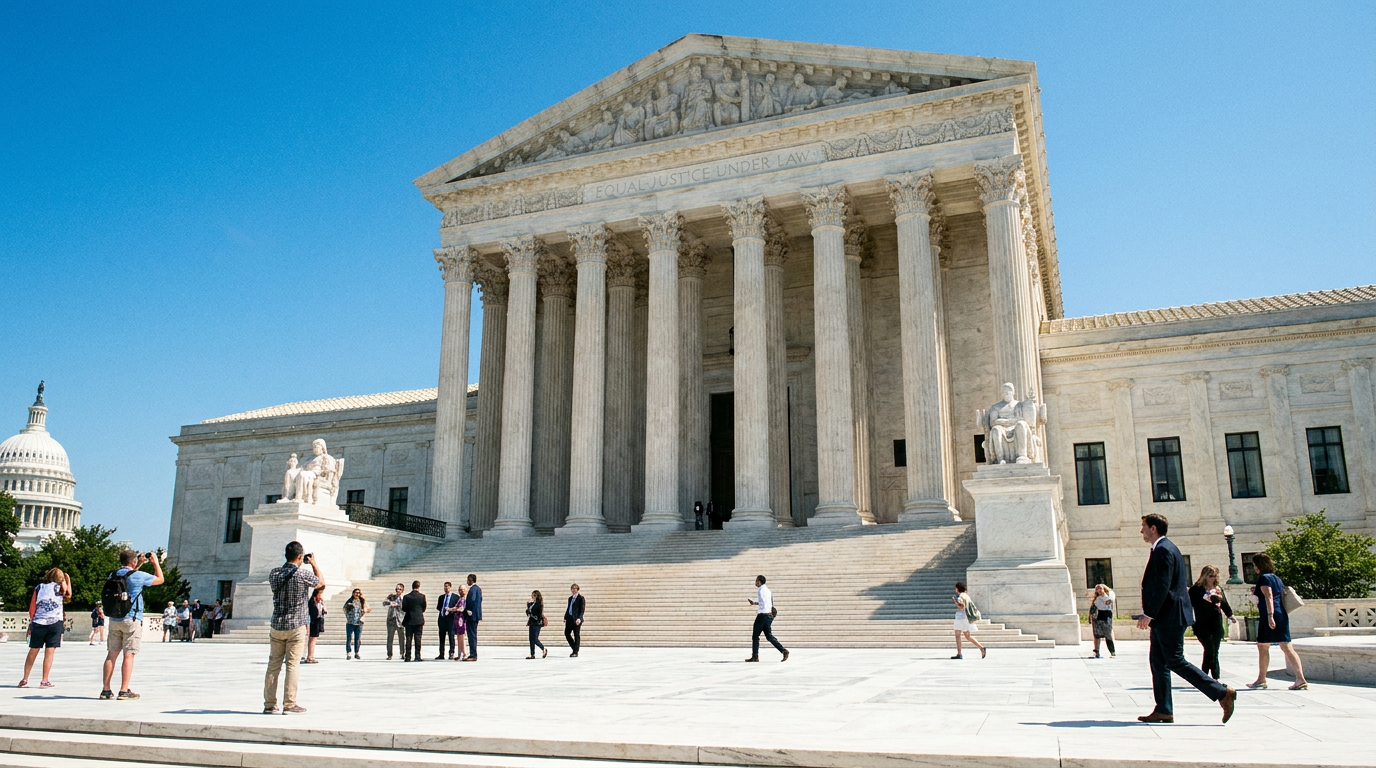
Every year, thousands of petitioners ask the U.S. Supreme Court to hear their cases, but the justices agree to review fewer than two percent. The process relies on a unique mechanism called the 'Rule of Four' and a discretionary writ of certiorari.
By Factlen Editorial Team
- Judicial Administrators
- Focus on the necessity of the discretionary docket to manage caseloads and prioritize national uniformity.
- Legal Analysts
- Focus on the mechanics, strategy, and implications of the certiorari process.
- Public Interest Synthesis
- Focus on demystifying the judicial process for the general public.
What's not represented
- · Litigants whose petitions are denied
- · Lower court judges whose decisions are left unreviewed
Why this matters
Understanding how the Supreme Court selects its docket demystifies the judicial system and explains why some major national disputes are resolved by the highest court while others are left to lower courts. It reveals that the Court's primary role is not to correct individual errors, but to ensure federal law is applied uniformly across the country.
Key points
- The Supreme Court receives up to 8,000 petitions annually but grants review to fewer than two percent.
- The Court uses a discretionary mechanism called a writ of certiorari to select its cases.
- Under the unwritten 'Rule of Four,' it takes only four justices to grant a petition for review.
- The most common reason for granting certiorari is to resolve a 'circuit split' between lower courts.
- A denial of certiorari leaves the lower court's ruling in place but does not establish national precedent.
Every year, the United States Supreme Court receives between 7,000 and 8,000 petitions from individuals, corporations, and governments asking the justices to review their legal disputes. Yet, when the Court’s term concludes each summer, it has typically issued full opinions in only 60 to 70 of those cases. This acceptance rate of less than two percent highlights a fundamental reality of the modern American judicial system: the Supreme Court is not a court of general error correction. Instead, the vast majority of the justices' time and institutional energy is spent not on deciding cases, but on deciding which cases to decide. Understanding this selection mechanism is essential for comprehending how federal law is shaped and why certain high-profile disputes never receive a hearing at the nation's highest tribunal.[1][6]
The primary vehicle for reaching the Supreme Court is the "writ of certiorari." Derived from a Latin phrase meaning "to be more fully informed," a writ of certiorari is a formal legal order instructing a lower court to deliver its record in a case so that a higher court may review it. For a losing party in a federal appeals court or a state supreme court, filing a petition for certiorari is often the final available legal maneuver. However, as outlined in the Supreme Court's own guidelines, review on a writ of certiorari is not a matter of right, but of judicial discretion. The Court is under no obligation to hear any particular appeal, and it rarely provides an explanation when it chooses to deny a petition.[1][3]
This nearly absolute discretion is a relatively modern feature of the Court. For the first century of its existence, the Supreme Court was required to hear almost every appeal that met certain jurisdictional requirements, leading to massive backlogs. Congress fundamentally altered this dynamic with the Judiciary Act of 1925, often called the "Certiorari Act." Championed by Chief Justice William Howard Taft, the legislation vastly expanded the Court's discretionary jurisdiction. By shifting the Court from a mandatory appellate body to a discretionary one, Congress empowered the justices to focus their attention exclusively on cases of national significance and issues where federal law required uniform interpretation.[5][6]

To manage the overwhelming flood of incoming petitions, the Court relies heavily on its law clerks and a collaborative system known as the "cert pool." Rather than having each of the nine justices and their respective clerks read all 8,000 petitions, participating justices pool their clerks together. A single clerk is randomly assigned to read a specific petition and draft a confidential memorandum summarizing the facts, the lower court's decision, and the legal arguments. The clerk then provides a recommendation on whether the Court should grant or deny the petition. This memo is circulated among the justices in the pool, streamlining the initial review process and allowing the Court to efficiently sift through thousands of filings.[2][4]
The clerk then provides a recommendation on whether the Court should grant or deny the petition.
When the justices meet in their private conferences to discuss the most promising petitions, they employ a unique and unwritten institutional practice known as the "Rule of Four." Unlike a final decision on the merits of a case, which requires a majority of five votes, it takes only four justices to grant a writ of certiorari. This super-minority rule ensures that a substantial block of the Court can bring a case to the docket even if a majority does not initially believe the case warrants review. The Rule of Four serves as a structural safeguard, preventing a narrow majority from completely controlling the Court's agenda and ensuring that minority viewpoints have a mechanism to force debate on pressing legal questions.[5][6]

What exactly makes a case "cert-worthy"? The Court's Rule 10 provides the primary roadmap, stating that certiorari will be granted only for "compelling reasons." The most common and compelling reason is the existence of a "circuit split." Because the federal judicial system is divided into 13 regional circuit courts of appeals, it is not uncommon for different circuits to interpret the same federal law in contradictory ways. For example, the Ninth Circuit in California might rule that a specific police search violates the Fourth Amendment, while the Fifth Circuit in Texas might rule that the exact same search is perfectly constitutional. The Supreme Court views resolving these geographic disparities as its primary administrative duty, ensuring that federal law applies uniformly across the entire country.[1][2]
Beyond circuit splits, the Court also looks for cases that present novel questions of constitutional law or issues of profound national importance. A petition involving a major separation-of-powers dispute between the President and Congress, a landmark civil rights question, or a challenge to a sweeping new federal regulation is highly likely to catch the justices' attention. Additionally, the Court may intervene if a lower court has so far departed from the accepted and usual course of judicial proceedings that it calls for an exercise of the Supreme Court's supervisory power. However, simply arguing that a lower court made a factual error or misapplied a settled rule of law is almost never sufficient to secure a grant of certiorari.[1][4]
When the Court ultimately denies a petition for certiorari—as it does in 98 percent of cases—the legal effect is straightforward but often misunderstood. A denial of cert does not mean that the Supreme Court agrees with the lower court's decision, nor does it establish any binding national precedent. It simply means that the petition did not garner the necessary four votes for review. The lower court's ruling remains the final word for the parties involved, and the legal precedent stands only within that specific lower court's geographic jurisdiction. This dynamic often frustrates litigants, but it is a necessary feature of a system designed to prioritize the development of federal law over the correction of individual injustices.[2][6]

For the rare cases that do survive the gauntlet and receive a grant of certiorari, the real work begins. The case is officially placed on the Supreme Court's docket, and a rigorous briefing schedule is established. The petitioner and the respondent file lengthy written arguments detailing their legal positions. Crucially, these cases also attract numerous "amicus curiae" or "friend of the court" briefs from outside organizations, legal scholars, and government entities eager to influence the Court's decision. After the briefing is complete, the justices hold oral arguments, where attorneys face intense questioning. Months later, the Court issues its final, binding written opinion—the culmination of a selective process that began with a single petition among thousands.[2][4]
How we got here
1789
The Judiciary Act of 1789 establishes the federal court system, initially giving the Supreme Court limited control over its docket.
1891
The Evarts Act creates the regional circuit courts of appeals and introduces the writ of certiorari, granting the Court its first measure of discretionary review.
1925
Congress passes the 'Certiorari Act,' fundamentally shifting the Supreme Court to a discretionary docket and allowing it to select cases of national importance.
1972
Justice Lewis Powell spearheads the creation of the 'cert pool' to help the Court manage a rapidly growing volume of petitions.
Viewpoints in depth
The Institutional View
Focuses on the necessity of the discretionary docket to manage caseloads and prioritize national uniformity.
From an administrative perspective, the Supreme Court's discretionary docket is essential for institutional survival. With over 7,000 petitions filed annually, it is mathematically impossible for nine justices to provide full appellate review for every case. Administrators and institutional defenders argue that the Court's primary constitutional duty is not to correct every individual error made by a lower court judge, but to ensure that federal law and the Constitution are interpreted consistently across the nation. By aggressively filtering cases, the Court preserves its resources for disputes that have broad, systemic implications.
The Litigant's Perspective
Highlights the frustration of the 98 percent denial rate and the limits of appellate review.
For individuals and corporations seeking justice, the certiorari process can be deeply frustrating. A party may spend years and millions of dollars litigating a case, only to have their final appeal denied without explanation. Critics from this perspective argue that the extremely low acceptance rate leaves many lower court errors uncorrected, effectively denying litigants a final hearing on the merits. Because a denial of certiorari provides no reasoning, losing parties are often left in the dark about why the highest court in the land declined to intervene in their dispute.
Strategic Legal Scholars
Examines how justices use the Rule of Four strategically during the selection process.
Legal scholars who study judicial behavior emphasize that the certiorari process is highly strategic. Because it takes four votes to grant review but five votes to win on the merits, justices must carefully calculate the likely outcome of a case before voting to hear it. Scholars point to the phenomenon of 'defensive denials,' where a justice might vote against granting certiorari—even if they believe the lower court was wrong—because they fear that a majority of their colleagues will vote the other way, thereby establishing a binding national precedent they oppose. This strategic maneuvering means the docket is shaped as much by judicial politics as by pure legal merit.
What we don't know
- Because the justices' conferences are strictly confidential, the exact reasoning behind why specific petitions are denied is rarely made public.
- It is often unclear whether a denial of certiorari is due to a lack of legal merit, or if justices strategically voted against review to avoid an unfavorable ruling on the merits.
Key terms
- Writ of Certiorari
- A formal legal order from an appellate court to a lower court requesting the record of a case for review.
- Rule of Four
- The Supreme Court's practice of granting a petition for review if at least four of the nine justices vote to do so.
- Cert Pool
- A labor-saving system where participating justices pool their law clerks to divide the work of reading and summarizing incoming petitions.
- Amicus Curiae
- Latin for 'friend of the court'; individuals or organizations not directly involved in a case who file briefs to provide expertise or advocate for a specific outcome.
- Circuit Split
- A situation where different federal courts of appeals issue contradictory rulings on the same legal issue.
Frequently asked
What happens if the Supreme Court denies certiorari?
The ruling of the lower court stands as the final decision for the parties involved. However, a denial does not create a binding national precedent or imply that the Supreme Court agrees with the lower court's reasoning.
Can a case go directly to the Supreme Court without lower court review?
Yes, but it is extremely rare. The Court has 'original jurisdiction' over a very narrow category of cases, most commonly disputes between two or more states.
Why does the Court need only four votes to hear a case instead of five?
The 'Rule of Four' is an unwritten institutional practice designed to ensure that a substantial minority of the Court can bring important legal questions to the docket, preventing a narrow majority from blocking debate.
What is a circuit split?
A circuit split occurs when two or more federal regional appeals courts interpret the same federal law differently. Resolving these splits is the most common reason the Supreme Court grants certiorari.
Sources
Source coverage
6 outlets
3 viewpoints surfaced





[1]Supreme Court of the United StatesJudicial Administrators
Rules of the Supreme Court of the United States
Read on Supreme Court of the United States →[2]United States CourtsJudicial Administrators
Supreme Court Procedures
Read on United States Courts →[3]Legal Information InstituteLegal Analysts
Certiorari
Read on Legal Information Institute →[4]SCOTUSblogLegal Analysts
Supreme Court Procedure
Read on SCOTUSblog →[5]Federal Judicial CenterJudicial Administrators
The Supreme Court's 'Rule of Four'
Read on Federal Judicial Center →[6]Factlen Editorial TeamPublic Interest Synthesis
Synthesis by Factlen editorial team
Read on Factlen Editorial Team →
Every angle. Every day.
Get law justice stories with full source coverage and perspective breakdowns delivered to your inbox.