
5,000-Year-Old Timber 'Prototype' for Stonehenge Solstice Alignment Discovered
Archaeologists have unearthed a ceremonial timber monument near Stonehenge that aligns perfectly with the solstices, predating the famous stone circle by 500 years.
By Factlen Editorial Team
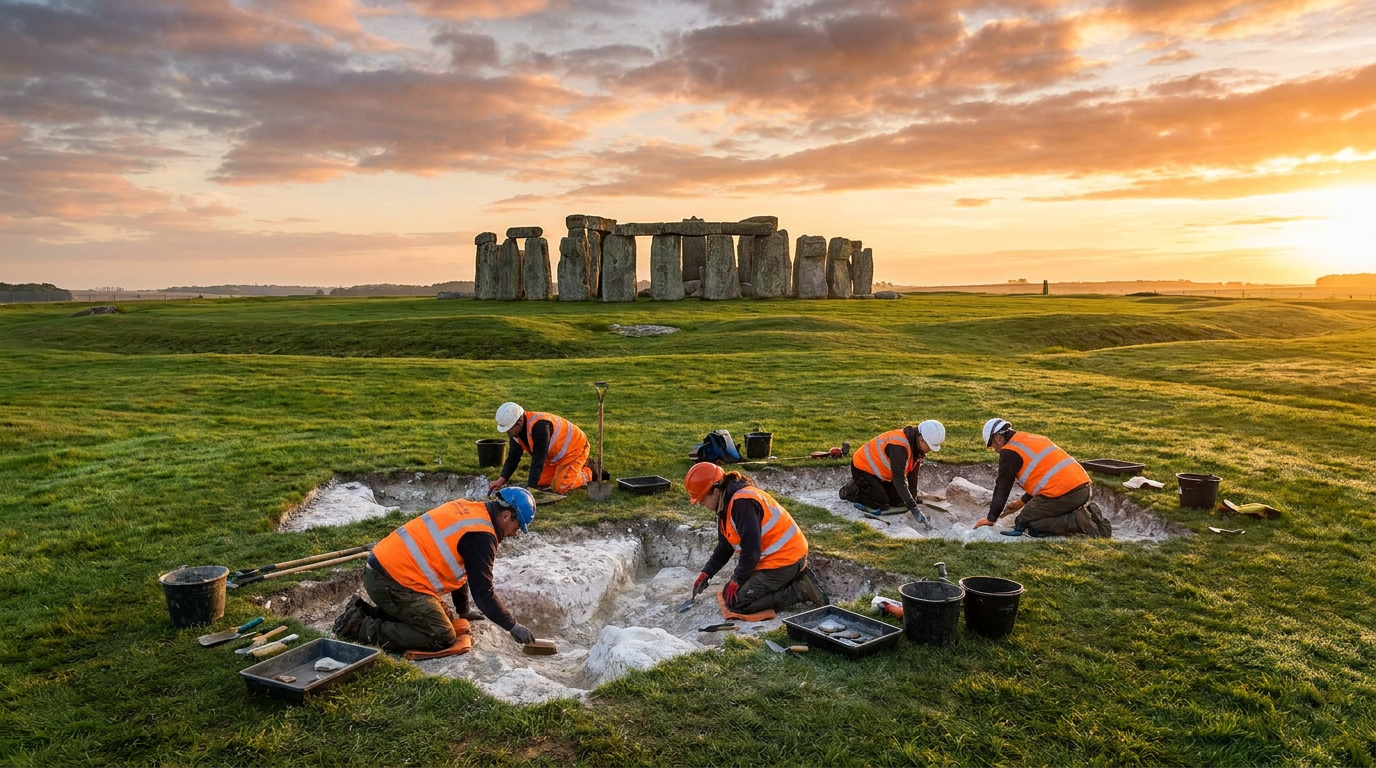
- Field Archaeologists
- Focus on the physical evidence of the pits, chalk packing, and artifacts like the flint knife.
- Skyscape Archaeologists
- Focus on the celestial alignments, digital horizon modeling, and astronomical precision.
- Heritage Managers
- Focus on the preservation and historical narrative of the wider Wiltshire landscape beyond the main stone circle.
What's not represented
- · Modern Druid and Pagan communities who actively use the Stonehenge landscape for contemporary solstice worship.
Why this matters
This discovery fundamentally rewrites our understanding of prehistoric Britain, proving that sophisticated astronomical observation and communal solar worship were deeply embedded in the culture centuries before the first stones were ever raised at Stonehenge.
Key points
- Archaeologists discovered a 5,000-year-old ceremonial site in Bulford, three miles from Stonehenge.
- The site features two massive postholes set 120 meters apart that perfectly align with the solstices.
- Radiocarbon dating places the timber monument at 2950 BC, 500 years before Stonehenge's main circle.
- Digital skyscape modeling confirmed the alignment is accurate to within one degree of the ancient sunrise.
- Excavators found a rare sun-shaped flint knife and extensive feasting debris at the site.
For decades, the towering sarsen stones of Stonehenge have stood as the ultimate symbol of prehistoric solar worship. But a remarkable discovery just three miles away in the village of Bulford is rewriting the timeline of ancient Britain. Archaeologists have identified a 5,000-year-old ceremonial site that perfectly aligns with the summer and winter solstices. This timber monument, which predates the famous stone circle by half a millennium, suggests that Stonehenge was not the birthplace of these celestial rituals, but rather the monumental culmination of a much older local tradition.[1][2]
The core claim emerging from the Wiltshire landscape is that Neolithic communities were engineering precise astronomical observation posts long before they had the capacity or desire to move massive megaliths. The Bulford site, radiocarbon dated to approximately 2950 BC, aligns with the earliest rudimentary earthworks at Stonehenge, but predates the iconic trilithon stones by roughly 500 years. Researchers argue this site served as an early "prototype" for the solar alignments that would later define the region.[2][5][6]
The physical evidence for this claim stems from a massive excavation carried out between 2015 and 2017. Commissioned by the Ministry of Defence ahead of a housing project for military personnel returning from Germany, Wessex Archaeology excavated a 13-hectare site near Bulford. Beneath the soil, they uncovered a complex of 48 pits. Unlike standard refuse pits, these contained concentrated deposits of pottery, animal bones, worked flint, and charcoal—the unmistakable archaeological signature of large-scale, short-term ceremonial feasting.[3][4][7]
The architectural centerpiece of the site, however, was not made of stone. Excavators identified two exceptionally large, distinct post pits filled with chalk rubble rather than domestic debris. Based on the one-meter depth of these holes, archaeologists calculate they originally supported two massive wooden poles, each standing three to four meters high. Crucially, these two posts were set exactly 120 meters apart across the landscape.[2][4][5]

The mechanism of the alignment was initially discovered through traditional, low-tech archaeological deduction. Phil Harding, the lead archaeologist on the dig, noticed an anomaly in the site plan. By drawing a simple pencil line between the two massive postholes, he realized the axis sat roughly 50 degrees off direct north. This specific angle corresponds almost perfectly to the trajectory of the midsummer sunrise and the midwinter sunset in the British Isles.[2][4]
To test this hypothesis against the rigorous standards of modern archaeoastronomy, the team brought in Dr. Fabio Silva, a specialist in skyscape archaeology. Because the Earth's tilt and orbit shift slightly over millennia, the position of the sun in the sky today is not exactly where it was in 2950 BC. Silva utilized specialized software to digitally reconstruct the ancient horizon, topography, and celestial mechanics of the Neolithic era.[3][4][7]
To test this hypothesis against the rigorous standards of modern archaeoastronomy, the team brought in Dr.
The digital modeling provided striking confirmation of the initial claim. Silva's reconstruction demonstrated that the two wooden poles would have aligned with the solstices to an accuracy of within one degree. For an observer standing at the designated viewing station, the poles would have acted like a "gunsight," framing the exact point where the sun breached the horizon on the longest day of the year, and where it sank on the shortest.[2][4][5]
Supporting the astronomical data is a piece of highly symbolic material culture. Within a smaller pit situated along the alignment—believed to be the exact viewing station for the ritual—archaeologists discovered an extremely rare, disc-shaped flint knife. Researchers hypothesize that this unique artifact was deliberately shaped and deposited as a physical representation of the sun disc, anchoring the celestial event to the earth.[2][3][6]

The presence of extensive feasting debris surrounding the alignment provides crucial context about how the site was used. The volume of animal bones and pottery indicates that these solar events were not solitary observations made by a single priest or astronomer. Instead, they were major communal gatherings. Neolithic Britons likely traveled significant distances to congregate at Bulford, using the solstice as a reliable calendar marker for seasonal festivals.[4][5]
Despite the strength of the alignment data, archaeologists maintain transparent uncertainty regarding the exact nature of the ceremonies. Because the wooden posts rotted away millennia ago, we cannot know if they were carved, painted, or decorated. Furthermore, while the chalk rubble confirms the posts were deliberately erected and supported, the specific rituals performed around them—whether they involved chants, sacrifices, or silent observation—remain entirely lost to time.[1][2][5]
There is also the inherent challenge of proving intentionality in prehistoric alignments. Skeptics in archaeoastronomy often caution that if you draw enough lines between random pits, some will inevitably point to celestial bodies. However, the Bulford site counters this skepticism through the sheer size of the two specific postholes, their distinct chalk packing, and the 1-degree precision of the alignment confirmed by the skyscape modeling. The presence of the sun-disc knife in the viewing pit further elevates the alignment from coincidence to deliberate design.[2][4][7]
This discovery fundamentally shifts the historical narrative of the Stonehenge landscape. For years, the assumption was that the architectural genius of Stonehenge arrived somewhat abruptly, culminating in the massive sarsen stones. The Bulford prototype proves that the local population had already spent centuries observing the sky, calculating angles, and building monumental—albeit temporary—structures to honor the sun.[3][4][6]

The transition from wood to stone represents a profound shift in Neolithic psychology. The Bulford monument, built of timber, was inherently temporary, destined to rot and return to the earth within a few generations. When their descendants decided to build Stonehenge 500 years later using sarsen boulders weighing up to 25 tons, they were translating a long-standing, ephemeral wooden tradition into a permanent claim on the landscape.[2][4][5]
As modern crowds continue to gather at Stonehenge every June to watch the midsummer sun rise over the Heel Stone, the Bulford discovery adds a poignant layer of depth to the tradition. It reveals that the human desire to track the cosmos, to find order in the changing seasons, and to gather in celebration of the light is a continuous thread stretching back at least 5,000 years into the chalky soil of Wiltshire.[1][3][4]
How we got here
2950 BC
Neolithic communities construct the timber monument and ceremonial pits at Bulford, aligning them with the solstices.
2500 BC
Roughly 500 years later, the iconic sarsen stones are erected at Stonehenge, mirroring the same solar alignments.
2015–2017
Wessex Archaeology excavates the Bulford site ahead of a Ministry of Defence housing project, uncovering 48 pits.
June 2026
Archaeologists publicly announce the confirmation of the site's solstice alignment ahead of the midsummer celebrations.
Viewpoints in depth
Field Archaeologists
Focus on the physical stratigraphy, material culture, and excavation data.
For the excavators on the ground, the significance of the Bulford site lies in the tangible material culture left behind. The 48 pits provide a wealth of data about Neolithic life, showing that these solar alignments were not purely scientific endeavors, but deeply social ones. The sheer volume of animal bones and pottery indicates massive feasts, suggesting that the solstice was a time of communal gathering, trade, and celebration. The discovery of the chalk-packed postholes grounds the astronomical theories in hard, physical evidence of monumental construction.
Skyscape Archaeologists
Focus on celestial mechanics, digital horizon modeling, and astronomical precision.
Archaeoastronomers view the site as a masterpiece of prehistoric engineering. By using digital modeling to wind back the celestial clock 5,000 years, they can prove that the 120-meter alignment was not a coincidence. The 1-degree accuracy required a sophisticated understanding of the solar cycle and the ability to track the sun's movement across the horizon over many years before committing to digging the massive post pits. For this camp, the site proves that complex astronomical observation in Britain predates the megalithic era.
Prehistoric Historians
Focus on the cultural evolution and the shifting narrative of the Stonehenge landscape.
Historians view the Bulford discovery as the missing link in the evolution of British monument building. It challenges the older narrative that Stonehenge was an isolated stroke of architectural genius. Instead, it shows a clear cultural progression: early farming communities first marked the cosmos with temporary wooden structures, establishing the sacred geography of the Wiltshire landscape. Centuries later, their descendants translated those exact same solar alignments into permanent stone, immortalizing a tradition that had already existed for generations.
What we don't know
- Whether the massive wooden posts were carved, painted, or decorated, as the timber rotted away millennia ago.
- The specific nature of the rituals, chants, or ceremonies performed at the site during the solstice.
- Why the Neolithic people eventually abandoned timber monuments in favor of the massive stone circles of Stonehenge.
Key terms
- Solstice alignment
- The deliberate positioning of a structure or monument to line up with the rising or setting sun on the longest or shortest days of the year.
- Skyscape archaeology
- A specialized field that uses digital modeling to reconstruct ancient skies and horizons to understand how past cultures interacted with the cosmos.
- Radiocarbon dating
- A scientific method used to determine the age of organic materials by measuring the decay of the radioactive isotope carbon-14.
- Sarsen stones
- The massive, hard sandstone boulders used to construct the primary trilithon circle at Stonehenge, weighing up to 25 tons each.
- Neolithic period
- The final stage of cultural evolution or technological development among prehistoric humans, characterized by farming and monument building.
Frequently asked
Is the Bulford site older than Stonehenge?
Yes and no. It is contemporary with the very earliest, rudimentary earthworks at Stonehenge (around 2950 BC), but it predates the famous large stone circle by about 500 years.
How do we know the wooden poles aligned with the sun?
Archaeologists mapped the exact positions of the postholes and used digital skyscape modeling to reconstruct the 2950 BC horizon, proving they aligned with the solstice sunrise to within one degree.
Can the public visit the Bulford timber monument?
No. The site was excavated ahead of a Ministry of Defence housing project, and the original pits are no longer visible or accessible to the public.
What happened to the wooden posts?
Because wood is organic, the massive poles rotted away thousands of years ago. Archaeologists only know they existed because of the deep, chalk-packed postholes left behind in the soil.
Sources
Source coverage
7 outlets
3 viewpoints surfaced







[1]The New York TimesHeritage Managers
In Ancient Pits Near Stonehenge, Scientists See Hints of Solstice Ritual
Read on The New York Times →[2]The GuardianField Archaeologists
Wessex Archaeology suspect they have uncovered a prototype for world-famous Stonehenge site in Wiltshire
Read on The Guardian →[3]ForbesSkyscape Archaeologists
A 5,000-Year-Old Discovery Near Stonehenge Reveals Solstice Prototype
Read on Forbes →[4]Heritage DailySkyscape Archaeologists
Ancient timber monument reveals earliest known solstice alignment in Stonehenge landscape
Read on Heritage Daily →[5]The IndependentField Archaeologists
Remarkable discovery sheds new light on the history of prehistoric religion
Read on The Independent →[6]Greek ReporterField Archaeologists
Archaeologists Discover 5,000-Year-Old Solstice Site Near Stonehenge
Read on Greek Reporter →[7]BBC NewsHeritage Managers
Stonehenge 'prototype' discovered 3 miles away
Read on BBC News →



Every angle. Every day.
Get science stories with full source coverage and perspective breakdowns delivered to your inbox.