
How the 'Library of Things' Movement is Rewiring Community Economics
Community lending hubs are allowing neighborhoods to borrow tools, appliances, and camping gear instead of buying them, saving millions of dollars and drastically reducing waste.
By Factlen Editorial Team
- Circular Economy Advocates
- Focus on reducing consumption, lowering greenhouse gas emissions, and diverting waste from landfills.
- Community Organizers
- Emphasize social cohesion, skill-sharing, mutual aid, and building local resilience through shared spaces.
- Economic Equity Proponents
- Highlight cost savings, democratized access to resources, and bypassing traditional retail for low-income households.
What's not represented
- · Traditional hardware retailers and manufacturers whose sales models rely on individual ownership
- · Gig-economy rental platforms that view community sharing as competition to their peer-to-peer rental apps
Why this matters
By shifting from individual ownership to community borrowing, households can save thousands of dollars on infrequently used items while significantly lowering their carbon footprint and building local neighborhood connections.
Key points
- The Library of Things movement allows communities to borrow infrequently used items like tools and appliances instead of buying them.
- Sharing resources significantly reduces greenhouse gas emissions and diverts durable goods from local landfills.
- Tool libraries save members money, democratizing access to expensive equipment for low-income households.
- These spaces serve as vital community hubs, offering repair workshops and fostering intergenerational skill-sharing.
- The movement has grown to roughly 2,000 formal locations globally, with many now partnering with municipal governments.
It is a familiar and frustrating scenario for almost anyone who has ever attempted a weekend home improvement project. You need a specialized piece of equipment—perhaps a heavy-duty power drill to hang a single floating shelf, or a commercial-grade carpet cleaner to handle an unexpected spill. You drive to a big-box hardware store, spend over a hundred dollars on a brand-new machine, use it for exactly twenty minutes, and then relegate it to the back of a hallway closet. There, it will gather dust for the next decade, taking up valuable space until it is eventually thrown away. This linear model of consumption—extracting raw materials, manufacturing a complex tool, shipping it across the globe, and selling it for a single brief use—is increasingly recognized as expensive, inefficient, and environmentally taxing.
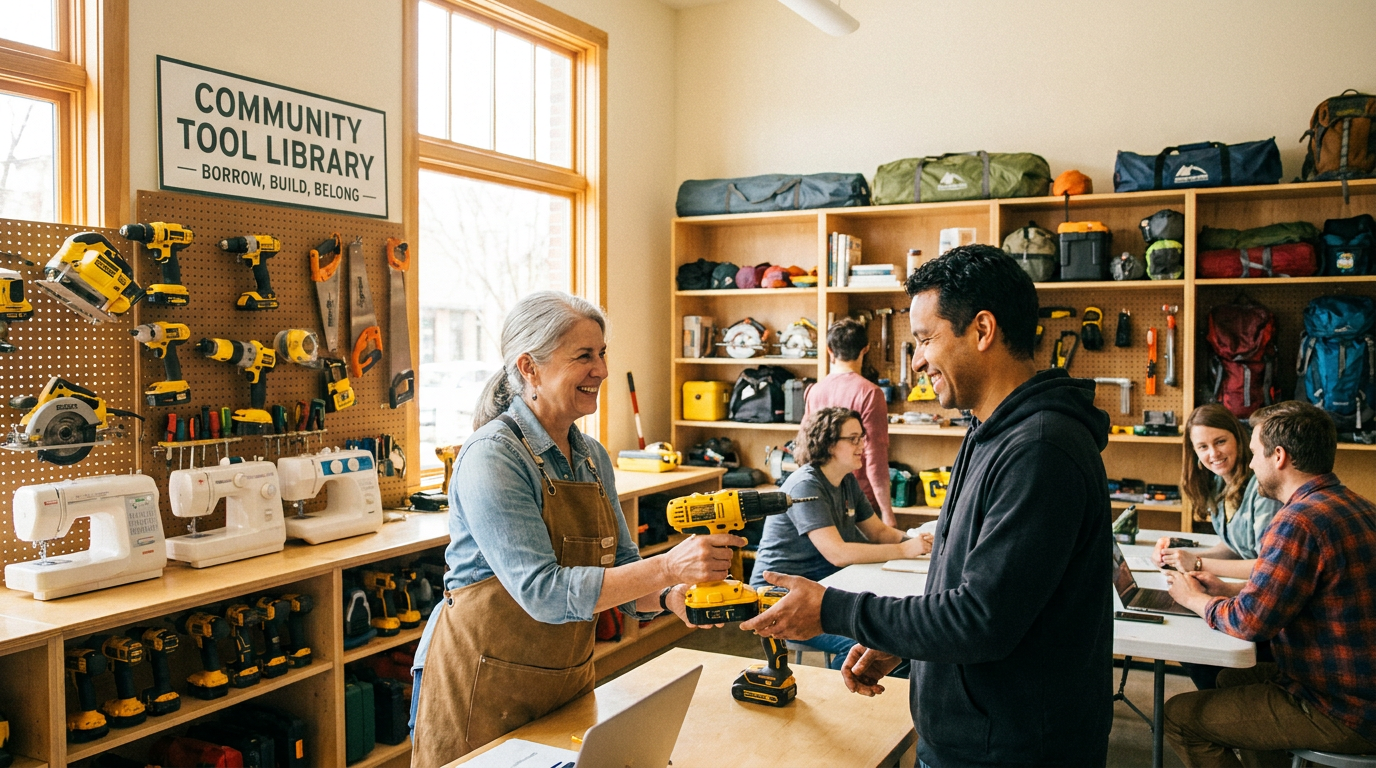
Enter the rapidly expanding 'Library of Things' movement. Instead of shelves lined exclusively with paperback novels and reference books, these community hubs lend out physical objects that people need only occasionally. The inventories of these specialized libraries are as diverse as the neighborhoods they serve, encompassing everything from camping tents and sleeping bags to high-end sewing machines, pressure washers, and even novelty items like ice cream makers. The underlying philosophy is simple but transformative: access is more important than ownership. By pooling resources, a single neighborhood can collectively enjoy the benefits of thousands of dollars worth of equipment without the financial burden or the clutter of individual ownership.
While the concept might sound like a modern innovation born of the internet age, it actually has deep historical roots. During the Great Depression, toy libraries emerged across the United States to support struggling families, and the first documented tool library opened in Grosse Pointe Farms, Michigan, in 1943 to offer vocational training to young people. However, the modern iteration of the movement has exploded over the last decade, driven by a growing awareness of climate change and the rising cost of living. Today, researchers estimate there are roughly 2,000 formal Libraries of Things operating worldwide, existing alongside countless informal neighborhood sharing networks and mutual aid groups.[1][7]
The day-to-day mechanics of a Library of Things are remarkably straightforward, intentionally mirroring the familiar operations of traditional public libraries. Community members can browse an inventory catalog—often hosted online with real-time availability tracking—or walk into a physical storefront to see what is in stock. After selecting an item, they check it out for a set period, usually ranging from a few days to two weeks, and return it when their project is finished. Volunteers or staff members then inspect the item, perform any necessary basic maintenance, and place it back on the shelf for the next borrower.

Behind the scenes, funding and membership models vary significantly depending on the organization's structure. Many operate as fiercely independent non-profits, supported by local grants, community fundraising, and sliding-scale annual membership fees that ensure access regardless of income. Others are being integrated directly into existing municipal library systems, funded by taxpayer dollars as an extension of civic services. To handle the complex logistics of tracking hundreds of physical objects, specialized software platforms like myTurn have emerged, allowing these organizations to seamlessly manage reservations, track maintenance schedules, and automate return reminders without overwhelming their volunteer staff.[4][6][10]
For advocates focused on economic equity, the primary draw of the movement is the immediate and tangible cost savings it delivers to households. Tool libraries actively democratize access to resources, allowing individuals to maintain their homes, repair their vehicles, or pursue new hobbies without facing prohibitive upfront costs. In neighborhoods suffering from disinvestment, a community tool library can be the catalyst that allows residents to renovate aging properties and build local wealth, bypassing the traditional retail monopolies that treat people merely as consumers.[5]
This model represents what organizers call a 'real sharing economy.' Unlike commercial peer-to-peer rental platforms that extract profit from gig workers and users, these libraries are neighborhood-focused, not-for-profit networks designed to keep wealth circulating within the community. The financial impact at scale is staggering. In the United Kingdom, the Library of Things network estimates that its platform has saved its members over £6 million simply by substituting borrowing for buying. That is disposable income that remains in the pockets of residents, available to be spent at local businesses or saved for emergencies.[5][8]
Beyond the immediate relief to household budgets, the environmental impact of the movement is profound and increasingly urgent in the face of a changing climate. The traditional retail model is incredibly resource-intensive and ecologically damaging. Extracting raw metals and plastics from the earth, manufacturing a complex product in a distant factory, packaging it in single-use materials, and shipping it across oceans accounts for a massive share of global greenhouse gas emissions. When that newly manufactured product is used only a handful of times before being discarded into a landfill, the ecological math becomes entirely unsustainable for the planet.[7][8]
Beyond the immediate relief to household budgets, the environmental impact of the movement is profound and increasingly urgent in the face of a changing climate.
Libraries of Things directly disrupt this destructive linear cycle by maximizing the lifespan and utility of every single manufactured item in their carefully curated inventory. A high-quality, commercial-grade power drill in a community tool library, for instance, might be borrowed and used over 100 times during its operational life by dozens of different families. That single shared tool effectively replaces the manufacturing, packaging, and transportation footprint of 99 individual retail purchases, proving unequivocally that collective stewardship is vastly more efficient than individual consumption.[2]
The emissions savings from this model are not just theoretical; they are highly measurable. Researchers at Finland's LAB University of Applied Sciences closely tracked a pilot library program in the municipality of Asikkala to quantify its climate impact. They found that just 107 loans in the program's first year saved an estimated 5,900 kilograms of carbon dioxide equivalent. To put that in perspective, that single small library eliminated emissions equal to roughly half the annual carbon footprint of an average Finnish citizen, simply by sharing a few dozen household items.[6]

Waste diversion is another critical environmental metric where these community libraries consistently excel. Because lending hubs prioritize durable, repairable, and high-quality goods over the cheap, disposable alternatives often found at big-box retailers, they keep massive amounts of plastic and metal out of local municipal landfills. Furthermore, when an item finally does break after repeated use, tool libraries typically have the in-house expertise and spare parts to repair it rather than throwing it away, ensuring that every single component is utilized to its absolute maximum potential before recycling.[4]
Yet, for all the measurable economic and environmental benefits, the most transformative aspect of the Library of Things movement may ultimately be its profound social impact. In an era characterized by increasing digital isolation, loneliness, and the steady decline of accessible civic spaces, these libraries serve as vital 'third places.' They provide neutral, welcoming environments outside of the home and the workplace where neighbors from diverse backgrounds can interact face-to-face, collaborate on shared goals, and build the kind of interpersonal trust that underpins healthy, resilient communities.[3]
Recognizing this social potential, many libraries have expanded their physical lending operations into robust educational programming. They frequently host 'fix-it nights' and repair cafes where skilled volunteers help residents mend torn clothing, rewire broken lamps, or sharpen dull garden shears. These events are incredibly effective at reducing waste—the Tacoma Tool Library in Washington diverted 1,741 pounds of waste in a single year through its repair programs—but they also serve as powerful community-building exercises that empower people to take control of their material lives.[4]

These community hubs also frequently incorporate dedicated makerspaces—communal workshops equipped with heavy machinery, 3D printers, and large worktables that would be entirely impossible to house in a standard urban apartment. Inside these collaborative spaces, intergenerational connections flourish organically and naturally. Retired tradespeople, experienced craft workers, and lifelong hobbyists pass down invaluable woodworking, sewing, or electronics skills to younger members, ensuring that practical, hands-on knowledge is preserved and shared widely rather than lost to time. This mentorship not only builds individual competence but also fosters a deep sense of mutual respect and belonging among community members who might otherwise never cross paths.[2][5]
For those inspired to bring this model to their own neighborhoods, starting a Library of Things almost always begins at the grassroots level. Community organizers typically start by gauging local interest through town halls or social media, asking neighbors what items they most need to borrow. The physical requirements are surprisingly modest; successful libraries have been launched in spaces as small as a 20-square-meter storage room or a retrofitted shipping container, relying entirely on donations of gently used tools from enthusiastic residents to build their initial inventory.[9]
Securing the necessary funding to cover initial operational costs—such as commercial insurance policies, sturdy industrial shelving, and specialized inventory that cannot be easily sourced through donations—often involves creative community financing strategies. Crowdfunding campaigns have proven to be a popular and highly effective tool, allowing organizers to raise essential capital while simultaneously marketing the project to the neighborhood. By offering early memberships, workshop vouchers, or branded merchandise as crowdfunding perks, organizers can successfully build a dedicated, financially invested user base before the library's doors even open to the public.[10]

As the movement continues to mature and prove its viability, it is increasingly intersecting with formal municipal infrastructure. Local governments and city councils are beginning to recognize that funding a Library of Things is a highly efficient, cost-effective way to meet municipal climate action goals while simultaneously supporting low-income residents. In many regions, city planners are now actively partnering with grassroots organizers to provide rent-free civic space or direct grant funding to ensure these libraries become permanent fixtures of the urban landscape.[8]
Ultimately, the global Library of Things movement is doing much more than just lending out power drills, sewing machines, and camping tents to weekend hobbyists. It is actively challenging the deeply ingrained cultural assumption that individual ownership is the only valid path to material access and personal security. By proving week after week that communities can successfully, safely, and joyfully collectively steward resources, these libraries are quietly building a more resilient, sustainable, and deeply connected future for neighborhoods around the world.[1][11]
How we got here
1943
The first known tool library opens in Grosse Pointe Farms, Michigan, to offer training to young people.
1970s
The Berkeley Tool Library launches in California, establishing a model for municipal tool lending.
2013-2014
A new wave of grassroots 'Libraries of Things' launches in Toronto, Sacramento, and London, popularizing the modern term.
2017
The first Lending Library Symposium is hosted, allowing organizers worldwide to share best practices and software.
2026
The movement reaches an estimated 2,000 formal locations globally, increasingly integrating with municipal governments.
Viewpoints in depth
Circular Economy Advocates
Argue that the primary value of the movement is environmental sustainability.
This camp focuses on the massive ecological footprint of the traditional retail model. They argue that by maximizing the lifespan of manufactured goods, communities can drastically reduce the carbon emissions tied to resource extraction, packaging, and global shipping. For these advocates, every borrowed power drill represents a direct reduction in industrial pollution and landfill waste.
Community Organizers
View the physical items as secondary to the social infrastructure they create.
Organizers argue that tool libraries serve as vital 'third places' that combat modern isolation. In their view, the true value of the movement lies in the repair cafes, makerspaces, and intergenerational skill-sharing that occur within the library walls. They see the shared tools merely as a catalyst for building neighborhood resilience and interpersonal trust.
Economic Equity Proponents
Focus on the financial barriers of the traditional retail model.
This perspective highlights how 'real sharing economies' bypass corporate monopolies, allowing low-income households to maintain their homes and access high-quality equipment without taking on debt. They emphasize that tool libraries democratize access to the means of production, keeping disposable income circulating within the local community rather than flowing to multinational big-box retailers.
What we don't know
- How traditional retail and hardware companies will respond if the community borrowing model reaches mainstream scale.
- Whether municipal governments will provide long-term, stable funding for these libraries or rely on volunteer labor.
- How libraries will manage the liability and insurance costs associated with lending high-risk equipment like chainsaws or heavy machinery.
Key terms
- Library of Things (LoT)
- A community lending center that allows people to borrow infrequently used physical items—like tools or appliances—instead of purchasing them.
- Circular Economy
- An economic model focused on minimizing waste and making the most of resources by sharing, leasing, reusing, repairing, and recycling existing materials.
- Third Place
- A sociological term for a social surrounding separate from the two usual social environments of home and the workplace, crucial for community building.
- Makerspace
- A collaborative workspace equipped with shared tools, machinery, and technology where people can gather to create, invent, and learn.
- Real Sharing Economy
- Community-driven, non-profit resource sharing, distinguished from commercial peer-to-peer rental platforms like Airbnb or Uber.
Frequently asked
How much does it cost to join a Library of Things?
Membership models vary by location. Many operate on a sliding scale or ask for a suggested annual donation (e.g., $20 to $100), while some municipal libraries offer the service completely free to residents.
What are the most commonly borrowed items?
High-demand items typically include power drills, carpet cleaners, sewing machines, pressure washers, and camping gear—items that are expensive to buy but only used a few times a year.
Who is liable if a borrowed tool breaks?
Most libraries expect normal wear and tear and will repair the item themselves. However, members typically sign a waiver assuming responsibility for gross negligence or injury while using the equipment.
Can I donate my old tools to a local library?
Yes, most independent Libraries of Things rely heavily on community donations to build their inventory, though they often have specific guidelines on what they can accept based on space and safety standards.
Sources
Source coverage
11 outlets
3 viewpoints surfaced










[1]ShareableCommunity Organizers
Library of Things Toolkit
Read on Shareable →[2]Circle EconomyEconomic Equity Proponents
Toronto Tool Library Economic Impact
Read on Circle Economy →[3]Sierra Service ProjectCommunity Organizers
Building Community Through the North Sacramento Free Tool Library
Read on Sierra Service Project →[4]A Drop in the OceanEconomic Equity Proponents
How Tool Libraries Reduce Waste and Build Community
Read on A Drop in the Ocean →[5]Partnership for the Public GoodEconomic Equity Proponents
Real Sharing Economies: Democratizing Access to Resources
Read on Partnership for the Public Good →[6]LAB University of Applied SciencesCircular Economy Advocates
Library of Things has Positive Social and Environmental Impacts
Read on LAB University of Applied Sciences →[7]Active SustainabilityCircular Economy Advocates
The Library of Things: Fostering the Circular Economy
Read on Active Sustainability →[8]Doughnut Economics Action LabCircular Economy Advocates
Library of Things UK: Making Borrowing Better Than Buying
Read on Doughnut Economics Action Lab →[9]Benthyg CymruCommunity Organizers
How to Start a Library of Things in Your Community
Read on Benthyg Cymru →[10]Geo.coopEconomic Equity Proponents
Starting a Library of Things: Crowdfunding and Community Building
Read on Geo.coop →[11]Factlen Editorial TeamCommunity Organizers
Synthesis by Factlen editorial team
Read on Factlen Editorial Team →
Every angle. Every day.
Get community stories with full source coverage and perspective breakdowns delivered to your inbox.