
The AI Filmmaking Pipeline: How Indie Creators Are Bypassing Hollywood in 2026
Video generation models have crossed the threshold from experimental novelties to reliable production tools, allowing independent filmmakers to produce cinematic shorts with zero crew and a fraction of traditional budgets.
By Factlen Editorial Team
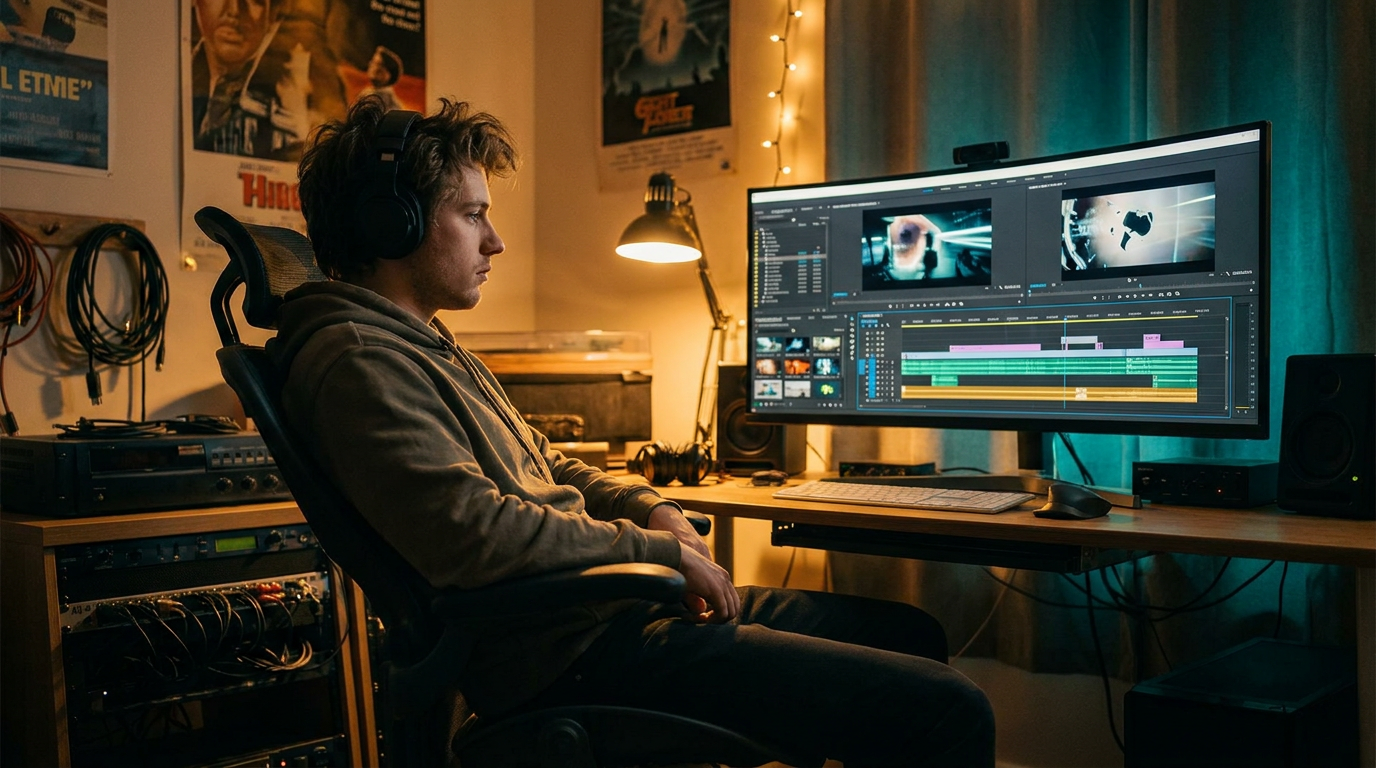
- Independent Filmmakers
- Value creative control and the ability to produce cinematic content without traditional budgets.
- Commercial Studios
- Focus on workflow efficiency, rapid pre-visualization, and reducing the cost of high-volume content.
- Open-Source Advocates
- Prioritize privacy, local hardware rendering, and avoiding cloud subscription lock-in.
What's not represented
- · Traditional Hollywood Crew Unions
- · Background Actors
Why this matters
By collapsing the cost and technical barriers of high-end video production, AI generation tools are allowing independent creators to produce cinematic stories that rival Hollywood studios, fundamentally democratizing who gets to shape our visual culture.
Key points
- AI video generation has matured into a reliable production pipeline, drastically reducing the cost of cinematic filmmaking.
- Filmmakers are using a 'Simulation Production Method' to tightly control framing, lighting, and composition via image-to-video workflows.
- Character consistency, once a major hurdle, is being solved through multi-shot generation capabilities and custom LoRA training.
- A growing open-source ecosystem allows creators to run powerful video models locally, bypassing expensive cloud subscription fees.
The baseline cost of high-fidelity video production has effectively collapsed. A 30-second commercial that once required a $50,000 budget, a dedicated physical crew, and weeks of post-production rendering can now be rough-cut in a single afternoon by a solo creator.[4]
In 2026, AI video generation has officially crossed the threshold from a fascinating novelty to a reliable, professional production pipeline. What started just two years ago as a medium defined by warped, inconsistent two-second clips has matured into a robust ecosystem of diffusion transformers capable of rendering cinematic, emotionally resonant films.[1][5]
At the heart of this shift is a workflow that early adopters call the 'Simulation Production Method.' Rather than typing random text prompts and hoping for the best, filmmakers are treating the creative process like building a simulated world, establishing strict parameters for framing, tone, and lighting before a single frame of video is generated.[2]

The pre-production phase has been entirely transformed by this approach. Independent creators now use advanced language models to draft meticulous scene breakdowns, which are then fed into image generators to create comprehensive storyboards. This visual framework ensures that every subsequent shot feels like it belongs to the exact same cinematic universe.[2][5]
When moving into the production phase, the industry standard has shifted heavily toward image-to-video generation. Directors upload their carefully crafted reference frames to guide the AI's output, locking in the composition and color grading before asking the model to simulate motion.[1][2]
Platforms like Runway Gen-4.5 remain the benchmark for this kind of professional output. The software offers granular, director-level controls—such as 'Motion Brush'—that allow creators to literally paint specific movement paths onto individual elements within a static frame, ensuring the AI only animates exactly what it is told to.[1][4]

The most notorious hurdle for early AI filmmakers—maintaining character consistency—has seen massive technical breakthroughs. New models like Kling 3.0 can now generate multi-shot sequences spanning up to 15 seconds that maintain a subject's precise facial features and physical dimensions across entirely different camera angles.[1][4]
The most notorious hurdle for early AI filmmakers—maintaining character consistency—has seen massive technical breakthroughs.
For narrative projects requiring even tighter character continuity, creators are utilizing custom LoRA models. By fine-tuning the AI on a specific character pose sheet, filmmakers can lock in a protagonist's identity, allowing them to cast the same synthetic actor across an entire short film without their appearance degrading over time.[2]
Audio integration has also crossed a critical milestone this year. Google's Veo 3.1 model now generates native, physics-accurate audio directly alongside its video output, dramatically reducing the time editors spend manually sourcing and syncing footsteps, ambient room tone, or environmental sound effects.[1][4]

However, relying on these elite cloud-based generators comes with a steep financial curve. High-end models charge per second of usable footage, and the inherently iterative nature of filmmaking means creators can quickly burn through expensive credits just testing different camera movements or lighting setups.[1][3]
In response, a robust open-source rebellion has taken hold. Platforms like LTX Desktop have emerged as the first free, locally running nonlinear AI video editors, allowing creators to bypass cloud rendering queues and subscription fees entirely.[3]
Running open-source models like LTX 2.3, Wan 2.7, or HunyuanVideo locally gives filmmakers absolute privacy and the freedom of unlimited iteration. They can generate hundreds of takes for a single scene without watching a credit balance drain away.[1][3]

This freedom does come with significant hardware demands. While highly optimized models can run on consumer graphics cards with 8GB of VRAM, achieving the highest-quality cinematic outputs requires hefty, specialized rigs boasting 24GB of memory or more.[1][4]
For projects that demand authentic, nuanced human performances, hybrid workflows are becoming the gold standard. Directors film real actors on practical green screens, then use AI to generate, relight, and composite complex, photorealistic environments around them in post-production.[2]
Ultimately, the democratization of video generation does not replace the fundamental art of filmmaking. By stripping away the friction of massive budgets and logistical constraints, these tools simply place the entire burden of success exactly where it belongs: on the creator's taste, story judgment, and cinematic vision.[5][6]
How we got here
Early 2024
AI video generation is largely limited to 2-second, highly warped clips with poor temporal consistency.
Late 2024
The introduction of advanced text-to-video models brings photorealistic quality, but character continuity remains a major hurdle.
Mid 2025
Image-to-video (I2V) workflows become standard, allowing directors to use static concept art to tightly control the generated motion.
Early 2026
Models like Kling 3.0 and Veo 3.1 solve multi-shot character consistency and introduce native audio generation.
Spring 2026
The release of LTX Desktop and Wan 2.7 brings commercial-grade AI video editing to local, open-source hardware.
Viewpoints in depth
Independent Filmmakers
Solo creators and small teams leveraging AI to bypass traditional budget constraints.
For independent creators, AI video generation is the ultimate equalizer. It removes the financial barriers of hiring large crews, renting expensive equipment, and securing locations. By mastering the 'Simulation Production Method,' these filmmakers can produce visually stunning, emotionally resonant stories that rival studio outputs, shifting the competitive advantage from capital to pure creative vision.
Commercial Studios
Established production houses using AI for rapid prototyping and scaling content.
Commercial studios view AI not as a replacement for live-action filming, but as a hyper-efficient pre-production and scaling tool. They utilize platforms like Runway Gen-4.5 to rapidly generate storyboards, pre-visualize complex VFX sequences, and produce high-volume social media variations of their core campaigns, reporting up to a 90% reduction in secondary production costs.
Open-Source Advocates
Developers and privacy-focused creators pushing for local, subscription-free models.
This camp argues that relying on cloud-based AI video generators traps creators in expensive, per-second billing cycles and subjects their work to corporate censorship. They champion local models like LTX Video and HunyuanVideo, emphasizing that true democratization of the medium requires artists to own their rendering infrastructure and iterate without financial penalty.
What we don't know
- How traditional film festivals will adapt their submission guidelines to accommodate hybrid or fully AI-generated narrative shorts.
- Whether the cost of high-end consumer GPUs required for local rendering will drop enough to make open-source models universally accessible.
Key terms
- Diffusion Transformer (DiT)
- A machine learning architecture that combines the image-generating power of diffusion models with the sequential processing of transformers, enabling highly realistic video generation.
- Image-to-Video (I2V)
- A generation method where a user uploads a static reference image to guide the AI, ensuring the resulting video matches the exact visual style and composition desired.
- LoRA (Low-Rank Adaptation)
- A lightweight training technique that allows creators to fine-tune an AI model on specific data, such as a single character's face, to maintain consistency across multiple generations.
- Temporal Consistency
- The ability of an AI video model to keep objects, characters, and backgrounds stable and coherent from one frame to the next without flickering or morphing.
- VRAM (Video RAM)
- The specialized memory on a graphics card required to process and render complex AI models locally.
Frequently asked
Do I need to know how to code to use AI video generators?
No. While some open-source models require technical setup, most commercial platforms in 2026 use intuitive, browser-based interfaces that rely on natural language prompts and drag-and-drop reference images.
Can AI video generators create consistent characters?
Yes. The latest models use multi-shot generation, character pose sheets, and custom LoRA training to maintain a subject's facial features and physical dimensions across different scenes and camera angles.
Are open-source AI video models completely free?
The models themselves are free to download and use, but running them locally requires a powerful computer with a high-end graphics card (typically 8GB to 24GB of VRAM), which represents a significant upfront hardware cost.
Does AI video generate its own sound?
Advanced models like Google Veo 3.1 now generate native, physics-accurate audio alongside the video, though many filmmakers still prefer to layer custom sound design in post-production.
Sources
Source coverage
6 outlets
3 viewpoints surfaced






[1]Crepal AICommercial Studios
AI Video Generation: The 2026 Filmmaker's Breakdown
Read on Crepal AI →[2]VP LandIndependent Filmmakers
Understanding the AI Filmmaking Workflow
Read on VP Land →[3]MindStudioOpen-Source Advocates
LTX Desktop: The First Free Open-Source AI Video Editor Explained
Read on MindStudio →[4]AI ComparisonCommercial Studios
The 15 Best AI Video Generators in 2026
Read on AI Comparison →[5]FrameoIndependent Filmmakers
How Independent Filmmakers Use AI in 2026
Read on Frameo →[6]Factlen Editorial TeamIndependent Filmmakers
Synthesis by Factlen editorial team
Read on Factlen Editorial Team →


Every angle. Every day.
Get ai stories with full source coverage and perspective breakdowns delivered to your inbox.