
How Voice AI is Transforming the Fast-Food Drive-Thru
Major fast-food chains are rapidly deploying conversational AI to take drive-thru orders, utilizing advanced language models to improve speed, accuracy, and multilingual support.
By Factlen Editorial Team
- Fast-Food Operators
- Focused on using AI to improve speed, reduce labor strain, and protect profit margins.
- Restaurant Tech Developers
- Focused on the engineering milestones of processing complex language in noisy environments.
- Consumer Watchdogs
- Focused on the user experience, order accuracy, and the potential for frustrating interactions.
What's not represented
- · Labor Unions
- · Franchise Owners in Rural Markets
Why this matters
The drive-thru accounts for the vast majority of fast-food sales, and automating the order-taking process promises to reduce wait times, eliminate missing items, and ease the burden on overworked restaurant staff. As the technology reaches maturity in 2026, conversational AI is moving from a novelty to a standard feature of the American dining experience.
Key points
- Major chains like Wendy's, Taco Bell, and McDonald's are rapidly expanding AI drive-thru testing in 2026.
- The systems use advanced language models to filter out ambient noise and map conversational speech to complex menus.
- Early metrics show AI assistants successfully completing roughly 90% of orders without human intervention.
- McDonald's new ArchIQ system features bilingual support, seamlessly handling both English and Spanish orders.
- Employees report reduced stress, as the AI allows them to focus on food preparation rather than juggling headsets.
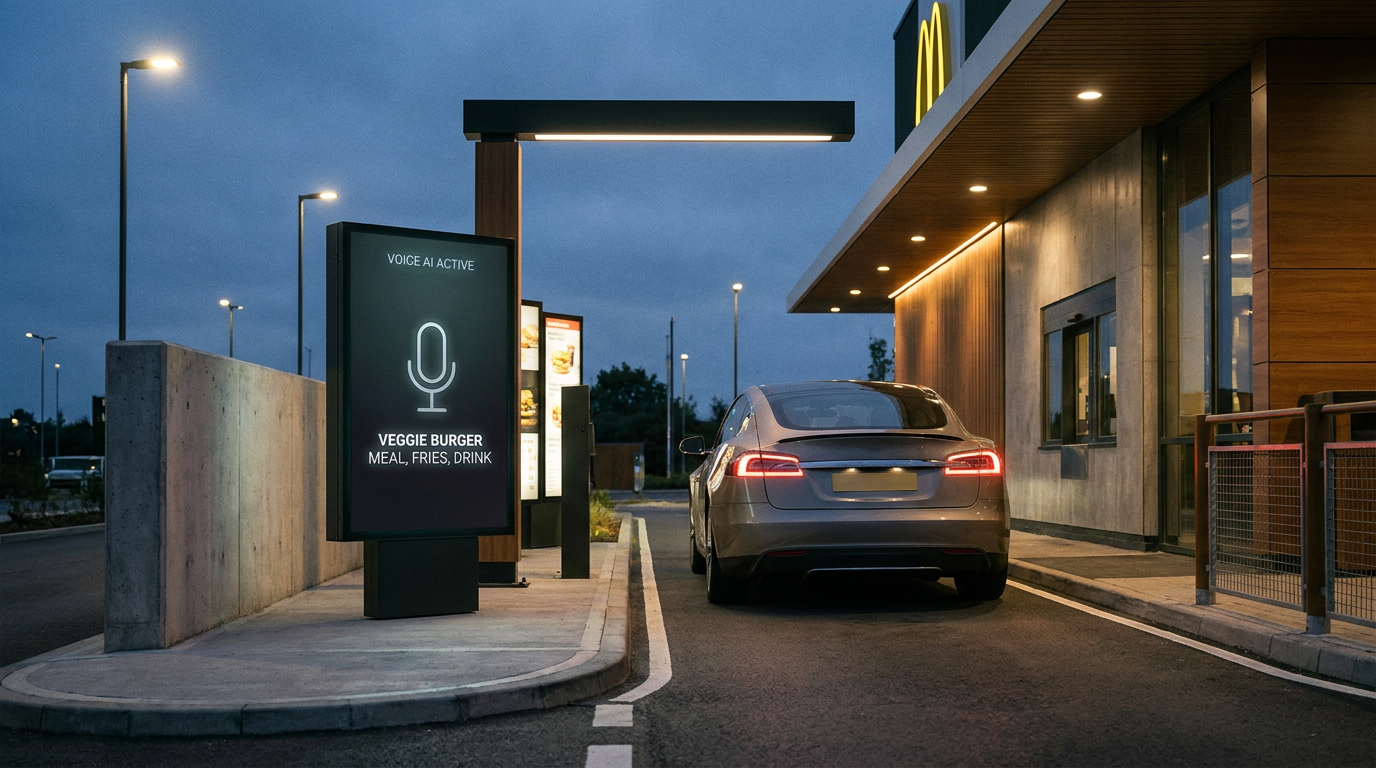
The next time you pull up to a fast-food speaker box, the voice greeting you is increasingly likely to be generated by artificial intelligence. After years of pilot programs, viral missteps, and technological refinement, the quick-service restaurant industry is aggressively rolling out conversational AI across thousands of drive-thru lanes in 2026. From McDonald's and Wendy's to Taco Bell and White Castle, automated order-taking has evolved from a clunky experiment into a sophisticated operational engine.
The catalyst for this shift is a persistent combination of labor shortages and the sheer volume of drive-thru traffic, which accounts for up to 80% of sales for many major chains. Fast-food operators have long struggled to staff the headset station—a high-stress role that requires employees to simultaneously listen to crackly audio, punch complex modifications into a point-of-sale system, and manage a timer. By delegating the initial conversation to an AI, restaurants aim to reallocate human workers to food preparation and face-to-face hospitality at the pickup window.[6]
The mechanism powering these new drive-thrus relies on advanced Large Language Models (LLMs) tailored specifically for the culinary environment. When a customer speaks, the system uses natural language processing to transcribe the audio in real-time, filtering out ambient noise like diesel engines or sirens. The AI then maps the customer's conversational phrasing—such as "gimme a number two, no pickles, large"—directly to the restaurant's structured menu database, instantly displaying the items on a digital confirmation board.[6]

Wendy's has been at the forefront of this integration with its "FreshAI" platform, developed in partnership with Google Cloud. The chain began testing the system in 2023 and is expanding it to between 500 and 600 locations by the end of 2025. The technical challenge is immense: because Wendy's prepares food to order, a single menu item like a Dave's Double can theoretically have billions of customization combinations. FreshAI uses Google's Vertex AI to navigate these permutations, offering intelligent upsells and improving order accuracy.[1][6]
McDonald's trajectory illustrates the rapid maturation of the technology. The burger giant famously ended an earlier AI drive-thru partnership with IBM in 2024 after customers posted viral videos of the system making bizarre errors, such as adding nine sweet teas to a single order. However, McDonald's has returned to the space in 2026 with a new Google-powered system dubbed "ArchIQ." Currently testing in select U.S. locations, the assistant—nicknamed "Archy"—boasts a roughly 90% completion rate without requiring a human employee to intervene.[4][7]
McDonald's trajectory illustrates the rapid maturation of the technology.
Crucially, the latest generation of drive-thru AI is breaking down language barriers. McDonald's ArchIQ system seamlessly handles both English and Spanish interactions, dynamically adjusting to the customer's preferred language. This bilingual capability reduces friction at the point of sale and creates a more welcoming environment for diverse customer bases, a feature that human staffing cannot always guarantee on every shift.[4][7]
Yum Brands, the parent company of Taco Bell, KFC, and Pizza Hut, is executing a similarly aggressive rollout. Following two years of fine-tuning, Taco Bell is expanding its voice AI to hundreds of U.S. stores. Yum Brands recently partnered with Nvidia to deploy a conversational chatbot that adapts to human speech patterns, aiming to make the interaction feel less robotic and more natural. The company reports that the technology has successfully reduced wait times and improved employee satisfaction.[2][5]

For chains operating 24 hours a day, AI offers a lifeline during difficult-to-staff overnight shifts. White Castle partnered with SoundHound AI to deploy a custom voice assistant named "Julia." The system, which is expanding to over 100 drive-thrus, operates entirely on end-to-end AI without human assistance in the background. White Castle reports that Julia processes orders in an average of just over 60 seconds and maintains a 90% order completion rate, outperforming previous staff-based benchmarks.[3]
Despite the impressive metrics, the systems are not infallible. Fast-food operators have implemented "human-in-the-loop" safeguards to ensure quality control. If a customer asks a question the AI cannot answer, or if the order becomes too convoluted, a human employee monitoring the headset channel can instantly take over the transaction. This seamless handoff prevents the frustrating loops that plague traditional automated phone menus.[1][4]

The employee response has been largely positive, countering early fears of job displacement. Restaurant managers report that crews view the AI as an "extra set of hands" rather than a replacement. By removing the cognitive load of order-taking, employees can focus on assembling meals accurately and engaging with customers at the payment window—tasks that directly impact customer satisfaction and repeat business.[2][3]
Looking ahead, the technology is poised to become even more predictive. Future iterations of these systems will likely integrate with loyalty apps and license plate recognition to recall a returning customer's "usual" order before they even speak. As the algorithms ingest more data from millions of daily transactions, the fast-food drive-thru is transforming into a highly personalized, frictionless digital ecosystem.[4][6]
How we got here
2020
White Castle begins early incubation tests of drive-thru AI with SoundHound and Mastercard.
May 2023
Wendy's announces a partnership with Google Cloud to pilot the 'FreshAI' ordering system.
June 2024
McDonald's ends its initial AI drive-thru test with IBM after customer complaints regarding order accuracy.
Mid-2025
Taco Bell and Yum Brands roll out Nvidia-powered AI chatbots to hundreds of locations.
June 2026
McDonald's tests its new Google-powered 'ArchIQ' system, boasting bilingual support and a 90% completion rate.
Viewpoints in depth
Fast-Food Operators
Restaurant chains view AI as a critical tool for operational efficiency and labor management.
For major brands and franchisees, the drive-thru is the financial engine of the restaurant. Operators argue that AI solves chronic staffing shortages by automating the most stressful and repetitive task in the building. By maintaining a consistent, friendly demeanor and never missing an opportunity to upsell, the technology protects profit margins while allowing human staff to focus on speed of service and food quality.
Restaurant Tech Developers
Engineers emphasize the rapid evolution of natural language processing in noisy environments.
Technology partners like Google Cloud and SoundHound highlight the immense computational challenge of the drive-thru. Developers point out that their systems must instantly parse regional accents, slang, and complex modifications over the roar of diesel engines. They view the current 90% completion rates as a milestone, arguing that continuous machine learning will soon make AI order-takers virtually flawless.
Drive-Thru Employees
Workers generally welcome the technology as a way to reduce workplace stress.
While automation often sparks fears of job losses, fast-food crews have largely embraced the AI assistants. Employees report that juggling a headset while managing a cash register and packing bags leads to burnout. By acting as an "extra set of hands," the AI relieves the cognitive load on the crew, allowing them to focus on fulfilling orders accurately and interacting with customers at the window.
What we don't know
- How customers will react to fully autonomous lanes during peak holiday or weekend rushes.
- Whether the technology will eventually lead to reduced overall headcount in fast-food restaurants.
- How smaller, regional chains will afford the enterprise-grade AI infrastructure currently dominated by massive brands.
Key terms
- Conversational AI
- Artificial intelligence designed to understand, process, and respond to human language in a natural, flowing dialogue.
- Large Language Model (LLM)
- A type of AI algorithm trained on massive amounts of text data, enabling it to understand context and generate human-like text or speech.
- Point-of-Sale (POS) System
- The digital cash register and order management software used by restaurants to track sales and send tickets to the kitchen.
- Order Completion Rate
- The percentage of drive-thru transactions successfully handled by the AI from start to finish without a human employee needing to intervene.
Frequently asked
Will AI replace fast-food workers?
Currently, chains are using AI to supplement staff, not replace them. The technology handles order-taking so employees can focus on food preparation and customer service.
What happens if the AI misunderstands my order?
A human employee monitors the AI's interactions through a headset and can instantly take over the conversation if the system struggles or if the customer asks a complex question.
Can the AI understand accents and different languages?
Yes. Modern systems use advanced natural language processing to understand heavy accents, and platforms like McDonald's ArchIQ can seamlessly switch between English and Spanish.
Sources
Source coverage
7 outlets
3 viewpoints surfaced







[1]Business InsiderFast-Food Operators
Wendy's Is Expanding AI Ordering to Hundreds More Drive-Thrus in 2025
Read on Business Insider →[2]CBS NewsFast-Food Operators
Taco Bell is expanding AI drive-thru to hundreds of U.S. locations
Read on CBS News →[3]Restaurant DiveRestaurant Tech Developers
White Castle to roll out voice AI to over 100 drive-thrus
Read on Restaurant Dive →[4]TrendHunterRestaurant Tech Developers
McDonald's Tests ArchIQ AI Drive-Thru System
Read on TrendHunter →[5]MashableConsumer Watchdogs
More KFC, Taco Bell, and Pizza Hut locations will get AI-powered drive-thru ordering
Read on Mashable →[6]Nation's Restaurant NewsFast-Food Operators
Wendy's teams with Google to test drive-thru artificial intelligence
Read on Nation's Restaurant News →[7]CyberGuyConsumer Watchdogs
McDonald's AI drive-thru could soon take your order, flag restaurant problems and change the fast-food experience
Read on CyberGuy →

Every angle. Every day.
Get food drink stories with full source coverage and perspective breakdowns delivered to your inbox.