
The Complete Guide to Retrofitting Older Homes for the Electric Era
As home remodeling shifts toward deep energy retrofits, new data proves high-efficiency heat pumps and smart electrical panels can successfully modernize older properties without requiring massive structural overhauls.
By Factlen Editorial Team
- Electrification Advocates
- Argue that transitioning homes to electric appliances is essential for climate goals and long-term savings.
- Building Science Researchers
- Focus on empirical data proving heat pumps function efficiently in older, unrenovated homes.
- Grid & Hardware Skeptics
- Highlight the high costs of panel upgrades and caution against over-relying on expensive smart panels.
What's not represented
- · Renters unable to modify their building's infrastructure
- · Municipal utility operators managing local grid capacity
Why this matters
Transitioning away from fossil fuels lowers utility bills, improves indoor air quality, and future-proofs your property's value. Understanding how to navigate electrical panel limits and leverage 2026 tax rebates can save homeowners thousands of dollars on their retrofits.
Key points
- Home remodeling is shifting toward whole-home electrification, replacing gas appliances with heat pumps and induction stoves.
- Recent studies prove that heat pumps operate at high efficiency even in century-old, unrenovated homes.
- Smart electrical panels and load-shedding devices allow older homes to electrify without expensive 200-amp service upgrades.
- Federal rebates and tax credits significantly offset the upfront costs of electrification retrofits in 2026.
Home renovation in 2026 has shifted its focus. Instead of purely cosmetic upgrades like marble countertops and open-concept layouts, homeowners are increasingly investing in the invisible infrastructure of their properties. Driven by volatile fossil fuel prices and a desire for energy independence, the prevailing trend is "whole-home electrification"—a comprehensive transition away from gas-powered appliances toward high-efficiency electric alternatives.[7][4]
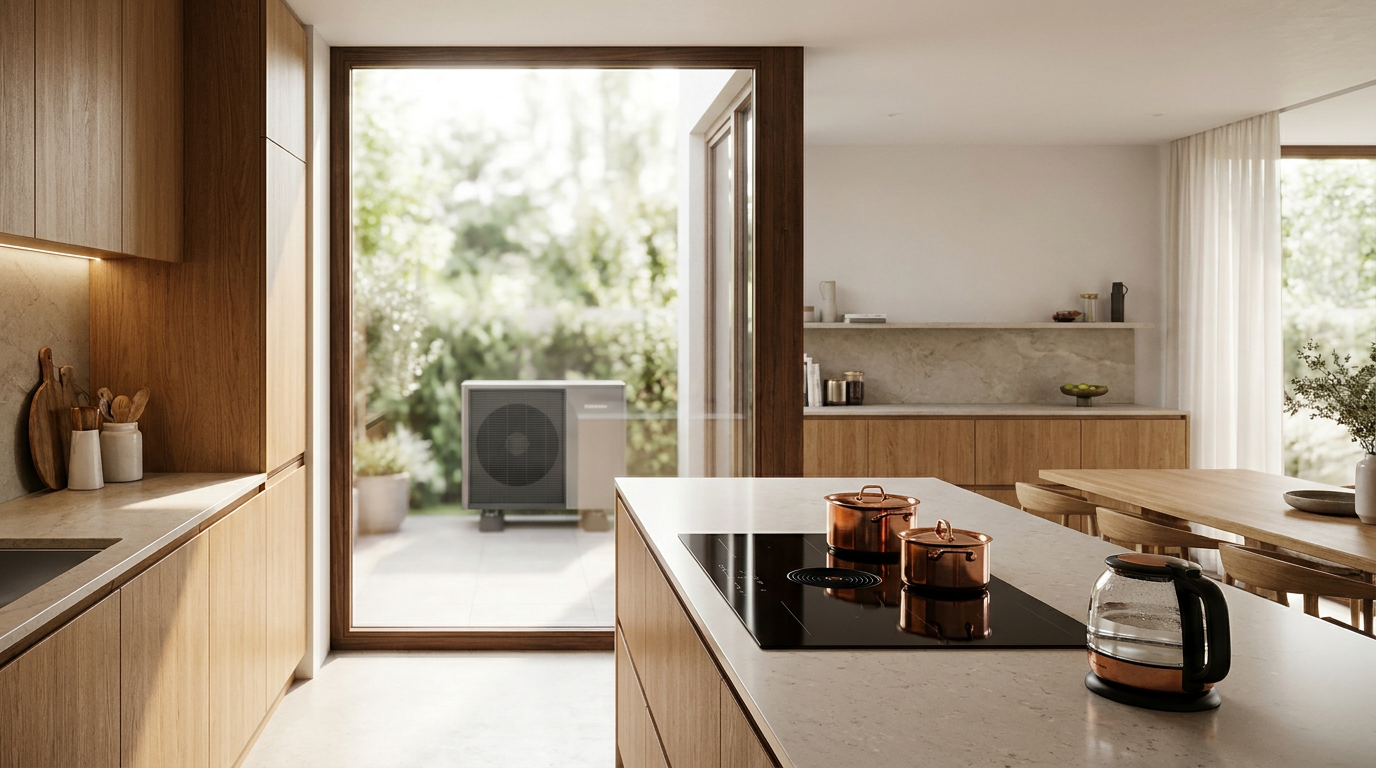
The cornerstone of this transition is the air-source heat pump. Unlike traditional gas furnaces that burn fuel to generate heat, heat pumps operate like reversible refrigerators. They use electricity to extract ambient thermal energy from the outside air, compress it to raise its temperature, and transfer it indoors. During the summer, the cycle reverses, pulling heat out of the house to provide air conditioning.[3]
Because they move heat rather than create it, heat pumps are remarkably efficient. Modern systems can deliver three to four units of heat for every one unit of electricity they consume, drastically reducing energy usage compared to electric resistance heating or gas boilers. As the electrical grid incorporates more renewable energy, these appliances become what advocates call "appreciating climate assets," lowering a household's carbon footprint year after year.[3][4]
Despite these advantages, a persistent myth has slowed adoption: the belief that heat pumps are only suitable for newly built, heavily insulated homes. For years, conventional wisdom suggested that older, drafty properties required extensive and costly weatherization—such as tearing down walls to add insulation—before a heat pump could adequately warm the space.[1]

Recent empirical data has thoroughly debunked this assumption. A comprehensive four-year study published by Germany's Fraunhofer Institute for Solar Energy Systems (Fraunhofer ISE) monitored heat pumps installed in unrenovated residential buildings, some over a century old. The researchers found no correlation between the age of the building and the heat pump's performance.[5]
The Fraunhofer ISE data revealed that air-to-water heat pumps in older homes achieved an average seasonal performance factor of 3.4, meaning they were more than three times as efficient as a standard gas boiler. Similarly, the UK's Electrification of Heat demonstration project installed heat pumps in properties built before 1919, finding that they performed consistently well in real-world winter conditions without requiring deep envelope retrofits.[5][1]
While the heating mechanism itself works in older homes, the transition often hits a different structural bottleneck: the electrical panel. Homes built decades ago were typically equipped with 100-amp electrical service, which was perfectly adequate when heating, water heating, and cooking were handled by natural gas.[8]

While the heating mechanism itself works in older homes, the transition often hits a different structural bottleneck: the electrical panel.
However, adding an electric vehicle charger, an induction stove, a heat pump water heater, and a central heat pump can easily exceed a 100-amp panel's capacity if all appliances run simultaneously. The traditional solution is a heavy-up—a full utility service upgrade to 200 amps. This process can cost thousands of dollars and is frequently delayed by utility company backlogs and the need for new municipal wiring.[4][8]
To bypass this hurdle, the remodeling industry has turned to smart electrical panels and load-management devices. A smart panel replaces the traditional breaker box with a computerized system that monitors power consumption at the circuit level in real time. If the home approaches its maximum electrical capacity, the smart panel automatically intervenes.[8]
The mechanism relies on load shedding. Homeowners can designate priority levels for different circuits via a smartphone app. If the heat pump and the induction stove are running at the same time, the smart panel might temporarily pause power to the electric vehicle charger or the heat pump water heater until the cooking is finished, preventing the main breaker from tripping.[8]
While this technology allows older homes to fully electrify without a costly utility upgrade, it is not without controversy. Grid edge analysts point out that the way some smart panels manage loads can be problematic. Rather than communicating directly with the appliance to gracefully ramp down its power draw, many smart panels simply open the breaker, abruptly cutting the electricity.[2]

Abruptly severing power to motor-based devices like heat pumps, dishwashers, or pool pumps can potentially damage the equipment over time. Furthermore, systems that cut power without warning can leave homeowners dealing with reset appliance clocks, interrupted laundry cycles, and blinking lights. As a result, simpler load-sharing switches that manage only two specific appliances—like an EV charger and a dryer—are often recommended as a cheaper, safer alternative.[2]
Beyond heating and electrical infrastructure, the kitchen is the third major frontier of the electrification retrofit. Induction cooktops use electromagnetic fields to directly heat the cookware, rather than heating the air around it. This technology boils water faster than gas, offers precise temperature control, and eliminates the indoor air pollution—specifically nitrogen dioxide—associated with burning fossil fuels in the kitchen.[4]
The financial calculus for these deep energy retrofits has shifted significantly in 2026. The upfront costs of heat pumps and smart panels are substantial, but they are increasingly offset by federal and state incentives. In the United States, the Inflation Reduction Act's High-Efficiency Electric Home Rebate Act (HEEHRA) provides up to $8,000 for heat pumps and $4,000 for electrical panel upgrades for income-qualified households.[6]

For those who do not qualify for upfront rebates, the 25C tax credit offers a 30 percent offset on the cost of heat pumps and related electrical upgrades, capped at $2,000 annually. By phasing these projects over multiple years—upgrading the electrical panel one year and the HVAC system the next—homeowners can maximize their tax credits and spread out the capital expenditure.[6][4]
Ultimately, retrofitting an older home for the electric era requires strategic planning rather than brute force. By leveraging high-efficiency heat pumps, intelligent load management, and federal incentives, homeowners are transforming aging, fossil-fuel-dependent properties into resilient, low-carbon homes equipped for the future.[7]
How we got here
1970s-1990s
Homes are predominantly built with 100-amp electrical service and rely on fossil fuels for heating and cooking.
2022
The Inflation Reduction Act is passed, allocating billions in rebates and tax credits for residential electrification.
2024
Smart electrical panels gain mainstream traction as a workaround for expensive utility service upgrades.
2025
Fraunhofer ISE publishes a landmark four-year study proving heat pumps operate at high efficiency even in unrenovated, century-old homes.
Viewpoints in depth
Electrification Advocates
Argue that transitioning homes to electric appliances is essential for climate goals and long-term savings.
This camp, which includes environmental organizations and green building advocates, views whole-home electrification as an urgent necessity. They emphasize that swapping fossil-fuel burners for heat pumps and induction stoves not only slashes carbon emissions but also drastically improves indoor air quality. They argue that with the current suite of federal rebates, the long-term energy savings make electrification a sound financial investment, regardless of the upfront costs.
Grid & Hardware Skeptics
Highlight the high costs of panel upgrades and caution against over-relying on expensive smart panels.
Industry analysts and some electricians warn that the push to electrify is hitting a hard infrastructure wall. They point out that upgrading a home's electrical service is often prohibitively expensive and delayed by utility backlogs. Furthermore, they are skeptical of using smart electrical panels as a universal workaround, noting that abruptly cutting power to motor-based appliances like heat pumps can cause long-term damage and create a frustrating user experience.
Building Science Researchers
Focus on empirical data proving heat pumps function efficiently in older, unrenovated homes.
Researchers and engineers focus on the actual performance data of modern HVAC technology. They aim to debunk the persistent myth that heat pumps require deep energy retrofits and perfect insulation to function. By pointing to large-scale, multi-year studies in Europe and the UK, they demonstrate that heat pumps can maintain high efficiency levels even in drafty, century-old homes, proving that the technology is ready for mass deployment across all housing types.
What we don't know
- How quickly municipal utility grids will be able to handle the increased load of fully electrified neighborhoods.
- Whether the long-term lifespan of motor-based appliances is significantly reduced by the abrupt load shedding of smart panels.
Key terms
- Air-Source Heat Pump
- A highly efficient heating and cooling system that uses electricity to transfer heat between the inside and outside of a home.
- Smart Electrical Panel
- An upgraded breaker box that monitors real-time energy usage and can automatically pause specific circuits to prevent overloading the home's electrical capacity.
- Load Shedding
- The process of temporarily reducing electricity demand by automatically turning off non-critical appliances during periods of high power usage.
- Induction Cooktop
- A cooking surface that uses electromagnetism to heat pots and pans directly, eliminating indoor combustion emissions.
- Seasonal Performance Factor (SPF)
- A metric used to measure the real-world efficiency of a heat pump over an entire heating season.
Frequently asked
Do I need to replace all my gas appliances at once?
No. Experts recommend creating an electrification roadmap and replacing appliances one by one as they reach the end of their lifespan to maximize tax credits and spread out costs.
Will a heat pump keep my house warm in freezing weather?
Yes. Modern cold-climate heat pumps are designed to extract heat from the air even when temperatures drop well below freezing, and they are widely used in cold regions.
Do I have to upgrade to a 200-amp electrical panel?
Not necessarily. Many homes can fully electrify on a 100-amp panel by using smart load-management devices or carefully selecting lower-amperage appliances.
Are induction stoves the same as traditional electric glass-top stoves?
No. Induction uses electromagnetic fields to heat the pan directly, offering much faster boiling times and more precise temperature control than traditional electric resistance coils.
Sources
Source coverage
8 outlets
3 viewpoints surfaced








[1]The GuardianBuilding Science Researchers
Can heat pumps be installed in older properties?
Read on The Guardian →[2]Utility DiveGrid & Hardware Skeptics
Smart electric panels are not a smart bet
Read on Utility Dive →[3]Department of EnergyBuilding Science Researchers
Heat Pump Systems
Read on Department of Energy →[4]Rewiring AmericaElectrification Advocates
Electrify Everything in Your Home
Read on Rewiring America →[5]Fraunhofer ISEBuilding Science Researchers
Four-year testing finds heat pumps run efficiently even in older homes
Read on Fraunhofer ISE →[6]Eco HomesElectrification Advocates
2026 Heat Pump Guide: Cold-Climate Systems & Rebates
Read on Eco Homes →[7]Factlen Editorial TeamElectrification Advocates
Synthesis by Factlen editorial team
Read on Factlen Editorial Team →[8]WattWalletGrid & Hardware Skeptics
Smart Electrical Panel Guide for Homeowners
Read on WattWallet →
Every angle. Every day.
Get home stories with full source coverage and perspective breakdowns delivered to your inbox.