
Borrowing Instead of Buying: How the 'Library of Things' is Reshaping Neighborhoods
A growing movement of tool libraries and hyper-local gift economies is challenging traditional consumerism. By prioritizing access over ownership, communities are saving money, reducing waste, and combating social isolation.
By Factlen Editorial Team
- Circular Economy Advocates
- Focus on the environmental necessity of transitioning away from disposable consumerism.
- Community Organizers
- Emphasize the social cohesion and mutual aid generated by hyper-local sharing.
- Economic Pragmatists
- Highlight the financial efficiency and democratization of access to expensive goods.
What's not represented
- · Traditional hardware retailers facing potential localized sales declines.
- · Municipal waste management officials tracking the long-term impact on city budgets.
Why this matters
The shift toward a sharing economy offers a practical blueprint for lowering household expenses while simultaneously addressing environmental degradation and neighborhood isolation.
Key points
- The 'Library of Things' model allows community members to borrow rarely used items like power tools and camping gear instead of buying them.
- The Buy Nothing Project has grown to over 14 million members globally, facilitating the free exchange of millions of items every month.
- Collaborative consumption provides significant financial relief, with London's Library of Things saving its members an estimated £6 million.
- Beyond economic and environmental benefits, these hyper-local networks are highly effective at combating social isolation and building neighborhood trust.
The modern consumer lifestyle is defined by accumulation. Basements, garages, and closets are routinely filled with specialized items that see the light of day only once or twice a year. The iconic example of this inefficiency is the household power drill, a tool that is manufactured, packaged, and shipped globally, only to be used for a fraction of its potential lifespan before being discarded. This linear model of "extract, make, use, and throw away" has long been the default, driving both environmental degradation and household financial strain.[5]
But a quiet revolution is challenging the necessity of ownership. Across the globe, neighborhoods are embracing the "Library of Things" (LoT) and hyper-local gift economies. Instead of defaulting to a hardware store or an online retailer for a one-off project, residents are turning to community hubs to borrow what they need. This shift from ownership to access is proving that communities can thrive by sharing infrastructure rather than duplicating it in every home.[2][4][7]
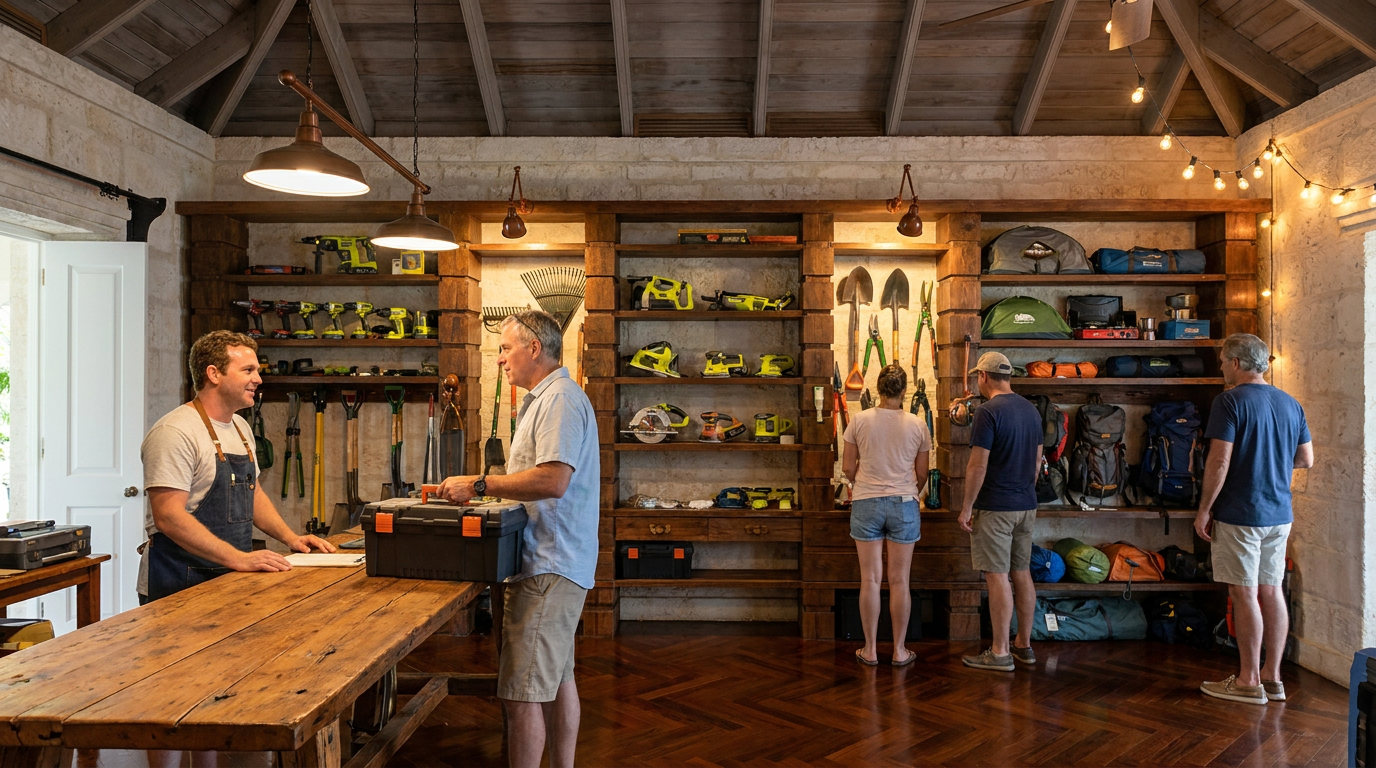
The mechanism of a Library of Things is straightforward and familiar. Operating much like a traditional public library, these spaces replace bookshelves with inventories of carpet cleaners, sewing machines, camping tents, and miter saws. Members can browse a catalog, reserve an item for a specific period, and return it when the job is done. By centralizing access to rarely used equipment, these hubs provide a practical alternative to rampant consumerism.[2][5][6]
The concept has evolved from grassroots experiments into sophisticated social enterprises. While early iterations relied entirely on volunteer labor in community centers, the model has proven highly adaptable. London's Library of Things, for instance, has partnered with local governments and housing associations to install self-service lockers in public spaces, making the borrowing process as seamless as picking up an online delivery.[2]

Running parallel to physical tool libraries is the digital phenomenon of the Buy Nothing Project. Founded in 2013 by two friends in Washington state who were dismayed by plastic waste, the initiative was designed to help neighbors offer and request free goods and services. Operating through localized social media groups and a dedicated app, the project enforces a strict rule: all items must be given freely, with no strings attached and no expectation of financial return.[1][3]
The scale of this digital gift economy is staggering. The Buy Nothing Project now boasts over 14 million members across more than 50 countries. Every month, millions of items change hands, ranging from outgrown baby clothes and half-used bags of flour to fully functional furniture. This massive network operates entirely outside the traditional bounds of commerce, driven solely by community participation.[1][3][6]
For households navigating inflation and a persistent cost-of-living crisis, the economic argument for collaborative consumption is undeniable. Purchasing high-quality tools or specialized equipment requires a significant upfront investment that many cannot afford. By offering a £250 carpet cleaner for a nominal £10 rental fee, or providing baby gear entirely for free, these networks democratize access to essential goods.[2][3][7]
For households navigating inflation and a persistent cost-of-living crisis, the economic argument for collaborative consumption is undeniable.
The aggregate financial relief is substantial. London's Library of Things estimates that its platform has saved members over £6 million by eliminating the need for outright purchases. This economic efficiency allows individuals to undertake home repairs, launch small businesses, or explore new hobbies without assuming prohibitive financial risks.[2]
Beyond financial savings, the sharing economy addresses a critical spatial challenge. As urban density increases and affordable living spaces shrink, the capacity to store bulky, rarely used items is a luxury. The principle of "borrowing instead of storing" allows city dwellers to maintain uncluttered homes without sacrificing their ability to tackle complex DIY projects or host large gatherings.[4]

The environmental implications of this shift are equally profound. Every borrowed or gifted item represents a direct intervention in the manufacturing supply chain. By extending the lifespan of existing products, communities are actively putting circular economy principles into practice, reducing the demand for new resource extraction and the energy required for production.[4][5][7]
The waste reduction metrics highlight the efficacy of this approach. The Buy Nothing Project estimates that its global network diverts approximately 162,000 tons of waste from landfills every year. By keeping functional items in circulation and out of the trash, these hyper-local economies are proving to be highly effective tools for municipal waste prevention.[1][6]
Yet, for many participants, the most transformative impact of the sharing economy is social rather than material. In an era characterized by digital isolation and declining civic engagement, these exchanges force neighbors to interact. A simple transaction over a borrowed ladder or a gifted set of dishes often serves as a catalyst for broader community connection.[3][4][5]
Stories of mutual aid are woven into the fabric of these networks. Members frequently go beyond simple exchanges, organizing community events, assembling furniture for newcomers, and providing emotional support during personal crises. Organizers note that the vulnerability required to ask for help—and the generosity required to give it—builds a resilient, hyper-local safety net rooted in mutual trust.[3]

Despite their success, these initiatives face significant hurdles as they attempt to scale. Grassroots tool libraries and gifting groups often rely heavily on the unpaid labor of dedicated volunteers, a dynamic that can lead to burnout and operational bottlenecks over time. Managing inventory, repairing broken tools, and moderating online disputes require consistent effort and administrative oversight.[2][7]
To ensure long-term viability, the movement is increasingly professionalizing. Organizations are developing regenerative business models, utilizing licensing fees, and securing mission-aligned investments to build robust software and supply chains. By transitioning from purely volunteer-run operations to sustainable social enterprises, they aim to make borrowing a permanent fixture of urban infrastructure.[2]
Ultimately, the Library of Things and the broader gift economy challenge the deeply ingrained cultural narrative that success is measured by accumulation. By proving that access can be just as fulfilling—and far more efficient—than ownership, these communities are sketching the outlines of a fairer, more sustainable society. They demonstrate that true wealth may not lie in what we own, but in what we are willing to share.[1][5][7]
How we got here
1943
The first recorded tool library opens in Grosse Pointe Farms, Michigan, to offer training to young people.
2013
The Buy Nothing Project is founded in Bainbridge Island, Washington, launching a global hyper-local gifting movement.
2014
The Library of Things begins testing its first pilot item-sharing library in South London.
2022
The Buy Nothing Project launches a standalone app to organize its rapidly expanding global user base.
2024
London's Library of Things reports its members have collectively saved over £6 million through borrowing.
Viewpoints in depth
Circular Economy Advocates
Focus on the environmental necessity of transitioning away from disposable consumerism.
For environmental researchers and sustainability advocates, the primary value of the sharing economy is resource conservation. They argue that the linear model of 'extract, make, use, and throw away' is fundamentally incompatible with planetary boundaries. By maximizing the lifespan of a single manufactured item—such as a power drill or a carpet cleaner—communities drastically reduce greenhouse gas emissions associated with production and divert significant tonnage from local landfills.
Community Organizers
Emphasize the social cohesion and mutual aid generated by hyper-local sharing.
Sociologists and community leaders view these networks primarily as engines for social resilience. In an era marked by digital isolation and declining civic participation, physical and digital sharing hubs force neighbors to interact. Organizers argue that the true wealth generated by these projects isn't the monetary value of the borrowed items, but the trust and reciprocal relationships forged during the exchange, which often evolve into broader mutual aid during local crises.
Economic Pragmatists
Highlight the financial efficiency and democratization of access to expensive goods.
From an economic perspective, the Library of Things corrects a massive market inefficiency: the underutilization of household capital. Pragmatists point out that requiring every household to purchase its own specialized tools creates unnecessary financial strain, particularly during periods of high inflation. By pooling resources, low- and middle-income families gain access to equipment that would otherwise be prohibitively expensive, enabling entrepreneurship, home maintenance, and skill development without the burden of ownership.
What we don't know
- How traditional hardware and consumer goods retailers will adapt if hyper-local sharing economies capture a significant portion of their market.
- Whether volunteer-driven networks can sustain their current growth rates without transitioning to paid administrative models.
- The exact long-term impact of these initiatives on municipal waste management budgets and infrastructure planning.
Key terms
- Library of Things
- A community hub that lends out rarely used household items, tools, and equipment instead of books.
- Circular Economy
- An economic system aimed at eliminating waste and the continual use of resources by reusing, repairing, and recycling products.
- Gift Economy
- A mode of exchange where valuables are given without an explicit agreement for immediate or future rewards.
- Collaborative Consumption
- The shared use of a good or service by a group, reducing the need for individual ownership.
Frequently asked
Does it cost money to use a Library of Things?
It depends on the model. Many community tool libraries charge a small sliding-scale membership fee or a nominal rental fee per item, while networks like the Buy Nothing Project are strictly free.
What kinds of items are most commonly shared?
Popular items include power tools, carpet cleaners, gardening equipment, camping gear, sewing machines, and specialized cooking appliances.
How do these groups handle broken or damaged items?
Most libraries factor maintenance into their operating costs, often hosting 'repair cafes' to fix items. In peer-to-peer networks, communication and community trust dictate how accidental damage is resolved.
Can anyone start a tool library?
Yes. Many begin as grassroots volunteer efforts, though organizations like the Library of Things now offer toolkits and licensing platforms to help municipalities and community centers launch their own hubs.
Sources
Source coverage
7 outlets
3 viewpoints surfaced







[1]Buy Nothing ProjectCommunity Organizers
Welcome to the Buy Nothing Project
Read on Buy Nothing Project →[2]Doughnut Economics Action LabEconomic Pragmatists
Library of Things: Making borrowing better than buying
Read on Doughnut Economics Action Lab →[3]Analyst NewsCommunity Organizers
How ‘Buy Nothing’ groups are building community and fighting waste
Read on Analyst News →[4]European Environment AgencyCircular Economy Advocates
Scaling circular business models in Europe
Read on European Environment Agency →[5]Active SustainabilityCircular Economy Advocates
The Library of Things where you can borrow anything you need
Read on Active Sustainability →[6]The Simple EnvironmentalistCircular Economy Advocates
What is a Buy Nothing Group and How Do I Find One?
Read on The Simple Environmentalist →[7]Factlen Editorial TeamEconomic Pragmatists
Synthesis by Factlen editorial team
Read on Factlen Editorial Team →
Every angle. Every day.
Get community stories with full source coverage and perspective breakdowns delivered to your inbox.