
How Empty Office Towers Are Becoming the Next Wave of American Housing
With national office vacancies topping 20%, developers are utilizing new zoning laws and tax incentives to convert obsolete commercial buildings into tens of thousands of residential apartments.
By Factlen Editorial Team
- Urban Planners & Architects
- Focused on the structural feasibility and urban design benefits of adaptive reuse.
- Commercial Real Estate Developers
- Focused on the financial viability, capital stack challenges, and the necessity of public subsidies.
- Municipal Policymakers
- Focused on solving the dual crises of empty downtowns and severe housing shortages through zoning reform.
What's not represented
- · Existing commercial tenants in partially vacant buildings who face disruption or forced relocation during the conversion process.
- · Affordable housing advocates who argue that luxury conversions do not adequately serve low-income residents.
Why this matters
Adaptive reuse is simultaneously addressing two of the most pressing urban crises of the decade: the collapse of downtown commercial real estate and a severe national housing shortage. By turning stranded office assets into livable apartments, cities are fundamentally reshaping the future of the American downtown.
Key points
- More than 90,300 apartments are currently in the U.S. pipeline to be converted from former office buildings.
- The national office vacancy rate has surpassed 20%, driven by enduring remote work trends.
- Only about 30% of commercial buildings are structurally suitable for residential conversion without cost-prohibitive renovations.
- Cities are introducing aggressive tax exemptions and zoning reforms to subsidize the high costs of adaptive reuse.
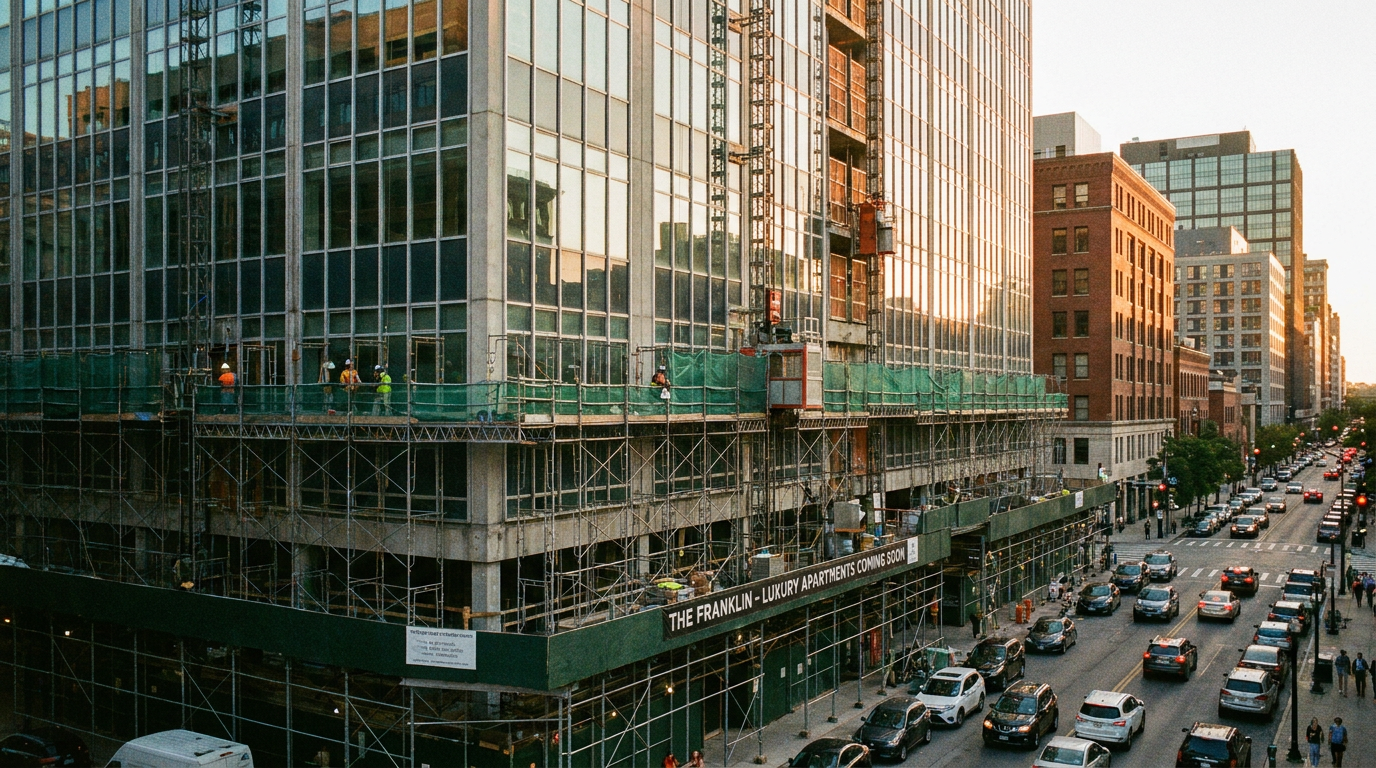
The modern American downtown presents a stark contradiction: millions of square feet of commercial office space sit entirely empty, while a severe national housing shortage pushes residential rents to historic highs.[7]
For years, the idea of converting vacant office towers into residential apartments was dismissed by the real estate industry as a niche architectural exercise. The conventional wisdom held that such projects were simply too expensive, too structurally complex, and too heavily regulated by local zoning boards to ever operate at scale.[7]
But in 2026, the underlying math of urban real estate has fundamentally shifted. Adaptive reuse has hit critical mass, transforming from a theoretical concept into the dominant form of new housing supply in several major urban centers.[7]
According to real estate data firm RentCafe, more than 90,300 apartments are currently in the pipeline to be converted from former office buildings across the United States.[2]
This represents a massive 28% year-over-year increase from early 2025, and nearly four times the total conversion volume recorded just four years ago in 2022.[2]

The catalyst for this unprecedented surge is a combination of enduring remote work trends and a wave of commercial loan maturities. The national office vacancy rate recently topped 20%, marking the highest level of empty commercial space in three decades.[3]
Class B and Class C office buildings—older structures that lack the premium amenities, natural light, and high-end finishes of newer corporate developments—are bearing the brunt of this vacancy crisis. As tenants flee to higher-quality spaces, these aging buildings are increasingly viewed as stranded assets.[6]
Yet, not every empty office can easily become a home. The architectural mechanics of an office-to-residential conversion are notoriously unforgiving, requiring a specific set of structural conditions to be viable.[4]
The architectural mechanics of an office-to-residential conversion are notoriously unforgiving, requiring a specific set of structural conditions to be viable.
Global architecture firm Gensler, which has assessed hundreds of commercial buildings for conversion potential using a proprietary algorithm, notes that only about 30% of evaluated office structures possess the right "bones" for residential use.[4]
The primary structural hurdle is the floor plate. Modern office buildings are often designed with massive, deep floor plates that leave interior spaces far from the exterior walls. Because residential building codes strictly require bedrooms to have operable windows and access to natural light, deep buildings are inherently problematic.[4]
To solve this geometry problem, developers are frequently forced to carve massive light wells straight through the center of the building, creating interior courtyards and redesigning HVAC and plumbing systems that were originally centralized for corporate use.[4]

Because these structural interventions are so extensive, financial feasibility remains the tightest bottleneck in the conversion pipeline. The hard costs of a gut renovation can frequently rival, or even exceed, the price of ground-up new construction.[5]
Recognizing that the private market cannot bridge this financial gap alone, municipalities have begun rolling out aggressive policy interventions to subsidize and streamline the process.[7]
In February 2026, Los Angeles enacted its Citywide Adaptive Reuse Ordinance, a sweeping zoning reform that allows commercial buildings as young as 15 years old to be converted into housing by right, bypassing years of discretionary reviews and environmental impact studies.[1]
New York City has similarly accelerated its conversion pipeline, offering up to 90% property tax exemptions for developers who designate at least 25% of their newly converted units as affordable housing.[5]

At the federal level, commercial real estate industry groups are actively lobbying for the Revitalizing Downtowns and Main Streets Act, bipartisan legislation that would provide a 20% tax credit to offset the eligible costs of adaptive reuse projects.[6]
Beyond the immediate economic and housing benefits, adaptive reuse offers a profound environmental advantage. Repurposing an existing concrete and steel structure saves massive amounts of "embodied carbon" compared to the emissions generated by demolition and new construction.[7]
How we got here
1999
Los Angeles passes its original Adaptive Reuse Ordinance, sparking a wave of historic building conversions in its downtown core.
2020–2022
The pandemic triggers a massive shift to remote work, causing office physical occupancy to plummet and vacancy rates to climb.
2023–2024
Commercial real estate faces a reckoning as office leases expire and high interest rates complicate refinancing, leading to a surge in distressed Class B and C properties.
2025
Office-to-residential conversions hit a record pace, with completed projects jumping 50% year-over-year as cities roll out new tax incentives.
February 2026
Los Angeles enacts the Citywide Adaptive Reuse Ordinance, allowing commercial buildings as young as 15 years old to be converted into housing by right.
Viewpoints in depth
Urban Planners & Architects
Focused on the structural feasibility and urban design benefits of adaptive reuse.
For the architectural community, the adaptive reuse boom is an opportunity to correct the monolithic zoning mistakes of the 20th century. Planners argue that central business districts were inherently fragile because they relied entirely on a 9-to-5 commuter workforce. By introducing residential units, these neighborhoods become vibrant, 24-hour communities. However, architects caution that not every building is a viable candidate. The physical constraints of deep floor plates, centralized plumbing, and sealed glass curtain walls mean that only about a third of the existing office stock can be successfully converted without cost-prohibitive structural interventions like carving out interior light wells.
Commercial Real Estate Developers
Focused on the financial viability, capital stack challenges, and the necessity of public subsidies.
Developers view conversions through a strictly financial lens, noting that the math is often brutally difficult. While acquiring a distressed Class B office building might seem like a bargain, the hard costs of retrofitting centralized HVAC systems into hundreds of individual residential units can quickly push the project's budget past the cost of ground-up new construction. Consequently, the development community argues that adaptive reuse cannot scale on free-market dynamics alone. They maintain that aggressive property tax abatements, historic preservation credits, and federal subsidies are absolute prerequisites for making these capital-intensive projects pencil out for investors.
Municipal Policymakers
Focused on solving the dual crises of empty downtowns and severe housing shortages through zoning reform.
City officials are approaching the conversion trend with a sense of urgency, driven by plummeting commercial property tax revenues and a desperate need for housing supply. Policymakers recognize that the traditional bureaucratic hurdles—years-long environmental reviews, strict minimum unit sizes, and rigid open-space requirements—are incompatible with the speed required to save struggling downtowns. In response, cities are rewriting decades-old zoning codes to allow conversions 'by-right,' effectively fast-tracking approvals. For local governments, the goal is twofold: stabilize the municipal tax base by replacing empty offices with rent-paying residents, and chip away at a historic housing deficit.
What we don't know
- Whether the current pace of conversions can be sustained if federal interest rates remain elevated, which significantly increases the cost of construction financing.
- How the influx of new residential units will impact the long-term retail and commercial ecosystem of traditionally 9-to-5 business districts.
- If federal lawmakers will pass the Revitalizing Downtowns and Main Streets Act to provide a national tax credit for adaptive reuse projects.
Key terms
- Adaptive Reuse
- The process of repurposing an existing building for a use other than what it was originally designed for, such as turning an office tower into an apartment complex.
- Floor Plate
- The total leasable square footage of a single floor in a commercial building. Deep floor plates are a major hurdle for residential conversions due to a lack of natural light in the center.
- Class B and C Offices
- Older commercial buildings that lack the modern amenities, premium locations, or high-end finishes of top-tier (Class A) properties, making them prime candidates for conversion.
- By-Right Development
- A project approval process that allows developers to proceed without discretionary review or public hearings, provided the project complies with existing zoning codes.
- Embodied Carbon
- The total greenhouse gas emissions generated by the manufacturing, transportation, installation, and disposal of building materials. Retaining an existing structure saves significant embodied carbon.
Frequently asked
Why can't all empty office buildings become apartments?
Many modern office buildings have massive, deep floor plates that leave interior spaces far from windows. Residential building codes require natural light and ventilation for bedrooms, making deep buildings structurally and financially unviable to convert without carving out expensive interior light wells.
Is it cheaper to convert an office or build a new apartment?
Surprisingly, conversion costs often rival ground-up new construction. The expense of completely redesigning centralized HVAC, plumbing, and electrical systems for hundreds of individual units makes these projects highly capital-intensive.
Will this solve the housing crisis?
No. While the 90,300 units currently in the pipeline provide vital relief to downtowns, the United States faces an estimated overall housing shortage of 4.5 million homes. Conversions are a helpful tool, but not a silver bullet.
Sources
Source coverage
7 outlets
3 viewpoints surfaced







[1]Los Angeles TimesMunicipal Policymakers
Apartments to take over empty office buildings with new L.A. ordinance
Read on Los Angeles Times →[2]RentCafeUrban Planners & Architects
Adaptive Reuse Report 2026: 90,300 Empty Offices Becoming Apartments
Read on RentCafe →[3]CBRECommercial Real Estate Developers
Conversions & Demolitions Reducing U.S. Office Supply
Read on CBRE →[4]GenslerUrban Planners & Architects
Understanding Office-to-Residential Conversion: Lessons from Six U.S. Case Studies
Read on Gensler →[5]Cushman & WakefieldCommercial Real Estate Developers
Office to Residential Conversions Surge to Record Levels
Read on Cushman & Wakefield →[6]NAIOPCommercial Real Estate Developers
Adaptive Reuse 2025: Incentivizing Commercial Property Conversions
Read on NAIOP →[7]Factlen Editorial TeamMunicipal Policymakers
Synthesis by Factlen editorial team
Read on Factlen Editorial Team →
Every angle. Every day.
Get real estate stories with full source coverage and perspective breakdowns delivered to your inbox.