
Haptic Suits Go Mainstream: How Festivals Are Making Live Music Radically Inclusive
Major music festivals are rolling out wearable haptic suits that translate sound into physical vibrations, allowing Deaf and hard-of-hearing fans to fully experience live concerts.
By Factlen Editorial Team
- Deaf and Hard-of-Hearing Fans
- Advocating for genuine social inclusion rather than isolated accommodations.
- Technology Innovators
- Treating physical vibration as a distinct, nuanced artistic medium.
- Festival Organizers
- Balancing the logistics of radical inclusivity with massive crowd operations.
What's not represented
- · Touring Musicians
- · Venue Sound Engineers
Why this matters
The widespread adoption of haptic suits marks a historic shift in live entertainment, transforming concerts from a purely auditory event into a fully inclusive, multi-sensory experience. For the Deaf and hard-of-hearing community, it removes decades-old barriers to social participation, allowing them to feel the music and share the crowd's energy in real time.
Key points
- Haptic suits translate live music into complex physical vibrations across 24 points on the body.
- The technology operates with near-zero latency, perfectly syncing physical sensations with the artist's performance.
- Over 40 major music festivals are deploying the suits for the 2026 summer season.
- The suits allow Deaf fans to join the general admission crowd rather than being isolated on viewing platforms.
- Major entertainment conglomerates are absorbing the costs as part of their diversity and inclusion commitments.
The visceral punch of a bass drop or the soaring crescendo of a guitar solo are universal hallmarks of live music. For generations, these auditory thrills have defined the festival experience, creating a shared emotional resonance among tens of thousands of fans. But for the Deaf and hard-of-hearing community, accessing that shared energy has historically required creative, albeit limited, workarounds. Fans have long relied on standing barefoot near massive subwoofers or holding inflated balloons to capture the ambient, muffled vibrations of a concert. While these methods provided a physical connection to the beat, they offered only a fraction of the music's true complexity and nuance.[4]
This summer, the landscape of live entertainment is undergoing a quiet but profound revolution. Across more than 40 major music festivals and stadium tours in North America and Europe, a new standard of accessibility is taking center stage: the haptic suit. Moving beyond the experimental phases and limited pilot programs of the early 2020s, these wearable devices are now being deployed at an unprecedented scale, fundamentally changing how live music is consumed and experienced by those who cannot hear it.[6][7]
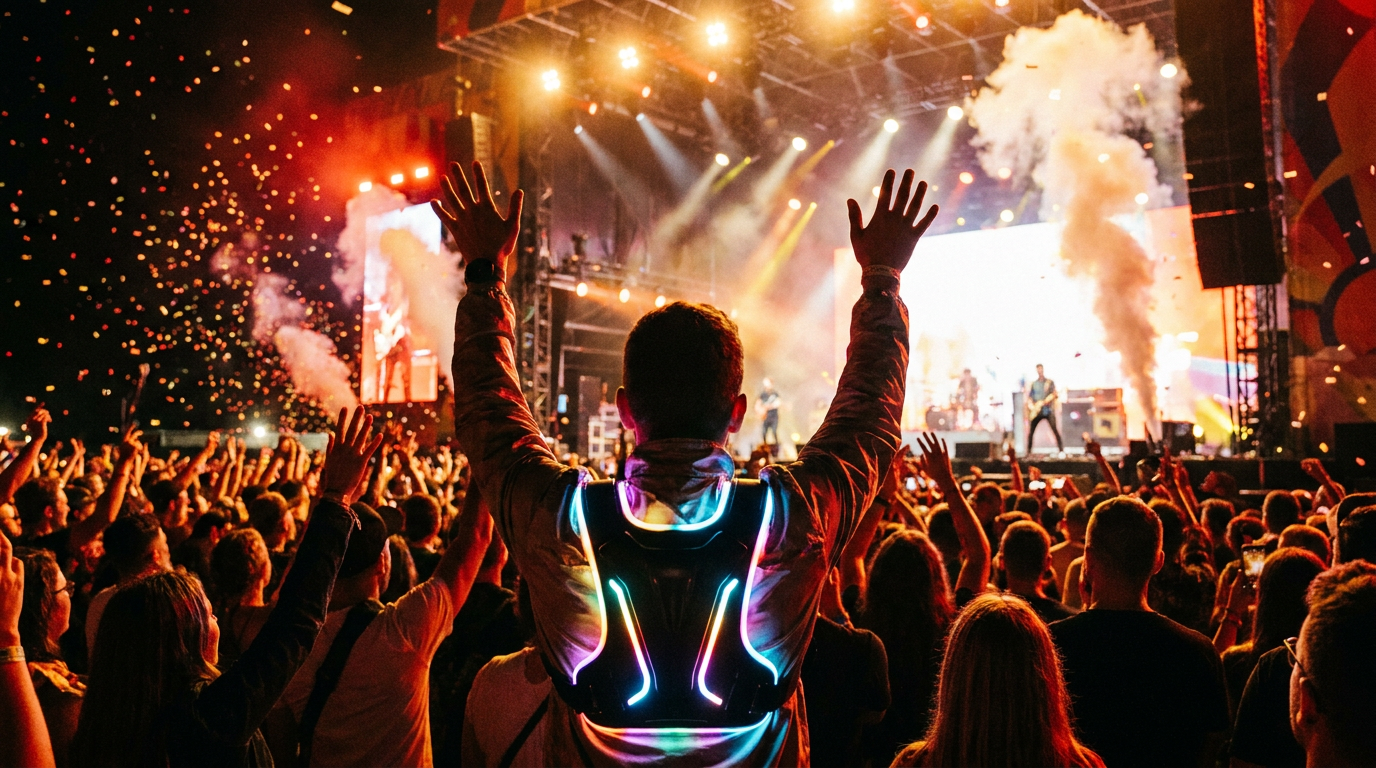
Leading the charge is 'Music: Not Impossible' (M:NI), a pioneering technology initiative that has transformed a bulky wearable prototype into a robust, scalable platform for live events. Their lightweight suits, which resemble a minimalist torso harness paired with specialized wrist and ankle bands, are meticulously designed to translate complex audio signals into high-fidelity physical sensations. The ultimate goal of the project is not merely to accommodate disabled fans, but to provide a radically inclusive sensory experience that rivals traditional hearing.[3]
The hardware relies on 24 distinct vibrating actuators strategically placed across the wearer's body. Rather than simply buzzing in a monotone rhythm to the beat of a kick drum, the system translates the entire frequency spectrum of a live performance into a complex, multi-sensory physical language. High, melodic notes might flutter lightly across the collarbones and upper chest, while heavy, driving bass lines send deep, resonant pulses through the lower back, legs, and feet. This spatial distribution allows the brain to interpret the vibrations as distinct musical elements.[3][4]

"Music is waves," as Coldplay drummer Will Champion noted when the band first began testing early versions of the haptic technology on their global tours. "You can hear them but also feel them as well." This fundamental understanding of sound as a physical force is the guiding principle behind the new wave of concert accessibility. By treating vibration as a primary medium rather than a secondary byproduct of loud speakers, engineers have unlocked an entirely new way to experience live performances.[2]
Coldplay's early adoption—spurred by lead singer Chris Martin, who was gifted a haptic vest by his partner—served as a high-profile proof of concept for the industry. The band paired the vests with local sign language interpreters and sensory refuge stations, proving that radical inclusivity could be seamlessly integrated into a blockbuster, globe-trotting stadium production without disrupting the show. Their success demonstrated to other touring artists that accessibility could be a core feature of a tour, rather than an afterthought.[2]
The technology has since evolved from a bespoke artist request to a standardized festival-wide infrastructure. Audio engineers, often referred to as 'haptic DJs,' now sit alongside traditional soundboard operators at major festivals. These specialized technicians actively mix the tactile experience in real-time, ensuring that the vibrational output captures the emotional arc, the subtle instrumental solos, and the dynamic shifts of the live performance, rather than just feeding a raw, automated audio signal into the suits. This human touch ensures the vibrations feel musical rather than mechanical.[3][4]
The technology has since evolved from a bespoke artist request to a standardized festival-wide infrastructure.
The precision of this translation is staggering. A sharp snare drum hit might trigger a localized, rapid pulse on the wrists, while a sweeping orchestral swell rolls smoothly across the shoulders and down the spine. Crucially, the proprietary wireless systems operate with less than 10 milliseconds of latency, ensuring that the physical sensation perfectly matches the visual cues of the artist performing on stage. This zero-delay synchronization is what tricks the brain into truly 'hearing' the music through the skin.[3][6]
For the Deaf community, the impact of this technology extends far beyond the novelty of the physical sensation. It addresses a profound and long-standing social barrier. As Daniel Belquer, the 'chief vibrational officer' at Not Impossible Labs, explains, the true value of the suits lies in allowing Deaf fans to 'disappear among the crowd' and share a synchronized, communal emotional experience with hearing attendees. It removes the stigma of being treated differently and fosters a genuine sense of belonging.[1][3]

This shift reflects a broader, much-needed reckoning within the $3 billion global music festival industry. For years, accessibility at major outdoor events was treated primarily as a legal compliance checklist. Organizers provided wheelchair ramps, accessible portable restrooms, and designated viewing platforms, but rarely considered the holistic experience of disabled fans. The focus was entirely on physical entry to the venue, rather than the quality of the artistic experience once the attendee was actually inside the gates. Advocates have long pushed for a standard that values emotional and social inclusion just as highly as physical access.[5]
Disability advocates have long pointed out the glaring gap between basic ADA accommodation and genuine integration. Traditional viewing platforms, while offering clear sightlines, often restrict disabled attendees to a single companion due to space limitations. This policy inadvertently isolates them from their larger friend groups and the broader social fabric of the general admission crowd, fundamentally altering the communal nature of a music festival and leaving disabled fans feeling segregated from the main event. It forces a choice between seeing the stage and being with friends.[5]
By distributing haptic suits directly into the crowd, festival organizers are finally dismantling those invisible walls. Deaf fans are no longer relegated to a separate, cordoned-off section at the back of the venue; they are in the pit, feeling the exact same rhythmic drops and sharing the exact same physical space as the thousands of people around them. This technological intervention restores the freedom of choice and the spontaneous joy that defines the festival experience. They can dance, move, and interact exactly like any other ticket holder.[7]
The widespread rollout has not been without its logistical hurdles. Deploying hundreds of haptic suits requires dedicated charging infrastructure, specialized wireless broadcasting antennas to prevent interference with the band's in-ear monitors, and trained staff to assist fans with fitting and calibration before the music starts. Venues must also ensure that the haptic signal can penetrate dense crowds and reach users regardless of where they choose to stand within the sprawling festival grounds. These technical demands require months of advance planning and significant financial investment.[7]
Yet, major entertainment conglomerates and festival promoters are increasingly absorbing these operational costs. They now view haptic accessibility as a core component of their diversity and inclusion commitments, rather than a burdensome expense. Market analysts project that exclusive supply relationships between haptic vendors and live event promoters will soon make the technology as ubiquitous as stage lighting, transforming it from a niche luxury into a standard operational requirement for any large-scale music event. The industry is recognizing that true accessibility is a moral imperative.[6]

Interestingly, the innovation is beginning to blur the lines between an accessibility tool and a mainstream entertainment enhancement. Hearing concertgoers who have tested the suits report that the added physical dimension significantly elevates the live performance, suggesting a future where haptic feedback could become a standard premium upgrade for any ticket holder. Just as rumble packs revolutionized video gaming, full-body haptic immersion could soon become the ultimate VIP concert experience for audiophiles and casual fans alike. This cross-market appeal is driving further investment into the technology.[3][6]
As the 2026 summer festival season hits its stride, the definition of a live music experience has been permanently expanded. It is no longer just about what can be heard through the speakers, but what can be felt through the body—proving that the universal language of music is finally becoming truly accessible to everyone. The haptic suit represents a triumph of empathetic engineering, ensuring that the unifying power of live music leaves no fan behind. It is a resounding victory for radical inclusivity in the arts.[7]
How we got here
1980s
Deaf music fans, known as 'Deafheads,' follow the Grateful Dead, holding balloons to feel ambient vibrations from the speakers.
2021
Not Impossible Labs begins testing early haptic suit prototypes at smaller events like Lincoln Center's silent discos.
2022-2023
Coldplay integrates haptic vests and sign language interpreters into their global 'Music of the Spheres' stadium tour.
Summer 2026
Haptic suits become a standardized accessibility feature, rolling out to over 40 major music festivals across North America and Europe.
Viewpoints in depth
Deaf and Hard-of-Hearing Fans
Advocating for genuine social inclusion rather than isolated accommodations.
For decades, Deaf concertgoers have relied on makeshift solutions like holding balloons or standing barefoot near subwoofers to feel the beat. While ADA-compliant viewing platforms provided physical access, they often forced disabled fans to separate from their friend groups, allowing only one companion. The Deaf community champions haptic suits because they dismantle this invisible wall, allowing fans to stand in the general admission pit and share a synchronized, emotional experience with the rest of the crowd.
Technology Innovators
Treating physical vibration as a distinct, nuanced artistic medium.
Engineers and designers behind platforms like Music: Not Impossible view their work as 'The Art of Haptics.' They argue that simply buzzing a vest to the beat of a kick drum is a crude substitute for sound. Instead, they map different frequencies and instruments to specific body parts—snare drums on the wrists, vocals across the shoulders—creating a complex physical language. Their primary technical triumph has been reducing wireless latency to under 10 milliseconds, ensuring the tactile sensation perfectly aligns with the visual performance.
Festival Organizers
Balancing the logistics of radical inclusivity with massive crowd operations.
Live event promoters are shifting their approach from basic legal compliance to proactive inclusivity. Integrating haptic suits requires significant backstage infrastructure, including dedicated charging stations, specialized wireless antennas that won't interfere with the band's in-ear monitors, and trained deployment staff. Despite these logistical hurdles, major conglomerates are absorbing the costs, viewing haptic accessibility as a necessary evolution of the modern festival experience and a core pillar of their corporate social responsibility.
What we don't know
- Whether haptic suits will eventually become a paid premium upgrade for hearing concertgoers.
- How smaller, independent venues will afford the infrastructure required to support haptic technology.
Key terms
- Haptic technology
- Systems that recreate the sense of touch by applying forces, vibrations, or motions to the user.
- Actuator
- A small mechanical device within the suit that generates the physical vibration against the wearer's skin.
- Haptic DJ
- An audio engineer who actively mixes and controls the tactile vibrational patterns sent to the suits during a live performance.
- Sensory delay (Latency)
- The time it takes for the audio signal from the stage to be processed and felt as a vibration; keeping this near zero is crucial for live music.
Frequently asked
How does a haptic suit translate music?
The suit uses 24 vibrating plates across the torso, wrists, and ankles that are wirelessly synced to the concert's soundboard, translating different instruments and frequencies into distinct physical pulses.
Is there a delay between the sound and the vibration?
No. The proprietary wireless systems used by companies like Not Impossible Labs operate with less than 10 milliseconds of latency, ensuring the physical sensation perfectly matches the live performance.
Can hearing people use haptic suits?
Yes. While designed primarily for the Deaf and hard-of-hearing community, many hearing concertgoers report that the suits add a compelling, multi-sensory physical dimension to the live music experience.
Do fans have to pay extra for this accessibility?
Generally, no. Major festivals and touring artists are increasingly absorbing the costs of the suits as part of their diversity and inclusion budgets, offering them free of charge to fans who request them.
Sources
Source coverage
7 outlets
3 viewpoints surfaced







[1]TIMEDeaf and Hard-of-Hearing Fans
How Haptic Suits Are Changing Live Music for the Deaf
Read on TIME →[2]CBS NewsFestival Organizers
Coldplay incorporates sign language, haptic vests to make concerts more inclusive
Read on CBS News →[3]Not Impossible LabsTechnology Innovators
Music: Not Impossible - The Art of Haptics
Read on Not Impossible Labs →[4]American Academy of AudiologyDeaf and Hard-of-Hearing Fans
Haptic Suits Bring New Dimension to Live Music
Read on American Academy of Audiology →[5]AFARFestival Organizers
How Music Festivals Are Finally Taking Accessibility Seriously
Read on AFAR →[6]Data InteloTechnology Innovators
Wearable Haptics for Concertgoers Market Analysis
Read on Data Intelo →[7]Factlen Editorial TeamFestival Organizers
Synthesis by Factlen editorial team
Read on Factlen Editorial Team →
Every angle. Every day.
Get entertainment stories with full source coverage and perspective breakdowns delivered to your inbox.