
How Solid-State Batteries Work: The Technology Rewriting the Rules of Electric Vehicles
By replacing flammable liquid electrolytes with stable solid materials, next-generation batteries promise to double EV range and eliminate fire risks. Here is the science behind the shift.
By Factlen Editorial Team
- Battery Innovators
- Focused on pushing the absolute limits of energy density and charging speed.
- Manufacturing Pragmatists
- Focused on the economics of scaling battery production in existing gigafactories.
- Safety & Market Analysts
- Focused on the elimination of fire risks and the expansion of battery applications.
What's not represented
- · Raw Material Miners
- · Legacy Oil & Gas Sector
- · End-of-Life Battery Recyclers
Why this matters
Solid-state batteries are the holy grail of electrification. By doubling the range of electric vehicles and cutting charging times to 15 minutes, this technology removes the final barriers to mass EV adoption and paves the way for a post-carbon economy.
Key points
- Solid-state batteries replace the flammable liquid electrolyte found in traditional cells with a stable, rigid material.
- This solid barrier prevents the growth of dangerous dendrites, allowing manufacturers to use high-capacity lithium metal anodes.
- The technology promises to push energy density to 500 Wh/kg, potentially doubling the range of modern electric vehicles.
- Due to high manufacturing costs, 'semi-solid' hybrid batteries are serving as the primary commercial bridge in 2026.
The modern world runs on the lithium-ion battery. Since its commercialization in 1991, the technology has untethered humanity from the wall socket, powering everything from smartphones to the global fleet of electric vehicles. Yet, despite decades of incremental improvements, traditional lithium-ion architecture is rapidly approaching its physical and chemical limits.[3]
The bottleneck lies in the battery's core anatomy. Conventional cells rely on a liquid electrolyte—a chemical soup that shuttles lithium ions back and forth between the anode and the cathode to store and release power. While effective, this liquid is heavy, takes up valuable physical volume, and, crucially, is highly flammable.[3][5]
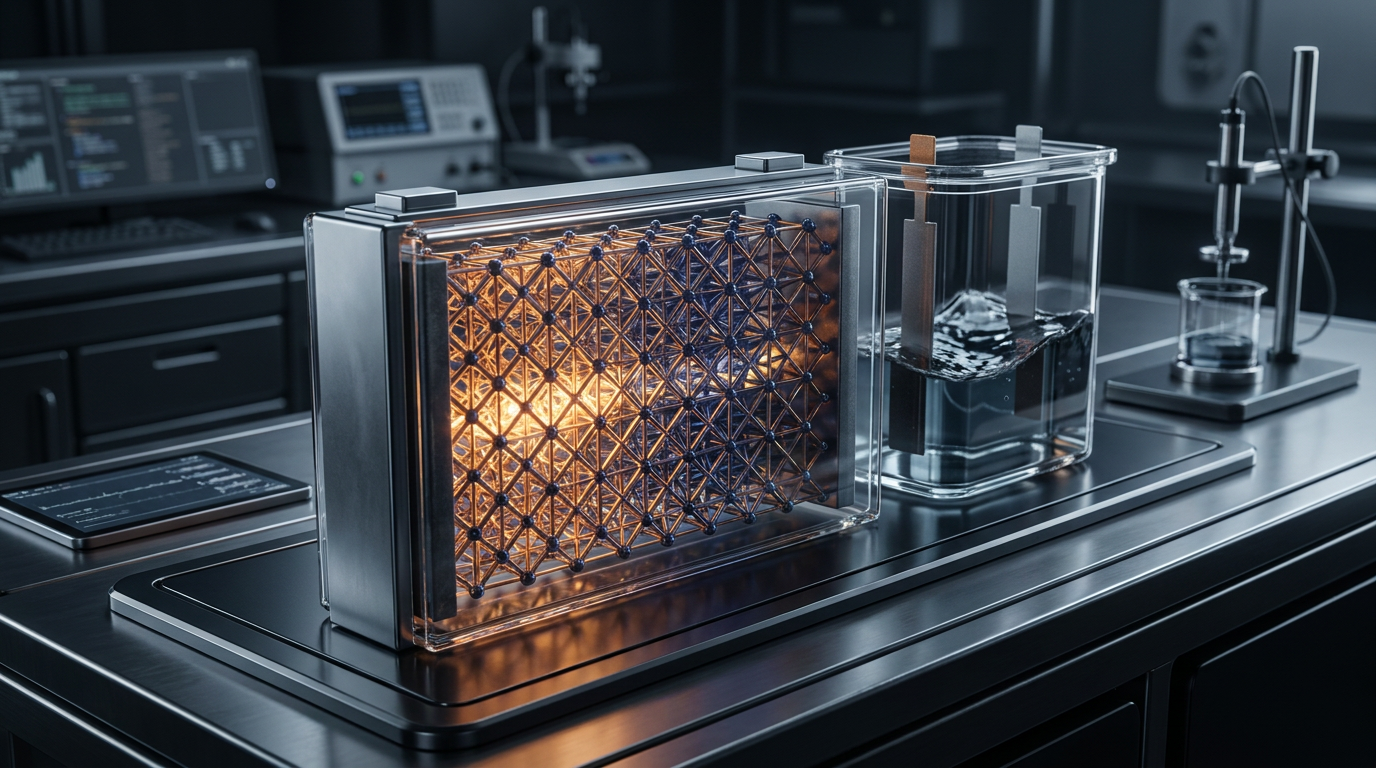
Enter the solid-state battery, a technology that replaces the volatile liquid bath with a stable, solid material. By utilizing advanced ceramics, sulfides, or specialized polymers as the conductive medium, engineers have created a crystal-like lattice that allows ions to flow freely while remaining structurally rigid.[4][5]

This single material swap fundamentally rewrites the safety profile of energy storage. Because there is no flammable organic solvent, the risk of catastrophic battery fires is virtually eliminated. Traditional liquid lithium-ion cells can enter a dangerous state called thermal runaway at temperatures as low as 90 degrees Celsius, whereas solid-state systems push that threshold to nearly 250 degrees Celsius.[1][7]
But safety is only half of the equation. The true prize driving billions of dollars in global research is energy density—the measure of how much power a battery can hold per kilogram of its own weight.[8]
To understand the massive leap in energy density, one must look at the battery's anode. In a standard lithium-ion cell, the anode is constructed from bulky graphite. The graphite does not generate power itself; it merely acts as a heavy, carbon-based sponge that safely absorbs and houses lithium ions during charging.[5]
Battery chemists have long known that replacing the graphite sponge with an anode made of pure lithium metal would drastically shrink the battery's size and weight. However, in a liquid electrolyte, lithium metal tends to form dendrites—microscopic, needle-like metallic whiskers that grow across the liquid gap, pierce the battery's internal separator, and cause explosive short circuits.[3][7]
Battery chemists have long known that replacing the graphite sponge with an anode made of pure lithium metal would drastically shrink the battery's size and weight.
The solid electrolyte solves this decades-old problem. Its rigid physical structure acts as an impenetrable barrier, mechanically suppressing the growth of dendrites. This allows manufacturers to finally deploy pure lithium metal anodes safely, unlocking what researchers call the "golden combination" of battery chemistry.[4]
The performance gains are staggering. While today's best lithium-ion batteries top out between 200 and 300 watt-hours per kilogram (Wh/kg), solid-state cells are targeting 400 to 500 Wh/kg. In practical terms, this means an electric vehicle could travel over 600 miles on a single charge, using a battery pack that is significantly lighter than today's models.[2]

Furthermore, the robust nature of the solid lattice allows the battery to absorb energy at blistering speeds without degrading. Early commercial prototypes suggest that solid-state electric vehicles will be capable of charging from 10 percent to 80 percent in just 10 to 15 minutes, rivaling the convenience of a traditional gas station visit.[4]
Given these utopian specifications, the obvious question is why solid-state batteries are not already in every driveway. The primary hurdle is the sheer complexity and cost of manufacturing.[8]
Building an all-solid-state battery requires immense precision and entirely new assembly techniques. Constructing a brand-new gigafactory line dedicated to all-solid-state cells can cost upwards of $112 million per gigawatt-hour of production capacity—roughly 30 to 50 times the cost of a standard lithium-ion facility.[2]
Because of this staggering capital expenditure, the 2026 commercial landscape is being dominated by a pragmatic bridge technology known as the semi-solid, or solid-liquid hybrid, battery.[2][6]
Semi-solid batteries utilize a mostly solid electrolyte but retain a tiny fraction of liquid to ensure the internal components maintain perfect electrical contact. This hybrid approach delivers many of the safety and density benefits of a pure solid-state cell while remaining compatible with existing manufacturing infrastructure.[2]

Crucially, upgrading a legacy lithium-ion factory to produce semi-solid batteries requires an equipment retrofit of just 10 to 15 percent of the original line cost. This economic reality has allowed semi-solid cells to scale rapidly, achieving impressive densities of up to 420 Wh/kg.[2]
How we got here
1991
The first commercial lithium-ion battery is released, revolutionizing portable electronics.
2010s
Electric vehicles scale globally, but liquid lithium-ion technology begins approaching its theoretical energy density limits.
Early 2020s
Laboratory breakthroughs prove that solid electrolytes can successfully suppress dangerous dendrite growth.
2025–2026
Semi-solid hybrid batteries enter commercial production, powering industrial drones and early-adopter vehicles.
2027–2030
Projected window for the mass-market adoption of true all-solid-state passenger vehicles.
Viewpoints in depth
Battery Innovators
Focused on pushing the absolute limits of energy density and charging speed.
For researchers and next-generation automakers, the true prize is the all-solid-state cell paired with a pure lithium metal anode. This camp views the technology as a binary shift: once the manufacturing hurdles of solid electrolytes are solved, the EV industry can double vehicle ranges and cut charging times to under 15 minutes. They argue that investing in anything less than the 'golden combination' of solid materials and lithium metal is merely a stopgap.
Manufacturing Pragmatists
Focused on the economics of scaling battery production in existing gigafactories.
Industrial suppliers and factory operators emphasize that the best battery in the world is useless if it cannot be manufactured profitably. Because a brand-new all-solid-state production line costs up to 50 times more than a standard line, this camp champions the 'semi-solid' hybrid approach. By retaining a tiny amount of liquid, manufacturers can retrofit existing gigafactories for a fraction of the cost, delivering 80 percent of the performance benefits to consumers today rather than waiting for 2030.
Safety & Market Analysts
Focused on the elimination of fire risks and the expansion of battery applications.
For market analysts and safety regulators, the most important metric isn't range—it's thermal stability. By replacing flammable organic solvents with non-combustible solid lattices, the risk of thermal runaway is virtually eliminated. This camp notes that this safety profile is what will finally allow high-density batteries to be deployed in highly sensitive environments, such as medical implants, aerospace, and dense urban energy storage grids.
What we don't know
- Exactly when true all-solid-state batteries will achieve price parity with traditional lithium-ion cells.
- How well the solid electrolytes will hold up to extreme mechanical vibrations over a 15-year vehicle lifespan.
- Which specific solid material—ceramics, sulfides, or polymers—will ultimately dominate the global manufacturing standard.
Key terms
- Electrolyte
- The medium inside a battery that allows ions to flow between the positive and negative ends, enabling the battery to charge and discharge.
- Anode
- The negative electrode of a battery where power is stored during the charging process.
- Dendrite
- Microscopic, branch-like metal formations that can grow inside liquid batteries and cause dangerous short circuits.
- Thermal Runaway
- An unstoppable chain reaction inside a battery where excess heat causes the cell to catch fire or explode.
- Energy Density
- A measurement of how much power a battery can hold relative to its weight, usually expressed in watt-hours per kilogram (Wh/kg).
- Semi-Solid Battery
- A transitional battery technology that uses a mostly solid electrolyte mixed with a small amount of liquid to ease manufacturing.
Frequently asked
What is the main difference between solid-state and lithium-ion batteries?
Traditional lithium-ion batteries use a liquid chemical bath to move ions between the anode and cathode. Solid-state batteries replace this liquid with a rigid, solid material like ceramic or specialized polymers.
What is a semi-solid battery?
A semi-solid battery is a hybrid that uses a mostly solid electrolyte but retains a tiny amount of liquid to help the internal components connect. It is easier and cheaper to manufacture today than a fully solid battery.
Will solid-state batteries make electric vehicles cheaper?
Eventually, yes. While the initial manufacturing costs are high, the massive increase in energy density means automakers can use fewer raw materials to achieve the same range, which should drive down vehicle prices over time.
Why are dendrites dangerous in batteries?
Dendrites are microscopic, needle-like metallic whiskers that can grow inside a liquid battery. If they grow long enough, they can pierce the internal separator and cause a short circuit, leading to fires.
Sources
Source coverage
8 outlets
3 viewpoints surfaced








[1]IDTechExSafety & Market Analysts
Solid-State and Polymer Batteries 2026-2036: Technology, Forecasts, Players
Read on IDTechEx →[2]Bonnen BatteriesManufacturing Pragmatists
Don't Get Fooled by Solid-State Hype: In 2026, Only Semi-Solid Batteries Are Hitting the Road!
Read on Bonnen Batteries →[3]WikipediaSafety & Market Analysts
Solid-state battery
Read on Wikipedia →[4]HighstarBattery Innovators
All-Solid-State Batteries: The Ultimate Guide to Next-Gen Power
Read on Highstar →[5]Flash BatteryBattery Innovators
What are solid-state batteries and how do they work: differences with lithium batteries
Read on Flash Battery →[6]XT BatteryManufacturing Pragmatists
Are Solid State Batteries Commercially Available in 2026?
Read on XT Battery →[7]QuratorSafety & Market Analysts
How Do Solid-State Batteries Work?
Read on Qurator →[8]Factlen Editorial Team
Synthesis by Factlen editorial team
Read on Factlen Editorial Team →



Every angle. Every day.
Get guides stories with full source coverage and perspective breakdowns delivered to your inbox.