
The End of Instant AI: How 'Test-Time Compute' is Teaching Models to Think Before They Speak
By shifting computational power from the training phase to the exact moment a user asks a question, artificial intelligence models are unlocking deliberate, multi-step reasoning that dramatically outperforms older systems.
By Factlen Editorial Team
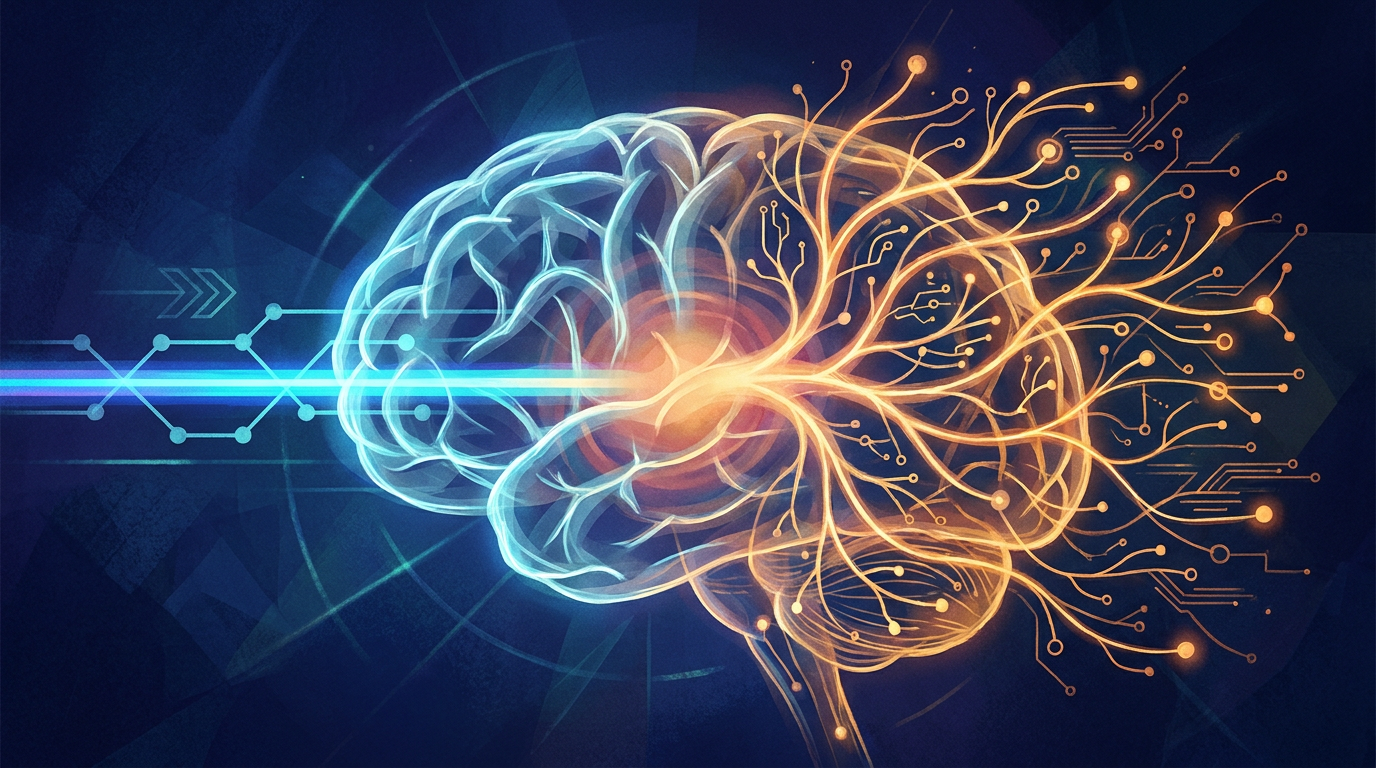
- AI Researchers & Developers
- Focuses on the efficiency gains of test-time compute, emphasizing how smaller models can now outperform massive frontier models by thinking longer.
- Enterprise Adopters
- Prioritizes the cost-benefit analysis, balancing the high intelligence of reasoning models against their increased latency and API costs.
- Cognitive Scientists
- Views the architectural shift through the lens of human psychology, comparing AI's new capabilities to Daniel Kahneman's System 1 and System 2 thinking.
What's not represented
- · Environmental Advocates concerned about the energy footprint of inference scaling
- · Consumer Application Developers managing latency expectations
Why this matters
Understanding how AI models 'think' allows users to deploy them more effectively, knowing when to use a fast, cheap model for simple tasks and when to leverage a slower, reasoning-heavy model for complex problem-solving.
Key points
- Test-time compute allows AI models to spend processing power deliberating on an answer rather than generating it instantly.
- This shift mimics human 'System 2' thinking, enabling models to solve complex math, coding, and logic problems.
- Smaller AI models utilizing test-time compute can now outperform massive frontier models on difficult benchmarks.
- The trade-offs for this deeper reasoning include significantly higher latency and increased per-query costs.
- The industry is moving toward hybrid systems that route simple questions to fast models and hard questions to reasoning models.
If you have interacted with a cutting-edge artificial intelligence model recently, you may have noticed a subtle but profound change: a pause. Instead of instantly streaming a response, the interface displays a 'thinking...' indicator, sometimes spinning for ten to sixty seconds before delivering an answer. This delay is not a network glitch or a server overload. It represents one of the most significant architectural revolutions in the history of machine learning.
For years, large language models operated entirely on what cognitive psychologists call 'System 1' thinking—fast, intuitive, and automatic. When prompted, traditional models generated responses sequentially, predicting the next most likely word in milliseconds without ever backtracking or reconsidering their logic. It was akin to a student taking a closed-book exam under extreme time pressure, blurting out the first plausible answer that came to mind. While this approach produced remarkably fluent text, it frequently stumbled on complex multi-step logic, leading to confident but mathematically or factually flawed outputs.[3]
Until recently, the AI industry's primary solution to this limitation was brute force. Developers relied on 'train-time compute,' building exponentially larger models and feeding them vast oceans of data. But this paradigm hit a wall. Training frontier models began costing billions of dollars, demanding massive data centers and months of continuous processing. The industry needed a way to make models smarter without simply making them bigger.[2]
The breakthrough came in the form of 'test-time compute,' also known as inference-time scaling. Instead of expending all computational resources during the initial training phase, researchers discovered they could dramatically boost a model's intelligence by giving it a compute budget at the exact moment the user asks a question. By allowing the AI to spend time deliberating, exploring options, and refining its ideas, developers unlocked a digital equivalent of 'System 2' thinking—slow, deliberate, and analytical.[1][3]

The mechanics of this process are hidden but fascinating. When a reasoning model receives a complex prompt, it does not immediately begin typing the final answer. Instead, it generates a hidden 'chain of thought,' producing thousands of internal thinking tokens. During this phase, the model breaks the problem down into manageable sub-tasks, converts variables, maps out logical dependencies, and drafts preliminary solutions on a virtual scratchpad.[4]
Crucially, this internal deliberation is not a straight line. Advanced test-time compute utilizes techniques like 'Tree of Thought' or parallel sampling. The model branches out, exploring multiple different reasoning paths simultaneously. If one path leads to a logical contradiction or a mathematical dead end, the model can abandon it, backtrack, and pursue a more promising avenue.[1][4]
To navigate these branching paths, reasoning models employ internal 'verifiers' or reward models. These are specialized sub-systems trained specifically to evaluate the quality of a logical step. Just as a human mathematician checks their work after solving an equation, the verifier scores the AI's intermediate steps, pruning the bad ideas and elevating the strongest candidate to become the final output.[4]
To navigate these branching paths, reasoning models employ internal 'verifiers' or reward models.
The empirical results of this architectural shift have been staggering. When OpenAI released its o1 reasoning model, the performance delta on complex benchmarks shocked the industry. On a qualifying exam for the International Mathematics Olympiad (IMO), the standard GPT-4o model scored a mere 13%. The o1 model, utilizing test-time compute, scored 83%. Independent researchers testing the model on rigorous national mathematics exams found it achieved near-perfect scores, operating at the level of a PhD student.[3][5]

Perhaps the most disruptive revelation is that test-time compute upends the 'bigger is better' dogma. A landmark 2024 study demonstrated that a relatively small language model—when given a sufficient budget of test-time compute to search for the right answer—can consistently outperform massive frontier models that are ten times its size. This leveled the playing field, proving that deep thinking can conquer raw parameter count.[1]
This realization triggered a massive wave of open-source innovation. By early 2025, models like DeepSeek-R1 proved that pure reinforcement learning could produce reasoning capabilities matching proprietary giants at a fraction of the cost. Shortly after, specialized open-source models combining reinforcement learning with test-time agents began winning gold medals in simulated international physics olympiads, proving the technique's viability across scientific domains.[4][6]
However, the shift to System 2 AI introduces significant trade-offs, the most obvious being latency. A model that spends 45 seconds generating internal thinking tokens is fundamentally unsuited for rapid-fire conversational chatbots or real-time voice assistants. While a minute of waiting is trivial for an autonomous agent writing a complex software application, it is an eternity for a user asking for a simple recipe.[2]
The second major trade-off is cost. Generating thousands of hidden reasoning tokens requires substantial processing power. Inference-time scaling effectively shifts the financial burden from the AI laboratory's training cluster to the end-user's API bill. A single complex query that utilizes extensive test-time compute can cost significantly more than a standard instantaneous generation, forcing developers to carefully manage their reasoning budgets.[2]

This dynamic introduces the 'overthinking' problem. If a user asks a reasoning model a trivial question—such as 'What is the capital of France?'—the model may waste valuable compute cycles analyzing the geopolitical history of Europe before concluding that the answer is Paris. Treating every piece of context as a variable in a deep reasoning chain is highly inefficient for simple information retrieval.[4]
To solve this, the industry is rapidly adopting adaptive routing architectures. In these hybrid systems, a lightweight 'router' evaluates the complexity of an incoming prompt. Simple, fact-based queries are instantly directed to fast, System 1 models. Only complex mathematical, coding, or logical tasks are escalated to the slower, more expensive System 2 reasoning engines. This ensures that compute is only spent where it genuinely adds value.[2]
The rise of test-time compute is now reshaping the physical infrastructure of the technology sector. Historically, the most intense computational demands occurred during the training of new models. Today, analysts project that inference will claim up to 75% of total AI compute by the end of the decade. This is driving a massive pivot in hardware procurement, with data centers increasingly prioritizing inference-optimized silicon over traditional training clusters.[2][6]

Artificial intelligence is maturing past the era of the fast-talking pattern matcher. By learning to pause, reflect, verify, and correct its own mistakes, AI is taking its first definitive steps toward deliberate, structured reasoning. The models of the future will not just be defined by how much data they have memorized, but by how deeply they are allowed to think.[6]
How we got here
Pre-2024
AI scaling relied almost entirely on increasing training data and model size, known as 'train-time compute'.
August 2024
Researchers publish landmark papers proving test-time compute can outperform traditional model scaling.
September 2024
OpenAI releases the o1 model, introducing mainstream 'System 2' reasoning to the public.
Early 2025
Open-source models like DeepSeek-R1 replicate advanced reasoning capabilities at a fraction of the cost.
2026
Inference-time scaling becomes the dominant paradigm, reshaping data center infrastructure and hardware procurement.
Viewpoints in depth
AI Researchers & Developers
Focuses on the efficiency gains of test-time compute, emphasizing how smaller models can now outperform massive frontier models by thinking longer.
For the research community, test-time compute represents an escape from the unsustainable economics of training ever-larger models. By proving that a 14-billion parameter model can beat a 70-billion parameter model simply by searching longer for the right answer, researchers have democratized advanced AI capabilities. This camp views inference scaling as the key to unlocking autonomous agents that can plan and execute tasks over long time horizons without requiring trillion-dollar training clusters.
Enterprise Adopters
Prioritizes the cost-benefit analysis, balancing the high intelligence of reasoning models against their increased latency and API costs.
Business leaders and software engineers are highly pragmatic about the shift to reasoning models. While they celebrate the ability to automate complex coding and data analysis tasks, they are acutely aware of the 'overthinking' problem. For enterprise applications, spending 30 seconds and a dollar's worth of compute to answer a simple customer service query is a failure. This camp is heavily focused on building adaptive routing systems that triage prompts, sending only the most difficult tasks to the expensive System 2 models.
Cognitive Scientists
Views the architectural shift through the lens of human psychology, comparing AI's new capabilities to Daniel Kahneman's System 1 and System 2 thinking.
Experts studying the intersection of human cognition and artificial intelligence see test-time compute as a profound structural alignment between machines and the human brain. They note that humans do not solve calculus problems by instantly blurting out the next logical syllable; we use scratchpads, we backtrack, and we verify our work. By embedding these exact mechanisms—chain of thought, tree search, and reward modeling—into neural networks, cognitive scientists argue that AI is moving from mere pattern mimicry toward genuine, structured reasoning.
What we don't know
- Whether the energy demands of inference-heavy reasoning models will outpace the efficiency gains of smaller model sizes.
- How quickly hardware manufacturers can pivot to produce silicon optimized specifically for test-time compute workloads.
- The absolute ceiling of inference-time scaling—whether giving a model infinite time to think will eventually yield diminishing returns.
Key terms
- Test-Time Compute (TTC)
- The computational power and time an AI model uses to process a prompt and generate a response, as opposed to the compute used to train the model initially.
- System 1 vs. System 2 Thinking
- A psychological framework applied to AI, where System 1 is fast, intuitive pattern-matching, and System 2 is slow, deliberate, multi-step reasoning.
- Chain of Thought (CoT)
- A technique where an AI model breaks a complex problem down into a series of intermediate logical steps before arriving at a final conclusion.
- Reward Model / Verifier
- An internal AI sub-system that evaluates the quality of a model's intermediate reasoning steps, helping it choose the best path forward.
- Inference
- The phase in machine learning where a trained model is actively used to make predictions or generate text based on new user inputs.
Frequently asked
Why do newer AI models take so long to answer?
Instead of predicting the next word instantly, reasoning models spend time generating hidden 'thinking tokens' to map out logic, check their work, and correct mistakes before showing you the final result.
Does test-time compute make AI more expensive?
Yes. Because the model generates thousands of hidden tokens to reason through a problem, a single complex query costs significantly more in compute power than a standard instant response.
Can smaller AI models really beat massive ones now?
Yes. Research shows that a smaller model given a large budget of test-time compute to search for the right answer can outperform a model ten times its size that relies only on instant generation.
What is the 'overthinking' problem in AI?
When a reasoning model is asked a simple, factual question, it may waste time and compute power deeply analyzing irrelevant context instead of just providing the obvious answer.
Sources
Source coverage
6 outlets
3 viewpoints surfaced






[1]arXivAI Researchers & Developers
Scaling LLM Test-Time Compute Optimally can be More Effective than Scaling Model Parameters
Read on arXiv →[2]MediumEnterprise Adopters
Inference-Time Scaling: How Modern AI Models Think Longer to Perform Better
Read on Medium →[3]MDPICognitive Scientists
System 2 Thinking in OpenAI's o1-Preview Model: Near-Perfect Performance on a Mathematics Exam
Read on MDPI →[4]Hugging FaceAI Researchers & Developers
Test-Time Compute: How AI Models Think Deeper
Read on Hugging Face →[5]Marketing AI InstituteEnterprise Adopters
OpenAI o1: What You Need to Know
Read on Marketing AI Institute →[6]Factlen Editorial TeamCognitive Scientists
Synthesis by Factlen editorial team
Read on Factlen Editorial Team →


Every angle. Every day.
Get ai stories with full source coverage and perspective breakdowns delivered to your inbox.