
The End of the NISQ Era: How Quantum Error Correction Made Logical Qubits a Reality
In 2026, quantum computing crossed a critical threshold, proving that error correction can successfully stabilize fragile qubits. This breakthrough marks the transition from theoretical physics to scalable engineering.
By Factlen Editorial Team
- Superconducting Advocates
- Focus on the fast gate speeds and proven scaling of surface codes on superconducting chips.
- Neutral Atom Pioneers
- Emphasize the high connectivity and naturally long coherence times of laser-trapped atoms.
- Topological Innovators
- Pursue exotic physics to build qubits that are inherently resistant to errors at the hardware level.
- Enterprise Adopters
- Prioritize hybrid classical-quantum workflows and standardized benchmarks for real-world ROI.
What's not represented
- · Cryptographers preparing for Q-Day
- · Classical supercomputing hardware vendors
Why this matters
Quantum computers promise to solve complex problems in minutes that would take classical supercomputers millennia. By proving that quantum errors can be reliably corrected, the industry has cleared the biggest scientific roadblock to unlocking revolutionary advancements in drug discovery, materials science, and cryptography.
Key points
- Quantum computing has officially transitioned from the Noisy Intermediate-Scale Quantum (NISQ) era to the Fault-Tolerant Foundation Era.
- Researchers proved that adding more physical qubits to a system exponentially suppresses logical error rates.
- Multiple hardware modalities, including superconducting circuits and neutral atoms, achieved major logical qubit milestones in 2026.
- The industry is adopting hybrid architectures, integrating quantum processing units with classical cloud infrastructure.
- Standardized frameworks are emerging to objectively benchmark logical qubit claims across different hardware platforms.
For the past decade, the quantum computing industry has been trapped in the "Noisy Intermediate-Scale Quantum" (NISQ) era. Researchers could build processors with hundreds of quantum bits, or qubits, but the systems were fundamentally fragile. Even the slightest environmental interference—a stray photon, a microscopic temperature fluctuation, or ambient electromagnetic noise—would cause the qubits to lose their quantum state, a process known as decoherence. This fragility meant that quantum computers could only run shallow, brief calculations before the accumulated errors rendered the output useless. But in 2026, the industry officially crossed a threshold that theorists have anticipated for thirty years. The field has entered the "Fault-Tolerant Foundation Era," a paradigm shift where adding more qubits to a system actually reduces the overall error rate rather than amplifying the noise.[2]
The mechanism driving this revolution is Quantum Error Correction (QEC). In classical computing, error correction is relatively straightforward: a system simply copies a bit of data multiple times. If a cosmic ray flips a 1 to a 0, the computer checks the redundant copies, takes a majority vote, and overwrites the error. However, the fundamental laws of quantum mechanics strictly forbid this approach. The "no-cloning theorem" dictates that it is physically impossible to create an identical copy of an unknown quantum state. If you cannot copy a qubit, and if measuring a qubit destroys its delicate superposition, engineers faced a seemingly insurmountable paradox: how do you detect and fix an error without looking at the data?[1]
The solution lies in the concept of the "logical qubit." Instead of relying on a single, error-prone physical qubit (the actual hardware component, such as a superconducting circuit or a trapped ion), quantum error correction weaves the information of one logical qubit across a vast, entangled network of multiple physical qubits. This redundancy allows the hardware to perform "syndrome measurements." By carefully measuring specific auxiliary qubits that are entangled with the data qubits, the system can extract information about whether an error occurred—and exactly what kind of error it was—without ever directly observing or collapsing the encoded quantum information itself.[1]

Two primary types of errors plague quantum systems. The first is a bit-flip error, which is analogous to a classical error where a 0 becomes a 1. The second is a phase-flip error, a uniquely quantum phenomenon that inverts the relative phase between the components of a superposition. A functional quantum error correction scheme must detect and correct both simultaneously. For years, the overhead required to do this was staggering. Early theories suggested it might take 1,000 or even 10,000 physical qubits to create just one reliable logical qubit, making large-scale fault-tolerant computing seem decades away.[1]
The turning point arrived when hardware finally became reliable enough to cross the "threshold." The threshold theorem states that if the baseline error rate of the physical qubits falls below a certain critical percentage, the error correction code will successfully suppress errors faster than the extra hardware introduces them. If the physical qubits are too noisy, adding more of them to the error-correction lattice simply creates more opportunities for failure. But once that threshold is crossed, a magical scaling law takes over: increasing the size of the qubit lattice exponentially drives down the logical error rate.[1][3]
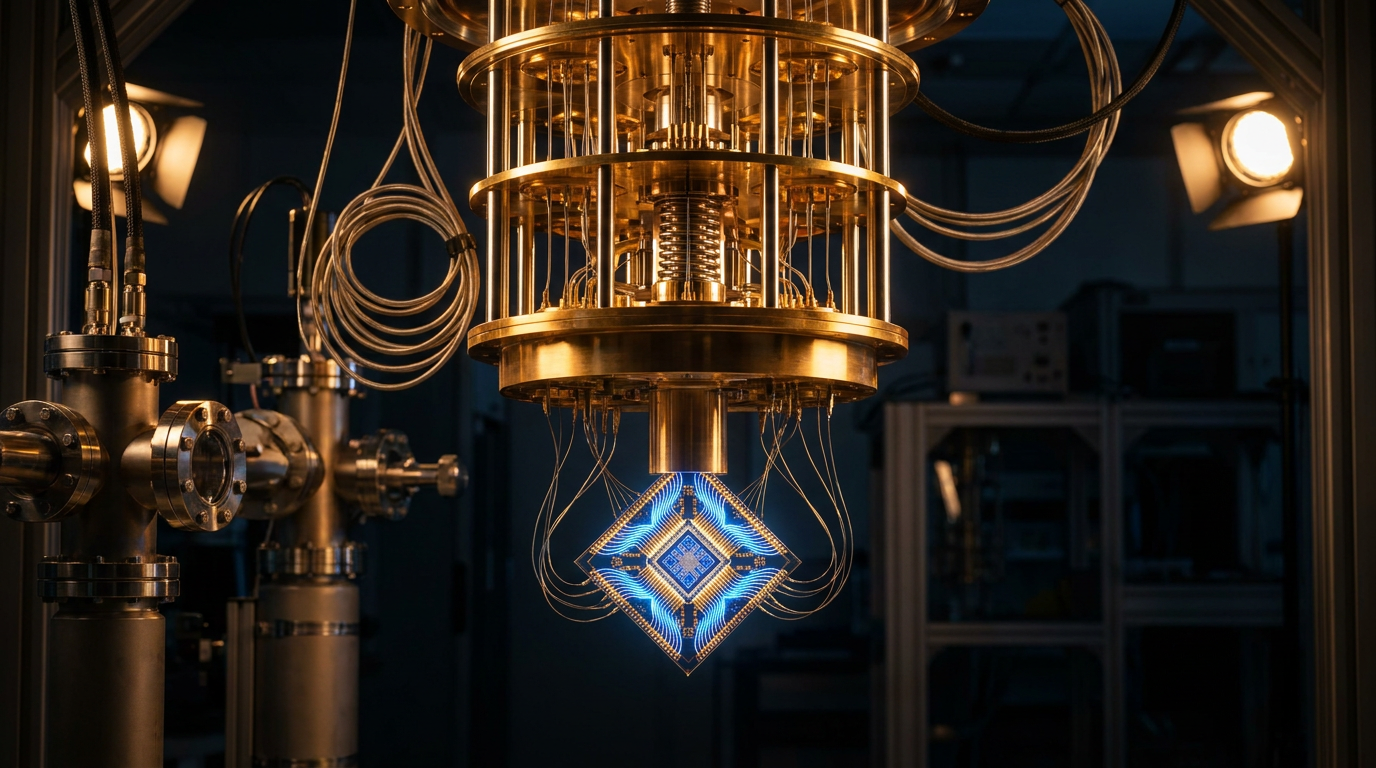
Google's Quantum AI division provided the definitive empirical proof of this scaling law with its Willow processor. Utilizing a 105-physical-qubit superconducting chip, Google demonstrated that logical error rates decreased by a factor of roughly 2.14 with each increase in their surface-code lattice size. This was the first hardware-scale proof that fault-tolerant quantum computing obeys the exact exponential scaling curves that theoretical physicists had predicted. It proved that the path to zero-error quantum computing is no longer a question of discovering new physics, but rather a matter of scaling up engineering pipelines.[3]

Google's Quantum AI division provided the definitive empirical proof of this scaling law with its Willow processor.
While Google championed superconducting circuits, other modalities achieved equally stunning milestones in 2026. Atom Computing, working in partnership with Microsoft, utilized neutral-atom hardware to create and entangle 24 logical qubits built from just 112 physical qubits. They successfully ran computations using the Bernstein–Vazirani algorithm, marking one of the first demonstrations where logical qubits served as the primary computational abstraction rather than physical qubits. Neutral atoms, which are suspended in a vacuum using precisely calibrated optical tweezers, offer high connectivity and naturally long coherence times, making them a formidable alternative to superconducting chips.[3]
The race for logical qubit volume accelerated rapidly across the industry. QuEra Computing and Quantinuum pushed the boundaries further, demonstrating systems with 30 and 48 error-corrected logical qubits, respectively. Quantinuum's Helios system achieved a remarkable 2.1 ratio of logical to physical qubits, showcasing the efficiency of advanced error correction codes. Meanwhile, Pasqal demonstrated the routine production of logical qubits on its neutral-atom platform, proving that these fault-tolerant building blocks can be generated reliably for enterprise partners.[4][5]

As the sheer number of logical qubit claims proliferated, the industry recognized the need for standardized metrics. In June 2026, quantum computing company Alice & Bob released a comprehensive five-criteria framework to define and benchmark logical qubits objectively. Their framework argues that a true logical qubit must demonstrate "breakeven"—meaning the logical qubit's lifetime strictly exceeds that of its constituent physical qubits. It must also feature scalable parameters, endure sufficient error-correction cycles, and perform reliably across all runs without cherry-picking data. This standardization is crucial for enterprise decision-makers trying to separate genuine hardware maturity from marketing hype.[4]
The transition to fault-tolerant computing is also reshaping how quantum computers integrate with existing technology. The industry has firmly settled on a hybrid quantum-classical architecture. Businesses will not replace their classical servers with quantum processors. Instead, classical high-performance computing (HPC) infrastructure will orchestrate the workflows, outsourcing only the most exponentially complex mathematical bottlenecks to a quantum processing unit (QPU) via the cloud. This hybrid approach is already being standardized by major cloud providers, making quantum acceleration accessible to engineering teams without requiring them to build cryogenic laboratories.[3]
The implications of reliable logical qubits extend far beyond the technology sector. With error rates plummeting, quantum computers are inching closer to "quantum advantage"—the point at which they can solve economically valuable problems that are practically impossible for classical supercomputers. The first wave of real-world applications is expected in materials science and chemistry. Because quantum computers natively operate using the rules of quantum mechanics, they are uniquely suited to simulate molecular interactions, potentially accelerating the discovery of next-generation battery materials, clean-energy catalysts, and targeted pharmaceuticals.[5]

Despite the monumental triumphs of 2026, significant engineering hurdles remain. Scaling from dozens of logical qubits to the thousands required to break RSA encryption or simulate complex proteins will require massive advancements in control electronics. Researchers must figure out how to route thousands of microwave control cables into dilution refrigerators operating at temperatures colder than deep space without introducing catastrophic heat. Breakthroughs in cryoelectronics, such as those demonstrated by Fermilab and MIT Lincoln Laboratory, are actively addressing this bottleneck by moving the control circuitry directly into the vacuum chamber.[2]
The quantum computing landscape of 2026 is defined by a profound sense of graduation. The fundamental question of whether quantum error correction can work in the real world has been answered with a resounding yes. The challenge has shifted from proving the physics to refining the engineering, optimizing the codes, and scaling the manufacturing. As logical qubits become the standard currency of quantum computation, the world is standing on the precipice of a new computational era, one that promises to unlock solutions to some of humanity's most intractable challenges.[6]
How we got here
Pre-2026
The NISQ Era is defined by noisy, error-prone physical qubits that limit computation length.
Dec 2024
Google's Willow processor demonstrates exponential error suppression on superconducting hardware.
Early 2026
Atom Computing and Microsoft successfully entangle 24 logical qubits using neutral atoms.
June 2026
Alice & Bob release a five-criteria framework to standardize logical qubit claims across the industry.
Viewpoints in depth
Superconducting Circuit Advocates
Proponents of superconducting qubits emphasize their fast gate speeds and proven track record of scaling.
Organizations like Google and IBM have invested heavily in superconducting circuits, which operate at near absolute zero. This camp argues that because superconducting qubits have incredibly fast gate operation times, they can execute complex error correction cycles rapidly. Their primary evidence is the successful demonstration of surface codes, which have proven that logical error rates can be driven down exponentially as the physical lattice size increases.
Neutral Atom Pioneers
Advocates for neutral atoms highlight the high connectivity and natural identicality of laser-trapped qubits.
Companies like Atom Computing, QuEra, and Pasqal argue that neutral atoms offer a superior path to fault tolerance. Because every atom of a specific isotope is identical by nature, there are no manufacturing defects between qubits. Furthermore, optical tweezers allow these qubits to be moved dynamically during computation, enabling high-connectivity error correction codes (like qLDPC) that require far fewer physical qubits per logical qubit compared to superconducting surface codes.
Topological Qubit Innovators
Researchers pursuing topological qubits aim to build hardware that is inherently resistant to errors.
Microsoft and its partners are betting on topological qubits, which rely on exotic quasiparticles like Majorana fermions. This camp argues that instead of building massive arrays of physical qubits to correct errors after they happen, it is more efficient to engineer qubits that are mathematically immune to local noise. While this approach is experimentally more difficult to realize, its proponents believe it will ultimately scale to millions of qubits much faster than competing modalities once the foundational physics is perfected.
What we don't know
- Which hardware modality (superconducting, neutral atom, topological) will ultimately scale most cost-effectively to millions of qubits.
- Exactly when quantum advantage will be achieved for commercial applications like drug discovery and materials science.
- How quickly control electronics and cryogenics can be miniaturized to support massive logical qubit arrays.
Key terms
- Logical Qubit
- A protected, highly reliable quantum bit built from a network of multiple physical qubits using error correction.
- Physical Qubit
- The actual hardware component, such as a superconducting circuit or trapped atom, that stores quantum information.
- Decoherence
- The process by which a quantum system loses its delicate state due to environmental noise or interference.
- Syndrome Measurement
- A technique to detect quantum errors by measuring auxiliary qubits without observing the actual encoded data.
- No-Cloning Theorem
- A principle of quantum mechanics stating that it is impossible to create an identical copy of an unknown quantum state.
Frequently asked
Will quantum computers replace classical computers?
No. The industry is moving toward hybrid architectures where classical supercomputers handle everyday tasks and outsource only the most complex calculations to quantum processors.
What is the difference between a physical and logical qubit?
A physical qubit is the raw hardware component, which is highly prone to errors. A logical qubit is a virtual, highly stable qubit created by entangling many physical qubits together using error correction.
Why is 2026 a turning point for quantum computing?
Researchers definitively proved that adding more physical qubits to a system reduces the overall error rate, crossing the threshold into the 'Fault-Tolerant Foundation Era'.
Sources
Source coverage
6 outlets
4 viewpoints surfaced






[1]Quantum ZeitgeistEnterprise Adopters
What is Quantum Error Correction? Complete 2026 Beginner's Guide
Read on Quantum Zeitgeist →[2]SpinQuantaNeutral Atom Pioneers
2026 Qubit Breakthroughs: Quantum Computing Enters the 'Fault-Tolerant Foundation Era'
Read on SpinQuanta →[3]BQPSimSuperconducting Advocates
The 2026 breakthroughs confirm the direction quantum computing is heading
Read on BQPSim →[4]Alice & BobTopological Innovators
Defining the Logical Qubit: Five Criteria to Benchmark Logical Qubit Claims
Read on Alice & Bob →[5]PasqalNeutral Atom Pioneers
Logical Qubits Advance to Real-World Impact
Read on Pasqal →[6]Factlen Editorial TeamEnterprise Adopters
Synthesis by Factlen editorial team
Read on Factlen Editorial Team →
More in technology
See all 5 stories →Digital Ownership
The Grassroots Fight to Save Video Games from Server Shutdowns Hits a Legal Wall in Europe
7 sources
EV Trends
The Rise of the Electric 'Grand Limousine': How Minivans Became the Ultimate Luxury EVs
6 sources

Materials Science
How AI Startups Are Shrinking the Century-Long Wait for New Materials
7 sources
Every angle. Every day.
Get technology stories with full source coverage and perspective breakdowns delivered to your inbox.