
OLED vs. Mini-LED TVs: The 2026 Comparison and Trade-Off Analysis
As OLED panels get brighter and Mini-LEDs achieve better contrast, the 2026 television market offers two distinct paths to premium picture quality. Choosing the right display depends entirely on your room's lighting, your media diet, and your budget for large screen sizes.
By Factlen Editorial Team
- Home Cinema Purists
- Value perfect blacks, infinite contrast, and exact creator intent.
- Bright-Room Pragmatists
- Prioritize high peak brightness and glare reduction for daytime viewing.
- Value-Conscious Upgraders
- Focus on maximizing screen size per dollar and long-term panel durability.
What's not represented
- · Environmental advocates focusing on the energy consumption differences between the technologies.
- · Professional colorists who require reference-monitor accuracy for studio work.
Why this matters
A premium television is a multi-year investment that dictates how you experience movies, sports, and gaming. Understanding the specific trade-offs between OLED and Mini-LED prevents you from overpaying for features that don't match your living room's lighting or your viewing habits.
Key points
- OLED TVs use self-illuminating pixels to achieve perfect black levels and infinite contrast.
- Mini-LED TVs use thousands of backlight zones to deliver exceptional peak brightness.
- 2026 OLED models have significantly improved brightness, narrowing the daylight viewing gap.
- Mini-LED technology is immune to permanent burn-in and boasts a 100,000-hour lifespan.
- OLED remains the superior choice for dark rooms, while Mini-LED dominates bright spaces.
- Mini-LED offers far better value for buyers seeking massive 75-inch or 85-inch screens.
The 2026 television market is dominated by two acronyms that dictate the premium viewing experience: OLED and Mini-LED. The era of standard LCD panels serving as the high-end benchmark is officially over, replaced by a heavyweight technological bout that forces consumers to choose between absolute precision and overwhelming power. For anyone upgrading their living room or building a dedicated home theater, this single technological fork is the most consequential decision in the purchasing process. Rather than a simple hierarchy where one technology universally defeats the other, the current landscape presents a fascinating study in specialized engineering. Each panel type has been ruthlessly optimized to solve specific environmental challenges, meaning the ultimate winner depends entirely on the architectural realities of the room it will inhabit and the specific media diet of the viewer.[1][2]
Understanding the trade-offs begins with the fundamental mechanical divide between the two display architectures. OLED, which stands for Organic Light Emitting Diode, features over 8.2 million self-illuminating pixels in a standard 4K display. This means that every single microscopic dot on the screen generates its own independent light and color, requiring no separate backlight mechanism. Mini-LED, conversely, relies on a highly advanced evolution of traditional LCD technology. It utilizes a dedicated liquid crystal panel that is illuminated from behind by thousands of microscopic LED lights. Rather than acting as a single uniform flashlight, these miniature diodes are grouped into hundreds or even thousands of independently controllable dimming zones, allowing the television to dynamically adjust the backlight intensity across different regions of the screen based on the content being displayed.[2][3]
The primary argument for OLED rests on its absolute, pixel-level precision. Because an OLED panel can command individual pixels to turn off completely, it achieves perfect, infinite black levels. When a cinematic scene features a bright starship flying across a pitch-black galaxy, the space immediately surrounding the ship emits zero light. This creates a staggering contrast ratio that traditional backlit televisions simply cannot replicate. For home cinema purists watching letterboxed movies in darkened rooms, this capability provides an unmatched sense of depth, making the image appear almost three-dimensional. The absence of a backlight also means that OLED panels offer exceptionally wide viewing angles, ensuring that colors remain accurate and contrast remains deep even for viewers sitting on the far edges of a wide sectional sofa.[1][2]
Crucially, this pixel-level control entirely eliminates 'blooming'—the distracting visual artifact that often plagues backlit televisions. Blooming occurs when light from a bright on-screen object bleeds into the surrounding dark areas, creating a hazy halo effect. This is most noticeable around white subtitles on a black background or during stark, high-contrast title sequences. Because Mini-LEDs rely on dimming zones that cover multiple pixels at once, they can never perfectly isolate a bright highlight from its dark neighbor. By completely bypassing the need for zones, OLED delivers a pristine, artifact-free image that perfectly preserves the original intent of the cinematographer, serving as the ultimate evidence for its superiority in controlled lighting environments.[2][4]

However, the case against OLED has historically centered on two significant limitations: peak brightness and long-term panel longevity. The organic materials used in OLED construction naturally degrade over time, introducing a slight but persistent risk of permanent image retention, commonly known as 'burn-in.' If static elements—such as a rolling news ticker, a sports network logo, or a video game heads-up display—are left on the screen for thousands of cumulative hours, their faint ghost can permanently etch into the panel. While modern OLEDs employ aggressive pixel-shifting algorithms and automatic brightness limiters to mitigate this risk, the underlying organic chemistry means the anxiety of panel degradation remains a factor for heavy users.[1][5]
Enter Mini-LED, the technology explicitly engineered to overpower OLED’s inherent weaknesses through sheer brute force. By packing thousands of brilliant inorganic diodes tightly behind the screen, Mini-LED panels can achieve blinding peak brightness levels that organic panels simply cannot sustain. While standard OLED televisions typically hover around 800 to 1,000 nits of peak brightness, premium 2026 Mini-LED models routinely push past 3,000 nits, with some flagship sets capable of hitting an astonishing 4,000 nits in localized highlights. This massive disparity in raw luminance fundamentally changes how high-dynamic-range (HDR) content is rendered, making explosions, sun glare, and bright skies look startlingly realistic and intensely vibrant.[2][4]
Enter Mini-LED, the technology explicitly engineered to overpower OLED’s inherent weaknesses through sheer brute force.
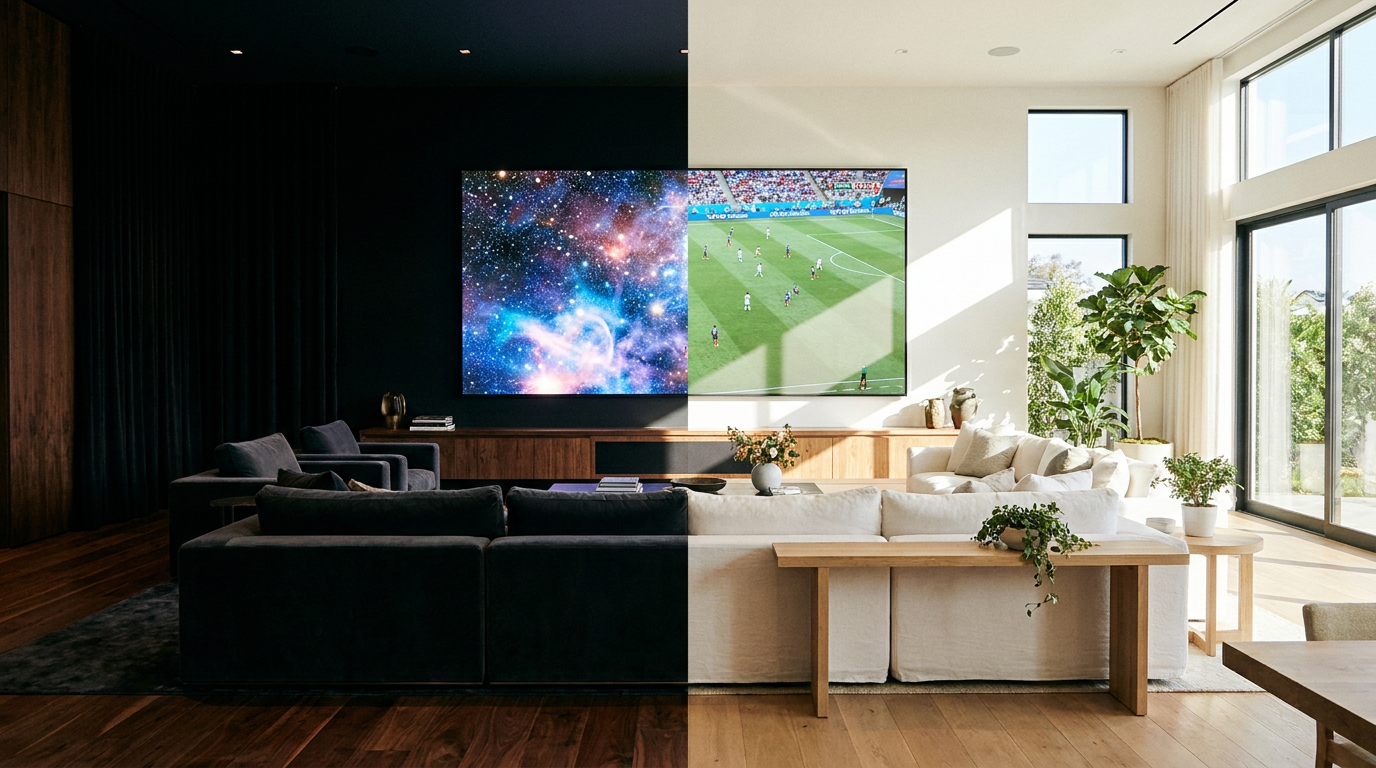
This overwhelming light output makes Mini-LED the undisputed champion of the bright, sun-drenched living room. If a viewing space features large, uncovered windows, skylights, or intense overhead lighting, an OLED panel can often look washed out, acting more like a dark mirror reflecting the room back at the viewer. A high-end Mini-LED panel, by contrast, cuts through ambient daylight glare with effortless ease. For households where daytime sports broadcasts, morning news, or casual afternoon gaming are the primary use cases, the sustained full-screen brightness of a Mini-LED ensures that the picture remains punchy, saturated, and perfectly visible regardless of the time of day.[1][2]
Furthermore, the inorganic nature of Mini-LED technology effectively eliminates the burn-in anxiety that haunts OLED owners. Industry testing and manufacturer specifications indicate that these LED backlights boast a standard lifespan of roughly 100,000 hours—equating to more than a decade of continuous, round-the-clock operation. Even under the most strenuous testing conditions, Mini-LED panels show virtually no susceptibility to permanent image retention. For families that leave the television running all day as background noise, or for users who exclusively watch a single cable news channel with static lower-third graphics, this bulletproof durability provides a decisive, quantifiable advantage over organic alternatives.[5]

Yet, the 2026 television market has dramatically blurred these traditional boundaries, turning the comparison into a moving target. OLED manufacturers have aggressively fought back in the brightness war by introducing advanced architectures like 'Tandem OLED' and 'QD-OLED' (Quantum Dot OLED). By stacking multiple emissive layers or utilizing highly efficient quantum dot color filters, the latest flagship OLEDs are now capable of pushing peak brightness between 2,000 and 2,800 nits. While they still cannot match a Mini-LED's sustained full-screen brightness during a hockey game, these advancements have largely neutralized OLED's historical daylight viewing penalty, making them highly viable for mixed-use living spaces.[3][6]
Simultaneously, Mini-LED manufacturers have refused to concede the contrast battle. By dramatically increasing their local dimming zone counts—often moving from hundreds of zones to several thousand—and refining the artificial intelligence algorithms that control them, the blooming effect has been aggressively minimized. On premium 2026 Mini-LED sets, haloing is now so tightly controlled that only the most discerning videophiles will notice it during standard playback. While it still cannot achieve the mathematical perfection of pixel-level dimming, the gap in perceived contrast has narrowed significantly, forcing buyers to look beyond basic black levels when making their final decision.[2][4]
When evaluating the evidence for gaming performance, both technologies offer stellar feature sets, including 120Hz to 144Hz refresh rates, variable refresh rate (VRR) support, and auto low-latency modes. However, OLED retains a distinct, measurable edge in pixel response time. Because organic pixels can change state almost instantaneously—often in less than 0.1 milliseconds—OLED panels provide a perfectly clear, blur-free image during fast-paced motion. For competitive gamers playing frantic first-person shooters or high-speed racing simulators, this unparalleled motion clarity is a massive advantage, whereas even the most advanced Mini-LEDs still exhibit microscopic amounts of ghosting or smearing behind fast-moving objects.[2]
Price scaling presents the final, and often most practical, trade-off in the comparison. Mini-LED technology scales to massive dimensions far more economically than organic panel manufacturing. For buyers seeking a truly cinematic 75-inch, 85-inch, or even 100-inch display, Mini-LED offers premium, room-filling performance at a fraction of the cost of an equivalently sized OLED. As OLED yields drop and prices skyrocket at sizes above 77 inches, the value proposition heavily favors Mini-LED for anyone prioritizing sheer screen real estate over microscopic pixel precision.[1][6]

Ultimately, synthesizing these trade-offs reveals that there is no universally superior television technology in 2026—only the correct tool for a specific environment. OLED technology fits perfectly when the television resides in a light-controlled room, a basement den, or a dedicated home theater. It remains the definitive choice for viewers whose primary media diet consists of high-dynamic-range movies, prestige television, or high-end gaming, and who demand absolute visual precision, infinite contrast, and perfect viewing angles without compromise. It is the ultimate purist's display, provided the budget accommodates the premium pricing.[1][2]
Conversely, Mini-LED is the ideal fit when the television serves as the centerpiece of a sun-drenched family room or an open-concept living space. It fits perfectly when daytime sports, morning news, and casual viewing make up the bulk of the household's media consumption, or when the buyer wants the largest possible screen size without triggering burn-in anxiety. By offering overwhelming brightness and bulletproof longevity, Mini-LED ensures that the viewing experience remains spectacular under the most demanding real-world conditions, proving that raw power can be just as valuable as perfect precision.[1][2][6]
How we got here
Early 2010s
OLED televisions enter the consumer market, establishing a new benchmark for perfect black levels.
2019
Mini-LED technology is introduced, offering a high-brightness alternative to traditional LCDs.
2024
Mini-LED zone counts increase dramatically, significantly reducing the 'blooming' effect.
2026
Tandem OLED and QD-OLED panels push organic brightness past 2,000 nits, blurring the lines between the two technologies.
Viewpoints in depth
Home Cinema Purists
Viewers who prioritize absolute image accuracy and perfect contrast above all else.
For dedicated cinephiles, the television's primary job is to replicate the creator's exact intent. This camp heavily favors OLED technology because its pixel-level dimming ensures that shadows remain perfectly crushed and highlights never bleed into letterbox bars. They argue that while Mini-LEDs are impressive, the slight blooming artifacts inherent to zone-based dimming break the immersion of prestige films and dark, atmospheric video games.
Bright-Room Pragmatists
Everyday viewers who need a television that performs well in sunlit, open-concept living spaces.
This perspective focuses on real-world viewing conditions rather than pitch-black testing laboratories. Pragmatists argue that perfect black levels are irrelevant if the screen acts like a mirror during a Sunday afternoon football game. They champion Mini-LED for its sheer brute force, noting that its ability to push past 3,000 nits of brightness ensures a punchy, vibrant image regardless of how many windows are open in the family room.
Value-Conscious Upgraders
Consumers looking to maximize screen size and longevity without overspending.
For buyers looking to fill a large wall, the cost-per-inch metric is paramount. This camp points out that while a 65-inch OLED might be affordable, scaling up to 85 inches introduces a massive 'OLED tax.' They advocate for Mini-LED as the ultimate value proposition, offering 90% of OLED's picture quality at massive sizes, combined with a 100,000-hour lifespan that guarantees the investment won't be ruined by burn-in.
What we don't know
- Whether emerging Micro-LED technology will eventually become affordable enough to replace both OLED and Mini-LED.
- Exactly how long the new high-brightness 'Tandem OLED' panels will last before showing signs of degradation.
Key terms
- Nits
- A unit of measurement for brightness; a higher nit count means a display can output more light.
- Blooming
- A visual artifact where light from a bright on-screen object bleeds into surrounding dark areas.
- Burn-in
- Permanent image retention caused by displaying static elements on an OLED screen for thousands of hours.
- Local Dimming Zones
- Specific areas of a Mini-LED backlight that can be independently dimmed or brightened to improve contrast.
- Tandem OLED
- A newer panel architecture that stacks multiple light-emitting layers to increase overall brightness and lifespan.
Frequently asked
Is OLED or Mini-LED better for gaming?
Both are excellent, but OLED has a slight edge for competitive gaming due to its near-instantaneous pixel response time, which eliminates motion blur. However, Mini-LED is better if you play in a very bright room.
Do I need to worry about OLED burn-in in 2026?
For most users, no. Modern OLEDs feature pixel-shifting and automatic dimming to prevent burn-in. However, if you leave the TV on a single news channel with a static ticker all day, Mini-LED is a safer choice.
Why are 85-inch OLED TVs so expensive?
Manufacturing large sheets of organic material without defects is incredibly difficult and costly. Mini-LEDs use standard LCD manufacturing processes, making them much cheaper to produce at massive sizes.
Sources
Source coverage
6 outlets
3 viewpoints surfaced






[1]CNETHome Cinema Purists
OLED vs. Mini-LED: Which TV Tech Is Best?
Read on CNET →[2]RTINGSHome Cinema Purists
Mini LED vs OLED: Which TV is better?
Read on RTINGS →[3]Tom's GuideBright-Room Pragmatists
OLED vs Mini-LED TVs: What's the difference and which is better?
Read on Tom's Guide →[4]Pocket-lintBright-Room Pragmatists
Why I prefer mini-LED TVs over OLED
Read on Pocket-lint →[5]BGRValue-Conscious Upgraders
Do Mini LED TVs last longer than OLEDs?
Read on BGR →[6]Data Wire SolutionsValue-Conscious Upgraders
Best TVs for 2026: 10 OLED and Mini-LED Picks
Read on Data Wire Solutions →

Every angle. Every day.
Get shopping stories with full source coverage and perspective breakdowns delivered to your inbox.