
US Advances Unified Federal AI Framework, Moving to Preempt State Patchwork
A new Executive Order and a bipartisan congressional bill aim to centralize US AI policy, prohibiting mandatory licensing while imposing strict cybersecurity baselines for federal contractors.
By Factlen Editorial Team
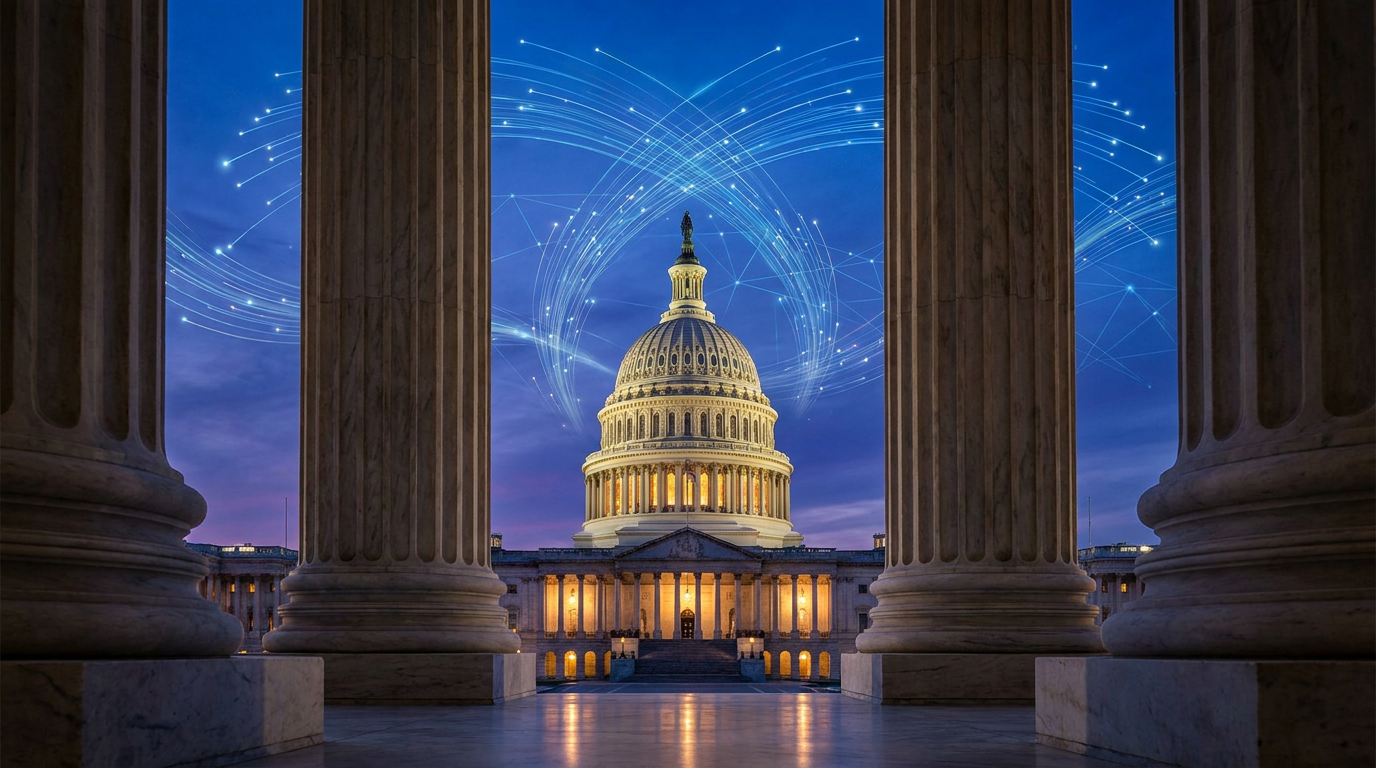
- Federal Policymakers
- Advocate for a unified national framework that prioritizes innovation, national security, and preempts state-level fragmentation.
- State Regulators
- Argue for localized, stringent consumer protections and algorithmic accountability, resisting federal preemption.
- Enterprise & HR Leaders
- Seek regulatory clarity, standardized compliance metrics, and workforce development support.
- Security & Legal Analysts
- Focus on the practical implications of voluntary vs. binding cybersecurity mandates and liability frameworks.
What's not represented
- · Open-source AI developers concerned about how federal cybersecurity baselines might impact decentralized model distribution.
- · Labor unions advocating for stronger federal protections against AI-driven workplace surveillance and automated firing.
Why this matters
The shift from a fragmented state-by-state regulatory environment to a unified federal framework will dictate how AI is developed, deployed, and secured in the US, directly impacting enterprise compliance costs and consumer protections.
Key points
- President Trump signed EO 14409, prohibiting mandatory AI licensing while imposing cybersecurity baselines for federal contractors.
- The bipartisan Great American AI Act of 2026 was drafted to nationalize frontier-model governance.
- The federal framework aims to preempt state-level AI regulations, sparking pushback from state attorneys general.
- The US approach relies heavily on voluntary compliance and federal procurement power, contrasting with the EU's mandatory risk tiers.
For the past three years, artificial intelligence regulation in the United States has been defined by a chaotic, state-by-state patchwork. California, Colorado, and Utah raced ahead with their own algorithmic accountability laws, leaving enterprise developers to navigate a fragmented and often contradictory compliance landscape. But in June 2026, the federal government decisively intervened. In a coordinated one-two punch, the White House and Congress advanced a unified national framework designed to preempt state laws, prioritize commercial innovation, and establish binding cybersecurity baselines for advanced models.[5][6]
The shift began on June 2, when President Trump signed Executive Order 14409, titled 'Promoting Advanced Artificial Intelligence Innovation and Security.' The directive marks a stark departure from the safety-heavy mandates of previous administrations. It explicitly prohibits mandatory licensing or preclearance requirements for AI development, cementing an 'America First' approach that treats rapid AI advancement as a critical national security imperative rather than an inherent public hazard.[1][4]
However, the Executive Order is not entirely hands-off. While it shields commercial developers from prescriptive consumer regulations, it imposes strict, binding cybersecurity mandates on federal agencies and the contractors that serve them. The order directs the establishment of an AI cybersecurity clearinghouse and a classified benchmarking framework for the most powerful frontier models on the market.[1]
For federal contractors, the compliance landscape changed overnight. Any AI system sold into federal civilian agency workflows now faces mandatory technical baselines that do not apply to purely commercial deployments. The order sets a rapid timeline, with initial cybersecurity hardening deadlines hitting as early as July 2, 2026. Legal analysts note that while the broader commercial market remains under a voluntary framework, the government is using its massive purchasing power to force baseline security standards across the industry.[1]

Two days after the Executive Order, the legislative branch delivered its counterpart. On June 4, Representatives Jay Obernolte (R-California) and Lori Trahan (D-Massachusetts) released the discussion draft of the Great American AI Act of 2026. The bipartisan bill attempts to nationalize the frontier-model governance approach that had been emerging in state legislatures, proposing a centralized federal framework that balances innovation with targeted risk management.[2][5]
The Great American AI Act introduces a suite of federal requirements for large-scale frontier developers. These include mandatory transparency reports, the publication of safety frameworks, critical incident reporting, and explicit whistleblower protections. By codifying these rules at the federal level, the bill aims to replace the overlapping and sometimes contradictory mandates currently being drafted in state capitals from Sacramento to Albany.[5]
The most contentious element of the emerging federal consensus is state preemption. The White House's National Policy Framework, released earlier in the spring, strongly advocated for broad federal preemption of state AI laws that impose 'undue burdens' on developers. The administration argued that a unified national market is essential for American competitiveness and that states should be precluded from regulating AI model development or imposing liability for third-party misuse.[3][7]
The most contentious element of the emerging federal consensus is state preemption.
The Great American AI Act attempts a delicate compromise on this front. The current discussion draft proposes preempting certain state laws that regulate AI development for a three-year period. However, it leaves much of the existing state patchwork intact, particularly laws of general applicability designed to protect children, prevent fraud, and safeguard consumers.[5][7]
This means that while developers of massive foundational models might gain a unified federal rulebook, companies deploying AI in specific sectors will still face local hurdles. For example, Utah's AI Policy Act, which requires healthcare professionals and regulated businesses to disclose when consumers are interacting with generative AI, would likely survive the preemption clause. Similarly, Colorado's automated decision-making technology (ADMT) law, effective January 2027, remains a looming compliance challenge for enterprise deployers.[5][6]

Beyond developer regulations, the federal push carries significant implications for the broader workforce. The Great American AI Act directs the National Institute of Standards and Technology (NIST) and the National Science Foundation to establish grants for AI education and workforce reskilling. It also mandates federal tracking of AI adoption metrics across the labor market, signaling a shift toward treating AI literacy as a core economic indicator.[2]
Human resources departments and enterprise compliance officers are closely watching the proposed Center for AI Standards and Innovation. Slated to be housed within the Commerce Department, this new body would be tasked with developing best practices for AI security and evaluating the safety of open-source software. For corporate leaders, the center represents a potential single source of truth for AI governance, replacing the current reliance on fragmented state guidance.[2]
The federal framework also introduces a novel mechanism for managing catastrophic risks: a voluntary 30-day pre-release review window for advanced AI models. Rather than mandating government approval before a model can be launched, the Executive Order and the accompanying legislative proposals encourage companies to share their frontier models with federal cybersecurity teams for vulnerability testing prior to public release.[4][5]
Security analysts note that while this review is technically voluntary, the political and optical pressure to participate will be immense. If a developer bypasses the 30-day window and their model is subsequently implicated in a major cybersecurity breach or critical infrastructure failure, the resulting backlash could swiftly trigger the mandatory regulations the industry has lobbied so hard to avoid.[4]

This uniquely American approach—blending voluntary commercial frameworks with strict federal procurement rules—stands in stark contrast to the European Union. Across the Atlantic, the EU AI Act is preparing to enter its high-risk enforcement phase in August 2026. While Europe is imposing comprehensive, risk-based compliance regimes on all market participants, the United States is betting that a lighter touch will secure its dominance in the global AI race.[6]
The final shape of the US regulatory landscape remains unsettled. The Great American AI Act must still navigate a deeply polarized Congress, and state attorneys general are already preparing legal challenges to the preemption clauses outlined in the White House framework. Yet the events of June 2026 mark a definitive turning point: the era of federal inaction has ended, and the blueprint for American AI governance has finally been drawn.[3][5]
How we got here
May 2025
Congress passes the bipartisan TAKE IT DOWN Act, criminalizing nonconsensual digital deepfakes.
March 2026
The White House releases its National Policy Framework, calling for federal preemption of state AI laws.
June 2, 2026
President Trump signs Executive Order 14409, prohibiting mandatory AI licensing while imposing federal cybersecurity baselines.
June 4, 2026
Reps. Obernolte and Trahan release the discussion draft of the Great American AI Act of 2026.
August 2026
The European Union's AI Act enters its high-risk enforcement phase, contrasting with the US approach.
Viewpoints in depth
The Federal Innovation Camp
Argues that a unified, light-touch federal framework is essential for national security and global competitiveness.
Proponents of the White House framework and the Great American AI Act argue that the US cannot afford a fragmented regulatory environment. They assert that subjecting frontier model developers to 50 different state laws stifles innovation and cedes ground to international rivals. By explicitly prohibiting mandatory preclearance and focusing on voluntary cybersecurity partnerships, this camp believes the US can maintain its technological edge while using federal procurement power to establish baseline security standards.
State-Level Consumer Advocates
Maintains that federal preemption strips states of their right to protect citizens from algorithmic harm.
State lawmakers and consumer protection groups view the federal preemption push as a corporate bailout designed to erase hard-won algorithmic accountability laws. They argue that states like California and Colorado have successfully implemented necessary guardrails against AI bias in hiring, lending, and housing. From this perspective, a 'voluntary' federal framework is toothless, and stripping states of their enforcement powers leaves vulnerable populations exposed to automated discrimination and deepfake fraud.
Enterprise Compliance Officers
Focuses on the practical mechanics of implementing AI governance across conflicting jurisdictions.
For corporate HR and legal departments, the debate is less about ideology and more about operational clarity. This camp welcomes the Great American AI Act's attempt to create a single national standard, noting that complying with conflicting state definitions of 'automated decision-making' is becoming financially unsustainable. However, they express concern that the proposed three-year preemption window is too short and leaves too many 'laws of general applicability' intact, meaning companies will still need to maintain complex, state-specific compliance programs.
What we don't know
- Whether the Great American AI Act can secure enough bipartisan support to pass a divided Congress before the end of the year.
- How federal courts will rule on the inevitable lawsuits from state attorneys general challenging the preemption of local algorithmic accountability laws.
- The exact technical thresholds that will define which models are subject to the voluntary 30-day cybersecurity review window.
Key terms
- Frontier Models
- Highly capable, large-scale artificial intelligence systems that can perform a wide variety of tasks and match or exceed the capabilities of today's most advanced models.
- State Preemption
- A legal doctrine where federal law supersedes and invalidates conflicting state or local laws.
- Automated Decision-Making Technology (ADMT)
- Systems that use algorithms to make or significantly influence consequential decisions, such as hiring, lending, or housing approvals.
- Preclearance
- A regulatory requirement that a company must obtain government approval or a license before releasing a new product to the public.
Frequently asked
Does the new Executive Order regulate commercial AI tools?
No. Executive Order 14409 explicitly prohibits mandatory licensing for commercial AI development, though it imposes strict cybersecurity requirements on AI systems used by federal agencies and contractors.
Will the Great American AI Act cancel state laws like California's?
Partially. The draft bill proposes preempting state laws that regulate AI development for three years, but it leaves laws protecting consumers from fraud and discrimination largely intact.
What is the 30-day pre-release window?
It is a voluntary framework encouraging developers of advanced frontier models to share their systems with the government for cybersecurity testing 30 days before public release.
How does this compare to the EU AI Act?
While the EU is implementing a mandatory, risk-based regulatory regime for all market participants, the US is pursuing a lighter-touch approach focused on voluntary compliance and federal procurement standards.
Sources
Source coverage
7 outlets
4 viewpoints surfaced







[1]DirectEmployers AssociationFederal Policymakers
The White House Just Signaled Where AI Policy Is Heading: What Federal Contractors Need to Know
Read on DirectEmployers Association →[2]SHRMEnterprise & HR Leaders
What HR Needs to Know About the Great American AI Act of 2026
Read on SHRM →[3]Center for Security and Emerging TechnologySecurity & Legal Analysts
Unpacking the White House National Policy Framework for AI
Read on Center for Security and Emerging Technology →[4]Jenner & BlockSecurity & Legal Analysts
New AI Executive Order: Key Takeaways For Companies Developing Advanced AI Models
Read on Jenner & Block →[5]GoodwinState Regulators
Congress and State Lawmakers Are Racing to Keep Up With AI
Read on Goodwin →[6]VerifyWiseState Regulators
US AI regulations 2026: federal orders, state laws, and what to comply with now
Read on VerifyWise →[7]WilmerHaleFederal Policymakers
White House Releases National Policy Framework for Artificial Intelligence
Read on WilmerHale →
More in ai
See all 6 stories →AI Reasoning
The End of Instant AI: How 'Test-Time Compute' is Teaching Models to Think Before They Speak
6 sources

Neuroprosthetics
How AI and Neural Interfaces Are Rewiring Human Mobility
8 sources

Local AI
How On-Device AI Chatbots Work (And Why They Matter)
6 sources

AI Filmmaking
How Indie Filmmakers Are Using AI Video Generators to Slash VFX Budgets and Rival Studio Productions
6 sources

Every angle. Every day.
Get ai stories with full source coverage and perspective breakdowns delivered to your inbox.