
How Indie Filmmakers Are Using AI Video Generators to Slash VFX Budgets and Rival Studio Productions
Generative AI tools are democratizing high-end visual effects, allowing independent creators to produce blockbuster-quality sequences for a fraction of the traditional cost. By solving technical hurdles like temporal consistency, these platforms are shifting indie budgets away from post-production and toward human talent.
By Factlen Editorial Team
- Indie Creators & Directors
- View AI as an empowering co-director that democratizes high-end visual effects and removes budget barriers.
- AI Platform Developers
- Focus on solving technical bottlenecks like temporal consistency and building unified end-to-end production pipelines.
- Industry Traditionalists
- Acknowledge the efficiency gains but caution against copyright risks and the loss of human touch in long-form narratives.
What's not represented
- · Traditional VFX Artists
- · Film Distributors
Why this matters
The barrier to entry for high-concept storytelling has collapsed. For creators, this means the ability to produce visually stunning films without massive studio backing, fundamentally shifting who gets to tell complex, visually demanding stories.
Key points
- Generative AI video models have advanced to provide photorealistic, physics-accurate footage for independent filmmakers.
- New features like Motion Brush and latent space mapping give directors precise control over camera movement and character consistency.
- Filmmakers are reducing traditional post-production and VFX costs by up to 50% using cloud-based AI subscriptions.
- Savings are increasingly being reinvested into hiring human actors and funding festival distribution campaigns.
The traditional barrier to entry for high-concept cinema has always been capital. For decades, independent filmmakers with ambitious sci-fi or fantasy scripts were forced to scale down their visions or rely on practical workarounds to avoid the exorbitant costs of visual effects (VFX). But in 2026, the landscape of independent cinema is undergoing a radical democratization. Generative AI video models have matured from producing glitchy, surreal five-second clips into robust, production-grade engines capable of rendering photorealistic, physics-accurate footage.[1]
This shift is effectively collapsing the cost of high-end visual storytelling. Industry analysts note that AI video generators are revolutionizing the film industry by allowing solo creators and micro-teams to execute blockbuster-level visual sequences without hiring massive VFX teams or renting expensive soundstages. What once required a $10,000 post-production budget and weeks of rendering can now be achieved for under $500 using a combination of cloud-based AI subscriptions.[1][4]
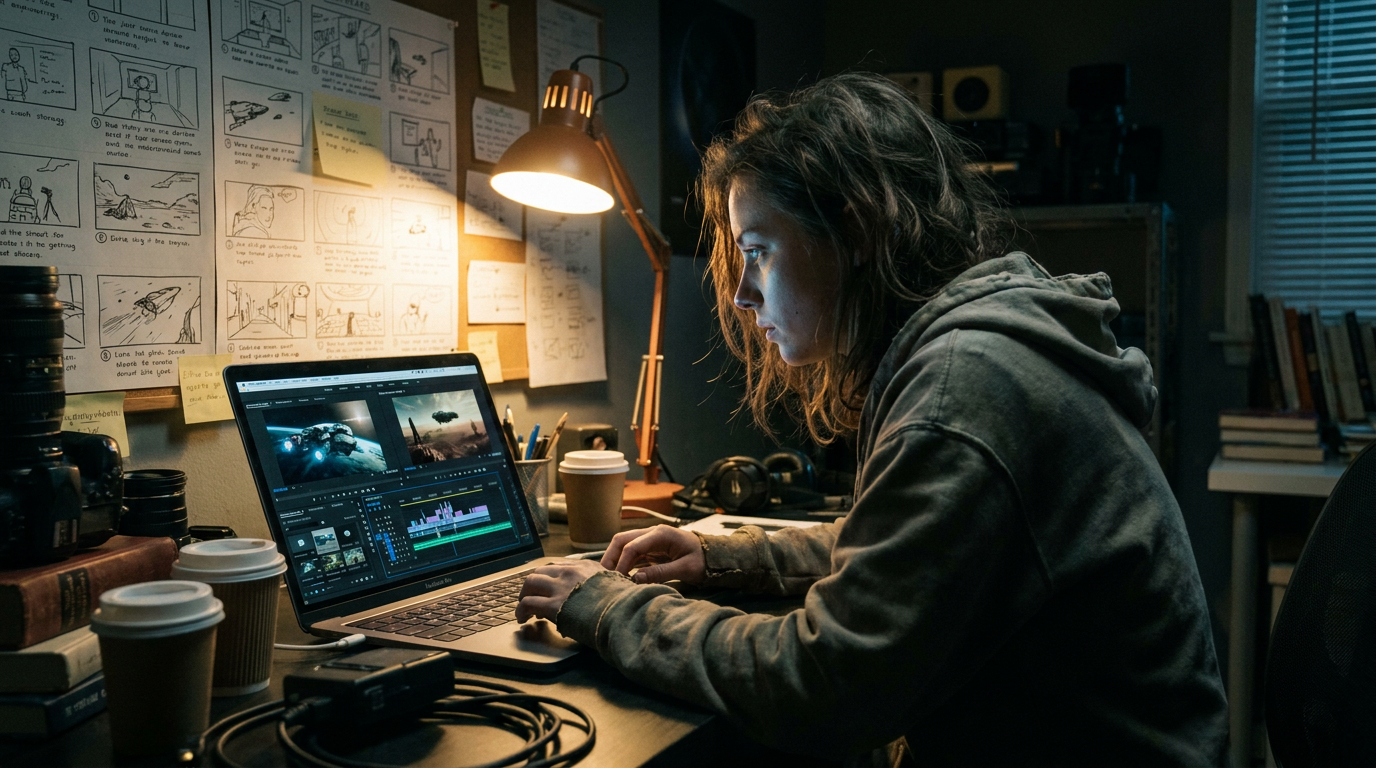
The mechanism driving this revolution is the transition from simple text-to-video prompting to advanced image-to-video and video-to-video workflows. Early generative models required users to type a description and hope the AI interpreted it correctly. Today's leading tools, such as Runway Gen-4.5 and Luma Dream Machine's Ray3 model, allow directors to upload a static reference frame—often a simple sketch or a photograph—and define the exact camera movement and subject motion.[2]
This level of control is achieved through features like Motion Brush, which lets a user paint over a specific element in a frame—like a river or a character's cloak—and dictate its exact trajectory and speed. The underlying neural networks process these inputs by calculating simulated physics, ensuring that water flows naturally and fabric folds react to digital wind. This reasoning-based generation means the AI understands cause and effect within a scene, producing highly plausible, cinematic motion.[2][3]

The most significant technical hurdle that 2026 models have largely solved is temporal consistency—the industry term for maintaining a character's exact physical traits, clothing, and lighting across multiple shots and angles. In previous years, AI-generated characters would notoriously morph or change identities from frame to frame. Now, models like Kling 3.0 and Google's Veo 3.1 utilize advanced latent space mapping to lock in character identities, allowing for multi-shot sequences that look like they were filmed with the same actor on the same day.[1][3]
Furthermore, the integration of native audio is bridging the gap between silent visual generation and complete scene creation. Google's Veo 3.1, for instance, is capable of generating synchronized audio—including dialogue lip-syncing and ambient sound effects—directly alongside the video output. This eliminates the tedious process of manually matching foley work to AI-generated footage, further accelerating the post-production timeline.[3]
Furthermore, the integration of native audio is bridging the gap between silent visual generation and complete scene creation.
As these tools become standard, a strategic debate has emerged among creators regarding the optimal workflow: the pipeline versus the point-tool stack. A pipeline approach utilizes end-to-end platforms, such as Saga or LTX Studio, which handle scriptwriting, storyboarding, video generation, and editing within a single unified interface. This method drastically reduces context-switching and manual file management, making it highly efficient for solo creators.[5][6]
Conversely, the point-tool stack involves stringing together specialized, best-in-class applications for each specific task. A filmmaker might use ChatGPT for script refinement, Midjourney for concept art, Runway for video generation, and ElevenLabs for voiceover. While this requires more technical assembly and manual syncing in traditional editing software like Adobe Premiere, it often yields the highest possible peak quality for individual hero shots.[3][5]
Regardless of the chosen workflow, the economic impact on independent productions is profound. By automating labor-intensive tasks like rotoscoping, background replacement, and color matching, filmmakers are slashing their mechanical production costs by up to 50 percent. This financial liberation does not necessarily mean movies are becoming cheaper to make overall; rather, the capital is being reallocated.[4]

Smart indie producers are taking the funds saved on VFX and studio rentals and reinvesting them into areas that AI cannot replicate: paying higher rates for talented human actors, securing better catering for the crew, and doubling down on festival marketing and distribution. The technology is not replacing the human element of filmmaking; it is removing the financial friction that prevents human stories from being told.[4]
The cultural output of this technological shift is already visible on the festival circuit. A new genre, sometimes dubbed Neural Cinema, is gaining traction, characterized by surreal, hyper-imaginative visuals that blend traditional live-action with generative environments. In 2025, a fully AI-generated short film titled 'To Dear Me' won the grand prize at the Reply AI Film Festival in Venice, judged by a panel of traditional feature film directors.[6]
Similarly, the viral success of AI-assisted shorts like 'Air Head'—created using early access to OpenAI's Sora—has proven that these tools can serve as legitimate launchpads for industry careers, with the creators recently landing Hollywood representation and feature film development deals. These are no longer tech demos; they are emotionally resonant films winning real awards.[6]

Despite the rapid advancements, uncertainties remain. The legal landscape surrounding the training data used by foundational video models is still actively contested, leaving some distributors hesitant to acquire fully AI-generated features without clear copyright indemnification. Additionally, while temporal consistency has improved dramatically, generating a cohesive 90-minute narrative still requires immense human oversight, curation, and hundreds of iterative prompts to achieve the desired result.[3][6]
Ultimately, AI video generators have evolved from experimental novelties into the ultimate AI Co-Director for independent creators. By lowering the financial drawbridge to high-fidelity visual effects, these tools are leveling the playing field between massive Hollywood studios and visionary creators working from their laptops. The defining factor for success in the late 2020s will no longer be the size of a filmmaker's budget, but the depth of their imagination.[1]
How we got here
2023
Early experimental AI shorts like 'The Frost' are created using primitive image-to-video tools.
2024
Creators begin stringing together hundreds of prompts to produce longer, 15-minute AI-assisted narratives.
2025
Fully AI-generated films begin winning awards at dedicated events like the Reply AI Film Festival.
Early 2026
Models like Veo 3.1 and Kling 3.0 solve temporal consistency, allowing for seamless multi-shot character continuity.
Viewpoints in depth
Indie Creators' View
AI is the ultimate equalizer that removes the financial gatekeepers of visual storytelling.
For independent directors, the appeal of generative AI is purely practical. It allows a solo creator with a $5,000 budget to execute a sci-fi script that would have previously required $5 million and a greenlight from a major studio. By treating AI as a 'co-director,' creators can rapidly prototype scenes, generate complex background plates, and fix continuity errors without expensive reshoots. They argue that this technology doesn't replace the soul of filmmaking; it simply removes the mechanical and financial friction that has historically kept marginalized or independent voices out of high-concept genres.
Platform Developers' View
The focus is on solving technical bottlenecks to create seamless, unified production operating systems.
The engineers and companies building these models view the current landscape as a transitional phase. Their immediate goal is solving the remaining technical hurdles—such as perfect temporal consistency, native lip-syncing, and rendering times. Developers are increasingly moving away from isolated 'point tools' and toward unified 'pipeline' platforms that keep a creator in one ecosystem from script to final export. They believe that once the friction of context-switching between five different AI apps is eliminated, the volume and quality of independent content will scale exponentially.
Industry Traditionalists' View
Efficiency gains are undeniable, but copyright risks and the loss of human nuance remain significant concerns.
While acknowledging that AI democratizes VFX, traditionalists and industry guilds urge caution. They point out that the foundational models powering these tools are often trained on copyrighted cinematic works, creating a murky legal environment for indie films seeking commercial distribution. Furthermore, they argue that while AI excels at generating spectacular B-roll and surreal environments, it still struggles to capture the micro-expressions and sustained emotional arcs of a human actor. For this camp, AI is best utilized as a post-production assistant rather than a replacement for on-set human collaboration.
What we don't know
- How major streaming platforms will handle the copyright indemnification of fully AI-generated indie films.
- Whether the cost of high-end API generation will remain affordable as models become more compute-intensive.
Key terms
- Temporal Consistency
- The ability of an AI video model to maintain a subject's exact physical appearance and environment across different frames and camera angles.
- Motion Brush
- A tool in AI video generators that allows users to paint over a specific area of an image to dictate its movement direction and speed.
- Latent Space Mapping
- A machine learning technique used to lock in character identities and physical traits so they don't morph during video generation.
- Point-Tool Stack
- A workflow where a creator uses multiple specialized AI applications (e.g., one for voice, one for video) and manually combines them.
- End-to-End Pipeline
- A unified software platform that handles scriptwriting, storyboarding, video generation, and editing all in one place.
Frequently asked
Can AI generate a full movie automatically?
No. While AI can generate individual clips and audio, creating a cohesive film still requires extensive human direction, iterative prompting, and traditional editing to stitch the narrative together.
What is temporal consistency in AI video?
Temporal consistency is the ability of an AI model to keep a character's appearance, clothing, and environment exactly the same across multiple shots and angles without morphing.
Do indie filmmakers still need actors if they use AI?
Yes. Many filmmakers are actually reinvesting the money saved on digital VFX into hiring better human actors, as AI still struggles to replicate nuanced, long-form emotional performances.
Are AI-generated films allowed in traditional film festivals?
Yes, they are increasingly being accepted. Dedicated AI film festivals have emerged, and traditional festivals are beginning to screen and award AI-assisted projects.
Sources
Source coverage
6 outlets
3 viewpoints surfaced






[1]The AI JournalIndustry Traditionalists
The 2026 AI Filmmaking Revolution: Beyond Basic Text-to-Video
Read on The AI Journal →[2]Indie Shorts MagazineIndustry Traditionalists
Top AI Tools for Indie Filmmakers in 2026
Read on Indie Shorts Magazine →[3]Crepal AIIndie Creators & Directors
AI Filmmaking Tools: The Realistic Workflow
Read on Crepal AI →[4]The Table Read MagazineIndie Creators & Directors
How Indie Filmmakers Are Slashing Budgets by 50% with AI
Read on The Table Read Magazine →[5]M StudioAI Platform Developers
AI Filmmaking Toolkit Comparison — 10 Tools Ranked
Read on M Studio →[6]MediumAI Platform Developers
No Crew. No Studio. Just AI Tools and Your Computer.
Read on Medium →

More in ai
See all 5 stories →Medical AI
AI System 'PhenoSeq' Bypasses Costly Lab Sequencing to Accelerate Cancer Drug Discovery
7 sources
Physical AI
Humanoid Robots Cross the Commercial Threshold: Inside the 2026 Factory Floor Deployments
8 sources
Frontier Models
The Great American AI Act of 2026: Evidence Pack on Congress's Frontier Model Play
7 sources
Every angle. Every day.
Get ai stories with full source coverage and perspective breakdowns delivered to your inbox.