
The Science of Space: How Neuroaesthetics is Transforming Interior Design
Researchers are using brain-scanning technology to prove that interior design is not just about aesthetics, but a vital tool for regulating stress, focus, and mental health.
By Factlen Editorial Team
- Neuroscience Researchers
- Focus on measuring the biological and chemical changes in the brain when exposed to different spatial stimuli.
- Evidence-Based Designers
- Focus on translating clinical data into practical design choices that improve mental health and cognitive performance.
- Biophilic Advocates
- Emphasize humanity's evolutionary need for nature, prioritizing raw materials, daylight, and plant life in modern habitats.
What's not represented
- · Real estate developers balancing the high costs of neuroaesthetic materials with affordable housing needs
- · Traditional interior decorators who prioritize personal expression and cultural trends over clinical data
Why this matters
With humans spending up to 90% of their lives indoors, the physical spaces we inhabit are silently shaping our nervous systems. Understanding how light, shape, and texture affect the brain empowers people to design homes and workspaces that actively reduce anxiety and boost cognitive performance.
Key points
- Neuroaesthetics uses brain-scanning technology to measure how interior design affects human biology.
- Thoughtfully designed spaces can reduce stress hormones like cortisol by up to 20 percent.
- Biophilic design integrates nature into buildings to combat cognitive fatigue and anxiety.
- Curvilinear shapes and natural textures activate the brain's pleasure and comfort centers.
- Biodynamic lighting mimics the sun to protect the human circadian rhythm and improve sleep.
- The pandemic accelerated the adoption of these principles as homes became 24/7 environments.
For decades, interior design was judged by a single, highly subjective metric: how a space looked. But as humans now spend an estimated 80 to 90 percent of their lives indoors, a profound shift is transforming the industry. Designers and scientists are no longer just asking if a room is beautiful; they are measuring how it alters our brain chemistry. This convergence of biology and architecture is fundamentally changing how we construct our homes, offices, and healing spaces.[4][6]
At the center of this shift is neuroaesthetics, an emerging interdisciplinary field that studies how the built environment affects the human nervous system. By combining neuroscience, psychology, and architecture, researchers are mapping exactly how elements like light, spatial layout, color, and acoustics influence our emotions and cognition. The goal is to move beyond subjective intuition and use concrete data to design spaces that actively reduce stress and foster human connection.[2][5]
The roots of this discipline trace back to the mid-20th century. When virologist Jonas Salk struggled with a mental block while developing the polio vaccine, he traveled to Assisi, Italy. Convinced that the city's classical architecture had cleared his mind, he later partnered with architect Louis Kahn to design the Salk Institute—a facility explicitly built to encourage scientific creativity. Decades later, in 1990, neurobiologist Semir Zeki discovered that perceiving beauty consistently activates specific regions of the brain, laying the clinical groundwork for modern neuroaesthetics.[4]
Today, advanced brain-scanning technology allows researchers to observe these physiological changes in real time. When a person enters a thoughtfully designed space, the brain's orbitofrontal cortex—a region linked to emotional regulation—lights up. Simultaneously, the body experiences measurable biological responses: heart rates slow, blood pressure drops, and serotonin levels increase. Clinical studies have documented that environments optimized for the human brain can reduce stress hormones like cortisol by 15 to 20 percent.[1]

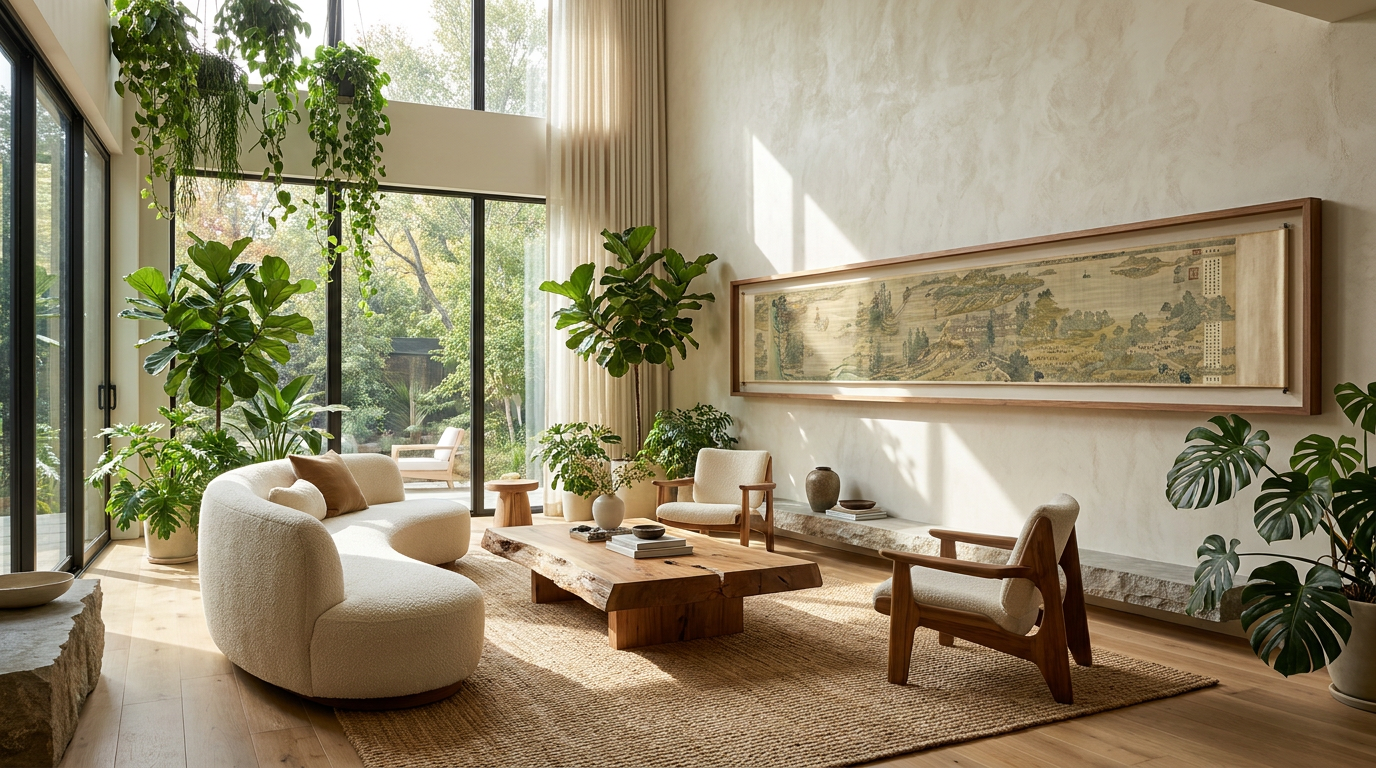
The most powerful and heavily researched tool within neuroaesthetics is biophilic design. Because humans evolved in continuous interaction with the natural world, our modern separation from nature is linked to heightened anxiety and cognitive fatigue. Biophilic design seeks to restore this biological baseline by integrating natural systems into the built environment, operating on the premise that nature is not merely decorative, but a fundamental human need.[3][6]
This approach is typically broken down into three categories: nature in the space, natural analogues, and the nature of the space itself. "Nature in the space" involves direct, physical connections, such as indoor plant life, water features, and abundant natural light. "Natural analogues" use organic shapes, materials like wood and stone, and earth-toned color palettes to mimic the outdoors. Finally, the "nature of the space" refers to architectural layouts that provide a sense of prospect (a clear view of the surroundings) and refuge (a feeling of safety and enclosure).[6]
This approach is typically broken down into three categories: nature in the space, natural analogues, and the nature of the space itself.
Lighting is perhaps the most critical variable in this equation. The human circadian rhythm is deeply tied to the sun's progression, and static, artificial lighting can severely disrupt sleep and mood. In response, neuroarchitects champion biodynamic lighting systems that emulate natural daylight, shifting from cool, blue-toned light in the morning to promote alertness, to warm, amber tones in the evening to prepare the brain for rest.[4]

The physical geometry of a room also dictates our subconscious comfort. Studies utilizing functional magnetic resonance imaging (fMRI) have revealed that curvilinear spaces and rounded furniture activate the brain's pleasure centers. Conversely, sharp angles and harsh edges can trigger subtle, subconscious threat responses. Furthermore, tactile elements like raw wood and woven fabrics stimulate the somatosensory cortex, producing feelings of warmth and belonging that sterile, synthetic materials cannot replicate.[6]
Beyond the visual and tactile, the acoustic environment plays a hidden but massive role in spatial well-being. Unpredictable or harsh ambient noise keeps the nervous system in a heightened state of alertness, elevating cortisol levels. Evidence-based design mitigates this through acoustic panels, soft furnishings that absorb sound, and the strategic introduction of white noise or water features to mask disruptive sounds.[1]
The global shift toward remote work during the COVID-19 pandemic served as a massive catalyst for this field. As homes suddenly doubled as offices and schools, the psychological impact of our immediate surroundings became impossible to ignore. This period accelerated the adoption of neuroaesthetic principles, proving that architecture and psychology must go hand in hand to support daily resilience.[2]

This philosophy is now scaling beyond luxury residential projects into the broader "Brain Economy." Hospitals are utilizing biophilic principles to accelerate patient recovery times and reduce the need for pain medication. Schools are deploying dynamic lighting and natural textures to improve student concentration, while corporate offices are finding that neuroaesthetic design directly correlates with higher employee retention and cognitive performance.[5][6]
Despite the robust data, the field still faces challenges. Human perception is inherently subjective, and cultural backgrounds heavily influence how individuals interpret spatial cues. What feels like a restorative refuge to one person may feel uncomfortably isolating to another. Researchers are continually working to separate universal biological responses from learned aesthetic preferences, striving to create adaptable environments that can serve diverse populations.[2][6]
Ultimately, neuroaesthetics represents a paradigm shift in how we value the spaces we inhabit. By validating the intuition of designers with the rigor of neuroscience, the industry is proving that beauty is not a frivolous luxury. Instead, thoughtful, evidence-based interior design is emerging as a vital form of preventative mental healthcare, transforming the buildings we live in into active participants in our emotional well-being.[1][5]
How we got here
1965
Jonas Salk opens the Salk Institute, partnering with Louis Kahn to create a space optimized for scientific creativity.
1990
Neurobiologist Semir Zeki maps the brain's response to beauty, laying the clinical groundwork for neuroaesthetics.
2014
The WELL Building Standard launches, introducing formal health and well-being metrics to the architecture industry.
2020
The COVID-19 pandemic forces a global shift to indoor living, accelerating the demand for restorative home design.
2026
Neuroaesthetics becomes a mainstream pillar of interior design, backed by wearable health data and fMRI research.
Viewpoints in depth
Neuroscience Researchers
Scientists mapping the biological mechanisms of spatial perception.
For neuroscientists, interior design is no longer a matter of taste; it is a matter of biology. By utilizing fMRI machines and wearable biometric trackers, researchers in this camp focus on the measurable physiological changes that occur when a person enters a room. They track how specific wavelengths of light alter melatonin production, how acoustic reverberations elevate cortisol, and how the perception of beauty activates the orbitofrontal cortex. Their goal is to establish universal, data-driven baselines for human comfort that exist independently of cultural aesthetic preferences.
Evidence-Based Designers
Architects and designers applying clinical data to the built environment.
This camp bridges the gap between the laboratory and the living room. Evidence-based designers argue that the industry has relied on intuition for too long, and that architects have a moral imperative to design for mental health. They utilize the findings of neuroaesthetics to justify design choices to clients, proving that investments in biodynamic lighting or acoustic dampening are not frivolous luxuries, but necessary interventions for productivity and well-being. For them, a successful space is one that produces documented health outcomes, such as accelerated healing in hospitals or higher retention in corporate offices.
Biophilic Advocates
Proponents of integrating natural systems into modern human habitats.
Biophilic advocates view the modern, sterile indoor environment as a biological mismatch for the human species. They argue that because humans evolved outdoors over millions of years, our nervous systems are fundamentally wired to respond positively to natural stimuli. This perspective prioritizes the 'Prakriti' concept of natural balance, advocating for the aggressive reintroduction of daylight, plant life, water features, and organic textures into homes and cities. They believe that true spatial well-being cannot be achieved through synthetic means, but only by repairing our severed connection to the natural world.
What we don't know
- How much of our spatial preference is universally biological versus culturally learned.
- The long-term psychological impacts of fully immersive, artificially generated biophilic environments (like VR nature).
- How to perfectly isolate the effects of a single design element from the holistic experience of a room.
Key terms
- Neuroaesthetics
- The scientific study of how the brain responds to aesthetic experiences and spatial design.
- Biophilic Design
- An architectural approach that connects building occupants more closely to nature through light, plants, and natural materials.
- Orbitofrontal Cortex
- A region of the brain involved in emotional regulation and decision-making, which is activated by perceiving beauty.
- Biodynamic Lighting
- Artificial lighting systems programmed to mimic the natural progression of sunlight to support human circadian rhythms.
- Somatosensory Cortex
- The part of the brain that processes tactile sensations, stimulated by natural textures like wood and stone.
Frequently asked
What is neuroaesthetics?
It is the scientific study of how the brain and nervous system respond to aesthetic experiences, including art, architecture, and interior design.
How does biophilic design reduce stress?
By integrating natural elements like plants, sunlight, and wood, biophilic design lowers cortisol levels and blood pressure, satisfying an evolutionary human need for nature.
Can lighting really affect my mood?
Yes. Biodynamic lighting that mimics the sun's natural cycle helps regulate the human circadian rhythm, improving sleep quality, alertness, and emotional stability.
Why do curved walls feel more relaxing?
fMRI studies show that curvilinear spaces activate the brain's pleasure centers, while sharp angles can subconsciously trigger threat responses.
Sources
Source coverage
6 outlets
3 viewpoints surfaced






[1]Science in DesignEvidence-Based Designers
Neuroaesthetics: The Future of Interior Design
Read on Science in Design →[2]NeurotecturaNeuroscience Researchers
What Is Neuroarchitecture?
Read on Neurotectura →[3]International Journal of Interdisciplinary Approaches in PsychologyNeuroscience Researchers
Biophilic Design and Psychological Well-being: Developing a Conceptual Framework through the Lens of the Indian Prakriti Perspective
Read on International Journal of Interdisciplinary Approaches in Psychology →[4]Connections by FinsaBiophilic Advocates
What is neuroaesthetics and how can it be applied in interior design?
Read on Connections by Finsa →[5]Studio 10 Interior DesignEvidence-Based Designers
The Impact of Neuroaesthetics on the Built Environment
Read on Studio 10 Interior Design →[6]Factlen Editorial TeamBiophilic Advocates
Synthesis by Factlen editorial team
Read on Factlen Editorial Team →

Every angle. Every day.
Get home stories with full source coverage and perspective breakdowns delivered to your inbox.