
The 'Library of Things' Movement: How Communities Are Sharing More Than Just Books
Neighborhoods worldwide are launching community hubs that lend out power tools, camping gear, and appliances, saving residents money while reducing environmental waste.
By Factlen Editorial Team
- Community Advocates
- Focus on social cohesion, skill-sharing, and providing equitable access to resources for low-income households.
- Circular Economy Proponents
- Emphasize the environmental benefits of reducing manufacturing demand, cutting carbon emissions, and diverting waste from landfills.
- Urban Planners & Operators
- Focus on the logistical challenges of space, funding, volunteer burnout, and the need for scalable models like self-serve lockers.
What's not represented
- · Traditional hardware retailers and tool manufacturers whose sales might be impacted by widespread sharing.
- · Gig-economy workers who might rely on cheap tool access versus professional-grade equipment leasing.
Why this matters
The average household spends thousands of dollars on specialized tools and equipment that sit unused for 99% of their lifespan. By shifting from individual ownership to community access, residents can save money, declutter their homes, and significantly lower their environmental footprint.
Key points
- Libraries of Things allow community members to borrow tools and equipment instead of buying them.
- The model saves households significant money and democratizes access to home repair for low-income residents.
- Sharing resources drastically reduces the carbon footprint and manufacturing demand of consumer goods.
- New models, like self-serve lockers in urban centers, are making the sharing economy more accessible than ever.
Consider the classic suburban dilemma of the eight-foot ladder. You need one to change a high hallway lightbulb or clear out the autumn leaves from your gutters. Purchasing a quality ladder costs roughly $265, takes up a significant portion of your garage wall, and will likely be used exactly twice a decade. Multiply that single idle ladder by every house on the block, and the sheer volume of wasted money, physical space, and manufacturing capacity becomes staggering. It is a prime example of how modern consumption habits prioritize ownership over actual utility.[2]
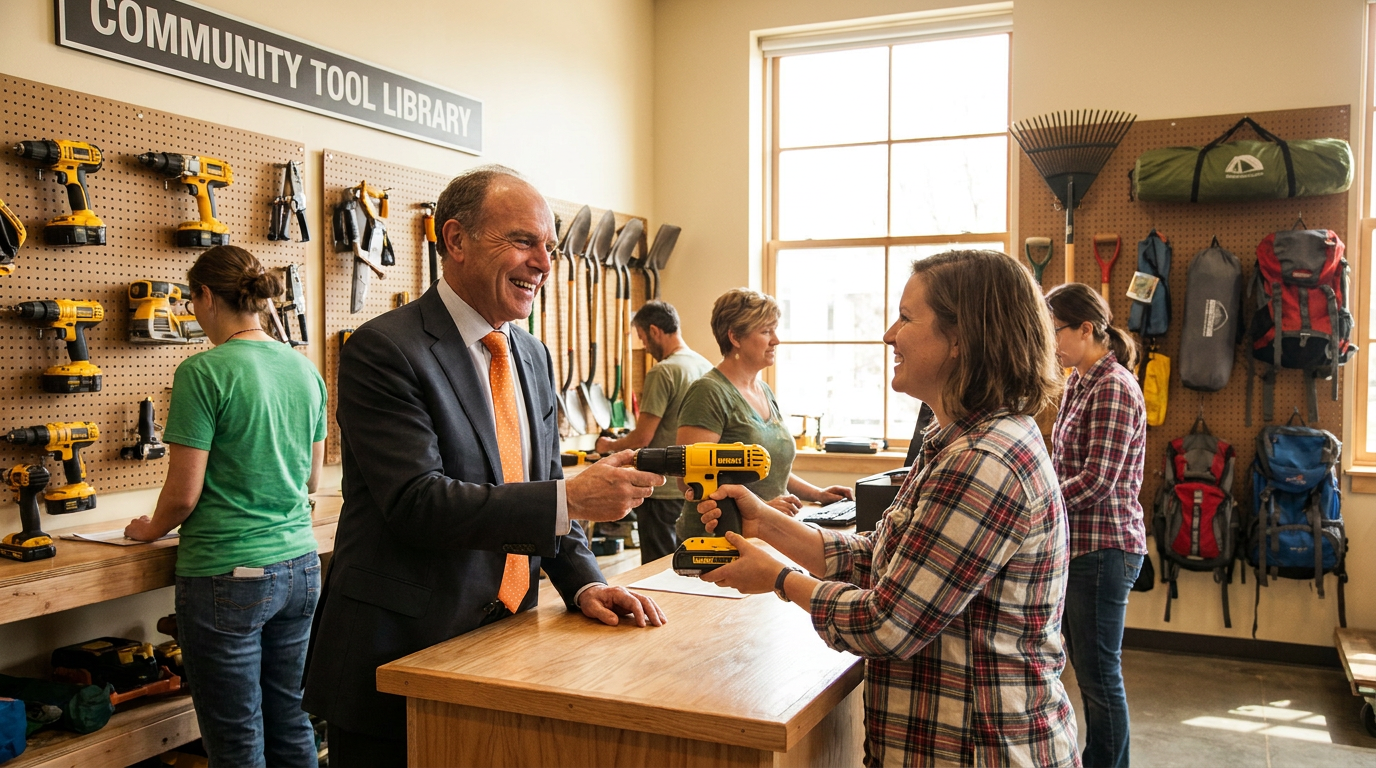
Enter the 'Library of Things' (LoT). Operating on the exact same fundamental principle as a traditional public book library, these community hubs allow members to borrow power tools, camping gear, kitchen appliances, and electronics for a fraction of the cost of ownership. Instead of checking out a hardcover novel, a resident can check out a circular saw, a pasta maker, or a heavy-duty carpet cleaner for the weekend, returning it when the project is complete so the next neighbor can use it.[1]
While the concept of sharing resources is as old as human civilization, the formalized Library of Things movement has exploded in recent years. What began as a handful of niche tool libraries in the late 1970s—most notably the pioneering program at the Berkeley Public Library—has blossomed into a sophisticated global network. Today, there are over 2,000 formally established LoTs worldwide, ranging from small, volunteer-run sheds in rural towns to highly automated, digitally tracked urban locker systems in major metropolitan centers. This growth reflects a broader cultural shift away from hyper-consumerism and toward community resilience.[1]
The mechanics of these libraries are straightforward but economically transformative. Members typically pay a sliding-scale annual subscription fee—often ranging from $50 to $100, with accommodations for low-income households—granting them full access to the organization's online inventory. Borrowers can browse the catalog from home, reserve the specific items they need for an upcoming project, pick them up for a set borrowing period, and return them when the work is done. It is a seamless process that mirrors the convenience of modern e-commerce, but without the financial burden of a permanent purchase.[2][5]

This seamless experience is largely powered by specialized software platforms that have provided the digital infrastructure for the sharing movement. Platforms like myTurn allow local organizers to easily track complex inventories, manage liability waivers, schedule maintenance for heavily used tools, and handle reservations without needing to build custom technology from scratch. By lowering the administrative barrier to entry, these platforms have enabled neighborhood groups to launch their own libraries with minimal upfront capital, focusing their energy on community outreach rather than software development.[5]
The direct economic impact on individual households is profound. The Inner West Library of Things (IWTL) in Sydney, Australia, recently released an impact report estimating that its members saved a collective $324,000 over just three years of operation. For an annual fee of $75, members gained access to hundreds of expensive items. One particularly active borrower at the Sydney location saved over $6,000 by renting instead of buying equipment for major home renovations, proving that the model scales effectively for both small tasks and massive DIY projects.[3]
Beyond individual household savings, these libraries serve a crucial role in democratizing access to home repair and maintenance. High-quality power tools are prohibitively expensive, creating a significant barrier for low-income residents who need to maintain aging homes, repair vehicles, or manage landscaping. By removing this steep financial hurdle, tool libraries empower residents to improve their living conditions, build home equity, and avoid predatory repair loans. It shifts home maintenance from a luxury of the middle class to an accessible right for the entire community.[6]
'Tool libraries bridge gaps between neighbors by providing people with the literal tools needed to complete home repair and other projects,' notes the Sierra Service Project, which operates a free tool library in Sacramento specifically designed to support under-resourced neighborhoods. Their organizers emphasize that a resource that removes barriers facing marginalized communities goes a long way in building supportive neighborhood relationships, increasing local spending power, and restoring dignity to residents who might otherwise be priced out of basic home upkeep.[6]
The environmental argument for the movement is equally compelling. The modern consumer economy relies heavily on a linear model: extract raw resources, manufacture a product, ship it across the globe, use it rarely, and eventually throw it away. Libraries of Things champion the 'circular economy,' a framework designed to keep a single manufactured item in continuous use at its highest possible value. By maximizing the utility of every drill, tent, and sewing machine, communities can drastically reduce their collective reliance on new manufacturing.[3][4]

The environmental argument for the movement is equally compelling.
Every pressure washer or stand mixer borrowed from a community hub is one less item that needs to be manufactured, packaged in plastic, and shipped across oceans. This drastically reduces the carbon footprint associated with consumer goods and diverts tons of functional, heavy-duty equipment from local landfills. Early studies of established hubs, such as the North Portland Tool Library, have shown that a single robust sharing center can reduce community carbon emissions by dozens of metric tons annually simply by curbing the demand for new retail products.[4]
But organizers frequently note that the most significant and lasting impact isn't the tools themselves—it is the community that forms around them. Libraries of Things often serve as physical gathering spaces where neighbors meet, exchange advice, and collaborate on projects. In an era marked by increasing social isolation and the decline of traditional 'third places'—spaces outside of home and work—these hubs offer a rare environment where people of different generations and socioeconomic backgrounds interact over shared practical goals, from building a garden box to fixing a bicycle.[2][3]

The Station North Tool Library in Baltimore, which boasts over 3,000 tools and 2,200 active members, regularly hosts educational classes and a highly popular 'Fix It Fair.' At a recent community event, over 280 people brought in wobbly chairs, torn clothing, restringing instruments, and broken appliances. They worked alongside a dedicated team of volunteer 'fixers' who didn't just repair the items, but actively taught the owners how to demystify the repair process themselves. Over 300 items were saved from the trash in a single afternoon.[2]
'A cool part of engaging with a local tool library is it offers a community for you,' says Jessa Wais, Director of Library Services at Station North. 'That human-to-human interaction is super valuable and fun.' This sentiment is echoed across the movement; members frequently report that the primary benefit they gain isn't just a repaired fence or a cheaper DIY project, but a renewed sense of pride and connection to their immediate neighborhood. The library becomes a focal point for civic engagement and mutual aid.[2]
As the movement matures, it is also evolving to meet the distinct needs of different urban landscapes. While rural and suburban areas might favor large warehouse spaces where residents can drive up and load heavy equipment, dense cities are innovating with highly efficient self-service models. The London Library of Things, for example, has successfully deployed self-serve lockers integrated directly into existing public libraries, reuse hubs, and busy shopping centers. These kiosks require only a few square meters of floor space while offering maximum convenience to pedestrians and transit riders.[4]
This locker model, which recently generated £800,000 in annual turnover for the London-based organization, allows for significantly longer opening hours and requires far less dedicated volunteer time to operate. By placing the lockers in high-traffic areas, the organization makes the sharing economy highly visible and accessible to busy urbanites who might not have the time to visit a specialized warehouse during limited weekend hours. It represents a crucial step toward making resource sharing as frictionless as traditional retail shopping.[4]

Despite the widespread enthusiasm, sustaining a Library of Things is not without its operational challenges. Standalone grassroots projects require rent-free or heavily subsidized commercial space, ongoing funding for tool maintenance, and a dedicated team to manage the inventory. Volunteer burnout is a notoriously common hurdle for small operations, as the sheer volume of tool sharpening, battery testing, and administrative work can quickly overwhelm a small team of well-meaning neighbors. Transitioning from a passion project to a sustainable utility requires rigorous planning.[1][5]
To ensure long-term longevity, many new libraries are moving away from the standalone model and partnering with established institutions. Traditional public libraries are increasingly adding 'thing collections' to their catalogs, leveraging their existing staff and real estate. Similarly, forward-thinking affordable housing developments, such as the Connect Highstar complex in Houston, are integrating shared tool spaces directly into their residential amenities. This embedded approach ensures that the library has a permanent home and a built-in user base from day one.[1][7]
Ultimately, the Library of Things movement challenges the deeply ingrained cultural assumption that individual ownership is the ultimate marker of success and security. By proving that shared access is often more practical, economical, and environmentally sound than private ownership, these community hubs are quietly rewiring how neighborhoods function. They offer a tangible, uplifting blueprint for a future where communities are defined not by what each person hoards in their garage, but by what they are willing to share with one another.[7]
How we got here
1979
The Berkeley Public Library launches one of the first modern tool lending libraries in the United States.
2010
The West Seattle Tool Library opens, helping to popularize the modern environmental focus of the movement.
2013
The term 'Library of Things' gains traction as a librarian in Sacramento applies the model to a wider variety of household goods.
2014
The London Library of Things begins testing, eventually pioneering a scalable self-serve locker model for dense urban areas.
2024
The Library of Things Co-Lab convenes hundreds of global organizers, signaling the transition from niche projects to a formalized global movement.
Viewpoints in depth
Community Advocates
Viewing shared resources as a tool for social equity and neighborhood connection.
For community organizers, the primary value of a Library of Things is social rather than purely economic. High-quality tools are expensive, creating a barrier for low-income residents who need to maintain their homes or vehicles. By removing this financial hurdle, tool libraries empower residents to improve their living conditions and build equity. Furthermore, the physical spaces serve as vital 'third places' where neighbors interact, share skills, and combat the isolation of modern urban life.
Circular Economy Proponents
Focusing on the environmental imperative of maximizing resource efficiency.
Environmental advocates view the movement as a critical intervention against the linear 'take, make, dispose' economy. They argue that manufacturing a heavy-duty power drill that will only be used for 15 minutes over its entire lifespan is an ecological failure. By keeping a single manufactured item in continuous use at its highest value, communities can drastically reduce the carbon emissions associated with resource extraction, global shipping, and eventual landfill disposal.
Urban Planners & Operators
Prioritizing scalable infrastructure and sustainable business models.
While supportive of the mission, operators and urban planners focus on the logistical realities of running these hubs. They point out that volunteer-run sheds often suffer from burnout and limited hours. To make the sharing economy truly viable, this camp advocates for integrating self-serve lockers into existing public infrastructure—like transit hubs and traditional libraries—and securing reliable municipal funding rather than relying solely on grants and donations.
What we don't know
- How traditional hardware retailers and tool manufacturers will adapt their business models if community sharing significantly reduces individual consumer demand.
- Whether municipal governments will begin systematically funding Libraries of Things as essential public infrastructure, similar to traditional book libraries.
Key terms
- Library of Things
- A community hub that lends out infrequently used items—like tools, appliances, and camping gear—operating much like a traditional book library.
- Circular Economy
- An economic system aimed at eliminating waste and the continual use of resources, contrasting with the traditional linear 'take, make, dispose' model.
- Mutual Aid
- A voluntary, reciprocal exchange of resources and services within a community, built on the idea that everyone has something to contribute and everyone has needs to meet.
- Sliding-Scale Fee
- A pricing model where the cost of membership is adjusted based on an individual's income or ability to pay, ensuring equitable access.
Frequently asked
How are Libraries of Things funded?
Most rely on a mix of sliding-scale membership fees, community grants, crowdfunding, and volunteer labor. Some are integrating into municipal public library budgets.
What happens if a borrowed item breaks?
Normal wear and tear is expected and covered by the library. Members are typically only asked to replace items if they are lost or damaged through gross negligence.
Can I donate my unused tools?
Yes, most libraries rely heavily on community donations to build their inventory, though they usually have specific guidelines on what they can accept and maintain.
Do I need to know how to use the tools before borrowing?
Not necessarily. Many libraries offer introductory classes, safety training, and volunteer advice to help members learn new skills safely.
Sources
Source coverage
7 outlets
3 viewpoints surfaced






[1]ShareableCircular Economy Proponents
The Library of Things Toolkit
Read on Shareable →[2]Green AmericaCommunity Advocates
A Safe Place for Community: Tool Libraries
Read on Green America →[3]ACE Hub AustraliaCircular Economy Proponents
More than just a place to borrow hammers and drills
Read on ACE Hub Australia →[4]Doughnut Economics Action LabUrban Planners & Operators
Library of Things: A circular platform
Read on Doughnut Economics Action Lab →[5]Geo.coopCommunity Advocates
Starting a Library of Things
Read on Geo.coop →[6]Sierra Service ProjectCommunity Advocates
Tool Libraries and Community Impact
Read on Sierra Service Project →[7]Factlen Editorial TeamUrban Planners & Operators
Synthesis by Factlen editorial team
Read on Factlen Editorial Team →
Every angle. Every day.
Get community stories with full source coverage and perspective breakdowns delivered to your inbox.