
How Wildlife Crossings Are Quietly Reconnecting North America's Fragmented Ecosystems
A network of overpasses and underpasses is drastically reducing vehicle collisions and restoring genetic diversity among North America's largest mammals. As initial federal funding expires, a bipartisan push is underway to expand the highly successful infrastructure.
By Factlen Editorial Team
- Conservation Biologists
- Focused on restoring genetic diversity and habitat connectivity for wildlife.
- Transportation & Safety Officials
- Focused on reducing human fatalities and the economic burden of vehicle collisions.
- State & Tribal Planners
- Focused on securing reliable federal funding to meet the massive local demand for infrastructure.
What's not represented
- · Insurance industry actuaries
- · Automobile manufacturers
Why this matters
Wildlife-vehicle collisions cost Americans $8 billion annually and result in hundreds of human fatalities. Expanding this proven infrastructure not only saves lives and taxpayer money, but actively rescues isolated animal populations from genetic collapse.
Key points
- Vehicle collisions with large animals cost the U.S. roughly $8 billion annually and result in hundreds of human fatalities.
- Wildlife crossing structures, paired with fencing, have been proven to reduce these collisions by up to 96 percent in heavily monitored areas like Banff National Park.
- The structures also prevent genetic isolation, helping species like grizzly bears expand their ranges and interbreed across previously fragmented landscapes.
- While upfront construction costs are high, the infrastructure typically pays for itself within 10 to 12 years through avoided accident costs.
- Demand for federal grants to build crossings currently outpaces available funding by five to one, prompting a bipartisan push in Congress to expand the program.
Across the United States and Canada, a vast network of asphalt acts as an invisible, often lethal barrier to the natural world. Every year, North American drivers are involved in an estimated one to two million collisions with large wild animals, ranging from white-tailed deer to thousand-pound moose. The toll is staggering on both sides of the windshield: these accidents result in approximately 200 human fatalities, tens of thousands of injuries, and an economic burden exceeding $8 billion annually in vehicle damage and emergency response costs. For decades, transportation planners accepted this carnage as an unavoidable byproduct of modern infrastructure. However, a quiet revolution in road ecology is proving that highways do not have to be death traps. By integrating specialized infrastructure into our road networks, engineers and biologists are successfully reconnecting fragmented ecosystems and saving human lives in the process.[6][8]
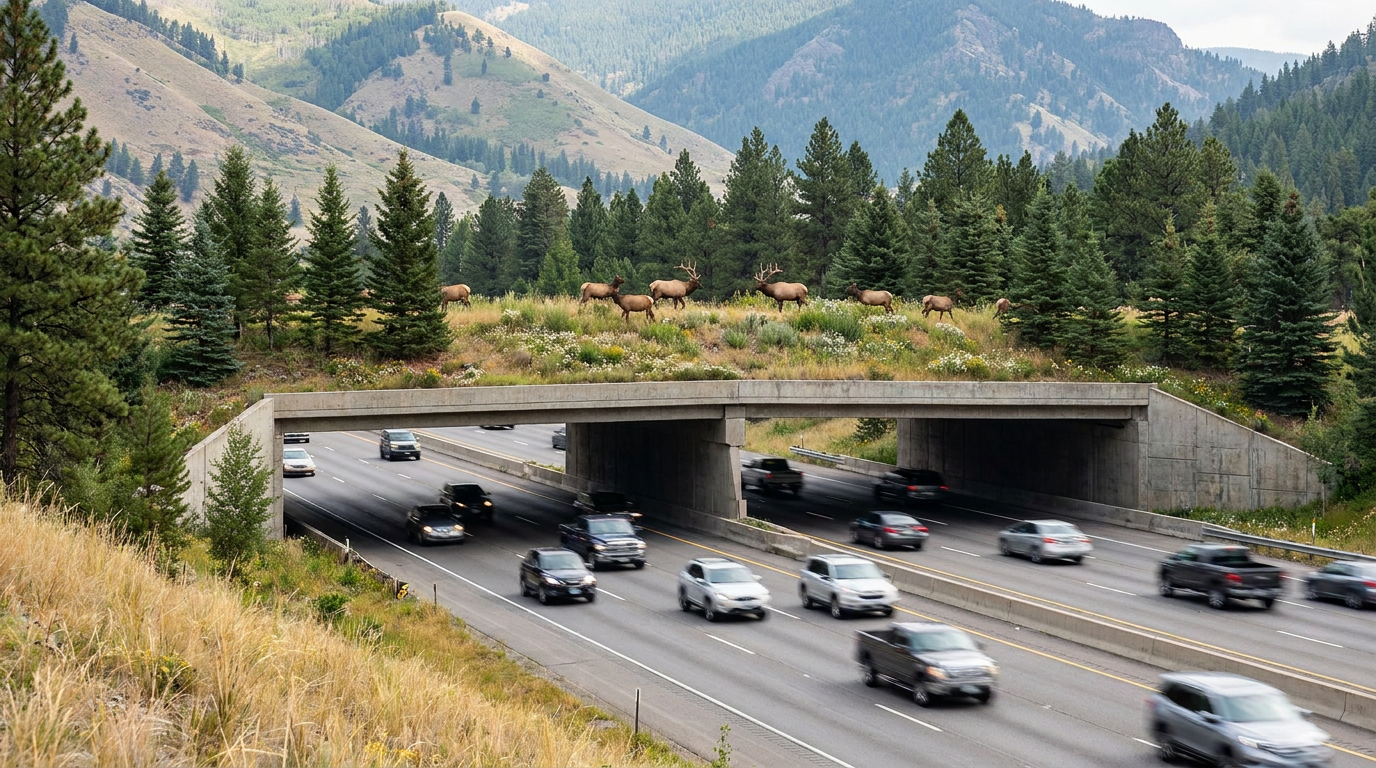
The solution lies in wildlife crossing structures—purpose-built overpasses and underpasses designed exclusively for animal transit. When strategically placed in known migration corridors and paired with extensive guide fencing, these structures funnel wildlife safely across busy thoroughfares. The concept, which originated in Europe, has been refined and scaled across North America over the past three decades. Today, these crossings are no longer experimental novelties; they are highly engineered, data-backed interventions that boast some of the most impressive return-on-investment metrics in the entire field of civil engineering. As the initial wave of federal funding for these projects approaches its expiration date, a rare bipartisan consensus is emerging to permanently embed wildlife crossings into the continent's transportation grid.[4][5][8]
The modern blueprint for this success story was drafted in the Canadian Rockies. In the early 1980s, Parks Canada faced a crisis as traffic volumes surged on the Trans-Canada Highway, which bisects Banff National Park. The mounting death toll of both wildlife and motorists prompted a radical proposal: as the highway was expanded to four lanes, the government would construct dedicated wildlife bridges over the asphalt. When the first two overpasses were completed in 1996 at a cost of $1.5 million each, they were met with intense public skepticism. Critics argued that the structures were a waste of taxpayer money, predicting that predators like wolves would simply use the fenced funnels to trap and slaughter prey in front of horrified tourists.[7]
Three decades of rigorous monitoring have thoroughly dismantled those early fears. The Banff wildlife crossing complex has grown to include six massive overpasses and 38 underpasses, making it the highest concentration of such structures anywhere in the world. The data collected by Parks Canada is unequivocal: the combination of crossing structures and 82 kilometers of highway fencing has reduced wildlife-vehicle collisions by more than 80 percent across the board. For specific ungulate species like elk and deer, the collision rate has plummeted by an astonishing 96 percent. Rather than serving as predator traps, the crossings have become vital arteries for the park's ecosystem, facilitating natural movement and hunting patterns without artificially skewing survival rates.[1][7]

The sheer volume of traffic utilizing these green bridges is a testament to their efficacy. Since monitoring began, researchers have documented more than 200,000 safe crossings by at least 11 species of large mammals. Motion-activated cameras have captured everything from grizzly bears and wolves to lynx, wolverines, and even boreal toads navigating the structures. Elk were famously the first to adapt, testing the overpasses while they were still under construction in the late 1990s. Over time, more cautious species learned to trust the infrastructure. Grizzly bear crossings, for instance, increased from just seven in 1996 to more than 100 annually a decade later, proving that learned behavior is passed down through generations of local wildlife.[7][8]
The success in Banff has transformed the park into a global laboratory for road ecology, yielding crucial insights into how different species interact with infrastructure. Biologists have discovered that a one-size-fits-all approach does not work for wildlife. Prey species like elk, deer, and moose, along with apex predators like grizzly bears, strongly prefer wide, open overpasses that offer clear sightlines and a sense of security. Conversely, species that naturally seek cover, such as cougars and black bears, gravitate toward the enclosed, cave-like environments of underpasses and culverts. This behavioral divergence dictates that a successful mitigation strategy must include a diverse portfolio of crossing types to accommodate the entire local food web.[1][7]
Biologists have discovered that a one-size-fits-all approach does not work for wildlife.
Engineering specifications also play a critical role in a crossing's success rate. Studies analyzing dozens of structures across western North America have found that width is a primary determinant of usage for overpasses. Structures that are at least 50 meters (164 feet) wide see nearly twice the crossing volume and a significantly more diverse array of species compared to narrower bridges. While wider structures carry a steeper upfront price tag—often ranging from $5 million to $15 million depending on the terrain—the ecological payoff is substantial. A wide, heavily vegetated overpass effectively masks the sensory intrusion of the highway below, allowing even the most skittish animals to cross without hesitation.[8]

The localized success in Banff has catalyzed a much larger, continent-spanning ambition known as the Yellowstone to Yukon (Y2Y) Conservation Initiative. This collaborative effort aims to connect and protect a 2,100-mile corridor stretching from Wyoming to the Canadian territories, ensuring that wide-ranging species have the room they need to adapt to a changing climate. Highways are the primary severing force in this landscape, isolating animal populations and creating genetic bottlenecks. By systematically identifying collision hotspots and migration pinch-points, the Y2Y initiative and its partners have successfully advocated for the installation of 204 wildlife underpasses and overpasses across the region to date.[2]
The ecological dividends of this macro-connectivity project are already measurable. In 1993, the isolated grizzly bear populations in the lower 48 states were separated by a daunting 150-mile expanse of fragmented, human-dominated landscape. Today, thanks to targeted land conservation and the strategic placement of highway crossings, that gap has shrunk to just 45 miles. By allowing individual bears to safely traverse the landscape and interbreed with neighboring populations, these structures are actively restoring the genetic diversity required for the species' long-term resilience. What began as a localized safety measure has evolved into a landscape-scale tool for evolutionary survival.[2][8]
Beyond the profound ecological benefits, the proliferation of wildlife crossings is increasingly driven by cold, hard economics. While the initial capital expenditure for an overpass can induce sticker shock for transportation departments, the long-term math heavily favors construction. Research consistently demonstrates that in areas with high collision rates, it actually costs society more to do nothing than it does to build a crossing. When factoring in the average cost of a collision with a large ungulate—which includes vehicle repair, medical bills, emergency response, and the lost value of the animal—a well-placed crossing structure typically pays for itself within 10 to 12 years.[6][8]

Recognizing this dual benefit to public safety and conservation, the United States federal government recently made an unprecedented commitment to road ecology. The 2021 Bipartisan Infrastructure Law established the Wildlife Crossings Pilot Program, injecting $350 million over five years specifically for the construction of these structures. It marked the first time in U.S. history that dedicated federal funding was allocated solely for wildlife-transportation mitigation. The response from states, Native American Tribes, and municipalities was overwhelming; applications for the grant money outpaced available funding by a ratio of roughly five to one, underscoring the massive pent-up demand for highway safety solutions.[4][5]
With the pilot program's funding set to expire in 2026, a coalition of lawmakers is mobilizing to ensure the momentum is not lost. The push for reauthorization has created remarkably unified political bedfellows. In Congress, Representatives Ryan Zinke, a Republican from Montana, and Don Beyer, a Democrat from Virginia, have co-authored the Wildlife Road Crossings Program Reauthorization Act. Their legislation proposes extending the program through 2031 and increasing the funding to $200 million annually—a $1 billion total investment. Simultaneously, the BUILD America 250 Act, a broader surface transportation bill, includes dedicated provisions to keep the crossing grants flowing.[3][4]

The bipartisan appeal of wildlife crossings is rooted in their universal utility. In rural, conservative-leaning states like Montana—which boasts the second-highest per-capita rate of wildlife-vehicle collisions in the country—crossings are championed as essential infrastructure that protects families driving to school and preserves the big-game herds vital to the hunting economy. In more urbanized, liberal-leaning states, the structures are celebrated for their role in biodiversity conservation and climate resilience. As advocates frequently point out, safety crossings placed in known migration corridors boast a virtually unheard-of 97 percent success rate in reducing collisions, making them one of the most reliable investments in modern transportation.[3][5][8]
As North America looks toward the next decade of infrastructure development, the integration of wildlife crossings is shifting from an optional environmental perk to a standard engineering requirement. The success of the Banff model and the Y2Y corridor has proven that human mobility and ecological integrity do not have to be mutually exclusive. By continuing to invest in these green bridges and tunnels, society is slowly stitching back together the landscapes it spent the last century tearing apart, ensuring that both commuters and carnivores can safely reach their destinations.[1][2][8]
How we got here
1996
Parks Canada completes the first two wildlife overpasses over the Trans-Canada Highway in Banff National Park, pioneering the modern approach to road ecology.
2021
The U.S. Congress passes the Bipartisan Infrastructure Law, establishing the first-ever dedicated federal funding ($350 million) for wildlife crossings.
2025
The Yellowstone to Yukon Conservation Initiative reports that 204 crossing structures now span the region, shrinking the isolation gap between grizzly populations to just 45 miles.
2026
Bipartisan legislation is introduced in the U.S. Congress to permanently reauthorize the expiring federal grant program, proposing up to $200 million in annual funding through 2031.
Viewpoints in depth
Conservation Biologists
Scientists focused on the long-term genetic health and climate resilience of North American wildlife.
For ecologists and biologists, the primary value of wildlife crossings extends far beyond preventing immediate roadkill. They view highways as genetic bottlenecks that isolate populations, leading to inbreeding and increased vulnerability to disease. By reconnecting these fragmented landscapes, biologists argue that crossings allow species to migrate, find mates, and adapt to shifting climate zones. They emphasize that a successful network must include a variety of structure types—both wide overpasses and sheltered underpasses—to accommodate the behavioral differences of the entire local food web.
Transportation & Safety Officials
Engineers and policymakers focused on reducing human fatalities, injuries, and the economic costs of highway collisions.
From the perspective of departments of transportation, wildlife crossings are a highly effective public safety intervention. Officials point to the staggering $8 billion annual cost of animal-vehicle collisions, which includes property damage, medical expenses, and emergency response deployments. While acknowledging the steep $5 million to $15 million upfront cost of a wide overpass, transportation planners argue that the infrastructure boasts an undeniable return on investment, typically paying for itself within a decade. Their focus is on securing reliable, long-term funding to scale these proven engineering solutions across high-risk rural corridors.
State & Tribal Planners
Local authorities tasked with implementing these massive infrastructure projects on the ground.
State agencies and Native American Tribes are the primary applicants for federal wildlife crossing grants, and they view the current funding landscape as both a historic opportunity and a frustrating bottleneck. With grant applications outstripping available funds by a five-to-one margin, local planners argue that the demand for these projects is massive. They advocate for the permanent reauthorization of federal programs, noting that complex, multi-year engineering projects require long-term funding certainty rather than short-lived pilot programs. Tribes in particular emphasize the need for waived matching-fund requirements to make these projects viable on indigenous lands.
What we don't know
- Whether the U.S. Congress will successfully pass the BUILD America 250 Act or standalone reauthorization bills before the current pilot program funding expires in late 2026.
- How rapidly changing climate conditions might shift traditional animal migration routes, potentially rendering some existing crossing structures obsolete.
- The exact long-term impact of these structures on smaller, less-studied species like amphibians and reptiles, as most monitoring has focused on large mammals.
Key terms
- Road Ecology
- The scientific study of the ecological effects of roads and highways on natural environments and wildlife populations.
- Ungulate
- A broad category of large, hooved mammals, such as elk, deer, moose, and bighorn sheep, which are frequently involved in highway collisions.
- Habitat Fragmentation
- The process by which large, continuous areas of natural environment are broken up into smaller, isolated patches, often by human infrastructure like highways.
- Genetic Bottleneck
- A sharp reduction in the size and genetic diversity of a population, which can occur when highways isolate animal groups and prevent them from interbreeding.
Frequently asked
Do animals actually know how to use the crossings?
Yes. While it can take a few years for some species to adapt, research shows animals are 146% more likely to use a crossing than a random spot on the highway. Elk and deer adapt almost immediately, while predators like grizzly bears learn over time and pass the behavior to their offspring.
Are overpasses or underpasses better?
Neither is universally better; they serve different species. Prey animals like elk and moose prefer wide, open overpasses with clear sightlines, while species that seek cover, like cougars and black bears, prefer the enclosed environment of underpasses.
How much does a wildlife overpass cost?
Costs vary widely based on terrain and size, but a standard wide overpass typically costs between $5 million and $15 million. However, studies show they pay for themselves in 10 to 12 years through reduced vehicle collision costs.
What happens if an animal wanders onto the highway instead?
Crossings are almost always paired with extensive guide fencing that runs for miles along the highway. This fencing prevents animals from accessing the road and naturally funnels them toward the safe crossing structures.
Sources
Source coverage
8 outlets
3 viewpoints surfaced








[1]Parks CanadaTransportation & Safety Officials
Making roads safer for wildlife at Parks Canada
Read on Parks Canada →[2]Yellowstone to Yukon Conservation InitiativeConservation Biologists
Wildlife Crossings: A Current of Hope
Read on Yellowstone to Yukon Conservation Initiative →[3]The Wildlife SocietyState & Tribal Planners
Bipartisan bill would reauthorize wildlife crossings program
Read on The Wildlife Society →[4]National Parks TravelerState & Tribal Planners
A bipartisan transportation bill would include five years of funding for wildlife crossings
Read on National Parks Traveler →[5]Mountain JournalState & Tribal Planners
Bipartisan Bill Aims To Secure Wildlife Crossing Funds
Read on Mountain Journal →[6]Center for Large Landscape ConservationTransportation & Safety Officials
Resources and Opportunities for Reducing Wildlife-Vehicle Collisions
Read on Center for Large Landscape Conservation →[7]Canadian GeographicConservation Biologists
How Banff’s wildlife crossings became a global conservation success story
Read on Canadian Geographic →[8]Factlen Editorial Team
Synthesis by Factlen editorial team
Read on Factlen Editorial Team →
Every angle. Every day.
Get world stories with full source coverage and perspective breakdowns delivered to your inbox.