
How Hotels Are Re-Engineering Rooms for the $690 Billion 'Sleep Tourism' Boom
As modern life disrupts natural circadian rhythms, travelers are increasingly booking vacations solely to get a good night's rest. Hotels are responding with AI smart beds, clinical sleep labs, and environments engineered for deep slumber.
By Factlen Editorial Team
- Hospitality Innovators
- Hotels and resorts view sleep as the ultimate luxury amenity and a massive growth market.
- Sleep Scientists & Clinicians
- Medical professionals emphasize evidence-based circadian alignment over expensive wellness fads.
- Wellness Consumers
- Travelers seeking rest and burnout recovery are driving the demand for sleep-focused vacations.
- Health Equity Advocates
- Advocates point out that optimized sleep is increasingly becoming a stratified luxury.
What's not represented
- · Shift workers
- · Budget travelers
Why this matters
With over a third of adults suffering from insufficient sleep, the hospitality industry is transforming how we travel and rest. Understanding the science behind these sleep retreats can help you engineer better, more restorative sleep in your own home.
Key points
- Sleep tourism has emerged as a major travel category, with the global market valued at over $690 billion.
- Luxury hotels are outfitting rooms with AI smart beds, circadian lighting, and soundproof walls to optimize rest.
- Some resorts are taking a holistic approach, offering yoga nidra, sleep doctors, and analog rooms devoid of screens.
- The trend highlights a growing "sleep divide," where optimized rest is increasingly treated as a luxury commodity.
- Experts hope the environmental engineering used in hotels will eventually influence everyday home and urban design.
For decades, the hallmark of a successful vacation was a packed itinerary—early-morning tours, late-night dinners, and the familiar refrain of "I'll sleep when I'm dead." But a profound shift is reshaping the hospitality industry. Travelers are increasingly booking trips with a single, overriding goal: getting a truly good night's rest. Welcome to the era of "sleep tourism," a booming travel category where restorative slumber is the main event rather than an afterthought.[1][3][4][5]
The numbers behind this shift are staggering. The global sleep tourism market is valued at over $690 billion and is projected to grow by hundreds of billions more by 2028. According to industry surveys, 91 percent of frequent travelers say they would pay a premium for accommodations specifically designed to enhance sleep. Major hospitality brands have taken notice, with companies like Hilton identifying sleep-focused travel as a defining trend for the coming years.[5][6][7][11]
This demand is driven by a widespread crisis of exhaustion. In the United States alone, roughly 36 percent of adults fail to get sufficient sleep, and nearly four in ten struggle to fall asleep multiple nights a week. Modern life—characterized by artificial lighting, late-evening screen use, and chronic stress—actively works against the body's natural biological clock. "Modern life is exhausting," notes the hospitality group Accor, pointing to the relentless rhythm of daily living that leaves many people desperate for a reset.[2][3][5]

At the core of the sleep tourism philosophy is the circadian rhythm, the body's master biological clock governed by the brain's suprachiasmatic nucleus. This internal timing system relies heavily on light exposure to regulate hormone production, metabolism, and sleep cycles. When travelers cross time zones or spend their days under fluorescent office lights, this rhythm fractures. Sleep retreats aim to repair it by carefully controlling environmental stimuli.[3][4]
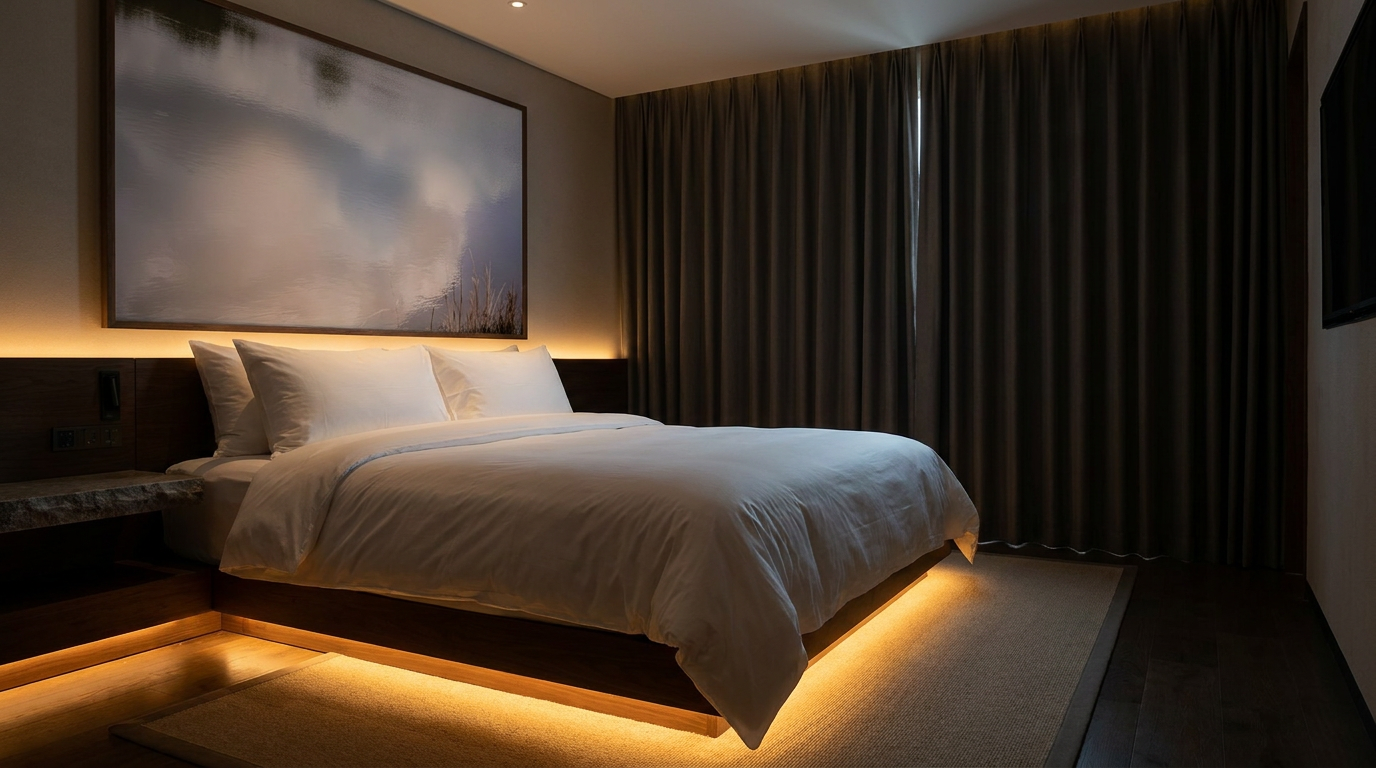
To achieve this, luxury hotels are transforming their rooms into high-tech sleep laboratories. On New York City's Billionaires' Row, the Park Hyatt offers dedicated "Sleep Suites" equipped with AI-enhanced Bryte Balance mattresses. For a roughly $300 nightly surcharge, guests sleep on beds that automatically adjust firmness throughout the night to mitigate pressure points. The mattresses can even play meditative pulses synced to soothing audio tracks, gently guiding users into deep sleep and waking them without a jarring alarm.[1]

To achieve this, luxury hotels are transforming their rooms into high-tech sleep laboratories.
Beyond the bed itself, properties are engineering the entire room environment to support biological needs. Hotels are installing circadian lighting systems that shift color temperature throughout the day, mimicking the natural progression of sunlight. Blackout technology, sound-engineered walls, and temperature-regulating linens treat light, sound, and heat as active wellness variables rather than incidental room features.[3][8]
While some properties lean into technology, others are embracing holistic, analog approaches to force a nervous system reset. At the cliffside Six Senses resort in Ibiza, guests undergo wellness screenings before embarking on multi-day sleep programs. These tailored itineraries blend yoga nidra, meditation, and spa therapies designed to regulate the nervous system, alongside sleep-supporting nutritional advice.[8]
Some retreats take the analog philosophy to the extreme by stripping away modern conveniences entirely. At the Post Ranch Inn in California, rooms are intentionally devoid of televisions and alarm clocks to eliminate sleep-disrupting stimuli. In Egypt's Siwa Oasis, the Adrère Amellal eco-lodge operates without electricity, forcing guests to reconnect with natural light-dark cycles and sleep in total silence under the desert sky.[9][10]

The trend is also driving a medicalization of the traditional hotel stay. Properties are increasingly partnering with renowned sleep scientists and clinicians to offer diagnostic services. At the Equinox Hotel, guests can participate in on-site sleep lab studies, while other resorts offer consultations that analyze airways, heart rates, and neurological systems to create personalized treatment plans.[1][4][5]
In London, The Cadogan hotel has partnered with a Harley Street hypnotherapist to offer a "Sleep Concierge" service, complete with meditative recordings, weighted blankets, and specially brewed bedtime teas. Other luxury resorts have introduced CPAP therapies for sleep apnea and phototherapy sessions to improve the body's response to light.[4][8]

However, the rapid rise of sleep tourism has also highlighted a growing "sleep divide." While affluent travelers can spend thousands of dollars on AI mattresses and curated sleep retreats, millions of people struggle to obtain the basic conditions necessary for healthy rest. Research consistently shows that financial insecurity, unstable housing, and shift work significantly reduce both sleep duration and quality, making optimized rest an increasingly stratified luxury.[3]
Ultimately, the goal of a sleep vacation is not just to catch up on missed hours, but to build sustainable habits. Sleep experts emphasize that the true value of these retreats lies in education—teaching guests how factors like nutrition, gut health, and stress are interconnected with insomnia. By experiencing what a perfectly optimized sleep environment feels like, travelers are better equipped to upgrade their own bedrooms into functional sleep infrastructure when they return home.[2][3]
How we got here
Pre-2020
Hotels primarily market sleep through basic amenities like high-thread-count sheets and pillow menus.
2022
Park Hyatt New York debuts its Bryte Restorative Sleep Suites, signaling the arrival of high-tech sleep tourism.
2024
The global sleep tourism market surpasses $690 billion as major brands like Hilton and Six Senses launch dedicated sleep programs.
2025
Sleep tourism shifts from a niche luxury offering to a mainstream travel category, with a focus on circadian health and medical diagnostics.
2026
The industry increasingly addresses the 'sleep divide,' exploring how to translate luxury hotel sleep innovations into everyday home environments.
Viewpoints in depth
Hospitality Innovators
Hotels and resorts view sleep as the ultimate luxury amenity and a massive growth market.
For the hospitality industry, sleep tourism represents a highly lucrative pivot from traditional sightseeing to wellness-centric travel. Brands like Hilton, Six Senses, and Park Hyatt argue that modern travelers are fundamentally exhausted and are willing to pay premium rates for guaranteed rest. By investing in AI mattresses, circadian lighting, and soundproof architecture, these innovators believe they are transforming the hotel room from a mere place to crash into an active health intervention. They view the integration of sleep technology and holistic spa treatments as the new baseline for luxury travel.
Sleep Scientists & Clinicians
Medical professionals emphasize evidence-based circadian alignment over expensive wellness fads.
Sleep researchers and clinicians welcome the growing cultural focus on rest, but they caution against conflating luxury amenities with medical treatment. This camp stresses that the foundation of good sleep relies on consistent schedules, light management, and stress reduction—not necessarily $4,000 smart beds or crystal therapy. While they praise hotels that incorporate genuine medical diagnostics like CPAP trials and sleep apnea screenings, they urge consumers to focus on the biological fundamentals. Their ultimate goal is to ensure that the habits learned on a sleep retreat are sustainable and scientifically sound once the traveler returns home.
Health Equity Advocates
Advocates point out that optimized sleep is increasingly becoming a stratified luxury.
While the booming sleep tourism market caters to affluent travelers, health equity advocates highlight a growing 'sleep divide.' Organizations like the Global Wellness Institute point out that millions of people struggle to obtain the basic conditions necessary for healthy rest due to financial insecurity, unstable housing, and shift work. From this perspective, the fact that people must pay thousands of dollars to travel to a quiet, dark room underscores a systemic failure in modern urban design and labor practices. They argue that the principles of sleep tourism—quiet, dark, cool, and safe environments—should be accessible public health standards, not just vacation upgrades.
What we don't know
- It remains unclear whether the short-term benefits of a sleep retreat lead to long-term improvements in chronic insomnia once guests return home.
- The exact efficacy of some high-tech interventions, like AI-adjusted mattress firmness, is still being debated by clinical sleep researchers compared to basic environmental changes.
Key terms
- Sleep Tourism
- A category of travel where improving rest and sleep quality is the primary purpose of the trip, rather than a secondary benefit.
- Circadian Rhythm
- The body's internal 24-hour biological clock that regulates sleep-wake cycles, hormone production, and metabolism, primarily guided by light.
- Suprachiasmatic Nucleus
- A tiny region in the brain that acts as the master pacemaker for the circadian rhythm, responding directly to light exposure.
- Yoga Nidra
- A state of conscious relaxation and guided meditation often referred to as 'yogic sleep,' used in retreats to calm the nervous system.
- AI Smart Bed
- A mattress equipped with sensors and artificial intelligence that automatically adjusts firmness and temperature throughout the night to optimize sleep.
Frequently asked
What exactly is sleep tourism?
Sleep tourism is a growing travel trend where the primary goal of the trip is to get restorative rest. It involves staying at hotels or resorts that offer specialized sleep environments, smart beds, and wellness programs designed to improve sleep quality.
Do AI smart beds actually improve sleep?
AI smart beds, like those used in Park Hyatt's Sleep Suites, use sensors to track movement and automatically adjust firmness to relieve pressure points. While many users report better rest, sleep scientists emphasize that a dark, quiet, and cool environment is just as critical.
Can a hotel stay permanently fix my sleep schedule?
A short hotel stay cannot permanently cure chronic insomnia, but sleep retreats aim to educate guests on healthy habits. The goal is to help travelers reset their circadian rhythms and take those improved routines back to their home bedrooms.
Why are hotels focusing on sleep now?
With over a third of adults reporting insufficient sleep, the hospitality industry has recognized a massive market demand. Travelers are increasingly exhausted by modern life and are willing to pay a premium for environments that guarantee deep rest.
Sources
Source coverage
11 outlets
4 viewpoints surfaced











[1]Business InsiderHospitality Innovators
Forget 'I'll sleep when I'm dead.' These days, it's all about sleeping on vacation
Read on Business Insider →[2]ForbesHospitality Innovators
Why Sleep Tourism Is The Trend We've Been Dreaming About
Read on Forbes →[3]Global Wellness InstituteHealth Equity Advocates
Sleep Tourism and the Growing Sleep Divide
Read on Global Wellness Institute →[4]National GeographicSleep Scientists & Clinicians
Why sleep tourism is the latest travel trend to know about
Read on National Geographic →[5]US MagazineWellness Consumers
Sleep Tourism Is One of 2026's Biggest Travel Trends — Why Travelers Are Booking Trips to Sleep Better
Read on US Magazine →[6]HiltonHospitality Innovators
Hilton's 2024 Trends Report: Rest and Rejuvenation
Read on Hilton →[7]SkyscannerWellness Consumers
The growth of sleep tourism
Read on Skyscanner →[8]Net-A-PorterHospitality Innovators
The best sleep retreats for a restorative getaway
Read on Net-A-Porter →[9]Offshore Travel MagazineHospitality Innovators
Six standout hotels where the art of sleep has become a signature experience
Read on Offshore Travel Magazine →[10]AviFaresHospitality Innovators
Top Sleep Tourism Destinations for 2026
Read on AviFares →[11]Mattress MiracleSleep Scientists & Clinicians
Sleep Tourism: Paying to Sleep Better (Somewhere Else)
Read on Mattress Miracle →

Every angle. Every day.
Get travel stories with full source coverage and perspective breakdowns delivered to your inbox.