
The Longevity Revolution: How Women's Gymnastics Erased Its Expiration Date
Driven by changes in scoring, sports science, and NCAA NIL rules, elite female gymnasts are now peaking in their mid-to-late 20s, transforming a sport once dominated by teenagers.
By Factlen Editorial Team
- Sports Scientists & Medical Staff
- Advocates for load management and evidence-based pacing, arguing that mature muscle development is essential for modern gymnastics.
- Collegiate & Professional Organizers
- Focuses on building sustainable financial bridges (NIL) and post-grad leagues (GIGA) to keep athletes in the sport.
- Elite Gymnasts & Advocates
- Pushes for cultural reform, ending abusive practices, and proving that adult women can dominate the sport.
What's not represented
- · Junior Elite Gymnasts
- · International Gymnastics Federation (FIG) Officials
Why this matters
This shift proves that prioritizing athlete well-being and sustainable training over abusive, high-repetition models actually produces better, more powerful athletes who can sustain professional careers for decades.
Key points
- The average age of elite female gymnasts has risen significantly, with top athletes now peaking in their mid-to-late 20s.
- The 2006 shift to an open-ended Code of Points rewarded extreme difficulty, favoring the explosive power of mature adult bodies.
- NCAA NIL rules implemented in 2021 allow gymnasts to monetize their Olympic success while continuing to compete in college.
- Collegiate gymnastics serves as a lower-impact incubator, extending careers and creating a sustainable NCAA-to-Elite pipeline.
- Modern sports science has replaced abusive, high-repetition training with evidence-based load management and periodization.
- New professional leagues like GIGA are launching to provide salaried post-collegiate careers with paid maternity leave.
For decades, the archetypal image of an Olympic women's gymnast was frozen in time: a tiny, prepubescent teenager defying gravity. When 14-year-old Nadia Comaneci scored the first perfect 10.0 at the 1976 Montreal Games, she inadvertently set a template that would govern the sport for nearly half a century. The prevailing wisdom dictated that gymnastics was a race against puberty. Coaches believed that smaller, lighter bodies were easier to flip and twist, leading to an era where the average age of Olympic medalists steadily plummeted. By the 1990s, the sport was widely perceived as the exclusive domain of 15- and 16-year-olds, and athletes who reached their early twenties were considered past their prime, their bodies supposedly too battered to continue at the elite level.[1][5]
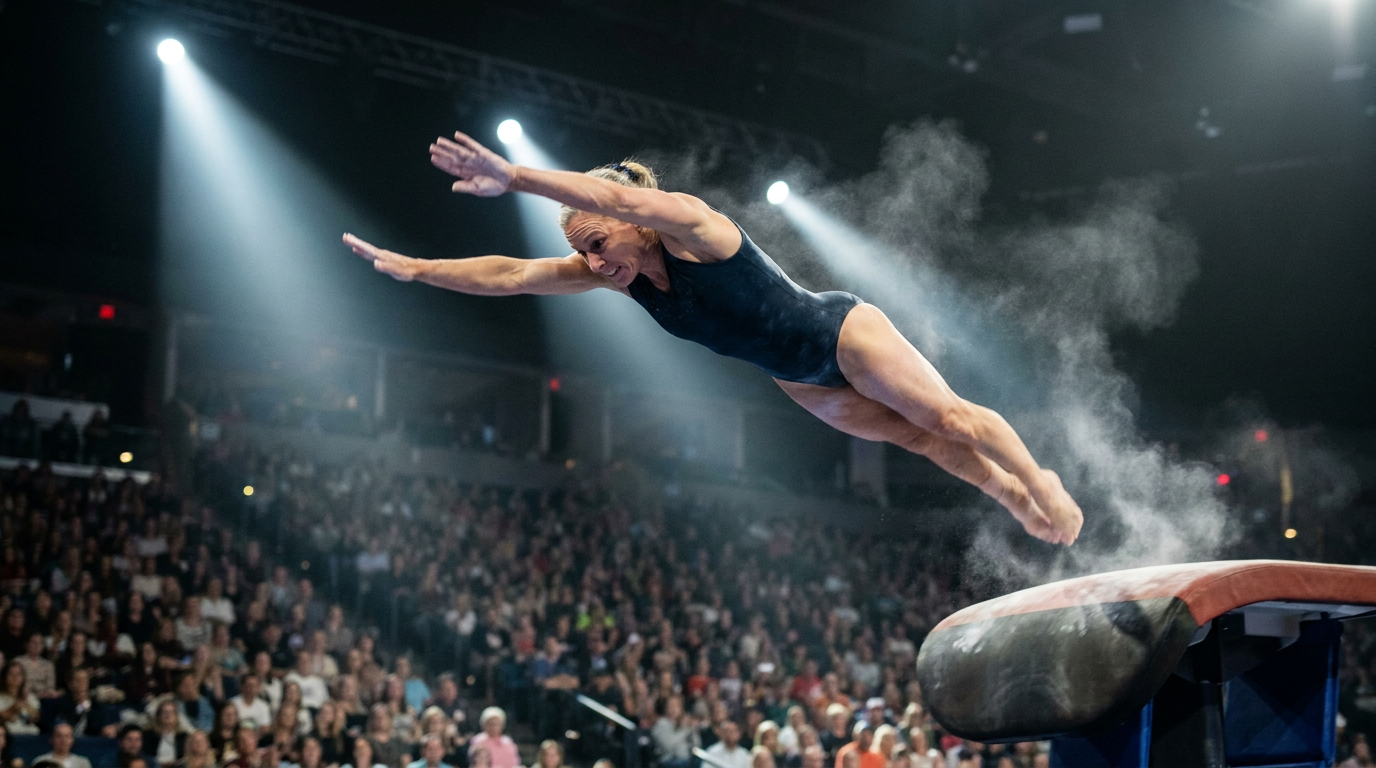
Today, the podium looks entirely different. The 2020s have ushered in a longevity revolution that has completely rewritten the biological clock of women's gymnastics. Simone Biles has continued to dominate the sport and win all-around gold medals at age 27, executing skills that no teenager has ever successfully landed. Great Britain's Becky Downie recently competed at the highest international level at age 32, while Brazil's Rebeca Andrade has secured her status as a global icon in her mid-twenties. The "pixie" era has been decisively replaced by an era of powerful, mature women who are proving that the human body can withstand and excel at elite gymnastics far longer than previously imagined.[2]
The shift has been so rapid and profound that the sport's internal culture is still catching up to the new reality. As recently as the 2016 Rio Olympics, 22-year-old Aly Raisman was affectionately dubbed the "grandma" of the United States team by her younger peers. Today, a 22-year-old elite gymnast is merely entering her prime. The average age of the U.S. women's team has steadily climbed over the last three Olympic cycles, with rosters routinely featuring multiple athletes over the age of 20. This aging trend is not a statistical anomaly or the result of a few exceptional outliers; it is a structural transformation driven by three intersecting revolutions in scoring, college athletics, and sports science.[1][2]

The first major catalyst for this longevity revolution was a fundamental change to the sport's rulebook. For decades, gymnastics was governed by the iconic "Perfect 10" scoring system. Under this framework, a routine had a maximum possible score, and judges deducted fractions of a point for every wobble, step, or bent knee. Because the difficulty of routines was effectively capped, the system heavily favored extreme flexibility and flawless execution—traits that were often easier to maintain in younger, more pliable bodies before the onset of adult growth spurts.[5]
That paradigm shattered in 2006 when the International Gymnastics Federation (FIG) introduced the open-ended Code of Points. The new system split a gymnast's score into two separate components: an Execution score (E-score), which still starts at 10.0 and deducts for errors, and a Difficulty score (D-score), which has no maximum limit. Gymnasts could now accumulate points by packing their routines with increasingly complex and dangerous skills. This change fundamentally altered the physical requirements of the sport, shifting the premium from pure flexibility to explosive power.[1][5]
Harder skills require immense physical strength and kinetic energy. To safely launch into the air for a Yurchenko double pike on vault, or to complete a double-twisting double backflip on the floor exercise, a gymnast needs highly developed fast-twitch muscle fibers. Sports scientists and coaches quickly realized that mature, adult bodies are far better equipped to generate this kind of explosive power than the bodies of 15-year-olds. The open-ended code inadvertently created an environment where athletes who stayed in the sport long enough to develop adult musculature possessed a distinct mathematical advantage over their younger competitors.[1][4]

The second revolution occurred off the mat, driven by the economics of American collegiate sports. Historically, elite gymnasts faced an agonizing financial dilemma when they reached the age of 16 or 17. Because of the NCAA's strict amateurism rules, an athlete who accepted endorsement money or turned professional to capitalize on their Olympic fame immediately forfeited their right to compete in college gymnastics. For many, this meant cashing in on a brief window of Olympic popularity and then abruptly retiring from the sport, as they had no collegiate safety net or funded training environment to sustain them for another four-year cycle.[1][6]
The second revolution occurred off the mat, driven by the economics of American collegiate sports.
That barrier was permanently dismantled in 2021 when the NCAA changed its rules to allow athletes to profit from their Name, Image, and Likeness (NIL). The impact on women's gymnastics was immediate and seismic. Olympic medalists like Suni Lee and Jade Carey no longer had to choose between financial security and collegiate competition. They could sign lucrative endorsement deals, monetize their massive social media followings, and still accept full athletic scholarships to compete for major university programs.[1][6]
The ability to compete in the NCAA while retaining elite status has created a sustainable "NCAA-to-Elite pipeline" that extends careers by a decade. Collegiate gymnastics offers a vastly different environment than the grueling elite circuit. NCAA routines are slightly shorter and have lower difficulty requirements, which significantly reduces the physical pounding on an athlete's joints. Gymnasts compete weekly in highly supportive, team-oriented environments, allowing them to stay in peak competitive shape while simultaneously resting their bodies from the extreme impact of elite-level skills.[4][6]
This collegiate bridge allows athletes to mature emotionally and physically. When these gymnasts eventually return to the elite stage—often taking a gap year or training simultaneously for both—they bring a renewed mental focus and a refined sense of artistry. They are no longer burned-out teenagers, but self-directed adults who are choosing to be in the gym. The NCAA system effectively serves as a high-performance incubator, preserving the health of top-tier athletes through their early twenties so they can peak on the international stage in their mid-to-late twenties.[4][6]

The third and perhaps most vital revolution has been a cultural reckoning regarding athlete well-being and sports science. For decades, the dominant training philosophy in women's gymnastics relied on extreme repetition, rigid authoritarianism, and a culture of pushing athletes through severe pain. Popularized in the 1980s and 90s, this approach treated gymnasts as disposable commodities, routinely breaking their bodies and spirits by the time they reached voting age. The sport's governing bodies and coaching ranks have been forced to confront and dismantle these abusive practices in recent years.[1][4]
Modern gymnastics training is increasingly guided by evidence-based sports medicine. Coaches now prioritize load management, periodization, and injury prevention over mindless repetition. There is a growing consensus among sports scientists that a female gymnast's actual physical peak—the optimal intersection of strength, spatial awareness, and mental resilience—likely falls between the ages of 22 and 28. By training smarter and listening to their bodies, today's athletes are avoiding the catastrophic overuse injuries that prematurely ended the careers of previous generations.[1][4]
As the demographic of the sport shifts, the infrastructure surrounding it is evolving to support adult women. Recognizing that athletes no longer want to walk away from the sport at age 22, organizers are building new professional avenues that cater to post-collegiate competitors. The Global Impact Gymnastics Alliance (GIGA), for example, is a newly formed professional league designed specifically to provide international gymnasts with a platform to continue competing on their own terms, long after their NCAA eligibility has expired.[3]
Leagues like GIGA aim to offer what has long been missing from the sport: a true, sustainable professional career path. Organizers are developing a modified code of points that balances spectacular skills with longevity, intentionally de-emphasizing elements that carry a high risk of career-ending injuries. The long-term vision for these professional circuits includes salaried positions, paid maternity leave, and a touring schedule that treats gymnastics as a viable adult profession rather than a fleeting childhood hobby. This ensures athletes can earn a living without destroying their bodies.[3]

The erasure of the sport's expiration date represents one of the most uplifting transformations in modern athletics. Women's gymnastics is no longer a cautionary tale of burned-out youth, but a celebration of enduring strength and adult mastery. By aligning the rules of the sport with the realities of human biology, and by providing the financial and cultural support necessary for athletes to thrive, gymnastics has finally allowed its brightest stars the time they need to truly shine.[2][4]
How we got here
1976
14-year-old Nadia Comaneci scores the first Perfect 10, cementing the 'pixie' era of teenage dominance.
1997
The International Gymnastics Federation raises the minimum senior competition age to 16 to protect young athletes.
2006
The open-ended Code of Points is introduced, rewarding extreme difficulty and favoring mature, powerful bodies.
2021
NCAA implements NIL rules, allowing elite gymnasts to profit from their fame while competing in college.
2025
The Global Impact Gymnastics Alliance (GIGA) plans its initial events to provide a post-collegiate professional league.
Viewpoints in depth
Sports Scientists & Medical Staff
Advocates for load management and evidence-based pacing, arguing that mature muscle development is essential for modern gymnastics.
Sports medicine professionals emphasize that the extreme difficulty required by the modern Code of Points cannot be safely executed by underdeveloped bodies. They argue that fast-twitch muscle fibers, which peak in a woman's mid-twenties, are necessary to generate the explosive power required for skills like the Yurchenko double pike. This camp strongly advocates for periodization and load management, pointing out that the catastrophic overuse injuries of the 1990s were the direct result of pushing prepubescent athletes too hard, too fast. By treating gymnastics as a marathon rather than a sprint, they believe athletes can safely compete well into their thirties.
Collegiate & Professional Organizers
Focuses on building sustainable financial bridges (NIL) and post-grad leagues (GIGA) to keep athletes in the sport.
For decades, the business model of gymnastics forced athletes into early retirement. Organizers in this camp view the 2021 NIL rule changes as the most significant structural shift in the sport's history, as it finally allowed athletes to monetize their Olympic success without sacrificing their collegiate eligibility. Looking ahead, this group is focused on building post-collegiate infrastructure, such as the Global Impact Gymnastics Alliance (GIGA). They argue that for gymnastics to be taken seriously as a professional sport, it must offer salaried positions, paid maternity leave, and a competition schedule that accommodates adult lives, rather than relying solely on the amateur NCAA system.
Elite Gymnasts & Advocates
Pushes for cultural reform, ending abusive practices, and proving that adult women can dominate the sport.
Gymnasts and their advocates view the longevity revolution as a reclamation of bodily autonomy. For years, athletes were treated as disposable commodities by authoritarian coaches who believed a gymnast's career was over by age 18. This camp highlights how athletes like Simone Biles and Rebeca Andrade have shattered the 'pixie' stereotype, proving that adult women with mature bodies and self-directed training regimens are actually superior competitors. They argue that the shift toward older athletes is not just a biological reality, but a necessary cultural reckoning that has finally made the sport safer, healthier, and more empowering for the women who compete in it.
What we don't know
- How the newly proposed professional leagues like GIGA will fare financially in a sports market dominated by traditional team sports.
- Whether the International Gymnastics Federation will eventually raise the minimum senior competition age beyond 16, as some advocates have requested.
- How the next iteration of the Code of Points might further adjust the balance between extreme difficulty and artistic execution.
Key terms
- Code of Points
- The official rulebook that defines the scoring system and values of skills in international gymnastics.
- D-Score
- The difficulty score in modern gymnastics, which has no maximum limit and rewards complex skills.
- E-Score
- The execution score, which starts at 10.0 and deducts points for errors like steps, wobbles, or bent knees.
- NIL (Name, Image, Likeness)
- NCAA rules that allow college athletes to earn money from endorsements and sponsorships without losing their eligibility.
- Elite Gymnastics
- The highest level of international competition, including the World Championships and the Olympic Games.
Frequently asked
Why did gymnasts used to retire so young?
Historically, the scoring system favored extreme flexibility over power, and strict amateurism rules forced athletes to choose between making money and competing in college. Abusive, high-repetition training also led to early burnout and injuries.
How does college gymnastics differ from elite?
NCAA gymnastics uses a modified scoring system that caps difficulty to prioritize perfect execution. The routines are slightly shorter, reducing the physical impact on the athletes' bodies, and the environment is highly team-oriented.
Can a gymnast compete in the Olympics and college at the same time?
Yes. Thanks to recent NCAA rule changes, athletes can now compete in elite international events, earn endorsement money, and still participate in collegiate gymnastics.
What is the new peak age for a female gymnast?
Sports scientists now believe the optimal intersection of strength, spatial awareness, and mental resilience for female gymnasts falls between the ages of 22 and 28.
Sources
Source coverage
6 outlets
3 viewpoints surfaced






[1]The Washington PostSports Scientists & Medical Staff
Women's gymnastics medal winners haven't been this old in more than 50 years
Read on The Washington Post →[2]The GuardianElite Gymnasts & Advocates
Older gymnastics stars in Paris are thriving, refuting the long-held belief that only teenagers can excel
Read on The Guardian →[3]Associated PressCollegiate & Professional Organizers
Women's gymnastics league aims to expand athletes' careers
Read on Associated Press →[4]Inside GymnasticsSports Scientists & Medical Staff
The Aging Trend in Gymnastics: Why Longevity is the New Normal
Read on Inside Gymnastics →[5]The Medal CountElite Gymnasts & Advocates
Why Did Gymnastics Pivot Towards Older Athletes?
Read on The Medal Count →[6]NCAA.comCollegiate & Professional Organizers
How NIL and extra eligibility have transformed NCAA women's gymnastics
Read on NCAA.com →

Every angle. Every day.
Get sports stories with full source coverage and perspective breakdowns delivered to your inbox.