
SpaceX Completes Historic $75 Billion IPO, Pushing Valuation Past $2 Trillion
Elon Musk's aerospace and AI conglomerate shattered market records with the largest public debut in history, minting the world's first trillionaire and delivering a massive windfall to Wall Street banks.
By Factlen Editorial Team
- Growth Optimists
- Investors buying into the long-term vision of space infrastructure and orbital AI.
- Wall Street Underwriters
- Investment banks focused on the massive fee generation and secondary trading volume.
- Fundamental Skeptics
- Analysts concerned by the company's lack of profitability and speculative valuation.
What's not represented
- · Competitor aerospace firms
- · Index fund managers
Why this matters
SpaceX's record-shattering $75 billion public debut fundamentally reshapes the global stock market, instantly making it one of the most valuable companies on Earth. For everyday investors, its expected inclusion in major index funds means millions of retirement portfolios will soon be directly tied to the commercial space and artificial intelligence sectors.
Key points
- SpaceX raised $75 billion in its initial public offering, shattering the previous record held by Saudi Aramco.
- The stock surged 19% on its first day of trading, pushing the company's market valuation past $2.1 trillion.
- The massive surge in valuation officially made SpaceX founder and CEO Elon Musk the world's first trillionaire.
- Wall Street banks are expected to reap up to $1 billion in underwriting fees, alongside a boost in secondary trading.
- The company pitched investors on a combined vision of space logistics and artificial intelligence, following its acquisition of xAI.
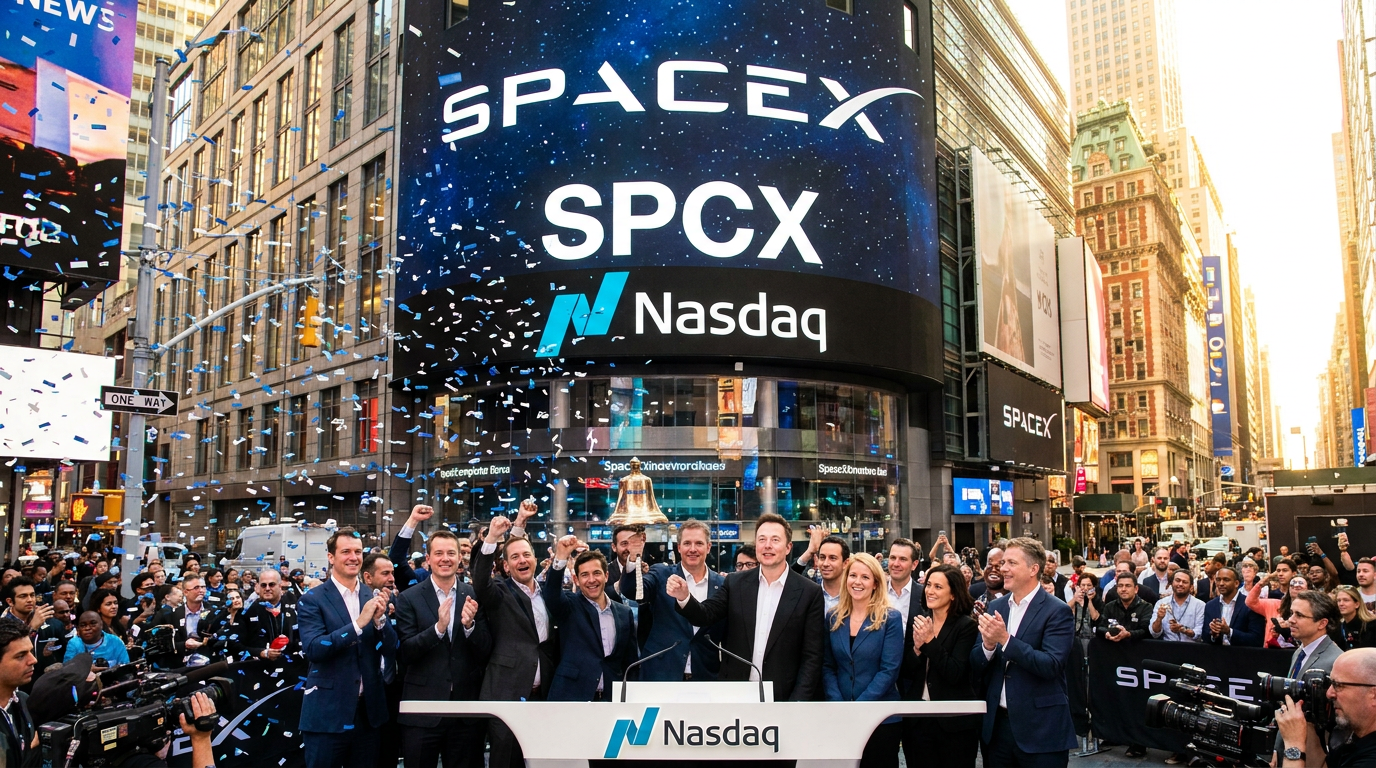
SpaceX has officially rewritten the record books of global finance. On Friday, Elon Musk's aerospace and artificial intelligence conglomerate completed the largest initial public offering in history, raising a staggering $75 billion and instantly becoming the sixth-most valuable publicly traded company in the world.[4][7]
The sheer scale of the debut eclipsed all previous market milestones. Priced at a fixed $135 per share—bypassing the traditional Wall Street price-discovery range—the stock opened at $150 and surged as high as $176 before closing its first day of trading at $160.95.[5][6]
That 19% first-day pop pushed SpaceX's total market valuation past $2.1 trillion. To put the offering in perspective, the $75 billion raised nearly triples the previous IPO record of $25.6 billion set by Saudi Aramco in 2019.[3][4]

The historic listing also triggered a personal wealth milestone that was previously confined to science fiction. The surge in SpaceX's valuation officially pushed founder and CEO Elon Musk's net worth past the $1 trillion mark, making him the world's first trillionaire.[3][5]
Musk, who retains an 82.4% voting stake in the company, addressed employees and investors at the company's headquarters as trading commenced. He reiterated the company's founding mission to make humanity multiplanetary, framing the massive capital injection as the fuel needed to build a permanent human presence on Mars.[5]
But Wall Street's voracious appetite for the stock was driven by more than just rockets. In February 2026, SpaceX acquired Musk's artificial intelligence startup, xAI, merging the space pioneer with one of the leading developers of large language models.[6]

The combined entity pitched investors on a sprawling vision that integrates space infrastructure with the booming AI economy. The company's prospectus outlined plans to deploy millions of Starlink satellites to establish "orbital compute" data centers, effectively moving the massive energy and cooling demands of AI processing into low-Earth orbit by 2028.[4]
The combined entity pitched investors on a sprawling vision that integrates space infrastructure with the booming AI economy.
Retail investors clamored for a piece of the action. The offering saw unprecedented demand from everyday traders, with retail orders reportedly topping $100 billion. The company allocated an unusually high 30% of its float to retail buyers, a move that Wall Street executives praised as a democratization of mega-cap tech investing.[1]
Behind the scenes, the IPO is generating a massive windfall for the Wall Street banks that orchestrated it. A syndicate of 23 banks, led by Goldman Sachs and JPMorgan, shepherded the deal to market.[2]
Analysts estimate that underwriting fees alone could approach $1 billion. Furthermore, JPMorgan issued a tactical buy signal for the investment banking sector, arguing that the market is underestimating the "multiplier effect" of the SpaceX listing, which is expected to drive massive secondary market trading and peripheral wealth management business.[2]

To celebrate the lucrative partnership, JPMorgan hosted a lavish, space-themed soirée for 250 SpaceX employees at its new Park Avenue headquarters, complete with a curated light show and a SpaceX-branded tomahawk steak carving station.[8]
Despite the euphoria, some market watchers urge caution regarding the company's fundamentals. While SpaceX generated $18.7 billion in revenue last year—largely driven by its profitable Starlink division—the broader company remains unprofitable, posting a net loss of $4.28 billion in the first quarter of 2026.[6]
Analysts point out that while SpaceX's $2.1 trillion valuation places it alongside tech titans like Apple, Microsoft, and Nvidia, those companies generate tens of billions in after-tax profits annually. SpaceX is currently trading on the promise of future monopolies in space logistics and orbital AI, rather than current earnings multiples.[6]

Nevertheless, the successful listing is expected to have immediate ripple effects across the broader stock market. SpaceX's sheer size guarantees its eventual inclusion in major benchmark indexes like the Nasdaq-100 and the S&P 500, meaning millions of Americans will soon hold the stock in their retirement accounts.[6]
The blockbuster debut also signals a robust risk-on environment that could pry open the IPO window for other highly anticipated tech unicorns. With SpaceX proving that the public markets can absorb a $75 billion offering without flinching, AI heavyweights like Anthropic and OpenAI are widely expected to accelerate their own plans to go public later this year.[4][7]
How we got here
December 2025
Elon Musk confirms plans to take SpaceX public after years of keeping the company private.
February 2026
SpaceX acquires Musk's artificial intelligence startup, xAI, merging space infrastructure with AI development.
May 2026
SpaceX files its S-1 prospectus, revealing plans to build 'orbital compute' data centers in space.
June 3, 2026
The company bypasses traditional bookbuilding, setting a fixed IPO price of $135 per share.
June 12, 2026
SpaceX debuts on the Nasdaq, raising $75 billion in the largest public offering in history.
Viewpoints in depth
Wall Street Underwriters
Investment banks view the mega-IPO as a massive catalyst for institutional revenue.
For the syndicate of 23 banks that shepherded the deal, the $75 billion offering is a historic windfall. Analysts at JPMorgan argue that the market is vastly underestimating the "multiplier effect" of the listing. Beyond the estimated $1 billion in direct underwriting fees, banks expect a surge in secondary market trading, hedging operations, and lucrative wealth management contracts from newly minted SpaceX millionaires.
Growth Optimists
Retail and institutional investors see a generational opportunity to invest in the space economy.
Bullish investors are largely ignoring the company's current lack of profitability, focusing instead on its monopolistic grip on space logistics and its aggressive pivot into artificial intelligence. By integrating xAI and planning "orbital compute" data centers, optimists argue SpaceX is positioning itself as the foundational infrastructure for the next century of technological advancement, justifying its $2.1 trillion valuation.
Fundamental Skeptics
Cautious analysts warn that the company's valuation is disconnected from its current financial reality.
Skeptics point out that while SpaceX is valued alongside tech titans like Apple and Microsoft, it lacks their massive, consistent cash flows. The company posted a net loss of over $4 billion in the first quarter of 2026 alone. Critics argue that the stock's massive first-day pop was driven more by retail FOMO and Elon Musk's celebrity status than by traditional financial metrics, leaving the stock vulnerable to severe corrections if its ambitious Mars and AI timelines slip.
What we don't know
- How quickly SpaceX can achieve overall profitability, given the massive capital expenditures required for its orbital data centers and Mars missions.
- The exact timeline for SpaceX's inclusion in the S&P 500, which requires four consecutive quarters of GAAP profitability.
- How the stock will perform once the initial retail euphoria subsides and the 90-to-180-day insider lockup periods expire.
Key terms
- Initial Public Offering (IPO)
- The process by which a private company offers shares of its stock to the public for the first time.
- Float
- The number of a company's shares that are available for trading by the public.
- Orbital Compute
- The concept of placing data centers in low-Earth orbit to handle massive artificial intelligence processing tasks in space.
- Underwriting Fees
- The compensation investment banks receive for managing a company's IPO and selling its shares to investors.
- Market Capitalization
- The total dollar market value of a company's outstanding shares of stock.
Frequently asked
How much did SpaceX raise in its IPO?
SpaceX raised $75 billion, making it the largest initial public offering in history. It nearly tripled the previous record of $25.6 billion set by Saudi Aramco.
Can anyone buy SpaceX stock now?
Yes. SpaceX is now a publicly traded company listed on the Nasdaq under the ticker symbol SPCX, meaning retail investors can buy and sell its shares through standard brokerage accounts.
Is SpaceX a profitable company?
While its Starlink satellite division generates significant revenue, the broader SpaceX company is currently unprofitable, having posted a net loss of $4.28 billion in the first quarter of 2026.
What does this mean for Elon Musk's wealth?
The massive valuation of SpaceX following its public debut pushed Elon Musk's net worth past the $1 trillion mark, officially making him the world's first trillionaire.
Sources
Source coverage
8 outlets
3 viewpoints surfaced







[1]MarketWatchWall Street Underwriters
How Elon Musk nailed the SpaceX IPO: ‘I’m not sure that this could have gone much better’
Read on MarketWatch →JPMorgan says investors are overlooking the upside to Wall Street banks that comes from SpaceX and other mega IPOs
Read on MarketWatch →[3]The Washington PostFundamental Skeptics
Elon Musk becomes world's first trillionaire after SpaceX IPO
Read on The Washington Post →[4]Fox BusinessGrowth Optimists
SpaceX IPO raises $75B in largest public market debut in history
Read on Fox Business →[5]The GuardianFundamental Skeptics
SpaceX made the biggest stock market debut in history
Read on The Guardian →[6]CBS NewsGrowth Optimists
SpaceX makes blockbuster stock market debut
Read on CBS News →[7]Financial TimesWall Street Underwriters
SpaceX raises $75bn in record-breaking IPO
Read on Financial Times →[8]Business InsiderWall Street Underwriters
Jamie Dimon Hosts SpaceX IPO Celebration at JPMorgan HQ
Read on Business Insider →
More in finance
See all 17 stories →Market Rotation
Why Value Stocks Are Outperforming Growth Equities in 2026
0 sources

Wealth Management
Robo-Advisors vs. Human Planners: Comparing Financial Guidance Tools in 2026
0 sources

IPO Mechanics
How SpaceX Bypassed Wall Street Norms to Pull Off the Largest IPO in History
0 sources
Space Economy
Inside the $75 Billion SpaceX IPO: How the Largest Public Debut in History Worked
0 sources
Every angle. Every day.
Get finance stories with full source coverage and perspective breakdowns delivered to your inbox.