
How SpaceX Bypassed Wall Street Norms to Pull Off the Largest IPO in History
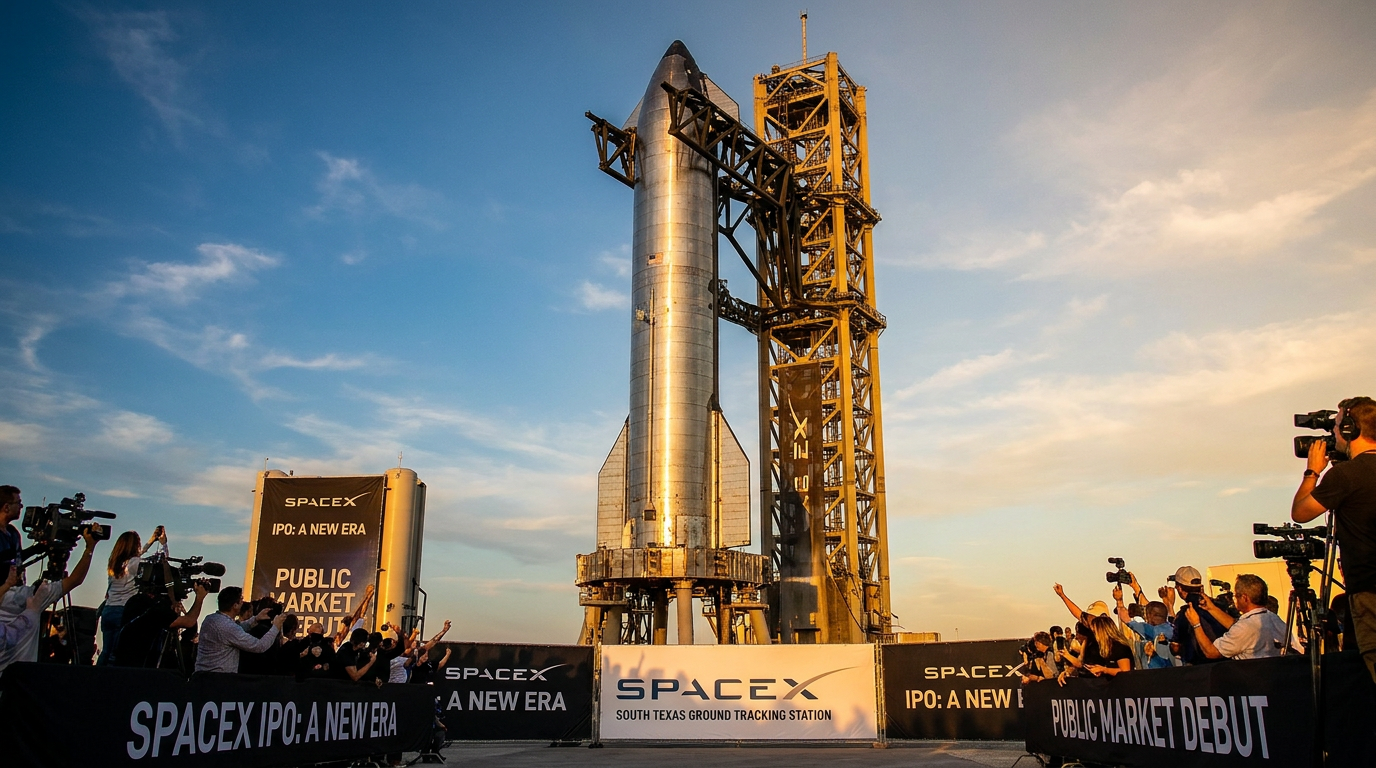
SpaceX's record-shattering $75 billion public debut didn't just mint new millionaires—it fundamentally rewrote the rules of how mega-cap companies go public.
By Factlen Editorial Team
- Retail Investors
- Everyday traders who view the unconventional allocation as a democratization of finance.
- Institutional Underwriters
- Wall Street banks that facilitated the deal and see massive secondary benefits.
- Market Structure Analysts
- Academic and financial researchers evaluating the long-term viability of the fixed-price model.
What's not represented
- · Traditional Institutional Buy-Side Funds
Why this matters
By reserving up to 30% of its shares for everyday traders and bypassing traditional Wall Street pricing games, SpaceX has created a new blueprint that democratizes access to mega-cap tech investments.
Key points
- SpaceX raised $75 billion at a $1.77 trillion valuation, executing the largest IPO in stock market history.
- The company bypassed traditional Wall Street bookbuilding, opting for a fixed, take-it-or-leave-it price of $135 per share.
- In a major win for everyday investors, SpaceX reportedly reserved up to 30% of its offering for the retail market.
- Despite compressed fee structures, the sheer size of the deal is expected to generate nearly $1 billion for underwriting banks.
The sheer scale of the SpaceX initial public offering (IPO) is difficult to overstate. By raising $75 billion and securing an implied valuation of $1.77 trillion, the aerospace giant executed the largest public market debut in history, dwarfing the previous record held by Saudi Aramco.[1][2]
But while the headline numbers have captivated the financial world, the size of the raise is only half the story. The true breakthrough lies in how SpaceX fundamentally altered the mechanics of going public, bypassing decades-old Wall Street traditions to dictate its own terms.[1][6]
To understand the magnitude of this shift, one must look at the traditional "bookbuilding" process. Historically, investment banks float a wide indicative price range, gauge institutional interest over several weeks, and slowly narrow the price based on feedback from major funds.[5][6]
SpaceX discarded this playbook entirely. Instead of offering a price range, the company's S-1 registration filing with the Securities and Exchange Commission went straight to a fixed, take-it-or-leave-it price of $135 per share.[2][7]

This fixed-price mechanism forced the market's hand. By eliminating the price discovery phase, SpaceX effectively told Wall Street that demand was not a variable they needed help measuring or generating.[3][6]
The gamble paid off spectacularly. By the time the order book closed, investor demand had reportedly surpassed $250 billion—making the offering nearly four times oversubscribed before a single share traded on the Nasdaq.[3]
A second major departure from Wall Street norms was the company's allocation strategy. In a standard IPO, the lion's share of the stock is reserved for institutional clients, hedge funds, and preferred wealth-management accounts, leaving everyday traders to buy on the open market.[5]
SpaceX, however, reportedly reserved up to 30% of its offering specifically for retail investors. This unprecedented retail allocation allowed everyday traders to participate in the initial pricing, democratizing access to a mega-cap tech debut.[2][6]
The retail enthusiasm was staggering, with individual investors placing orders for more than $100 billion in shares. In response, major brokerages even lowered their minimum investment requirements to accommodate the massive surge in individual demand.[2]

The retail enthusiasm was staggering, with individual investors placing orders for more than $100 billion in shares.
Despite these unconventional, underwriter-light tactics, traditional financial institutions still reaped massive rewards. A sprawling syndicate of 23 banks, led by Goldman Sachs and JPMorgan, shepherded the complex deal to market.[4]
While the percentage fee was compressed compared to standard IPOs—reportedly hovering around 0.75%—the sheer volume of the $75 billion raise means underwriting fees could still approach $1 billion for the syndicate.[4]
Financial analysts note that the secondary trading volume and associated financing deals will create a powerful "multiplier effect" for these banks. JPMorgan specifically highlighted that investors are underestimating the earnings boost this mega-IPO will deliver to Wall Street.[4]
The structural implications for the broader market are profound. Academic research into going-public mechanisms has long highlighted the friction and "underpricing" inherent in traditional IPOs, where companies intentionally leave money on the table to guarantee a successful launch.[5]
By setting a fixed price and leaning heavily on retail demand, SpaceX minimized this mechanical underpricing. The company secured maximum capital while still achieving a healthy 19% "pop" on its first day of trading, with shares closing near $160.[1][5]

The lingering question is whether this fixed-price model is replicable. Market structure analysts caution that SpaceX's unique brand power, tangible spaceflight achievements, and Elon Musk's massive retail following provided a safety net that most private companies lack.[6]
For a standard enterprise software or biotechnology firm, attempting a fixed-price, retail-heavy IPO without the traditional institutional bookbuilding process could easily result in a failed offering or severe price volatility.[5][6]
Furthermore, the long-term stability of a stock with such high retail concentration remains untested. Retail investors can occasionally be more prone to sentiment-driven selloffs during periods of macroeconomic volatility than long-term institutional holders.[6]
Nevertheless, the SpaceX debut has permanently expanded the menu of options for mega-cap private companies looking to enter the public markets. The traditional IPO is no longer the only viable path for a trillion-dollar valuation.[1][6]

How we got here
April 2026
SpaceX confidentially files S-1 paperwork with the SEC.
May 20, 2026
The SEC publicly discloses the S-1 filing, revealing the company's financials.
June 3, 2026
SpaceX bypasses a traditional price range, announcing a fixed target of $135 per share.
June 11, 2026
The IPO officially prices at $135, raising a record $75 billion.
June 12, 2026
Shares debut on the Nasdaq, popping 19% to close near $160.
Viewpoints in depth
Retail Investors
Everyday traders who view the unconventional allocation as a democratization of finance.
For years, retail investors have been locked out of the most lucrative phase of an IPO—the initial pricing—forcing them to buy shares only after they "pop" on the open market. By reserving up to 30% of the offering for individual accounts, retail advocates argue SpaceX has leveled the playing field. They view the fixed $135 price as a transparent mechanism that prevented institutional gatekeepers from hoarding the stock at a discount.
Institutional Underwriters
Wall Street banks that facilitated the deal and see massive secondary benefits.
While the fixed-price model reduced the banks' traditional role in price discovery, institutional underwriters remain highly supportive of the structure for mega-cap unicorns. Firms like JPMorgan and Goldman Sachs recognize that shepherding a $75 billion deal generates nearly $1 billion in direct fees, even at compressed rates. Furthermore, they anticipate a massive multiplier effect from secondary trading, wealth management onboarding, and future financing deals tied to the newly public giant.
Market Structure Analysts
Academic and financial researchers evaluating the long-term viability of the fixed-price model.
Market structure economists view the SpaceX IPO as a fascinating stress test of adverse selection and underpricing theories. While the fixed-price model successfully minimized the capital left on the table, analysts caution that it relies on an extraordinary level of information symmetry and brand momentum. They warn that if a less-established company attempted a similar underwriter-light, retail-heavy approach, it could face severe opening-price dispersion or a failed offering altogether.
What we don't know
- Whether other highly valued private companies, such as AI unicorns, will be able to successfully replicate this fixed-price model.
- How the unprecedented 30% retail allocation will affect the stock's long-term volatility during broader market downturns.
- The exact timeline for when SpaceX's massive capital injection will translate into its stated goal of a crewed Mars mission.
Key terms
- Initial Public Offering (IPO)
- The process by which a private company offers shares to the public in a new stock issuance, raising capital from public investors.
- Bookbuilding
- The traditional process where investment banks gauge institutional investor demand to determine the price at which an IPO will be offered.
- Underpricing
- The phenomenon where an IPO's initial offer price is set lower than its actual market value, resulting in a first-day price surge but leaving capital on the table for the issuing company.
- Retail Allocation
- The percentage of IPO shares reserved specifically for individual, non-institutional investors.
- Underwriting Syndicate
- A group of investment banks and brokerages that work together to sell new securities to the public and manage the risk of the offering.
Frequently asked
Why didn't SpaceX use a traditional price range?
SpaceX bypassed the traditional price range to dictate its own valuation, relying on massive pre-existing demand rather than letting Wall Street institutions discover the price.
How much of the company does Elon Musk still own?
While the exact post-IPO breakdown fluctuates, SEC filings indicate Musk retains significant voting control and roughly 42% of the company's equity.
Can other companies copy this fixed-price model?
Market analysts believe this model is highly dependent on a company having overwhelming brand power and retail demand; standard companies likely still need traditional bookbuilding.
Sources
Source coverage
7 outlets
3 viewpoints surfaced







[1]MarketWatchRetail Investors
How Elon Musk nailed the SpaceX IPO: ‘I’m not sure that this could have gone much better’
Read on MarketWatch →[2]ForbesRetail Investors
SpaceX Cements Final IPO Price At $135 As Retail Investor Orders Top $100 Billion
Read on Forbes →[3]ReutersInstitutional Underwriters
SpaceX IPO draws $250 billion in demand, four times oversubscribed
Read on Reuters →[4]MorningstarInstitutional Underwriters
JPMorgan says investors are overlooking the upside to Wall Street banks that comes from SpaceX and other mega IPOs
Read on Morningstar →[5]American Economic AssociationMarket Structure Analysts
Direct Listing or IPO? The Anatomy of the Going-Public Market
Read on American Economic Association →[6]Factlen Editorial TeamMarket Structure Analysts
Synthesis by Factlen editorial team
Read on Factlen Editorial Team →[7]U.S. Securities and Exchange CommissionMarket Structure Analysts
SpaceX Form S-1 Registration Statement
Read on U.S. Securities and Exchange Commission →
More in finance
See all 17 stories →Market Rotation
Why Value Stocks Are Outperforming Growth Equities in 2026
0 sources
SpaceX IPO
SpaceX Completes Historic $75 Billion IPO, Pushing Valuation Past $2 Trillion
0 sources
Wealth Management
Robo-Advisors vs. Human Planners: Comparing Financial Guidance Tools in 2026
0 sources
Space Economy
Inside the $75 Billion SpaceX IPO: How the Largest Public Debut in History Worked
0 sources
Every angle. Every day.
Get finance stories with full source coverage and perspective breakdowns delivered to your inbox.