
SpaceX Completes Historic $75 Billion IPO, Reshaping Global Equity Markets
SpaceX's record-shattering public debut raised $75 billion and sent shares surging 19%, making Elon Musk the world's first trillionaire. The massive listing is expected to rapidly enter major index funds, tethering everyday retirement accounts to the space and AI economies.
By Factlen Editorial Team
- Moonshot Optimists
- Believe the unprecedented valuation is justified by SpaceX's monopoly on space infrastructure and AI.
- Value Traditionalists
- Warn that the stratospheric multiples leave no room for error and prefer companies with established economic moats.
- Broad Market Analysts
- Focus on the systemic mechanics of the IPO, retail allocation, and its ripple effects on global indices.
- Policy Critics
- Highlight the societal implications of a single founder reaching trillionaire status through AI and space monopolies.
What's not represented
- · Space Industry Competitors
- · Antitrust Regulators
Why this matters
SpaceX's $75 billion IPO fundamentally reshapes the global equity market, placing the economics of space exploration and artificial intelligence directly into the retirement accounts of millions of everyday investors.
Key points
- SpaceX raised $75 billion in its IPO, shattering Saudi Aramco's previous record of $29.4 billion.
- Shares surged 19% on their first day of trading, pushing Elon Musk's net worth past $1 trillion.
- Retail investors received a significant allocation, meaning the stock will quickly enter standard 401(k) portfolios.
- The massive valuation is heavily driven by Starlink's 10 million subscribers and the company's expansion into AI infrastructure.
- Analysts expect the successful listing to clear the way for other mega-cap tech IPOs like OpenAI and Anthropic.
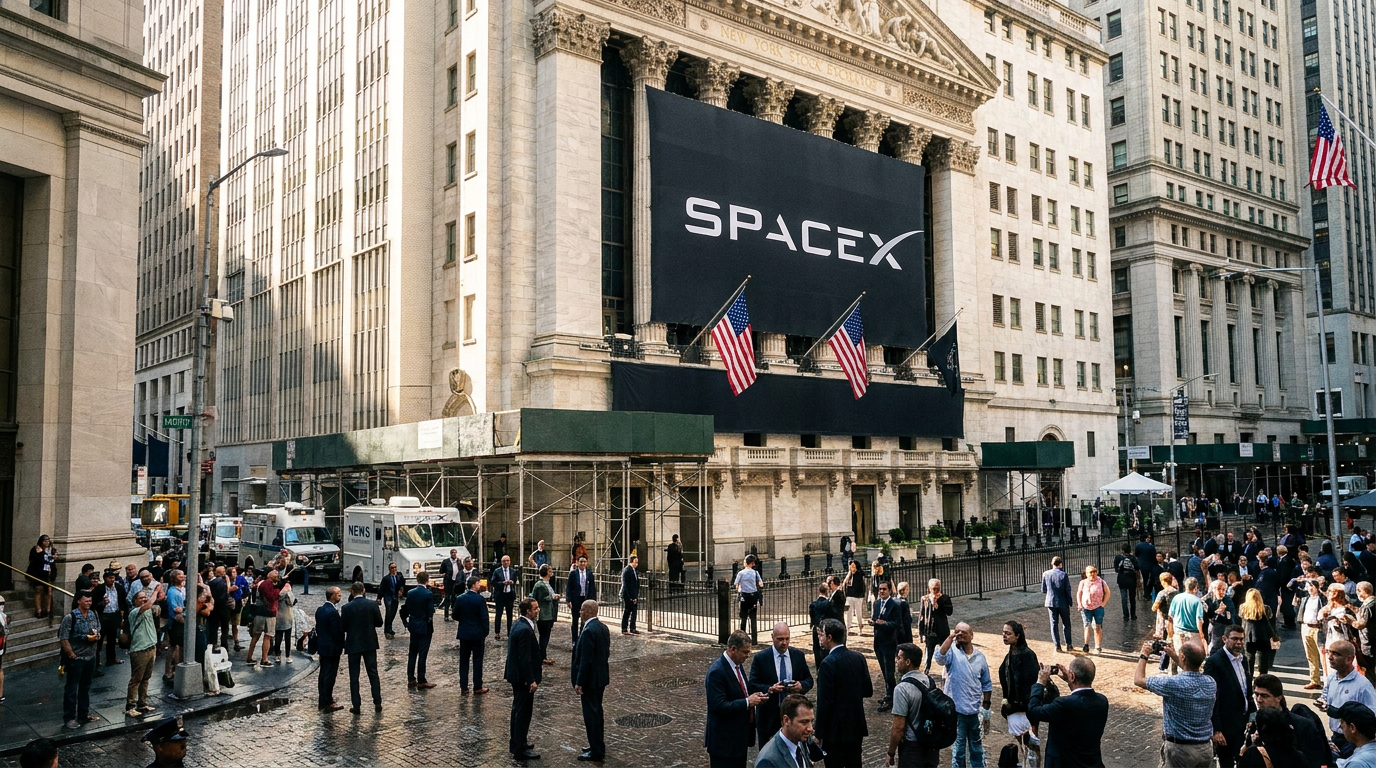
The long-awaited public debut of SpaceX has fundamentally rewritten the record books of global finance, testing the absolute limits of modern capital markets. On Friday, the aerospace and telecommunications giant completed its initial public offering, raising an unprecedented $75 billion in fresh capital. The sheer scale of this equity raise shattered the previous global record—Saudi Arabian Oil Co.’s $29.4 billion listing in December 2019—by a staggering margin. Despite the historic influx of supply hitting the open market, demand proved insatiable from the opening bell. SpaceX shares closed 19% higher on their first day of trading, a robust pop that defied expectations of sluggishness for an offering of this immense size. The successful debut cemented the company’s status as one of the world’s most valuable public entities, instantly catapulting its market capitalization past legacy tech titans. More personally, the 19% surge pushed founder and CEO Elon Musk across a historic wealth threshold, officially making him the world’s first individual trillionaire. The milestone underscores how deeply the market has tied the company's astronomical valuation to Musk's singular vision, though it has simultaneously reignited fierce political debates over wealth concentration and how to appropriately tax AI-driven windfalls.[1][2][6][9]
To understand the magnitude of this liquidity event, one must look closely at the mechanics of the offering itself. Pricing a company with a multi-trillion-dollar implied valuation is fiendishly difficult, as underwriters must balance institutional appetite with retail accessibility while avoiding a first-day collapse. The offering utilized a massive greenshoe option—a standard provision allowing underwriters to sell additional shares if public demand exceeds expectations—to accommodate a flood of early orders. Retail investors, who historically have been locked out of the most lucrative private-market gains during a startup's hyper-growth phase, were allocated a significant portion of the float. Brokerages reported unprecedented retail participation, with millions of individual accounts placing orders in the days leading up to the debut. Despite this unusually large retail allocation and the sheer volume of shares changing hands, market volatility remained surprisingly moderate throughout the trading session. The stock found its footing early and climbed steadily, avoiding the wild intraday swings that often characterize high-profile technology debuts.[2][6][7]

The implications of this stability extend far beyond day traders. Market analysts noted that SpaceX is rapidly coming to a mutual fund or 401(k) near you, highlighting how quickly the stock will be integrated into major indices like the S&P 500 and Nasdaq 100. This rapid inclusion means that millions of passive investors are now indirectly exposed to the economics of reusable rockets and satellite internet, democratizing access to the space economy while tethering the retirement savings of everyday workers to the success of Starship. But what exactly are public markets buying at this astronomical premium? The answer lies less in the cinematic spectacle of rocket launches and more in the compounding, high-margin revenue of global telecommunications. Starlink, the company’s low-Earth orbit satellite internet constellation, has transformed over the past three years from a capital-draining moonshot into SpaceX’s core profit center. While the launch business provides the necessary infrastructure, it is Starlink's recurring subscription revenue that provides the financial bedrock necessary to justify a valuation multiple that far exceeds traditional aerospace contractors.[4][7][8]
By early 2026, Starlink surpassed 10 million active customers across 160 countries and territories, effectively doubling its subscriber base year-over-year. This growth trajectory has turned the service into a cash-generating engine, with enterprise and government contracts supplementing the massive consumer base. Investors are pricing SpaceX not as a hardware manufacturer, but as a global internet service provider with a monopoly on its own delivery mechanism. Beyond internet infrastructure, the valuation is heavily tethered to the explosive growth of artificial intelligence. Following its strategic integration with xAI, SpaceX has positioned itself as a unique dual-threat infrastructure play. The company is now building both the orbital network required for global data transmission and the terrestrial data centers necessary for advanced AI compute. This convergence of space and AI infrastructure is what ultimately convinced institutional investors to swallow the unprecedented valuation, viewing the combined entity as the backbone of the next technological era.[7][8]

By early 2026, Starlink surpassed 10 million active customers across 160 countries and territories, effectively doubling its subscriber base year-over-year.
This dual mandate explains the absolute necessity of the $75 billion capital raise. Out of the company’s massive capital expenditure budget, billions are earmarked not just for the continued development of the Starship rocket program, but for building out the massive, energy-intensive data centers required to train next-generation AI models. The capital intensity of dominating both the commercial space race and the artificial intelligence sector requires a balance sheet that only the deepest pools of public market capital can sustain. The historic IPO has also reignited a long-standing philosophical debate in investing circles: the value of moats versus moonshots. Traditional value investors, famously championed by figures like Warren Buffett, prefer companies with wide economic moats—defensible, predictable businesses that generate steady cash flow without requiring constant, massive capital reinvestment. For decades, this conservative approach has been the gold standard for long-term wealth accumulation.[5][7]
Musk’s approach represents the ultimate manifestation of the moonshot philosophy, where capital is continuously incinerated in pursuit of paradigm-shifting breakthroughs. The core belief is that if a company can solve impossibly hard physics and engineering problems, the resulting technological monopoly will eventually yield unprecedented returns that dwarf traditional moats. The market’s enthusiastic reception of the SpaceX IPO suggests that Wall Street is firmly backing the moonshot model. However, this enthusiasm is not without its prominent skeptics. Veteran investors and macroeconomic analysts are questioning whether any technology company, no matter how innovative, can truly justify these stratospheric multiples in the long run. The scale of the valuations and fundraising involved is entirely unprecedented, reflecting a near-utopian optimism about the transformative power of AI and space infrastructure. Critics warn that pricing a company for perfection leaves zero margin for error, making the stock highly vulnerable to any technical setbacks.[3][5]

There are also growing systemic concerns about market concentration. With SpaceX now commanding such a massive share of total market capitalization, the broader indices become increasingly vulnerable to the operational risks of a single company. A significant failure in the Starship program, a regulatory crackdown on satellite deployments, or a slowdown in AI monetization could now send immediate ripples through the entire global equity market. The sheer size of the company means its individual volatility is now a macroeconomic factor. Despite these systemic risks, the successful listing is expected to act as a powerful catalyst for the broader technology sector. Analysts predict that SpaceX’s triumphant debut will reinvigorate a dormant IPO market, effectively clearing the runway for other high-profile, AI-adjacent private companies that have been waiting for optimal market conditions.[3][6]
Industry heavyweights like OpenAI and Anthropic are widely expected to be the next to test the public markets, hoping to capitalize on the same wave of retail and institutional enthusiasm. The $75 billion raise proves that there is still massive liquidity available for compelling growth narratives, provided the underlying technology is sufficiently transformative. If SpaceX’s first day of trading is any indication, the public market’s appetite for trillion-dollar tech narratives remains far from satisfied. The era of the mega-cap private startup may be ending, giving way to a new phase where the most ambitious technological projects are funded directly by the global public.[3][6]
How we got here
Dec 2019
Saudi Aramco sets the previous global IPO record by raising $29.4 billion.
Dec 2024
SpaceX reaches a $350 billion private valuation following a secondary share sale.
Feb 2026
SpaceX acquires xAI, pushing its implied private valuation past $1.25 trillion.
June 2026
SpaceX completes its historic IPO, raising $75 billion and surging 19% on its first day.
Viewpoints in depth
Growth Investors
Arguing that the valuation is justified by SpaceX's monopoly on space access and compounding Starlink revenue.
Growth-focused funds view SpaceX not as a traditional aerospace company, but as the ultimate infrastructure play for the next century. They argue that Starlink's high-margin subscription revenue, combined with the data center build-out for xAI, creates an economic moat that justifies a trillion-dollar premium. In their view, traditional valuation multiples fail to capture the terminal value of a company that controls the primary delivery mechanism for both global internet and orbital logistics.
Market Traditionalists
Warning that unprecedented valuations leave zero margin for error and create systemic market risks.
Value investors and macroeconomic analysts express deep concern over the sheer scale of the capital involved. They point out that pricing a company at over a trillion dollars requires flawless execution across multiple highly experimental verticals, from Starship's reusability to xAI's commercialization. Traditionalists warn that if SpaceX encounters significant regulatory hurdles or technical failures, the resulting valuation collapse would not just harm early investors, but would drag down the broader indices and mutual funds that are now heavily weighted with the stock.
What we don't know
- How quickly SpaceX can achieve consolidated profitability given the massive capital expenditures required for Starship and AI data centers.
- Whether the broader market can absorb upcoming mega-IPOs from companies like OpenAI without draining liquidity from other sectors.
Key terms
- Greenshoe Option
- A provision in an underwriting agreement that allows the underwriters to sell more shares than originally planned if public demand is higher than expected.
- Economic Moat
- A company's ability to maintain competitive advantages over its rivals in order to protect its long-term profits and market share.
- Capital Expenditure (CapEx)
- Funds used by a company to acquire, upgrade, and maintain physical assets such as property, industrial buildings, or equipment.
Frequently asked
How does this IPO compare to previous records?
SpaceX raised $75 billion, which is more than double the previous global record of $29.4 billion set by Saudi Aramco in 2019.
Why is SpaceX valued so highly?
Investors are pricing in the compounding subscription revenue from Starlink's 10 million users, as well as the company's recent expansion into artificial intelligence infrastructure.
Can I buy SpaceX stock in my retirement account?
Yes. Because of its massive market capitalization, SpaceX is expected to be rapidly integrated into major mutual funds and index-tracking ETFs commonly found in 401(k)s.
Sources
Source coverage
9 outlets
4 viewpoints surfaced






[1]BloombergBroad Market Analysts
SpaceX Shares Close 19% Higher After Historic $75 Billion IPO
Read on Bloomberg →[2]CNBCValue Traditionalists
SpaceX IPO sticks the landing. Here's what investors are saying about its epic first trading day
Read on CNBC →Can Tech Justify a Trillion-Dollar Valuation?
Read on Bloomberg →We’re All on Starship Elon Now
Read on Bloomberg →Moats vs. moonshots: The Warren Buffett-Elon Musk style debate
Read on CNBC →[6]ReutersBroad Market Analysts
From Saudi Aramco to Alibaba: World's biggest IPOs
Read on Reuters →[7]TSG InvestMoonshot Optimists
SpaceX Stock: $2T+ IPO Valuation — Is It a Buy?
Read on TSG Invest →[8]KeepTrackMoonshot Optimists
Who Owns SpaceX in 2026? Ownership, Valuation, and the Trillion-Dollar IPO
Read on KeepTrack →[9]NYTPolicy Critics
Everyone Wants to Tax A.I. The Big Disagreement: How?
Read on NYT →
More in business
See all 13 stories →SpaceX IPO
SpaceX Completes Historic $75 Billion IPO, Pushing Elon Musk to Trillionaire Status
0 sources
Robotics Industry
The Billion-Dollar Race to Commercialize Humanoid Robots
0 sources

Space Economy
SpaceX Completes Historic IPO, Reaching $2 Trillion Market Valuation on First Day of Trading
0 sources
Business Strategy
Moats vs. Moonshots: The Two Playbooks Dominating Modern Entrepreneurship
0 sources

Every angle. Every day.
Get business stories with full source coverage and perspective breakdowns delivered to your inbox.