
Moats vs. Moonshots: The Two Playbooks Dominating Modern Entrepreneurship
As SpaceX achieves a historic $2 trillion public valuation, the business world is re-examining the fundamental divide in modern entrepreneurship: building impenetrable "moats" versus launching high-risk "moonshots."
By Factlen Editorial Team
- Value Investors
- Prioritize predictable cash flows, strong competitive advantages, and capital preservation over speculative growth.
- Techno-Optimists
- Believe that rapid innovation is the only true defense, and that capital should be deployed to solve massive, paradigm-shifting problems.
- Hybrid Strategists
- Advocate for building a strong foundational moat specifically to generate the free cash flow required to fund high-risk moonshots.
What's not represented
- · Labor Unions
- · Regulatory Bodies
Why this matters
Understanding these two distinct strategies helps investors allocate capital more effectively and gives aspiring founders a clearer framework for deciding what kind of company they actually want to build.
Key points
- The business world is divided between building defensive 'moats' and launching high-risk 'moonshots.'
- Moats focus on predictable cash flows and low capital intensity, championed by investors like Warren Buffett.
- Moonshots require massive upfront capital to create entirely new industries, championed by founders like Elon Musk.
- SpaceX's $2 trillion IPO proves public markets are increasingly willing to fund massive moonshots.
- Many modern tech giants use a hybrid approach, funding moonshots with the cash flow from their moats.
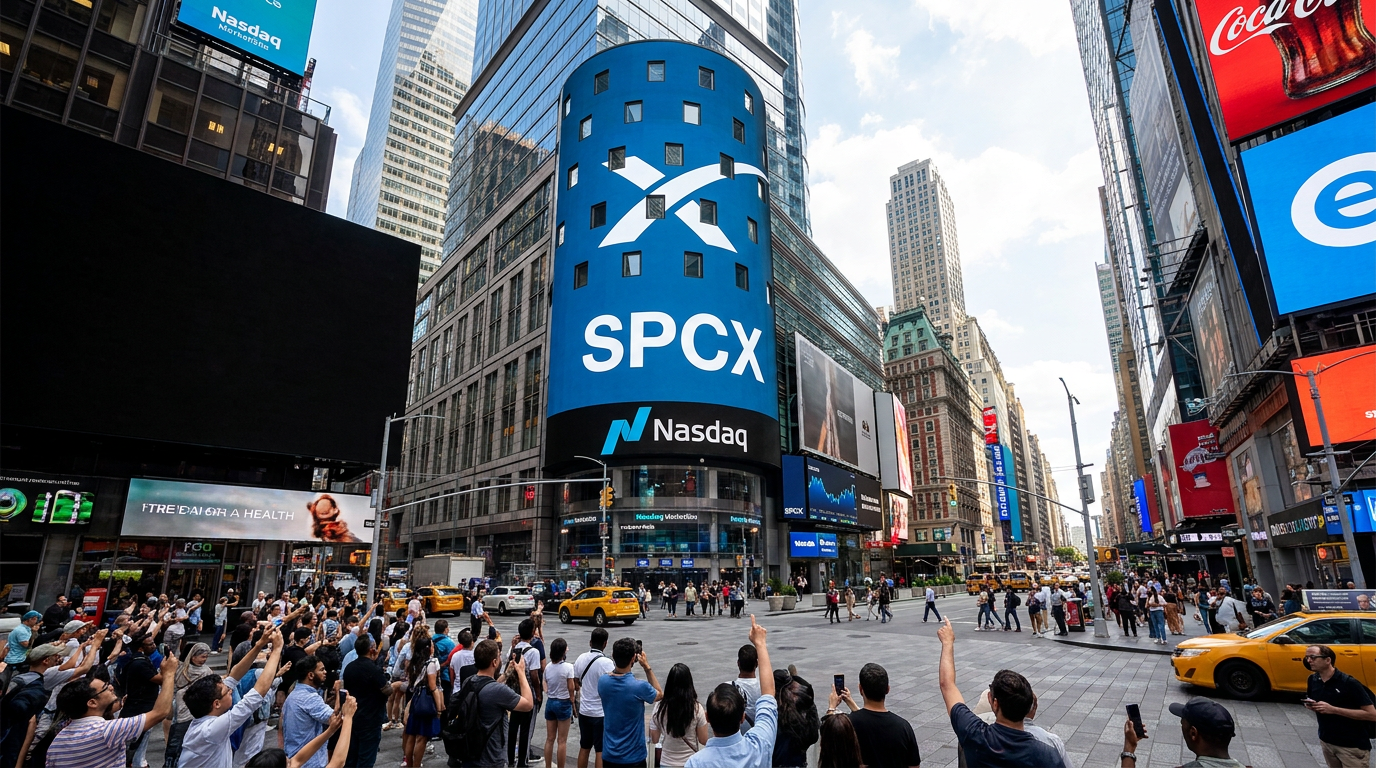
The recent public debut of SpaceX at a staggering $2 trillion valuation is more than just a financial milestone; it is the ultimate vindication of the "moonshot" philosophy of entrepreneurship [3]. For decades, business schools and institutional investors have debated the best way to build a lasting enterprise, often splitting into two distinct camps.[3]
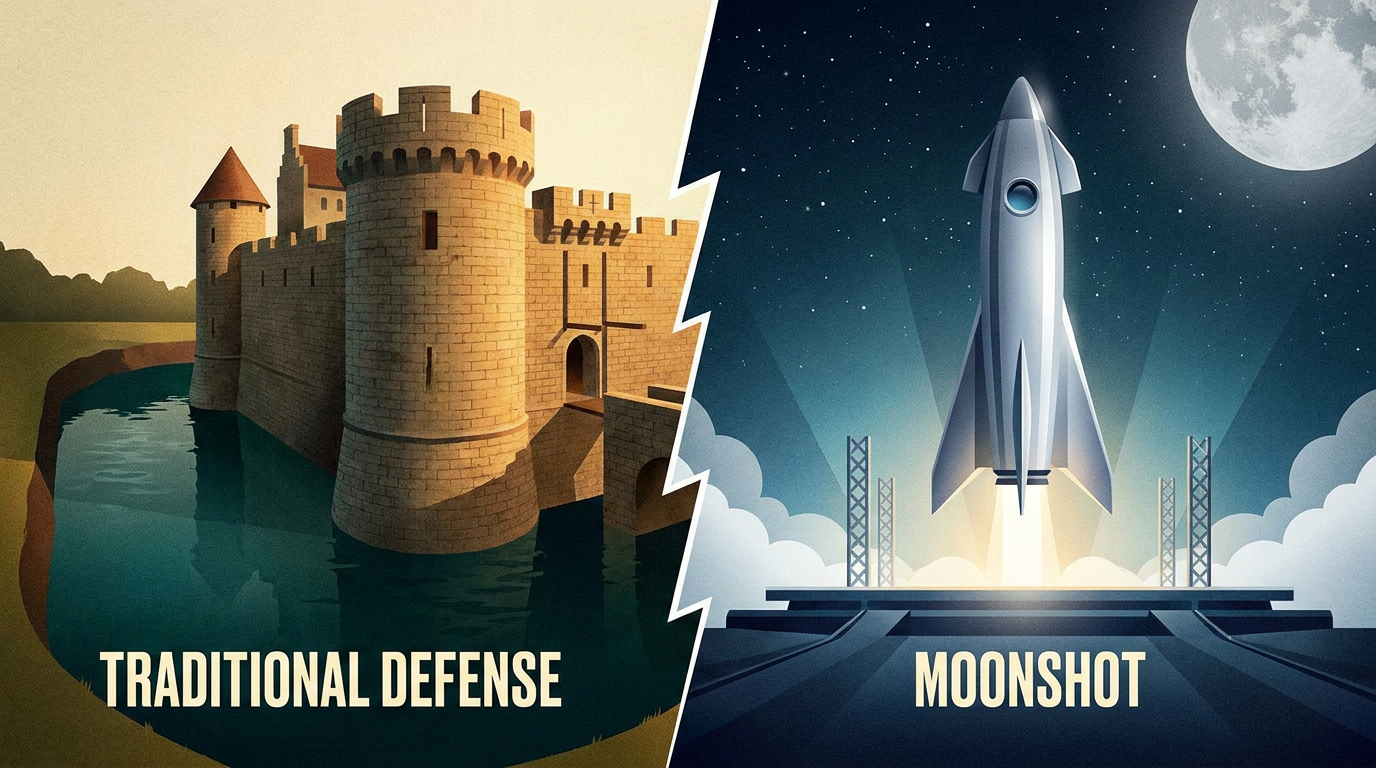
On one side is the gold standard of traditional business strategy, defined by Warren Buffett's concept of the "economic moat" [1]. A moat is a structural advantage—like fierce brand loyalty, high switching costs, or a regulatory monopoly—that protects a company's profit margins from aggressive competitors.[1]
Moat-builders seek predictability above all else. They want businesses that require very little ongoing capital to maintain, yet generate massive, reliable cash flows year after year. Classic examples include Coca-Cola's brand dominance or the toll-bridge economics of major credit card networks.[1][4]
On the other end of the spectrum is the "moonshot," a term popularized by Silicon Valley and embodied by founders like Elon Musk [1]. Moonshots ignore safe, incremental gains in favor of binary, paradigm-shifting bets that attempt to create entirely new industries from scratch.[1]

The mechanics of a moonshot require traversing what venture capitalists call the "valley of death" [4]. This means burning billions of dollars in research and development for years, or even decades, before seeing a single dollar of profit. The goal is not to defend a castle, but to discover a new continent.[4]
The tension between these two philosophies famously boiled over in 2018. During an earnings call, Musk declared that "moats are lame," arguing that a static defense is useless against a rapidly innovating competitor, and that the pace of innovation is the only true competitive advantage [1].[1]
Buffett responded by defending his beloved See's Candies, challenging Musk to disrupt it. The exchange, while lighthearted, highlighted a fundamental divide in how capital is allocated in the 21st century and what investors value most [1].[1]
Today, the public markets are increasingly forced to grapple with this divide. Historically, Wall Street preferred the safety of moats, rewarding companies that offered steady dividends, share buybacks, and predictable quarterly earnings.[2][6]
Today, the public markets are increasingly forced to grapple with this divide.
However, the recent wave of mega-cap tech valuations suggests a massive shift in investor psychology [2]. Retail and institutional investors alike are now willing to assign trillion-dollar premiums to companies promising to fundamentally alter the human economy, from artificial intelligence to space exploration.[2]
The SpaceX S-1 registration statement explicitly outlined the company's long-term goal of making humanity multi-planetary—a far cry from traditional corporate mission statements focused on maximizing near-term shareholder returns [5].[5]

When SpaceX was founded, internal estimates gave the company roughly a 10% chance of survival [3]. The fact that it has now reached a $2 trillion market capitalization proves that public markets are willing to underwrite extreme risk if the potential reward is a monopoly on a new frontier.[3]
Yet, the most successful modern enterprises often find a way to blend both strategies. They use the cash flow from an impenetrable moat to fund their most ambitious, capital-intensive moonshots [6].[6]
Alphabet is the classic example, using Google Search revenues to fund its experimental "Other Bets" division. Now, we are seeing this hybrid approach emerge in the physical world of hardware and manufacturing as well.[4][6]

Rivian CEO RJ Scaringe recently launched Mind Robotics, a humanoid robot venture that has already raised over $1 billion [1]. By leveraging Rivian's existing manufacturing footprint and software expertise, Scaringe is attempting to build a moonshot on top of an emerging industrial moat.[1]
The risk profiles of these two approaches remain vastly different. If a true moonshot fails, the capital is entirely wiped out, and the technology is often too bespoke to be salvaged [4].[4]
Conversely, if a moat-based business stumbles, it usually just means slightly lower margins or a temporary dip in market share. The underlying asset—the brand, the real estate, the customer base—retains significant value.[1][6]
For aspiring entrepreneurs, choosing between these paths dictates everything from fundraising strategy to company culture. Moat-builders hire for optimization, efficiency, and operational excellence; moonshot-builders hire for radical invention and a tolerance for chaos.[6]
Ultimately, a thriving global economy requires both. Moat businesses provide the stable foundation, the employment, and the steady compounding of wealth that anchors retirement accounts. Moonshots, while volatile, are the engines of human progress, launching the ventures that cure diseases, transition the energy grid, and take humanity to the stars [6].[6]

How we got here
1999
Warren Buffett popularizes the 'economic moat' concept in a Fortune magazine article.
2002
SpaceX is founded with a 'moonshot' goal of Mars colonization, facing steep odds of survival.
2018
The famous 'candy debate' occurs between Elon Musk and Warren Buffett over the value of moats.
Late 2025
Rivian CEO RJ Scaringe launches Mind Robotics, raising over $1 billion for a humanoid robot moonshot.
June 2026
SpaceX goes public at a $2 trillion valuation, validating the moonshot model at a massive scale.
Viewpoints in depth
The Value Investor's View
Prioritizing capital preservation and predictable compounding over speculative growth.
Value investors argue that the primary duty of a business is to generate a return on invested capital. From this perspective, moonshots are often seen as reckless capital destruction. They prefer businesses with wide economic moats—such as strong brands, network effects, or cost advantages—because these traits ensure that the company can survive economic downturns and consistently return cash to shareholders through dividends and buybacks. To a value investor, a boring business that compounds at 10% annually is vastly superior to an exciting business with a 90% chance of going bankrupt.
The Techno-Optimist's View
Believing that rapid innovation is the only true defense against obsolescence.
Techno-optimists, often found in Silicon Valley and venture capital circles, argue that the concept of a static moat is an illusion in the modern era. They believe that technology moves too fast for any traditional defense to hold up indefinitely. Therefore, the only way to survive is to constantly attack your own business model by launching moonshots. They argue that while the failure rate is high, the successes—like reusable rockets or artificial intelligence—create trillions of dollars in new economic value that far outweighs the cost of the failures.
The Hybrid Strategist's View
Using the cash flow of today's moat to fund tomorrow's moonshot.
The hybrid approach recognizes the validity of both sides. These strategists argue that a company cannot survive on moonshots alone without constantly diluting shareholders to raise capital. Instead, the ideal corporate structure is to build a highly profitable, moat-protected core business, and then strictly allocate a percentage of that free cash flow to a portfolio of moonshots. This allows a company to swing for the fences without risking the survival of the entire enterprise, a model successfully pioneered by companies like Alphabet and Amazon.
What we don't know
- Whether retail investors in public markets will have the patience to hold moonshot stocks through prolonged periods of unprofitability.
- How traditional moat-based businesses will adapt if AI accelerates the pace of disruption across all sectors.
- If the current trillion-dollar valuations for tech moonshots represent a permanent shift in market psychology or a temporary bubble.
Key terms
- Economic Moat
- A distinct competitive advantage that protects a company's long-term profits and market share from competing firms.
- Moonshot
- An ambitious, exploratory, and ground-breaking project undertaken without any expectation of near-term profitability.
- Capital Intensity
- The amount of fixed or real capital required to operate a business in relation to other factors of production.
- Valley of Death
- The period in a startup's life where it has begun operations and is burning through capital, but has not yet generated revenue.
Frequently asked
Did Elon Musk really say moats are lame?
Yes, during a 2018 earnings call, Musk argued that the pace of innovation is the only true competitive advantage, calling static moats 'lame.'
Can a company have both a moat and a moonshot?
Yes. Companies like Alphabet use the massive cash flow from their search engine 'moat' to fund experimental 'moonshot' divisions like Waymo.
Why is the SpaceX IPO significant for this debate?
It proves that public markets, which traditionally favor predictable 'moat' businesses, are now willing to assign multi-trillion-dollar valuations to high-risk, high-reward moonshot enterprises.
Sources
Source coverage
6 outlets
3 viewpoints surfaced





[1]CNBCValue Investors
Moats vs. moonshots: The Warren Buffett-Elon Musk style debate
Read on CNBC →[2]BloombergTechno-Optimists
Can Tech Justify a Trillion-Dollar Valuation?
Read on Bloomberg →From 10% chance of success to $2 trillion market cap: SpaceX's historic IPO
Read on CNBC →[4]Harvard Business ReviewHybrid Strategists
The Innovator's Dilemma and the Moonshot Economy
Read on Harvard Business Review →[5]SECTechno-Optimists
Space Exploration Technologies Corp. Form S-1 Registration Statement
Read on SEC →[6]Factlen Editorial TeamHybrid Strategists
Synthesis by Factlen editorial team
Read on Factlen Editorial Team →
Every angle. Every day.
Get business stories with full source coverage and perspective breakdowns delivered to your inbox.