
SpaceX Completes Historic $75 Billion IPO, Pushing Valuation Past $2 Trillion
SpaceX shares surged 19% in their Nasdaq debut, marking the largest initial public offering in history and making CEO Elon Musk the world's first trillionaire.
By Factlen Editorial Team
- Retail & Institutional Investors
- Focused on the unprecedented demand and the democratization of a mega-cap IPO.
- Space & Tech Optimists
- Viewing the capital raise as the necessary fuel for humanity's next great leaps.
- Economic Equality Advocates
- Raising alarms over the societal implications of a single individual controlling a trillion-dollar fortune.
What's not represented
- · Competitors in the aerospace and satellite internet industries who now face a massively capitalized rival.
- · Environmental groups concerned about the ecological impact of vastly increased rocket launch cadences.
Why this matters
The sheer scale of the $75 billion capital raise reshapes the global equities market and provides SpaceX with unprecedented funding to accelerate its Mars colonization goals, Starlink expansion, and artificial intelligence infrastructure. It also marks a historic wealth milestone, minting the world's first trillionaire and reigniting debates over extreme wealth concentration.
Key points
- SpaceX raised $75 billion in its IPO, shattering the previous record of $29.4 billion.
- Shares closed at $160.95, a 19% increase from the fixed $135 offering price.
- The company's valuation surpassed $2.1 trillion, making it the sixth-most valuable globally.
- The debut officially made CEO Elon Musk the world's first trillionaire, with a net worth of $1.14 trillion.
- SpaceX allocated an unusually high 30% of its offering to retail investors.
- Funds will accelerate Mars colonization efforts, Starlink expansion, and AI infrastructure.
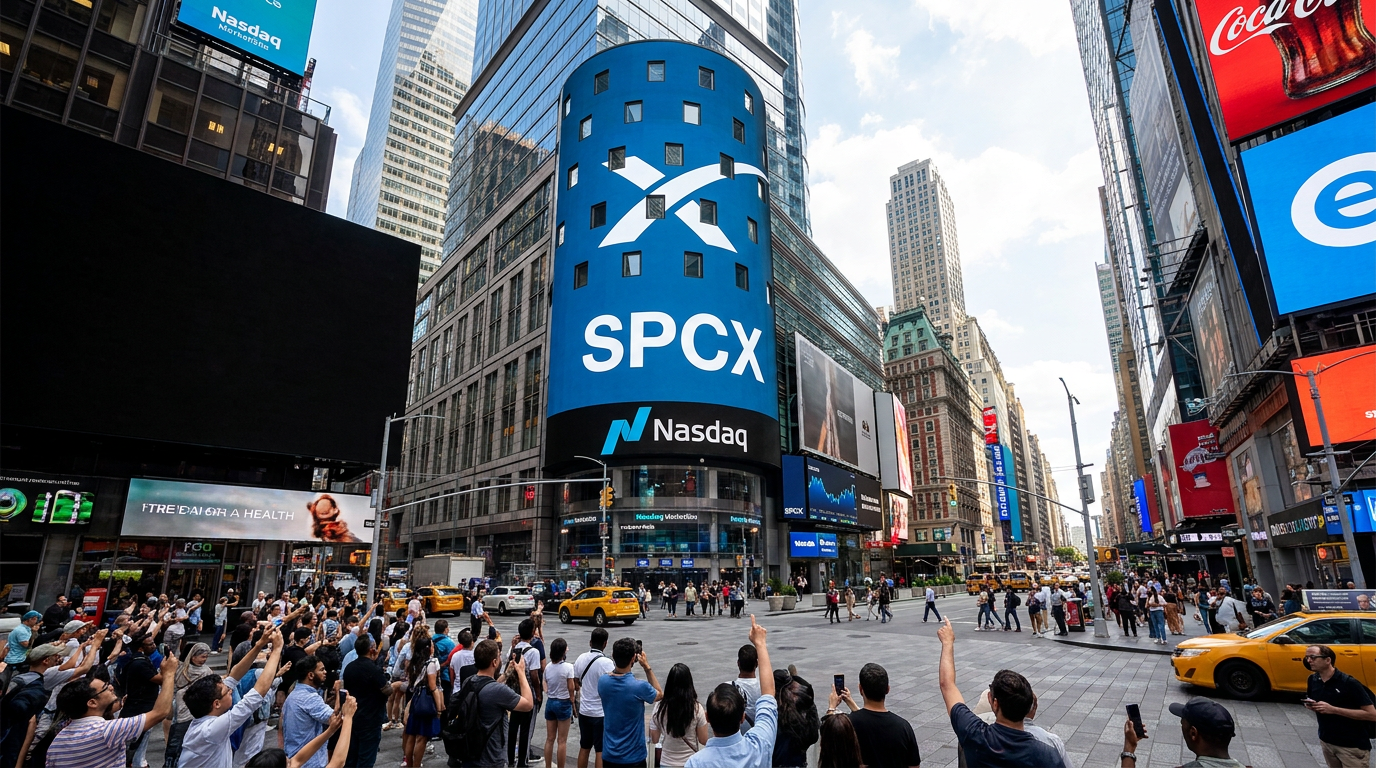
SpaceX, the aerospace company that began 24 years ago in a California warehouse with a slim chance of survival, executed the largest initial public offering in history on Friday, fundamentally altering the landscape of the global stock market. Trading under the ticker symbol SPCX on the Nasdaq exchange, the company's shares opened at $150 and closed at $160.95, representing a 19 percent surge from its fixed IPO price of $135. Company executives rang the opening bell as Elton John's "Rocket Man" played on the trading floor, marking the culmination of weeks of intense investor frenzy.[1][4]
The blockbuster debut raised a staggering $75 billion, easily eclipsing the previous record set by Saudi Aramco's $29.4 billion offering in 2019. By the time the closing bell rang, SpaceX's market capitalization had swelled to roughly $2.1 trillion. This astronomical valuation instantly made it the sixth-most valuable company in the world, trailing only entrenched technology giants like Apple, Nvidia, and Microsoft. The successful launch wiped away a week of broader market anxiety, proving that investor appetite for high-growth, mega-cap technology stocks remains incredibly resilient.[2][7]

The unprecedented scale of the public offering was matched by an equally historic personal milestone: the IPO officially minted SpaceX Chief Executive Officer Elon Musk as the world's first trillionaire. With his 42 percent equity stake in the aerospace company, combined with his massive holdings in Tesla and other ventures, Musk's net worth soared to an estimated $1.14 trillion by the end of Friday's trading session. This figure excludes additional shares Musk could unlock if the company achieves future performance milestones, including establishing a human colony on Mars.[3][5]
To put that staggering wealth into perspective, a trillion dollars rivals the gross domestic product of all but 19 nations on Earth, including major economies like the Netherlands. The milestone immediately drew sharp commentary from economic equality advocates and progressive lawmakers. Oxfam noted that Musk's fortune now exceeds the combined wealth of the bottom 46 percent of the global population—roughly 3.8 billion people. Meanwhile, Senator Elizabeth Warren criticized the extreme concentration of wealth as a symbol of a broken system and a "new Gilded Age," having previously petitioned the SEC to delay the IPO over governance concerns.[3][8]
The milestone immediately drew sharp commentary from economic equality advocates and progressive lawmakers.
Despite the eye-popping valuation, SpaceX's path to the public market was highly unconventional and broke several long-standing Wall Street traditions. Rather than offering a customary price range and relying on a weeks-long institutional bookbuilding process to gauge demand, the company set a firm, take-it-or-leave-it price of $135 per share. The aggressive strategy paid off handsomely, as investor demand reportedly topped $250 billion—more than three times the available shares. The offering was heavily oversubscribed before the final pricing was even announced.[6][7]

In another massive departure from standard mega-cap IPO practices, SpaceX allocated up to 30 percent of the offering to retail investors, vastly exceeding the 5 to 10 percent typically reserved for mom-and-pop buyers. Brokerages like Fidelity even lowered their minimum account requirements to just $2,000 to accommodate the massive flood of individual investors eager to own a piece of the space race. This democratization of access resulted in retail orders topping $100 billion before the stock even began trading, creating a massive groundswell of grassroots support for the stock.[2][6]
The $75 billion injection of capital is explicitly earmarked for an ambitious, science-fiction-esque slate of projects that require astronomical levels of funding. Musk has repeatedly stated that the primary goal of taking SpaceX public is to secure the capital necessary to fund the development of the Starship rocket program. This next-generation launch vehicle is the cornerstone of the company's ultimate ambition: establishing a self-sustaining human colony of one million inhabitants on Mars. The sheer cost of iterative rocket testing necessitates a war chest that only the public equities market can provide.[3][4]

Beyond interplanetary travel, the funds will heavily subsidize the rapid global expansion of Starlink, the company's satellite internet constellation, which already generated $11.4 billion in revenue last year. The capital will also support SpaceX's aggressive push into artificial intelligence infrastructure, including plans to build orbital data centers to power xAI, Musk's artificial intelligence venture that recently merged with the aerospace giant. The company is currently spending billions to build out this AI capacity, resulting in significant short-term cash burn despite its massive top-line revenue growth.[4][5]
While SpaceX is growing quickly—total revenue hit $18.7 billion in 2025—it is still losing money, producing a net loss of $4.9 billion largely due to its massive capital expenditures. Nevertheless, the 19 percent first-day pop indicates that public shareholders are willing to underwrite those losses in exchange for a stake in a company that dominates the commercial launch sector. With rivals like OpenAI and Anthropic reportedly eyeing their own public offerings later this year at valuations near $1 trillion, SpaceX's historic Friday may serve as the opening salvo in a massive wave of AI-driven market debuts.[1][7]
How we got here
2002
Elon Musk founds Space Exploration Technologies Corp. with the goal of reducing space transportation costs.
2008
SpaceX's Falcon 1 becomes the first privately developed liquid-fueled rocket to reach orbit, saving the company from bankruptcy.
2020
The company begins beta testing Starlink, its satellite internet constellation, which quickly becomes a major revenue driver.
April 2026
SpaceX files confidential paperwork with the SEC to go public.
June 11, 2026
The company bypasses traditional bookbuilding, setting a fixed IPO price of $135 per share.
June 12, 2026
SpaceX debuts on the Nasdaq, raising $75 billion and pushing its valuation past $2.1 trillion.
Viewpoints in depth
Retail & Institutional Investors
Focused on the unprecedented demand and the democratization of a mega-cap IPO.
Market participants have praised SpaceX's unconventional approach to its public debut, particularly the decision to allocate 30% of the float to retail investors. Analysts argue that despite the company's history of cash burn—including a $4.28 billion net loss in the first quarter of 2026—the sheer scale of investor demand validates the $2.1 trillion valuation. They view the 19% first-day pop as proof that both institutional heavyweights and individual traders are willing to pay a premium for a company dominating multiple high-growth sectors simultaneously.
Space & Tech Optimists
Viewing the capital raise as the necessary fuel for humanity's next great leaps.
For aerospace engineers and technology advocates, the financial metrics are secondary to the mission. They view the $75 billion war chest as the critical unlock for making humanity multiplanetary. By securing public market capital, SpaceX can accelerate the iterative testing of its Starship rocket without the constraints of private funding rounds. Furthermore, proponents argue that integrating AI infrastructure into low-Earth orbit via Starlink could revolutionize global computing, justifying the massive capital expenditures required to build orbital data centers.
Economic Equality Advocates
Raising alarms over the societal implications of a single individual controlling a trillion-dollar fortune.
The milestone of the world's first trillionaire has sparked intense criticism from wealth equality organizations and progressive lawmakers. Groups like Oxfam point out that a single individual now controls more wealth than the bottom 3.8 billion people on Earth combined. Critics argue that this level of wealth concentration represents a systemic policy failure and a 'new Gilded Age.' Additionally, lawmakers have raised concerns about the governance structure of SpaceX, questioning whether public markets can adequately hold accountable a CEO who retains 85% of the voting power despite the massive public float.
What we don't know
- How SpaceX will balance the short-term profitability demands of public shareholders with its capital-intensive, decades-long Mars colonization goals.
- Whether the stock's massive valuation can be sustained once the initial post-IPO lockup periods expire and more shares flood the market in late 2026.
- How regulators will respond to the unprecedented concentration of wealth and voting power held by a single CEO in a publicly traded mega-cap company.
Key terms
- Initial Public Offering (IPO)
- The process by which a private company offers shares of its stock to the public for the first time, allowing it to raise capital from public investors.
- Market Capitalization
- The total dollar market value of a company's outstanding shares of stock, calculated by multiplying the current share price by the total number of shares.
- Float
- The number of a company's shares that are available for trading by the public, excluding closely held shares owned by insiders.
- Retail Investor
- An individual, non-professional investor who buys and sells securities for their personal account, rather than on behalf of an institution.
- Bookbuilding
- The traditional process by which underwriters determine the price at which an IPO will be offered, based on demand from institutional investors.
Frequently asked
How much did SpaceX raise in its IPO?
SpaceX raised $75 billion by selling 555.6 million shares, making it the largest initial public offering in history.
What is SpaceX's stock ticker symbol?
SpaceX trades on the Nasdaq stock exchange under the ticker symbol SPCX.
How did the IPO affect Elon Musk's net worth?
The surge in SpaceX's valuation pushed Musk's estimated net worth to $1.14 trillion, making him the world's first trillionaire.
Could regular people buy shares in the IPO?
Yes, in an unusual move, SpaceX allocated up to 30% of its offering to retail investors, allowing individuals to participate through brokerages like Fidelity and Robinhood.
What will SpaceX do with the $75 billion?
The company plans to use the funds to develop its Starship rocket for Mars missions, expand its Starlink satellite internet network, and build artificial intelligence infrastructure.
Sources
Source coverage
8 outlets
3 viewpoints surfaced








[1]BloombergRetail & Institutional Investors
SpaceX Shares Close 19% Higher After Historic $75 Billion IPO
Read on Bloomberg →[2]CNBCRetail & Institutional Investors
SpaceX IPO sticks the landing. Here's what investors are saying about its epic first trading day
Read on CNBC →[3]The Washington PostEconomic Equality Advocates
Elon Musk becomes the first trillionaire as SpaceX soars in its market debut
Read on The Washington Post →[4]Los Angeles TimesSpace & Tech Optimists
SpaceX shares rise 19% in stock market debut after historic IPO
Read on Los Angeles Times →[5]Business InsiderRetail & Institutional Investors
Elon Musk's net worth is soaring after SpaceX made him the world's first trillionaire
Read on Business Insider →[6]ForbesSpace & Tech Optimists
SpaceX IPO: What Time Does SPCX Debut On The Stock Market? (Live Updates)
Read on Forbes →[7]The GuardianEconomic Equality Advocates
SpaceX makes largest ever stock market debut, making Elon Musk world's first trillionaire
Read on The Guardian →[8]CBS NewsEconomic Equality Advocates
Elon Musk becomes the world's first trillionaire with SpaceX's IPO
Read on CBS News →
Every angle. Every day.
Get business stories with full source coverage and perspective breakdowns delivered to your inbox.