
How Koji Transforms Home Cooking: The Science of Culinary Alchemy
The ancient Japanese mold Aspergillus oryzae is moving from professional kitchens to everyday homes, offering a biological shortcut to deep umami flavors.
By Factlen Editorial Team
- Modern Food Scientists
- View koji as a highly efficient biological tool for rapid flavor extraction, meat tenderization, and industrial enzyme production.
- Home Cooking Advocates
- Champion koji as an accessible, everyday ingredient that saves time and elevates weeknight meals without complex techniques.
- Culinary Traditionalists
- Focus on preserving the ancient, slow-fermentation arts of miso, soy sauce, and sake brewing.
What's not represented
- · Commercial soy sauce and miso manufacturers scaling these processes globally
Why this matters
Understanding how to use koji allows home cooks to naturally tenderize meats, boost savory flavors, and improve the nutritional profile of their meals without relying on ultra-processed additives. It represents a fundamental, accessible upgrade to everyday cooking.
Key points
- Koji is a domesticated mold that produces powerful enzymes to break down starches and proteins.
- It is the foundational ingredient behind traditional Japanese staples like soy sauce, miso, and sake.
- Home cooks are increasingly using shio koji (koji salt) as a rapid marinade to tenderize meat and boost umami.
- The mold's enzymes predigest food, making nutrients more bioavailable and supporting gut health.
- Centuries of domestication have rendered the mold completely safe and non-toxic for culinary use.
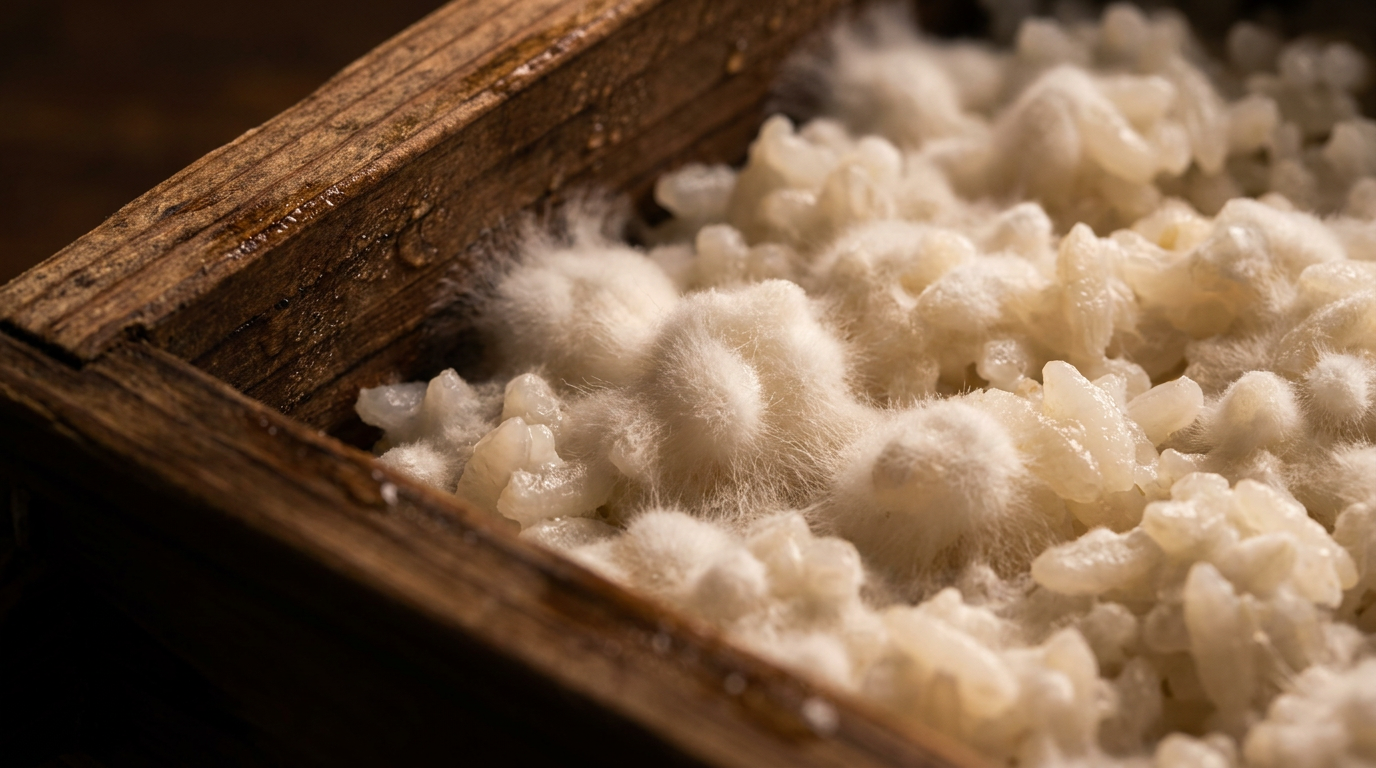
The secret weapon in the world's most innovative restaurant kitchens is not a rare truffle or a complex chemical additive. It is a fluffy, white, 9,000-year-old domesticated mold. Known scientifically as Aspergillus oryzae, this humble fungus—commonly referred to as koji—has been the invisible architect of East Asian cuisine for millennia. Now, it is quietly revolutionizing Western home cooking, offering everyday chefs a biological shortcut to profound, slow-cooked flavor in a fraction of the time.[1][6]
Koji is not a dish itself, but rather a biological processing agent. The term refers both to the specific fungal spores and to the grain—usually steamed rice, barley, or soybeans—that has been inoculated with them. When kept in a warm, humid environment, the spores bloom into a fragrant, cotton-like mycelium that smells faintly of sweet fruit and roasted nuts. In 2006, the Brewing Society of Japan officially declared it the "national fungus" due to its foundational role in the country's culinary heritage.[3]
The magic of koji lies in its voracious appetite and its highly efficient digestive system. As the mold grows on its host grain, it secretes a massive payload of powerful enzymes to break down the substrate into usable food. This robust hydrolytic enzyme secretion system is what makes it so valuable to both industrial bioproduction and the home kitchen. The fungus essentially pre-digests the food, doing the heavy biochemical lifting before the ingredient ever hits the frying pan.[4][5]
The first crucial enzyme produced by koji is protease, which targets complex proteins. Proteins themselves do not have much taste, but when protease shears them apart, it releases individual amino acids. Chief among these is glutamate, the molecular building block responsible for umami—the deeply satisfying, savory "fifth taste." When koji is applied to a bland piece of chicken or tofu, it rapidly dismantles the surface proteins, transforming them into a rich, meaty flavor profile that would normally require hours of slow braising to achieve.[2][4]

Simultaneously, the mold produces amylase, an enzyme that attacks complex carbohydrates and starches. Amylase snips these long carbohydrate chains into simple sugars like glucose. This dual action means that an ingredient treated with koji becomes both profoundly savory and delicately sweet. When these newly freed sugars and amino acids are exposed to the heat of a skillet or oven, they trigger a hyper-accelerated Maillard reaction, resulting in a beautifully caramelized, golden-brown crust.[1][4]
Simultaneously, the mold produces amylase, an enzyme that attacks complex carbohydrates and starches.
For centuries, this enzymatic alchemy was harnessed primarily for long-term fermentation. Koji is the biological engine that drives the production of soy sauce, miso paste, mirin, and sake. In the brewing of sake, for instance, rice lacks the natural enzymes found in malted barley used for beer. Koji steps in to saccharify the rice starch into fermentable sugars, which yeast then converts into alcohol. These traditional processes often take months or even years of careful aging.[3][5]
Today, however, culinary innovators and home cooks are decoupling koji from these long-term ferments and using it as a rapid-fire seasoning. The gateway application for most home kitchens is shio koji, or koji salt. By mixing dried, inoculated rice with water and salt, and letting it sit at room temperature for about a week, cooks create a thick, porridge-like marinade. This living mixture can be stored in the refrigerator for months, ready to be deployed as a universal flavor booster.[2][6]
When smeared on a turkey breast or a pork chop, shio koji works miracles in a matter of hours. The enzymes penetrate the meat, tenderizing the muscle fibers while simultaneously injecting it with umami. Culinary experts note that marinating poultry in koji before frying gives the meat an almost snack-food-like savory intensity. It turns notoriously dry or bland cuts of meat into incredibly juicy, deeply flavored centerpieces with minimal active prep time.[2]

The applications extend far beyond meat. Because koji's enzymes work on any protein or starch, it is a revelation for plant-based cooking. Home cooks are mixing activated koji into tomato passata and leaving it to gently warm, creating a "tomato koji" that acts as a hyper-savory umami bomb for pasta sauces. Others use it to rapidly cure vegetables, producing complex, pickle-like flavors while maintaining a crisp, fresh texture.[1][6]
Beyond flavor, integrating koji into daily meals offers compelling nutritional benefits. The predigestion process initiated by the enzymes increases the bioavailability of nutrients, making it easier for the human body to absorb vitamins and minerals. Furthermore, koji acts as a prebiotic, supporting the growth of beneficial intestinal bacteria. This gut-friendly profile is frequently cited as a contributing factor to the digestive health and longevity associated with traditional Japanese diets.[3]

For those wary of intentionally introducing mold into their kitchens, science offers profound reassurance. Genomic analysis reveals that Aspergillus oryzae was likely domesticated from a wild, toxic relative thousands of years ago. Through centuries of careful human selection, the gene cluster responsible for producing harmful toxins was rendered completely non-functional. Today, it holds a "Generally Recognized as Safe" (GRAS) status from the FDA and is celebrated globally for its biosecurity.[3][5]
The democratization of koji represents a fundamental shift in how home cooks can build flavor. It bridges the gap between the complex, time-intensive ferments of professional kitchens and the fast-paced reality of weeknight dinners. By harnessing the ancient, invisible labor of enzymes, anyone can transform simple, everyday ingredients into extraordinary meals, proving that the most powerful tool in the kitchen might just be a microscopic fungus.[1][6]
How we got here
4th Century BC
First documented processes of making fermented bean pastes and rice wines using molds in China.
725 AD
The Japanese text Harima no Kuni Fudoki first mentions koji production outside of China.
2006
The Brewing Society of Japan officially declares Aspergillus oryzae the "national fungus."
2010s
High-end Western restaurants begin experimenting with koji for rapid aging and novel ferments.
2020s
Koji enters the mainstream Western home kitchen through accessible recipes for shio koji and marinades.
Viewpoints in depth
Traditional Fermentation Artisans
Value the centuries-old methods of sake and miso brewing.
For traditional brewers and artisans, koji is the sacred foundation of a slow, deliberate craft. In the production of sake, soy sauce, and miso, the cultivation of koji is treated with immense reverence, often taking place in specialized cedar-lined rooms where temperature and humidity are meticulously controlled. This perspective emphasizes patience, arguing that the deepest, most complex flavor profiles can only be achieved through months or years of careful aging, allowing the enzymatic breakdown to fully mature.
Modern Culinary Innovators
Focus on rapid flavor extraction and novel applications like koji-cured meats.
Modern chefs and food scientists view koji less as a strict tradition and more as a highly efficient biological tool. By isolating the enzymatic power of the mold, they apply it to non-traditional ingredients—curing charcuterie in days instead of months, or creating umami-rich sauces from food waste. This camp celebrates the versatility of Aspergillus oryzae, pushing the boundaries of what can be fermented and proving that ancient microbiology can solve modern culinary challenges.
Everyday Home Cooks
Value the accessibility, health benefits, and ease of shio koji as a weeknight shortcut.
For the home cook, the appeal of koji lies in its practical, everyday utility. Products like dried koji rice and pre-made shio koji have democratized the fermentation process, removing the need for specialized equipment or deep scientific knowledge. This perspective champions koji as a simple, healthy alternative to ultra-processed flavor enhancers, allowing busy families to quickly tenderize proteins and elevate the taste of weeknight dinners with minimal effort.
What we don't know
- The exact geographical origin where Aspergillus oryzae was first domesticated from its wild counterparts.
- The full extent of how koji-fermented foods interact with the human microbiome over a lifetime.
Key terms
- Koji
- A grain or legume that has been inoculated with the Aspergillus oryzae mold.
- Aspergillus oryzae
- The scientific name for the specific filamentous fungus used to make koji.
- Shio Koji
- A versatile, salty marinade made by fermenting dried koji rice, water, and salt.
- Amylase
- An enzyme produced by koji that breaks down complex starches into sweet, simple sugars.
- Protease
- An enzyme produced by koji that breaks down proteins into savory amino acids.
- Umami
- The savory, rich "fifth taste" primarily driven by the amino acid glutamate.
Frequently asked
Is cooking with mold actually safe?
Yes. Aspergillus oryzae has been domesticated over thousands of years and has lost the ability to produce toxins. It is recognized as safe by the FDA and WHO.
Does koji contain gluten?
The mold itself is gluten-free. Rice koji is gluten-free, but koji grown on barley or wheat is not.
Where can I buy koji for home cooking?
Dried rice koji or pre-made shio koji can be found in Japanese grocery stores, health food stores, or ordered online.
How long does homemade shio koji last?
Once fermented for a week at room temperature, shio koji can be stored in the refrigerator for up to six months.
Sources
Source coverage
6 outlets
3 viewpoints surfaced






[1]Science FridayModern Food Scientists
Koji: The Mold You Want In Your Kitchen
Read on Science Friday →[2]The Splendid TableHome Cooking Advocates
Koji: The ancient mold that makes modern food taste better
Read on The Splendid Table →[3]WikipediaCulinary Traditionalists
Aspergillus oryzae
Read on Wikipedia →[4]Nordic Food LabCulinary Traditionalists
Koji: History and Process
Read on Nordic Food Lab →[5]National Center for Biotechnology InformationModern Food Scientists
The ancient koji mold (Aspergillus oryzae) as a modern biotechnological tool
Read on National Center for Biotechnology Information →[6]Factlen Editorial TeamHome Cooking Advocates
Synthesis by Factlen editorial team
Read on Factlen Editorial Team →
More in food drink
See all 11 stories →Inclusive Design
The Rise of Sensory-Friendly Dining: How Restaurants Are Redesigning for Neurodiversity
0 sources
Baking Science
The Science of Tangzhong: How a Simple Flour Paste Creates the World's Softest Bread
0 sources
Packaging Tech
How the Fast-Food Industry Finally Eliminated 'Forever Chemicals' From Its Packaging
0 sources
Culinary Science
The Science of the Reverse Sear: Why Low-and-Slow Before High-Heat is the Ultimate Grilling Technique
0 sources
Every angle. Every day.
Get food drink stories with full source coverage and perspective breakdowns delivered to your inbox.