
The Rise of Sensory-Friendly Dining: How Restaurants Are Redesigning for Neurodiversity
A growing movement in the hospitality industry is transforming loud, overstimulating dining rooms into inclusive spaces. By adjusting lighting, acoustics, and service, restaurants are making dining out accessible for neurodivergent families and those seeking a quieter experience.
By Factlen Editorial Team
- Neurodivergent Advocates
- Focuses on the emotional relief of inclusion and the removal of barriers that have historically isolated families from public life.
- Hospitality Operators
- Views sensory-friendly initiatives as a way to build deep brand loyalty, tap into an underserved market, and improve the overall guest experience.
- Inclusive Designers
- Argues that good acoustics, indirect lighting, and clear spatial organization should be standard architectural practices rather than special accommodations.
What's not represented
- · General diners who prefer energetic, loud atmospheres
Why this matters
For millions of neurodivergent individuals, dining out has historically been an isolating or impossible experience due to sensory overload. This shift not only opens up public spaces to marginalized groups but also signals a broader cultural move toward accessible, low-stress environments that benefit anyone seeking relief from an overstimulating world.
Key points
- Restaurants across North America are introducing sensory-friendly dining experiences to accommodate neurodivergent guests.
- Accommodations include dimmed lighting, lowered music, acoustic dampening, and the provision of sensory kits.
- Up to 90 percent of individuals on the autism spectrum experience heightened sensitivity to excessive sound.
- Establishments are offering off-menu 'safe foods' and training staff to assist guests experiencing overstimulation.
- The trend aligns with a broader cultural shift toward 'soft socializing,' attracting general diners seeking quieter environments.
The clatter of silverware, blaring background music, and harsh overhead lighting are standard features of the modern dining experience. For many, this bustling atmosphere is part of the appeal. But for neurodivergent individuals and their families, it can present an unbearable barrier. Now, a growing movement across the hospitality industry is changing the script, transforming overstimulating dining rooms into inclusive, sensory-friendly spaces.[1][5]
The shift is happening at both independent cafes and major chains. In Ottawa and Quebec, the St. Hubert restaurant group recently introduced sensory-friendly Sunday service, dimming the lights and lowering the music to accommodate guests with autism. Similarly, Chuck E. Cheese has expanded its "Sensory Sensitive Sundays" across North America, providing a low-volume, low-light environment for children who might otherwise be unable to visit during regular hours.[1][6]
The need for these accommodations is rooted in neurological realities. Research indicates that up to 90 percent of individuals on the autism spectrum experience heightened responses to excessive sound, making traditional restaurant noise physically painful or deeply anxiety-inducing. As a result, many neurodivergent families simply stop dining out altogether, losing access to a fundamental social ritual.[1][5][7]

To combat this, some restaurants are turning to science. Toronto's Sarang Kitchen partnered with researchers to create a scientifically backed playlist designed specifically to calm the brain. Instead of merely turning the music off, the restaurant utilizes specific sound frequencies, tempos, and brown noise to alter moods and reduce anxiety, allowing neurodivergent guests to dine in peace.[7]
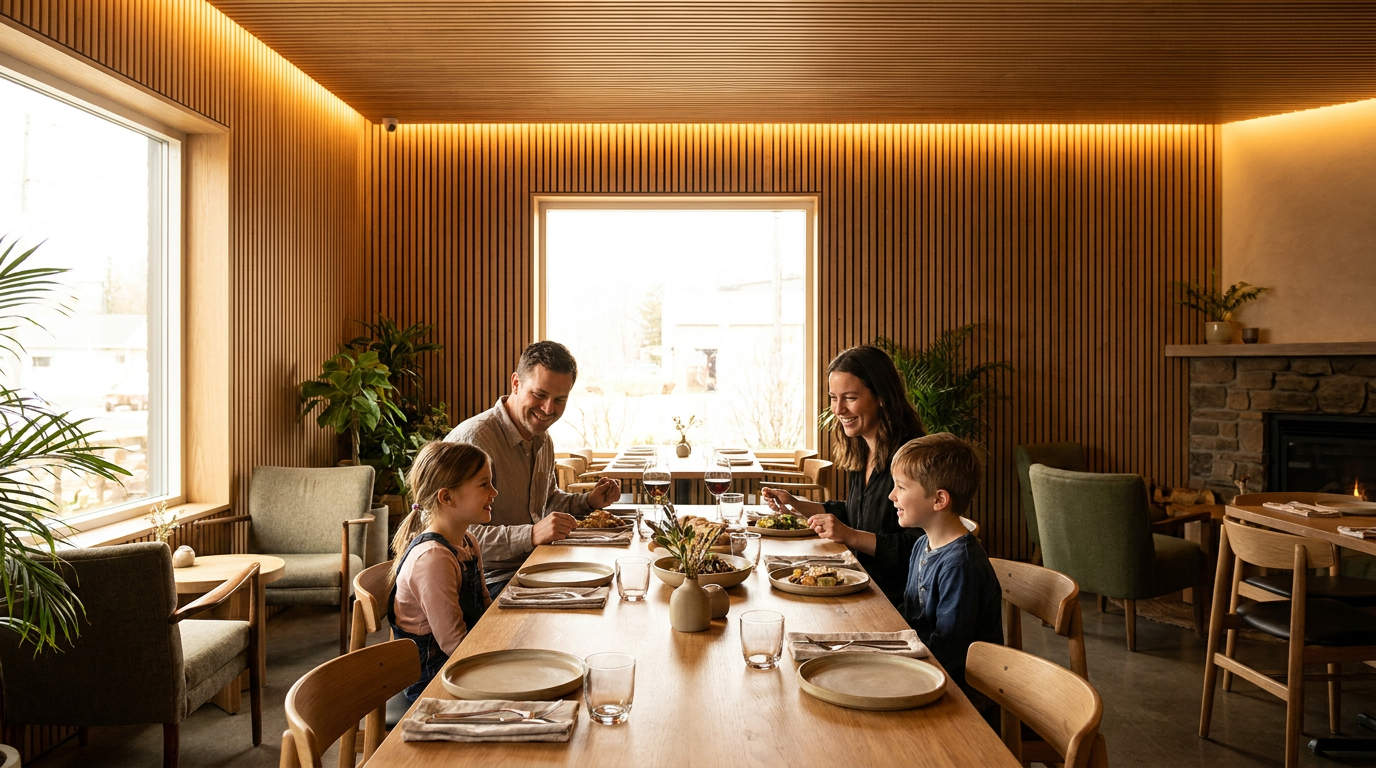
Beyond temporary service windows, architects are now incorporating sensory-inclusive elements into the foundational blueprints of new restaurants. Industry experts recommend replacing harsh LEDs with soft cove lighting that conceals direct light sources, and installing acoustic panels to absorb the chaotic echoes of a busy dining room. At HAGS, a fine-dining establishment in New York City, the design intentionally utilizes elegant softness and spatial organization to prevent sensory overload.[2][3]
Beyond temporary service windows, architects are now incorporating sensory-inclusive elements into the foundational blueprints of new restaurants.
The accommodations extend to the table itself. Many participating restaurants now offer "sensory kits" at the host stand. These kits typically include noise-canceling headphones, fidget tools, and visual-friendly timers. Because some autistic individuals process time differently, a visual timer helps them understand exactly how long they will wait for their food, significantly reducing anxiety.[1]

Menu flexibility is another crucial component. At Boba Cafe in Las Cruces, New Mexico, the owner intentionally offers off-menu "safe foods"—like simple chicken nuggets or peanut butter and jelly sandwiches—to provide comforting, predictable options for guests with sensory sensitivities to taste and texture. Digital menus with sans-serif fonts and clear images are also being adopted to assist patrons with dyslexia or processing delays.[3][5]
Physical changes are only effective when paired with empathy, making staff training a cornerstone of the movement. Servers are being educated on what autism is, how to recognize signs of overstimulation, and how to offer a quieter back room or a sensory kit without making the guest feel judged. This training ensures that the environment is not just physically accommodating, but emotionally safe.[1][5]

Interestingly, the push for sensory-friendly spaces is resonating far beyond the neurodivergent community. As "soft socializing" becomes a broader cultural trend in 2026, many diners exhausted by screen time, urban noise, and the chaotic energy of traditional bars are actively seeking out these peaceful environments. The appeal of a quiet, predictable meal is proving to be a universal desire.[6]
The movement is also creating new pathways for employment. Establishments like Brewability and DIRT Coffee in Denver are not only designing accessible spaces but actively hiring and training neurodivergent staff. By building a holistic ecosystem of inclusion, the hospitality industry is proving that accommodating diverse sensory needs is not just a charitable gesture, but a sustainable model that ensures everyone has a seat at the table.[3][4]
How we got here
Pre-2020s
Dining out remains largely inaccessible for many neurodivergent families due to a lack of awareness and standard loud restaurant environments.
2022–2024
Early pioneers and specialized cafes begin experimenting with quiet hours and hiring neurodivergent staff.
April 2025
Major chains like Chuck E. Cheese roll out 'Sensory Sensitive Sundays' nationwide in recognition of World Autism Month.
2026
Sensory-friendly design moves from temporary event windows to permanent architectural and operational standards in new restaurants.
Viewpoints in depth
Neurodivergent Advocates
Focuses on the emotional relief of inclusion and the removal of barriers to public life.
For advocates, dining out is a fundamental social experience that has long been inaccessible due to sensory barriers. They argue that accommodations like dimmed lighting and visual timers prevent isolation and allow neurodivergent families to participate in public life without fear of judgment or meltdowns. The focus is on the profound emotional relief that comes from being accommodated rather than merely tolerated.
Hospitality Operators
Views sensory-friendly initiatives as a way to build deep brand loyalty and improve the overall guest experience.
Operators emphasize the business and community benefits of inclusive dining. They view sensory-friendly initiatives as a way to tap into an underserved market and build fierce brand loyalty among families who finally have a safe place to eat. Furthermore, they note that proper staff training and flexible service models ultimately create a more empathetic and attentive experience for all guests, not just those with specific diagnoses.
Inclusive Designers
Argues that good acoustics and indirect lighting should be standard architectural practices.
Designers and architects argue that structural solutions like acoustic dampening, indirect lighting, and clear spatial organization shouldn't be viewed as special accommodations, but as the baseline for good design. They believe that environments built to support the most sensitive users inherently become more comfortable and inviting for the general public, reducing overall stress and fatigue.
What we don't know
- Whether sensory-friendly design will become a mandated accessibility standard under future building codes, or remain a voluntary hospitality choice.
- How independent restaurants operating on razor-thin margins will afford the architectural retrofits required for optimal acoustic dampening.
- The long-term impact of these specialized environments on the employment rates of neurodivergent individuals in the broader hospitality sector.
Key terms
- Neurodivergent
- An umbrella term for people whose brains function, learn, and process information differently than what is considered typical, including autism and ADHD.
- Sensory Overload
- A condition where one or more of the body's senses experiences overstimulation from the environment, often causing distress, anxiety, or physical pain.
- Visual Timer
- A countdown tool that shows the passage of time visually, helping individuals who struggle with abstract time concepts manage waiting periods.
- Brown Noise
- A sound frequency that is deeper and softer than white noise, often used to promote relaxation and mask distracting background sounds.
- Cove Lighting
- A form of indirect lighting built into ledges or recesses, providing soft, diffused illumination without harsh glare.
Frequently asked
What makes a restaurant sensory-friendly?
A sensory-friendly restaurant adjusts its environment by dimming lights, lowering or changing background music, and providing tools like sensory kits to prevent guests from becoming overstimulated.
What is included in a restaurant sensory kit?
Kits typically include noise-canceling headphones, fidget tools, visual timers to track food wait times, and communication charts for non-verbal guests.
Does quiet dining only benefit autistic individuals?
No. While designed for neurodivergent guests, these peaceful environments are increasingly popular among general diners seeking relief from urban noise and screen fatigue.
Sources
Source coverage
7 outlets
3 viewpoints surfaced






[1]CTV NewsHospitality Operators
St. Hubert brings inclusive dining experience for people with autism to Ottawa
Read on CTV News →[2]Metropolis MagazineInclusive Designers
Designing for Autism and Neurodiversity in Hospitality
Read on Metropolis Magazine →[3]Modern Restaurant ManagementInclusive Designers
Sensory-Friendly Lighting and Sound Management in Restaurants
Read on Modern Restaurant Management →[4]DiningOutHospitality Operators
Inclusive Dining Options in Denver
Read on DiningOut →[5]KFOX14Neurodivergent Advocates
A welcoming table: Las Cruces restaurant sets new standard for inclusive dining
Read on KFOX14 →[6]Trend HunterHospitality Operators
Sensory-inclusive Entertainment and Adaptive Family Experiences
Read on Trend Hunter →[7]InnoceanNeurodivergent Advocates
Using Science to Help Neurodivergent Families Dine Out Again
Read on Innocean →

Every angle. Every day.
Get food drink stories with full source coverage and perspective breakdowns delivered to your inbox.