
SpaceX Completes Historic $75 Billion IPO, Pushing Elon Musk to Trillionaire Status
SpaceX has executed the largest initial public offering in history, raising $75 billion and achieving a market valuation near $2.1 trillion after its first day of trading. The blockbuster Nasdaq debut also cemented founder Elon Musk as the world's first trillionaire.
By Factlen Editorial Team
- Growth & Innovation Investors
- Investors who argue SpaceX's valuation is justified by its monopoly on the future space economy and its rapid revenue growth.
- Fundamental Value Analysts
- Financial analysts who warn that the company's valuation is detached from economic reality and driven by market hype.
- Market Skeptics & Governance Critics
- Watchdogs concerned about the concentration of power and the lack of traditional corporate checks and balances.
What's not represented
- · Retail investors who purchased shares on day one
- · Competitors in the legacy aerospace industry
Why this matters
SpaceX's record-shattering IPO not only mints the world's first trillionaire, but it also opens the rapidly growing space economy to public investment for the first time. The $2.1 trillion valuation sets a new benchmark for the technology sector, signaling that Wall Street is willing to heavily finance highly speculative, multi-decade ambitions like Mars colonization.
Key points
- SpaceX raised $75 billion in its Nasdaq debut, shattering the global record for the largest initial public offering.
- Shares jumped 19% on their first day of trading, giving the aerospace company a market capitalization of roughly $2.1 trillion.
- The massive valuation surge pushed founder Elon Musk's personal net worth past $1 trillion, making him the world's first trillionaire.
- Starlink, SpaceX's satellite internet division, accounted for the vast majority of the company's $18.67 billion in revenue last year.
- Traditional financial analysts have criticized the valuation as being detached from fundamentals and driven primarily by hype.
- A dual-class share structure ensures Musk retains absolute operational control over the company despite the public listing.
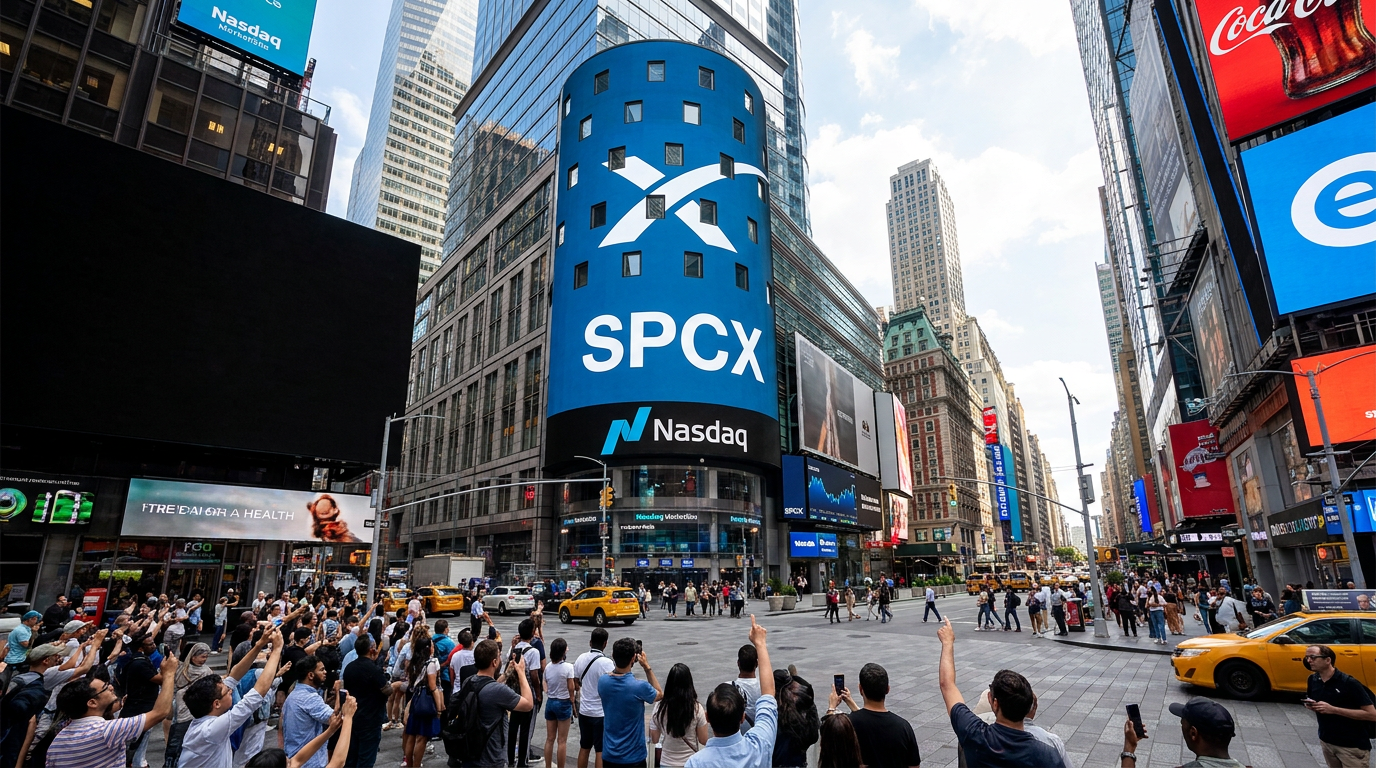
On Friday, Space Exploration Technologies Corp.—better known as SpaceX—rewrote the record books of global finance. The aerospace manufacturer and satellite internet provider completed its initial public offering (IPO)—the process of offering shares of a private corporation to the public for the first time—on the Nasdaq under the ticker symbol "SPCX," raising an unprecedented $75 billion.[1][2]
The sheer scale of the offering dwarfs any previous public market debut. Prior to Friday, the largest IPO in history belonged to the Saudi Arabian state oil company, Saudi Aramco, which raised $29 billion in 2019. Alibaba's 2014 debut, which raised $25 billion, held the previous record for a U.S. exchange.[4]
Despite the massive supply of shares hitting the market, investor appetite proved voracious. SpaceX priced its offering of 555.6 million shares at $135 late Thursday evening. When trading commenced on Friday, the stock opened at $150 and touched an intraday high of $168.75 before settling at $160.95—a 19% first-day return.[2][6]
That closing price assigned SpaceX a staggering market capitalization—the total dollar market value of a company's outstanding shares—of approximately $2.1 trillion. For context, this valuation immediately places the newly public aerospace firm among the most valuable corporate entities on the planet, trailing only a handful of established tech giants like Apple, Microsoft, and Nvidia.[2][4]

The blockbuster listing also triggered a historic milestone in personal wealth. The surge in SpaceX's valuation officially pushed founder and CEO Elon Musk's net worth past the $1 trillion threshold, making him the world's first trillionaire.[3][5]
Musk's financial ascent is heavily tied to his retained ownership in the company he founded in 2002. According to the IPO filings, Musk holds roughly 4.8 billion shares—a 42% stake—alongside 350 million exercisable stock options. At Friday's closing price, his SpaceX holdings alone are worth over $820 billion.[3][6]
Combined with his equity in Tesla and his artificial intelligence venture xAI, Musk's total net worth is now estimated at $1.14 trillion. This figure makes his personal fortune larger than the gross domestic product of countries like the Netherlands or Saudi Arabia, and greater than the combined wealth of the next four richest individuals on Earth.[5][6]

Combined with his equity in Tesla and his artificial intelligence venture xAI, Musk's total net worth is now estimated at $1.14 trillion.
But beneath the historic wealth generation lies a fierce debate over the company's fundamental valuation. Proponents argue that SpaceX is not merely a rocket manufacturer, but an emerging monopoly over the entire space economy.[1][4]
The primary engine of SpaceX's current financial model is Starlink, its satellite internet constellation. According to the company's prospectus, Starlink generated the vast majority of SpaceX's $18.67 billion in revenue last year, providing high-speed broadband to remote areas, maritime vessels, and commercial airlines globally.[4]
Beyond telecommunications, SpaceX has fundamentally altered the economics of spaceflight. By pioneering reusable rocket boosters, the company has drastically lowered the cost per kilogram of launching payloads into orbit, securing lucrative contracts with NASA and the U.S. Department of Defense while effectively pricing out legacy competitors.[1][4]
Yet, traditional financial analysts remain deeply skeptical of the $2.1 trillion price tag. Aswath Damodaran, a prominent finance professor at New York University, publicly argued that the valuation is detached from traditional cash-flow metrics. "The $1.8 trillion is frankly made up," Damodaran noted regarding the initial pricing, suggesting that buyers are driven by hype rather than fundamentals.[5]

Critics also point to the company's history of negative profitability and the highly speculative nature of its long-term goals. The Guardian characterized the IPO as a reflection of an era where market prices are dictated by "hype, connections and total, arbitrary control," rather than traditional supply and demand.[7]
This tension highlights a broader philosophical divide in modern investing, often framed as the "moats versus moonshots" debate. While traditional investors seek companies with wide economic moats—distinct competitive advantages that protect market share and ensure predictable cash flows—a new generation of capital is willing to pay massive premiums for "moonshots," which are companies attempting to solve existential problems or create entirely new industries.[1]
To maintain his grip on those moonshot ambitions, Musk has structured the IPO to ensure his continued dominance over the company's direction. SpaceX went public with a dual-class share structure, a mechanism that grants Musk super-voting rights and leaves operational control firmly in his hands, insulating him from activist investors.[4]

The offering was also notable for its accessibility. In a departure from typical mega-IPOs that cater almost exclusively to institutional investors, SpaceX allocated an unusually large 20% of the offering to retail investors, allowing the public to buy directly into the space race.[4]
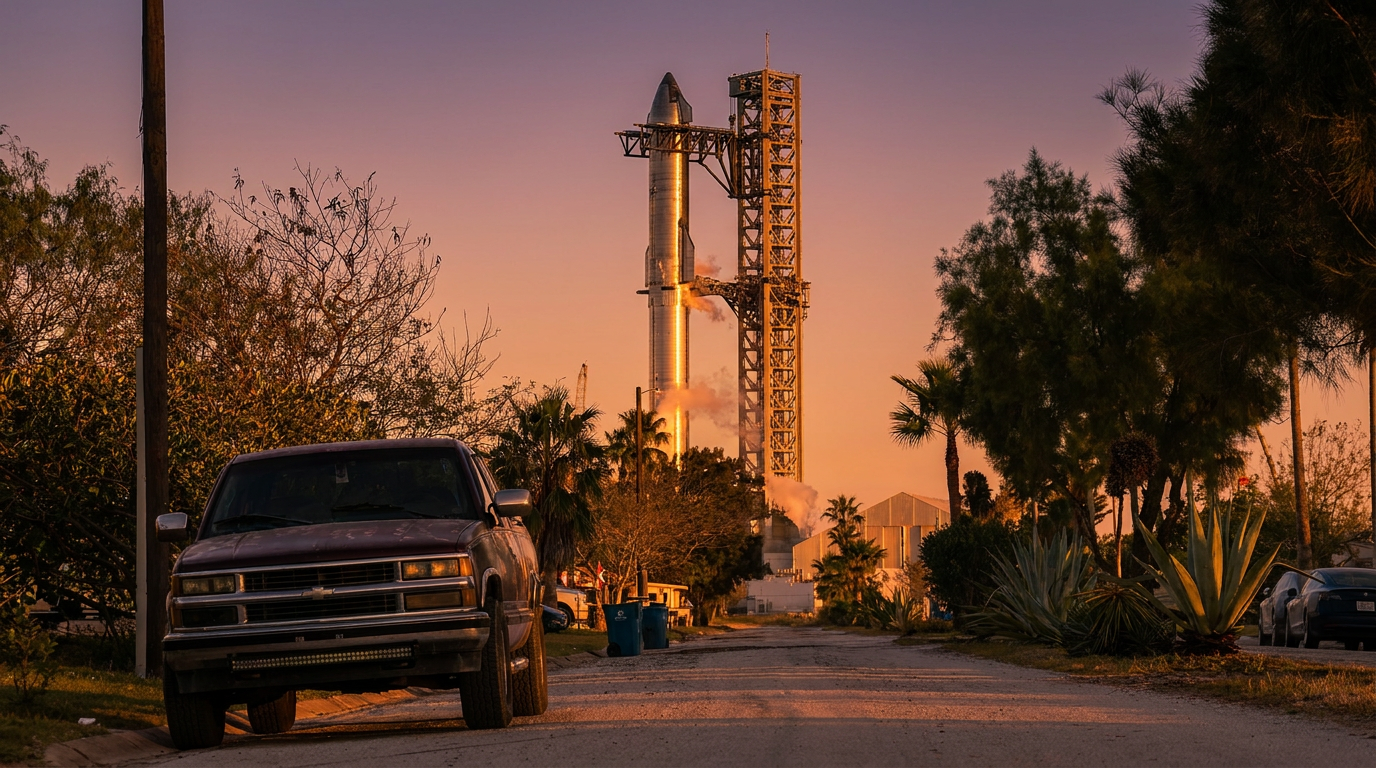
The $75 billion war chest raised by the IPO will be directed toward SpaceX's most capital-intensive projects. Chief among these is the continued development of Starship, the fully reusable super-heavy lift launch vehicle designed to carry humans to the Moon and, ultimately, fulfill Musk's stated mission of establishing a permanent settlement on Mars.[5][6]
How we got here
2002
Elon Musk founds Space Exploration Technologies Corp. with the ultimate goal of reducing space transportation costs and colonizing Mars.
2014
Alibaba sets the record for the largest U.S. IPO, raising $25 billion.
2019
Saudi Aramco sets the global record for the largest IPO, raising $29 billion.
Thursday Evening
SpaceX prices its initial public offering at $135 per share, raising $75 billion.
Friday Morning
SpaceX begins trading on the Nasdaq under the ticker SPCX, opening at $150 per share.
Friday Afternoon
Shares close at $160.95, pushing SpaceX's valuation to $2.1 trillion and making Musk a trillionaire.
Viewpoints in depth
The Moonshot Believers
Investors who argue SpaceX's valuation is justified by its monopoly on the future space economy.
This camp views SpaceX not as a traditional aerospace manufacturer, but as the foundational infrastructure for the next century of human expansion. They point to Starlink's rapidly growing revenue and the cost-saving breakthroughs of reusable rockets as proof that the company can execute on seemingly impossible goals. For these investors, traditional price-to-earnings ratios are irrelevant when a company is creating entirely new markets.
The Fundamental Skeptics
Financial analysts who warn that the company's valuation is detached from economic reality.
Traditional value investors and finance academics argue that a $2.1 trillion valuation for a company with a history of negative profitability is a dangerous bubble. They emphasize that the IPO price was based on hype and the cult of personality surrounding Elon Musk, rather than reliable cash flows. This camp warns that retail investors could be left holding the bag if the company's speculative Mars ambitions fail to materialize into profitable business models.
Corporate Governance Critics
Watchdogs concerned about the concentration of power in a publicly traded mega-cap company.
This perspective focuses on the dual-class share structure that allows Elon Musk to retain absolute control over SpaceX despite taking public money. Critics argue that this structure removes necessary checks and balances, leaving public shareholders with no recourse if the CEO makes erratic decisions or prioritizes personal interplanetary ambitions over fiduciary duties to investors.
What we don't know
- Whether SpaceX can maintain its $2.1 trillion valuation once the initial hype of the IPO subsides.
- How public market pressure for quarterly profits will impact the company's timeline for highly speculative projects like Mars colonization.
- The exact breakdown of profitability between SpaceX's launch services and its Starlink satellite internet division.
Key terms
- Market Capitalization
- The total dollar market value of a company's outstanding shares of stock, calculated by multiplying the current stock price by the total number of outstanding shares.
- Dual-Class Share Structure
- A corporate structure where a company issues two different classes of shares, typically giving founders or executives shares with significantly more voting power than those sold to the general public.
- Economic Moat
- A distinct advantage a company has over its competitors that allows it to protect its market share and profitability over the long term.
- Institutional Investor
- Large organizations, such as mutual funds, pensions, or insurance companies, that invest massive pools of capital on behalf of others.
Frequently asked
What is an IPO?
An Initial Public Offering (IPO) is the process by which a private company offers shares of its stock to the public for the first time, allowing it to raise capital from public investors.
How much did SpaceX raise in its IPO?
SpaceX raised $75 billion, making it the largest initial public offering in global financial history, surpassing Saudi Aramco's $29 billion IPO in 2019.
What is SpaceX's stock ticker symbol?
SpaceX trades on the Nasdaq stock exchange under the ticker symbol "SPCX".
Does Elon Musk still control SpaceX?
Yes. Despite selling shares to the public, SpaceX instituted a dual-class share structure that grants Musk super-voting rights, ensuring he retains operational control.
What is Elon Musk's net worth now?
Following the IPO, Musk's net worth surged to an estimated $1.14 trillion, making him the first trillionaire in history.
Sources
Source coverage
7 outlets
3 viewpoints surfaced







[1]CNBCGrowth & Innovation Investors
SpaceX IPO sticks the landing. Here's what investors are saying about its epic first trading day
Read on CNBC →[2]BloombergFundamental Value Analysts
SpaceX Shares Close 19% Higher After Historic $75 Billion IPO
Read on Bloomberg →[3]ForbesFundamental Value Analysts
Forbes Declares Elon Musk as the World's First Trillionaire
Read on Forbes →[4]Fox BusinessGrowth & Innovation Investors
SpaceX makes historic debut; Musk solidifies status as world's first trillionaire
Read on Fox Business →[5]The Washington PostFundamental Value Analysts
Elon Musk crosses unfathomable barrier to become history's first trillionaire
Read on The Washington Post →[6]CBS NewsMarket Skeptics & Governance Critics
Key details on the SpaceX IPO that made Elon Musk a trillionaire
Read on CBS News →[7]The GuardianMarket Skeptics & Governance Critics
Elon Musk is now the world's first trillionaire. What does this tell you about capitalism?
Read on The Guardian →
Every angle. Every day.
Get business stories with full source coverage and perspective breakdowns delivered to your inbox.