
Gaming Industry Rolls Out Standardized Accessibility Tags and Open-Source Adaptive Tech
Major publishers and platform holders have united to implement standardized accessibility tags across digital storefronts, alongside a wave of new adaptive hardware and AI-driven mods.
By Factlen Editorial Team
- Disabled Gamers & Advocates
- Argue that accessibility is a fundamental quality criterion that removes the financial risk of buying unplayable games and erases physical barriers to social interaction.
- Platform Holders & Publishers
- Focus on ecosystem integration and standardized language to expand market reach and ensure players can seamlessly transition between consoles and PC.
- Modders & Engine Developers
- Champion grassroots, open-source solutions and AI tools as essential for retrofitting older games and pushing the boundaries of what is possible for blind and low-vision players.
What's not represented
- · Small Indie Developers
- · Esports Tournament Organizers
Why this matters
For decades, millions of players with motor, visual, or cognitive disabilities were locked out of major video game releases by rigid control schemes and unreadable interfaces. The shift toward standardized storefront tags, royalty-free patents, and AI-assisted mods transforms gaming from an exclusionary hobby into a universally accessible medium.
Key points
- The Accessible Games Initiative introduced 24 standardized tags to digital storefronts.
- Xbox launched new 3D-printable Adaptive Thumbstick Toppers and facial-recognition controls.
- Kakao Games provided over 600 customized assistive devices to disabled players in South Korea.
- Electronic Arts expanded its Patent Pledge, offering royalty-free access to accessibility technology.
- Over 50 AI-powered mods have recently been released to help blind players navigate mainstream games.
The gaming industry has reached a watershed moment in 2026, shifting accessibility from a niche bonus feature to a core design expectation. Major platform holders and publishers have begun rolling out standardized accessibility tags across digital storefronts, fundamentally changing how players with disabilities discover and purchase games. For years, inclusive design was treated as an afterthought, leaving millions of potential players sidelined by rigid mechanics and unreadable interfaces. Now, driven by a combination of grassroots advocacy, open-source technology sharing, and corporate buy-in, the medium is undergoing a structural transformation. This shift is not merely about adding a few toggles in an options menu; it represents a comprehensive rethinking of how virtual worlds are built, marketed, and played, ensuring that the social and cognitive benefits of gaming are available to everyone.[1][3]
For decades, disabled gamers faced a landscape of hidden barriers and costly gambles. A player with limited motor function might purchase a highly anticipated $70 title only to discover an un-remappable "button mashing" quick-time event in the opening tutorial, rendering the entire game unplayable. Visually impaired players frequently encountered microscopic user interface text, low-contrast environments, or un-narrated menus that locked them out of progression entirely. Because digital storefronts historically lacked detailed accessibility metadata, buying a new release required relying on crowdsourced community warnings rather than official documentation. This lack of transparency turned gaming into an exclusionary hobby, where physical or sensory limitations dictated what cultural touchstones a person could participate in.[3][5]
Spearheaded by the Accessible Games Initiative (AGI), a new system introduces 24 standardized tags that clearly define a game's built-in features before purchase. These criteria include specific labels like "playable with buttons only," "narrated menus," "stick inversion," and "large and clear subtitles." By standardizing this language, the AGI eliminates the financial risk for players who previously had to guess if a game would accommodate their needs. Xbox has already integrated these tags into its digital store, allowing users to filter the entire catalog by specific accessibility criteria, with PlayStation and Nintendo expected to follow suit in the near future. This unified approach ensures that developers and players are finally speaking the same language regarding inclusive design.[1][5]

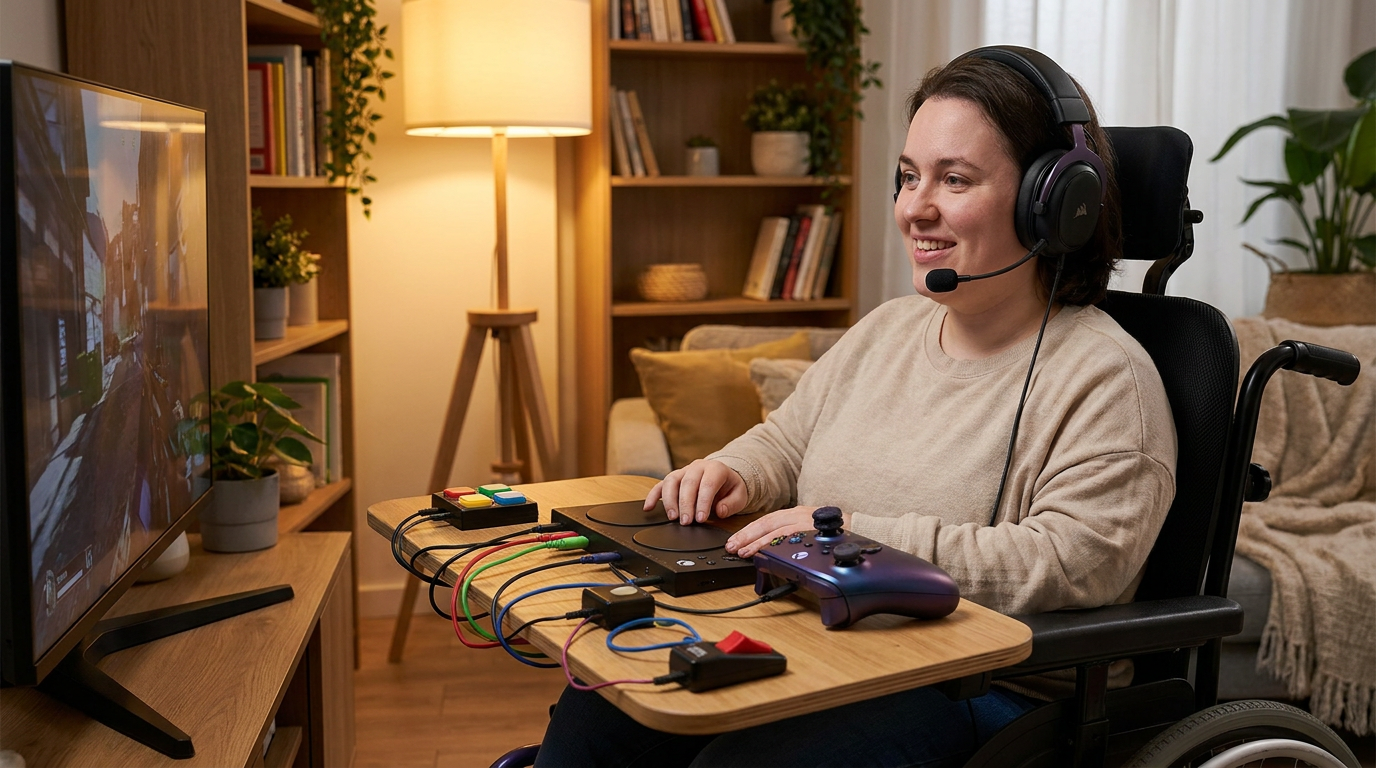
Alongside software standards, hardware manufacturers are rapidly expanding their adaptive ecosystems to meet diverse physical needs. Xbox recently launched new Adaptive Thumbstick Toppers through its Design Lab, allowing players to 3D-print custom shapes—such as the widened "Goal Post" design—to suit specific motor requirements. The platform also introduced native support for Cephable, an innovative application that allows players with limited mobility to control games using facial expressions, head movements, and customizable voice commands. These hardware and peripheral advancements move beyond the traditional gamepad, offering modular, highly personalized setups that can be adjusted as a player's physical needs change over time.[2]
The push for physical accessibility extends globally, with international markets adopting aggressive support structures. In South Korea, Kakao Games recently received a government commendation for its "Play Buddy Together" program, the country's first assistive-device support initiative for game accessibility. Over the past three years, the program has matched nearly 100 disabled players with over 600 customized assistive devices. These include specialized tools like the QuadStick Mouse—a mouth-operated joystick equipped with sip-and-puff sensors for quadriplegic gamers—and the Tobii Eye Tracker 5, which allows users to control the camera through eye movement alone. This level of institutional support highlights how direct hardware intervention can bridge the gap between disabled players and mainstream gaming.[3]

The push for physical accessibility extends globally, with international markets adopting aggressive support structures.
To accelerate this industry-wide shift, major publishers are actively tearing down intellectual property barriers that previously stifled innovation. Electronic Arts recently expanded its Patent Pledge, offering developers worldwide royalty-free access to its accessible technology patents. This unprecedented move encourages studios of all sizes to implement inclusive design features—such as advanced ping systems or colorblind rendering techniques—without the threat of infringement claims or costly licensing fees. By treating accessibility advancements as open-source public goods rather than competitive trade secrets, the industry is fostering a collaborative environment where a breakthrough at one studio immediately benefits the entire global player base.[1][6]
Artificial intelligence is also playing a crucial role, particularly in opening up virtual worlds for blind and low-vision players. A recent boom in community-driven development has seen over 50 AI-powered accessibility mods released for mainstream games in just a few months, bridging the gap where official developer support falls short. These tools use AI to dynamically read on-screen text, describe environments, and provide audio cues for navigation. Meanwhile, major game engines like Unity are developing native screen-reader support, democratizing accessibility at the foundational engine level so that indie developers can easily implement features that previously required massive AAA budgets.[4][7]
The impact of these innovations is also rippling into the competitive sphere, challenging long-held notions of what constitutes high-level play. At the CES 2026 "Gaming for All" panel, industry leaders discussed the necessary infrastructure to support inclusive esports, ensuring that players using adaptive controllers or eye-tracking software can compete on level playing fields. This represents a massive cultural shift for an industry that historically equated competitive viability with standard controller dexterity. As adaptive interfaces become more sophisticated, tournament organizers are beginning to recognize that strategic brilliance and reaction times are not exclusively tied to traditional hand-eye coordination.[3]
Disability advocates frequently compare these digital innovations to physical "curb cuts"—architectural features designed for wheelchair users that ultimately benefit everyone, from parents pushing strollers to delivery workers with carts. In gaming, features like high-contrast modes, scalable text, and remappable controls are widely used by non-disabled players to reduce eye strain or improve comfort. A recent study commissioned by Activision and the Royal National Institute of Blind People highlighted the profound psychological impact of these efforts. The research found that 84% of visually impaired players reported improved social interaction through gaming, while 87% cited significant stress relief, underscoring the medium's role in fostering connection.[2][3]

As 2026 progresses, the collaborative effort between hardware giants, software developers, and the disabled gaming community is successfully dismantling decades-old barriers. With standardized storefront tags, open-source patents, and AI-assisted tools rapidly becoming the industry norm, the medium is transforming into a truly universal platform. The days of disabled players being treated as an edge case are ending, replaced by a design philosophy that views accessibility as a fundamental pillar of quality. Through these combined technological and cultural shifts, the gaming industry is finally delivering on the long-held promise that virtual worlds are meant for everyone.[1][2][3]
How we got here
March 2023
Kakao Games launches the 'Play Buddy Together' assistive-device program in South Korea.
December 2025
Electronic Arts expands its Patent Pledge to share accessibility tech royalty-free.
January 2026
Industry leaders present the next era of accessibility tools at the CES 'Gaming for All' panel.
May 2026
Xbox updates its Accessible Gaming hub and releases new Adaptive Thumbstick Toppers for Global Accessibility Awareness Day.
June 2026
Standardized accessibility tags begin rolling out across major digital storefronts.
Viewpoints in depth
Disabled Gamers & Advocates
Argue that accessibility is a fundamental quality criterion, not a bonus feature.
For disability advocates, the rollout of standardized tags and adaptive hardware is about basic consumer fairness and social inclusion. They emphasize that buying a video game should not be a financial gamble where the player risks $70 on an unplayable product. Furthermore, advocates point out that virtual worlds erase the physical and transportation barriers that disabled players face in offline spaces, making accessible gaming a vital tool for combating isolation and building community.
Hardware & Platform Holders
Focus on ecosystem integration and standardized language to expand their market reach.
Platform holders view accessibility as both a moral imperative and a massive market expansion. By standardizing tags and creating modular hardware like the Adaptive Controller, they ensure that players can seamlessly transition between consoles, mobile devices, and PCs. These companies argue that inclusive design is simply good business, as features originally designed for disabled players—like high-contrast modes and remappable buttons—are frequently adopted by the broader player base for comfort and convenience.
Independent Modders & AI Developers
Champion grassroots, open-source solutions to retrofit older games and push boundaries.
While major publishers are making strides, independent developers and modders argue that official support often moves too slowly. They champion the use of open-source AI tools to rapidly retrofit existing games with screen readers and audio navigation cues. This community believes that true accessibility will only be achieved when the tools to create it are democratized at the engine level, allowing even solo indie developers to build fully inclusive experiences without needing a AAA budget.
What we don't know
- When PlayStation and Nintendo will fully integrate the new standardized accessibility tags into their respective digital storefronts.
- How smaller indie studios with limited budgets will implement the full suite of 24 accessibility criteria.
- Whether cross-platform controller compatibility will become a universal standard across all major consoles.
Key terms
- Accessible Games Initiative (AGI)
- A collective of video game publishers working to standardize accessibility language and tags across digital storefronts.
- Adaptive Controller
- A customizable gaming hub designed for players with limited mobility, allowing them to connect external switches, buttons, and joysticks.
- Screen Reader
- Assistive software that translates on-screen text and menu interfaces into synthesized speech for blind or low-vision users.
- Tobii Eye Tracker
- A hardware device that monitors a user's eye movements, allowing them to control the camera or interface without a traditional mouse or joystick.
- QuadStick
- A mouth-operated joystick equipped with sip-and-puff sensors, designed specifically for quadriplegic gamers.
Frequently asked
What are standardized accessibility tags?
They are a unified set of 24 labels (like "narrated menus" or "playable with buttons only") used across digital stores to tell players what accessibility features a game has before they buy it.
Can I use voice commands to play games?
Yes, new integrations like Cephable allow players to control games using voice commands, facial expressions, and head movements.
Are these accessibility features patented?
While some are, major publishers like Electronic Arts have pledged to make their accessibility-related patents available royalty-free so any developer can use them without fear of infringement.
Sources
Source coverage
7 outlets
3 viewpoints surfaced







[1]MashablePlatform Holders & Publishers
Game accessibility has garnered more focused, industry-wide attention
Read on Mashable →[2]Xbox WirePlatform Holders & Publishers
Xbox Celebrates Global Accessibility Awareness Day with Improved Adaptive Thumbstick Toppers
Read on Xbox Wire →[3]Thompson TribuneDisabled Gamers & Advocates
Adaptive gaming interfaces multiplied across 2026
Read on Thompson Tribune →[4]GAConfModders & Engine Developers
Not just vibes: How Blind Players Are Modding Accessibility into Games with AI
Read on GAConf →[5]YouTubeDisabled Gamers & Advocates
What might we see in gaming accessibility in the year ahead?
Read on YouTube →[6]Electronic ArtsPlatform Holders & Publishers
EA Expands Patent Pledge for Accessible Technology
Read on Electronic Arts →[7]UnityModders & Engine Developers
Democratizing Accessibility: Native Screen Reader Support
Read on Unity →

More in entertainment
See all 16 stories →Streaming Wars
The Great Re-Bundling: How 2026's Streaming Mega-Deals Are Curing Subscription Fatigue
0 sources
Vinyl Revival
Vinyl Record Sales Cross Historic $1.4 Billion Mark as Gen Z Drives Physical Music Revival
0 sources

Philanthropy Milestone
Michael J. Fox Foundation Surpasses $3 Billion in Funding, Ushers in 'Precision Medicine' Era for Parkinson's
0 sources

Indie Box Office
Micro-Budget Horror 'Obsession' Crosses $240M, Becoming Focus Features' Biggest Hit Ever
0 sources

Every angle. Every day.
Get entertainment stories with full source coverage and perspective breakdowns delivered to your inbox.