
How Empty Office Towers Are Being Engineered Into the Next Generation of Housing
Faced with record-high commercial vacancies, developers are utilizing advanced algorithms and new zoning laws to transform obsolete office buildings into tens of thousands of residential apartments.
By Factlen Editorial Team
- Commercial Real Estate Developers
- Evaluates the structural feasibility, construction costs, and financial incentives required to make adaptive reuse profitable.
- Urban Planners & Municipalities
- Focuses on revitalizing downtowns, stabilizing tax revenues, and solving the housing shortage through zoning reform.
- Sustainability Advocates
- Champions adaptive reuse as a critical strategy to reduce embodied carbon and prevent demolition waste.
What's not represented
- · Existing commercial tenants dealing with construction noise
- · Low-income housing advocates concerned about luxury-only conversions
Why this matters
As remote work permanently empties millions of square feet of commercial space, adaptive reuse offers a rare double-victory: saving downtown economies from collapse while simultaneously delivering tens of thousands of new homes. Understanding this architectural pivot explains why your city's skyline is changing and how the 9-to-5 business district is evolving into a 24/7 neighborhood.
Key points
- Office space slated for conversion or demolition surpassed new construction in 2025.
- Only about 25% of existing office buildings are structurally suitable for residential conversion.
- Conversion costs can reach $500 per square foot due to complex plumbing and HVAC retrofits.
- Cities are offering tax abatements and zoning exemptions to bridge the financial feasibility gap.
- Preserving existing structures dramatically reduces the embodied carbon emissions of new housing.
For decades, the American downtown operated on a rigid, predictable rhythm. Millions of workers flooded into towering glass-and-steel monoliths at dawn, fueled a localized economy of lunch counters and dry cleaners, and evacuated by dusk. The pandemic permanently shattered that cycle, leaving behind a staggering surplus of vacant commercial real estate. By mid-2025, the national office vacancy rate hovered near an all-time high of 19 percent, threatening to plunge major metros into an 'urban doom loop' of declining property values and shrinking municipal tax bases. Yet, from this crisis of obsolescence, a profound architectural and civic transformation has emerged. Rather than abandoning these stranded assets, developers and urban planners are increasingly executing complex adaptive reuse projects, turning empty cubicle farms into much-needed residential apartments.[1][4]
The momentum behind this shift has reached a historic tipping point. According to a 2025 report by the commercial real estate firm CBRE, the United States is now removing more office space from the market than it is building—the first time this has happened in modern history. By the end of the year, an estimated 23.3 million square feet of office space is slated for conversion or demolition, vastly outpacing the 12.7 million square feet of new construction. This contraction is not a sign of urban decay, but rather a deliberate recalibration. Developers are projected to deliver over 70,000 converted apartment units in 2025 alone, representing a staggering 357 percent surge compared to just three years prior.[1]
But transforming a mid-century corporate headquarters into a livable, light-filled residential community is far more complicated than simply erecting drywall and installing kitchen appliances. The physical anatomy of a commercial building is fundamentally hostile to residential living. Offices are designed around massive, deep floor plates illuminated by artificial fluorescent lighting, with centralized HVAC systems and a single core of communal bathrooms. Apartments, by contrast, require natural light in every bedroom, operable windows, individualized climate control, and distributed plumbing networks capable of supporting dozens of private kitchens and bathrooms on a single floor.[4][6]

To solve this architectural puzzle, the industry has turned to data. The global architecture firm Gensler developed a proprietary algorithm known as Conversions+ to rapidly assess whether a stranded asset is mathematically viable for a residential pivot. By analyzing over 1,300 buildings across North America, the tool evaluates 150 different data points—including structural grid spacing, floor-to-floor height, and window-to-core depth. The results are sobering but actionable: only about 25 to 30 percent of existing office buildings possess the right 'bones' to make a conversion physically and financially feasible. Buildings constructed in the 1970s and 1980s often hit the sweet spot, offering the structural flexibility that modern, ultra-deep glass towers lack.[2]
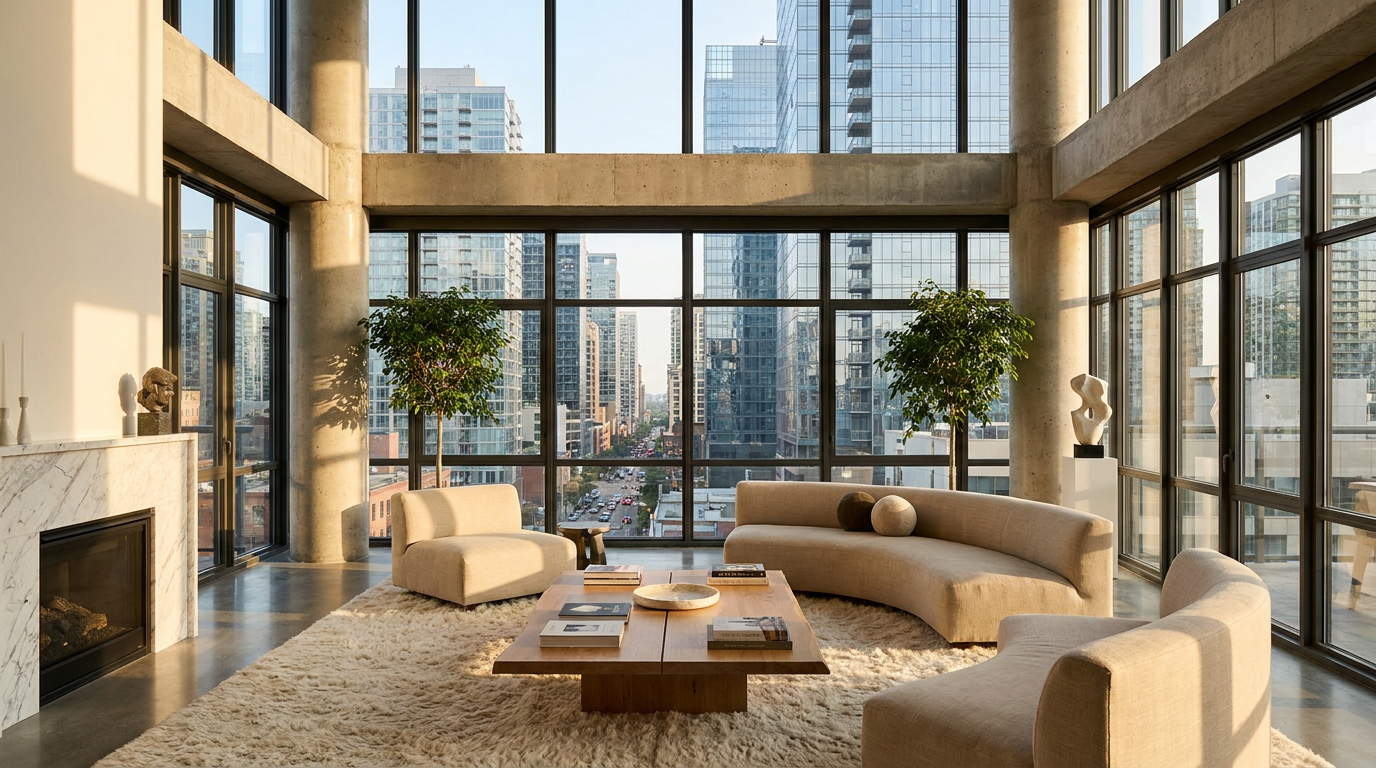
When a building does meet the criteria, the results can be spectacular, often yielding architectural features that ground-up residential developers could never afford to build. A Class C office building might feel oppressive with an eight-foot drop ceiling hiding massive air ducts and wiring trays. But once those commercial systems are stripped away, developers frequently uncover 11-to-12-foot clear heights and rugged concrete pillars. These industrial remnants are highly prized in the luxury multifamily market, allowing developers to market the units as premium loft spaces. Furthermore, because the core structure is already in place, conversion projects can be completed up to 50 percent faster than equivalent ground-up construction.[2]
A Class C office building might feel oppressive with an eight-foot drop ceiling hiding massive air ducts and wiring trays.
Despite the architectural promise, the financial mathematics of adaptive reuse remain daunting. The cost of retrofitting an office building can range wildly from $100 to over $500 per square foot, depending on the extent of the structural interventions required. Developers must purchase the vacant building, gut the interior, core through thick concrete floors to run new plumbing stacks, and often replace the entire exterior glass facade to install operable windows. A recent analysis by the Brookings Institution highlighted a persistent 'feasibility gap'—the chasm between the high cost of executing these complex renovations and the market value of the resulting apartments. Without intervention, many of these projects simply cannot secure traditional financing.[3][4]

Recognizing that the free market alone cannot absorb the glut of empty offices, local and state governments have aggressively stepped in to bridge the financial divide. Cities are utilizing a combination of tax abatements, zoning reforms, and direct subsidies to incentivize developers. In New York City, the newly minted 467-m tax incentive provides up to a 35-year property tax exemption for conversion projects that set aside at least 25 percent of their units as affordable housing. Meanwhile, Chicago has deployed hundreds of millions in Tax Increment Financing (TIF) to revitalize its historic LaSalle Street corridor, aiming to convert millions of square feet of historic commercial space into mixed-income neighborhoods.[5][6]
Beyond the immediate financial and housing benefits, adaptive reuse represents a massive victory for environmental sustainability. The construction and real estate sectors are notoriously carbon-intensive, with the production of steel and concrete accounting for a significant portion of global greenhouse gas emissions. Demolishing a 40-story office tower and building a new residential high-rise in its place releases thousands of tons of 'embodied carbon' into the atmosphere. By preserving the existing superstructure and foundation, conversion projects dramatically reduce the environmental footprint of creating new housing, aligning urban growth with aggressive municipal climate targets.[2][4]
The regulatory landscape is also shifting to accommodate this new reality. Historically, urban zoning codes strictly separated commercial and residential uses, a relic of the industrial era designed to keep noxious factories away from homes. Today, those rigid delineations are actively hindering downtown recovery. Progressive cities like Los Angeles and Alexandria, Virginia, have implemented sweeping adaptive reuse ordinances that bypass lengthy rezoning processes, grant density bonuses, and relax outdated parking requirements for developers willing to repurpose commercial spaces. These legislative changes are effectively rewriting the DNA of the city, legally permitting the blending of work, life, and leisure.[3][5]

While the surge in conversions is undeniably positive, industry experts caution against viewing it as a panacea for the broader housing crisis. Even if every viable office building in Manhattan were converted tomorrow, it would only yield a fraction of the hundreds of thousands of units required to stabilize the city's housing market. Furthermore, the 70 to 75 percent of office buildings that fail the algorithmic suitability tests will eventually face a harsh reckoning. Owners of these deeply obsolete properties may be forced to accept massive financial losses, ultimately leading to a wave of strategic demolitions to clear the land for entirely new uses.[1][2]
Nevertheless, the successful projects currently coming online offer a compelling blueprint for the future of the American city. The transition from a monoculture of 9-to-5 office blocks to vibrant, mixed-use, 24/7 neighborhoods fundamentally alters the urban experience. Ground-floor lobbies that once featured austere security desks are being transformed into bustling cafes, grocery stores, and community amenities. As more residents move into these formerly corporate spaces, they provide a vital, continuous customer base for local businesses that previously relied exclusively on the lunchtime rush of office workers.[3][4]
Ultimately, the great office-to-residential pivot of the 2020s will be remembered as a masterclass in urban resilience. Faced with the sudden obsolescence of its primary economic engine, the commercial real estate industry did not collapse; it adapted. By leveraging advanced data analytics, forging unprecedented public-private financial partnerships, and embracing the inherent sustainability of recycling massive structures, cities are slowly curing the hangover of the remote work revolution. The buildings that once symbolized the rigid corporate hierarchy of the 20th century are now providing the flexible, sustainable housing required for the 21st.[6][7]

How we got here
March 2020
The COVID-19 pandemic triggers a mass exodus from downtown commercial centers, normalizing remote work.
Late 2022
Office vacancy rates begin to stabilize at historically high levels, prompting developers to seriously evaluate stranded assets.
2024
Major municipalities, including New York and Los Angeles, pass aggressive zoning reforms and tax incentives to spur adaptive reuse.
Mid 2025
For the first time, the volume of U.S. office space slated for conversion or demolition surpasses new construction.
Viewpoints in depth
Urban Planners & Municipalities
Focuses on revitalizing downtowns, stabilizing tax revenues, and solving the housing shortage through zoning reform.
For city officials, the empty office crisis represents an existential threat to municipal budgets. Commercial property taxes fund essential services, and a collapse in office valuations creates a massive fiscal deficit. Planners view adaptive reuse not just as a real estate transaction, but as a vital civic intervention. By rewriting outdated zoning codes and offering tax abatements, they hope to engineer a transition from sterile, 9-to-5 business districts into vibrant, 24-hour neighborhoods that generate diverse economic activity.
Commercial Real Estate Developers
Evaluates the structural feasibility, construction costs, and financial incentives required to make adaptive reuse profitable.
Developers approach conversions through a strictly mathematical lens. They rely on advanced algorithms to filter out the 75 percent of buildings that are structurally incompatible with residential layouts. For the remaining viable candidates, the focus shifts to the 'feasibility gap'—the reality that gut-renovating a skyscraper often costs as much as building from scratch. Consequently, developers argue that without significant public subsidies, tax credits, and expedited permitting, the financial risk of these mega-projects remains too high for private capital to bear alone.
Sustainability Advocates
Champions adaptive reuse as a critical strategy to reduce embodied carbon and prevent demolition waste.
Environmental groups see the office vacancy crisis as a unique opportunity to decarbonize the real estate sector. The greenest building is the one that already exists; demolishing a high-rise releases thousands of tons of embodied carbon and fills landfills with concrete and steel. By preserving the superstructure and foundation, adaptive reuse projects drastically lower the carbon footprint of creating new housing. Advocates push for policies that penalize demolition and reward developers who upcycle existing architectural assets.
What we don't know
- What will ultimately happen to the 75 percent of office buildings that are structurally incapable of being converted.
- Whether the influx of new downtown residents will be enough to replace the economic footprint of lost daily office workers.
- How long municipal governments can afford to subsidize these conversions before the tax abatements strain city budgets.
Key terms
- Adaptive Reuse
- The process of repurposing an existing building for a use other than what it was originally designed for.
- Floor Plate
- The total leasable square footage of a single floor in a commercial building, which dictates how much natural light reaches the interior.
- Embodied Carbon
- The total greenhouse gas emissions generated by the manufacturing, transportation, and assembly of building materials.
- Feasibility Gap
- The financial shortfall between the high cost of converting a building and the market value of the finished residential units.
Frequently asked
Why can't every empty office become housing?
Only about 25 percent of office buildings have the right structural dimensions. Many modern towers have floor plates that are too deep, leaving interior spaces without access to natural light, which is legally required for bedrooms.
Is converting a building cheaper than building a new one?
Not always. While it saves the cost of pouring a new foundation and erecting a steel frame, the extensive interior demolition and plumbing retrofits can cost up to $500 per square foot, making it financially challenging without government subsidies.
Will this solve the housing crisis?
No. While conversions will add tens of thousands of new units to the market, the national housing shortage is measured in the millions. It is a helpful tool for downtown revitalization, but not a standalone cure.
Sources
Source coverage
7 outlets
3 viewpoints surfaced







[1]CBRECommercial Real Estate Developers
Office Conversions and Demolitions Will Exceed New Construction in 2025
Read on CBRE →[2]GenslerCommercial Real Estate Developers
What We've Learned by Assessing More Than 1,300 Potential Office-to-Residential Conversions
Read on Gensler →[3]Brookings InstitutionUrban Planners & Municipalities
Understanding office-to-residential conversion: A case study approach
Read on Brookings Institution →[4]Bipartisan Policy CenterUrban Planners & Municipalities
Converting Vacant Offices to Housing: Challenges and Opportunities
Read on Bipartisan Policy Center →[5]Commercial SearchCommercial Real Estate Developers
Top City Programs for Office-to-Residential Conversions
Read on Commercial Search →[6]J.P. MorganCommercial Real Estate Developers
What's driving office-to-residential conversion demand?
Read on J.P. Morgan →[7]Factlen Editorial TeamSustainability Advocates
Synthesis by Factlen editorial team
Read on Factlen Editorial Team →
Every angle. Every day.
Get real estate stories with full source coverage and perspective breakdowns delivered to your inbox.