
Lab-Grown vs. Mined Diamonds: The 2026 Data on Price, Value, and Environment
With lab-grown stones capturing a massive share of the jewelry market, the price gap between manufactured and mined diamonds has reached 90%. A side-by-side analysis reveals stark trade-offs in purchasing power, long-term resale value, and environmental impact.
By Factlen Editorial Team
- Value & Size Maximizers
- Prioritize budget efficiency and visual impact over traditional resale value.
- Legacy & Investment Buyers
- Value geological rarity, long-term wealth preservation, and traditional romance.
- Eco-Conscious Consumers
- Focus strictly on carbon footprint, land displacement, and renewable energy certification.
What's not represented
- · Diamond Miners in Developing Nations
- · Pawn Shops & Secondary Market Dealers
Why this matters
Choosing a diamond is often one of the largest discretionary purchases a person makes. Understanding the exact trade-offs between lab-grown and mined stones ensures buyers maximize their budget without falling for outdated marketing or hidden environmental costs.
Key points
- Lab-grown and natural diamonds are chemically and optically identical, scoring a perfect 10 on the Mohs hardness scale.
- A 1.50-carat lab-grown diamond costs roughly $500 to $1,200, compared to $8,000 to $12,000 for a natural equivalent.
- Natural diamonds retain 40 to 60 percent of their retail value, whereas lab-grown diamonds hold virtually no resale value due to infinite supply.
- Lab-grown diamonds eliminate land excavation but require massive electricity, making renewable-energy certification crucial for eco-conscious buyers.
The global diamond market has officially crossed a historic tipping point. By 2026, the laboratory-grown diamond sector has swelled to a valuation of nearly $34 billion, driven by a combination of technological mastery and shifting consumer values. This shift has transformed what was once a niche alternative into a dominant choice for millennial and Gen Z consumers entering the bridal and fine jewelry markets. Yet, the rise of the manufactured stone has not erased the appeal of the mined diamond; rather, it has split the market into two distinct philosophies of luxury. Today's consumers are forced to weigh immediate purchasing power against long-term geological rarity, making the decision less about finding a "fake" versus "real" stone, and more about aligning a major financial purchase with personal priorities.[4][7]
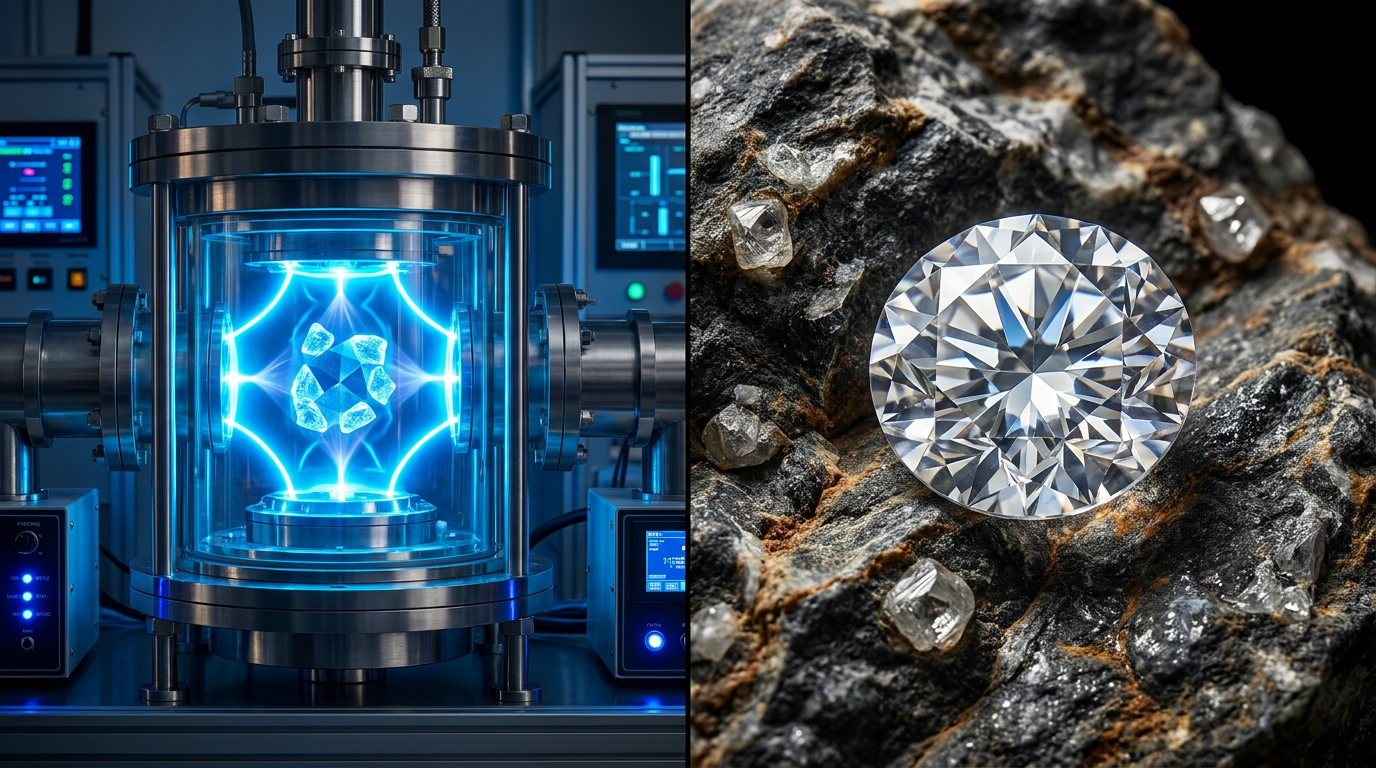
At the atomic level, the two contenders are indistinguishable. Both mined and lab-grown diamonds consist of pure carbon crystallized in an isometric cubic system, scoring a perfect 10 on the Mohs hardness scale. They share the exact same refractive index, fire, and brilliance. The sole difference lies in their origin story. Natural diamonds were forged billions of years ago deep within the Earth's mantle under crushing pressure and extreme heat, eventually carried to the surface by ancient volcanic eruptions. In contrast, modern laboratories replicate these exact conditions in a matter of weeks using High Pressure High Temperature (HPHT) or Chemical Vapor Deposition (CVD) reactors. Because they are chemically identical, traditional jeweler's loupes cannot tell them apart, and the Federal Trade Commission recognizes both as genuine diamonds.[1][8]
The most immediate argument for choosing a lab-grown diamond is the sheer maximization of purchasing power. By 2026, the price gap between the two origins has widened into a structural divide. A premium 1.50-carat lab-grown diamond with excellent cut and clarity can now be acquired for roughly $500 to $1,200. An equivalent natural diamond of the exact same visual quality commands anywhere from $8,000 to $12,000. This 80 to 90 percent price difference fundamentally alters the consumer experience. Buyers who opt for lab-grown stones routinely upgrade to significantly larger carat weights, higher clarity grades, or more elaborate custom settings that would have been entirely out of reach in the mined market. For those whose primary goal is visual impact and daily wearability, the laboratory route offers undeniable financial leverage.[2][3][6]

However, the argument against lab-grown diamonds centers entirely on long-term financial retention and the economics of infinite supply. Because laboratories can continuously produce new stones at scale, wholesale prices for lab-grown diamonds have plummeted by over 74 percent since 2020. Consequently, a lab-grown diamond holds virtually no resale value on the secondary market. Natural diamonds, by contrast, are bound by the absolute limits of global mining, which has fallen to multi-decade lows of roughly 100 million carats annually. This geological scarcity means that natural diamonds typically retain 40 to 60 percent of their retail value over time, with premium stones occasionally appreciating. For buyers who view fine jewelry as an heirloom asset or a store of value, the mined diamond remains the only viable candidate.[2][3]

However, the argument against lab-grown diamonds centers entirely on long-term financial retention and the economics of infinite supply.
The environmental evidence presents a complex trade-off that requires careful consumer scrutiny. The argument against natural diamonds highlights the severe ecological disruption of traditional mining, which permanently alters landscapes, displaces massive amounts of earth, and consumes up to 127 gallons of water per carat. Mining operations also rely heavily on diesel-powered machinery, consuming roughly 500 kWh of energy per carat extracted. Lab-grown diamonds eliminate land excavation entirely, preserving local biodiversity and marine life. However, replicating the Earth's mantle requires colossal amounts of electricity. If a laboratory relies on a standard fossil-fuel grid, creating a single carat can still consume over 250 kWh of energy, making it a highly energy-intensive process despite the lack of physical mining.[5]
To resolve this environmental paradox, the industry has introduced rigorous new standards that track the exact energy mix used in diamond production. The most advanced laboratories, particularly those operating in regions with abundant renewable infrastructure, now run entirely on solar and wind power. These certified eco-friendly lab diamonds boast a net-zero carbon footprint, offering a genuinely sustainable alternative. Consumers prioritizing the environment must therefore look beyond the generic "lab-grown" label and demand evidence of renewable energy usage or traceable origins. The manufacturing method and the power grid it relies on ultimately dictate whether the manufactured stone is a climate savior or simply a different kind of industrial polluter.[5]

As the market bifurcates, identification and certification have become paramount to consumer trust. The Gemological Institute of America (GIA) and other leading authorities now issue distinct grading reports for both origins to ensure absolute transparency. To separate the two, gemologists rely on advanced spectroscopic technology, such as the GIA iD100 screening device. These machines analyze the stone's growth morphology and detect the presence of nitrogen—a trace element commonly trapped inside natural diamonds during their billion-year gestation, but entirely absent in the sterile environment of a CVD reactor. This microscopic evidence ensures that buyers can verify exactly which legacy they are purchasing at the retail counter.[1][8]
Ultimately, navigating the 2026 diamond market requires matching the stone's profile to the buyer's specific conditions. The lab-grown diamond fits perfectly when the consumer prioritizes maximum carat size, flawless clarity, and upfront budget efficiency. It is the ideal choice for modern bridal jewelry, travel rings, and fashion pieces where the visual aesthetic is the primary goal and resale value is irrelevant. Conversely, the natural diamond fits perfectly when the purchase is intended as a generational heirloom, a milestone marker of rarity, or a long-term store of value. By stripping away the marketing noise and focusing on these quantifiable trade-offs, consumers can confidently select the diamond that aligns with both their financial reality and their personal philosophy.[3][6]
How we got here
1954
General Electric successfully creates the first commercially viable synthetic diamonds using the HPHT method.
2018
The Federal Trade Commission removes the word 'natural' from its definition of a diamond, officially recognizing lab-grown stones.
2020
Wholesale prices for lab-grown diamonds begin a steep multi-year decline as global production capacity surges.
2026
The global lab-grown diamond market reaches a valuation of nearly $34 billion, dominating the bridal jewelry sector.
Viewpoints in depth
Value & Size Maximizers
Prioritize budget efficiency, visual impact, and ethical certainty over traditional resale value.
For this camp, a diamond is a beautiful piece of wearable art, not a financial asset. They argue that paying an 800% premium for a stone that looks identical to the naked eye is an outdated flex. By choosing lab-grown, they can afford significantly larger carat weights or higher clarity grades, redirecting the saved thousands toward a honeymoon, a house down payment, or other investments.
Legacy & Investment Buyers
Value geological rarity, long-term wealth preservation, and traditional romance.
This perspective views fine jewelry as a generational heirloom and a store of value. They point to the collapsing wholesale prices of lab-grown diamonds as evidence that manufactured stones are essentially consumer electronics that depreciate to zero. To them, the billion-year geological history and finite global supply of a natural diamond provide an intrinsic romance and financial stability that a factory-produced stone can never replicate.
Eco-Conscious Consumers
Focus strictly on carbon footprint, land displacement, and renewable energy certification.
For these buyers, the origin of the stone is secondary to its planetary impact. They reject mined diamonds due to the massive land displacement and water usage required for extraction. However, they are equally critical of lab-grown diamonds produced using fossil-fuel grids. This camp demands rigorous traceability and third-party certifications, such as SCS-007, ensuring their purchase is powered entirely by renewable energy like wind or solar.
What we don't know
- Where the absolute price floor for lab-grown diamonds will settle as manufacturing technology continues to scale globally.
- Whether the secondary resale market will eventually develop a standardized pricing tier for vintage or pre-owned lab-grown stones.
Key terms
- CVD (Chemical Vapor Deposition)
- A manufacturing process that grows diamonds by breaking down carbon-rich gases into atoms that crystallize on a diamond seed.
- HPHT (High Pressure High Temperature)
- A production method that mimics the extreme heat and pressure of the Earth's mantle to forge a diamond.
- Mohs Scale
- A scientific scale used to measure the hardness of minerals, on which diamonds score a perfect 10.
- GIA iD100
- An advanced spectroscopic screening device used by gemologists to distinguish natural diamonds from lab-grown stones.
Frequently asked
Can a jeweler tell if a diamond is lab-grown just by looking at it?
No. Because they are chemically and optically identical, traditional jeweler's loupes cannot tell them apart. Gemologists must use advanced spectroscopic machines to detect growth patterns and trace elements.
Do lab-grown diamonds get cloudy over time?
No. Lab-grown diamonds are pure crystallized carbon, exactly like natural diamonds. They will not fade, cloud, or change color over time.
Why is the resale value of lab-grown diamonds so low?
Resale value is driven by scarcity. Because laboratories can continuously manufacture new stones at scale, there is an infinite supply, which drives down secondary market prices.
Are lab-grown diamonds always better for the environment?
Not automatically. While they avoid the land destruction of mining, replicating the Earth's pressure requires massive electricity. They are only truly eco-friendly if the laboratory uses renewable energy.
Sources
Source coverage
8 outlets
3 viewpoints surfaced







[1]GIA
Is There a Difference Between Natural and Laboratory-Grown Diamonds?
Read on GIA →[2]OM JewelsLegacy & Investment Buyers
How Diamond Prices Have Changed in 2025–2026
Read on OM Jewels →[3]Shree Gems & JewelsValue & Size Maximizers
2026 Guide: Lab-Grown vs Natural Diamond Comparison
Read on Shree Gems & Jewels →[4]Fortune Business InsightsEco-Conscious Consumers
Lab Grown Diamond Market Size, Share, Trends 2034
Read on Fortune Business Insights →[5]QueensmithEco-Conscious Consumers
Are Lab Grown Diamonds More Ethical for the Environment?
Read on Queensmith →[6]StoneBridge JewelryValue & Size Maximizers
Lab Grown vs Mined Diamonds Price Comparison
Read on StoneBridge Jewelry →[7]Straits Research
Lab Grown Diamond Market Size, Share, Growth, Report, 2034
Read on Straits Research →[8]Diamond MansionLegacy & Investment Buyers
Lab Grown Diamonds vs Natural: 6 Differences Between Them
Read on Diamond Mansion →
Every angle. Every day.
Get shopping stories with full source coverage and perspective breakdowns delivered to your inbox.