
How SpaceX Executed the $75 Billion Mega-IPO That Rewrote Wall Street's Rules
By raising a record-shattering $75 billion and allocating an unprecedented share to everyday buyers, SpaceX's public debut has fundamentally altered how mega-cap companies enter the stock market.
By Factlen Editorial Team
- Retail Investors
- Everyday buyers view the massive retail allocation as a long-overdue democratization of wealth creation.
- Institutional Underwriters
- Wall Street banks emphasize the necessity of stabilization mechanisms like the greenshoe option for deals of this magnitude.
- Space Economy Analysts
- Industry experts justify the historic valuation by pointing to Starlink's recurring revenue and future orbital infrastructure.
What's not represented
- · Traditional value investors concerned by the 94x revenue multiple
- · Competitors in the aerospace sector facing a newly capitalized giant
Why this matters
Understanding the mechanics of the SpaceX IPO demystifies how Wall Street allocates wealth, offering retail investors a blueprint for how future mega-listings from AI and tech giants will likely operate.
Key points
- SpaceX completed the largest IPO in history, raising $75 billion and achieving a $1.77 trillion valuation.
- The company bypassed Wall Street norms by allocating 30% of shares directly to retail investors.
- Shares popped 19% on the first day of trading, creating unprecedented dollar-value wealth for early buyers.
- Underwriters utilized a $11.25 billion greenshoe option to ensure price stability for the massive listing.
- The valuation is heavily driven by Starlink's recurring revenue and future plans for orbital AI data centers.
The initial public offering of Space Exploration Technologies Corp.—better known as SpaceX—has officially shattered every record in global financial history. By raising $75 billion in a single day, the aerospace manufacturer did more than just secure capital for its Mars ambitions; it fundamentally rewired the relationship between Silicon Valley and Wall Street.[1][2]
To understand the sheer scale of the SpaceX debut, one must look at the previous titleholders. For nearly seven years, the record belonged to the Saudi Arabian state oil giant, Saudi Aramco, which raised $29.4 billion in 2019. Before that, the Chinese e-commerce behemoth Alibaba held the crown with a $25 billion raise in 2014. SpaceX’s offering is nearly three times the size of Aramco’s, instantly valuing the company at $1.77 trillion.[4]

But the size of the check is only half the story. The true disruption lies in how the company chose to distribute its shares. Historically, the IPO process has been an exclusive club. Investment banks, acting as underwriters, typically allocate the vast majority of new shares to institutional clients—hedge funds, pension funds, and high-net-worth individuals.[3]
Retail investors are usually left to buy shares on the open market after the stock has already experienced its initial pop in price. SpaceX, however, bucked this Wall Street norm entirely. The company set aside an unprecedented 30% of its offering specifically for retail buyers, allowing everyday investors to purchase shares at the ground-floor price of $135.[1][6]
This democratization of access resulted in retail orders topping $100 billion. The move effectively bypassed the traditional price discovery phase, where bankers spend weeks on a roadshow negotiating the share price with institutional titans. Instead, SpaceX simply announced its price, confident that retail demand would fill any gaps left by skeptical institutions.[1][6]

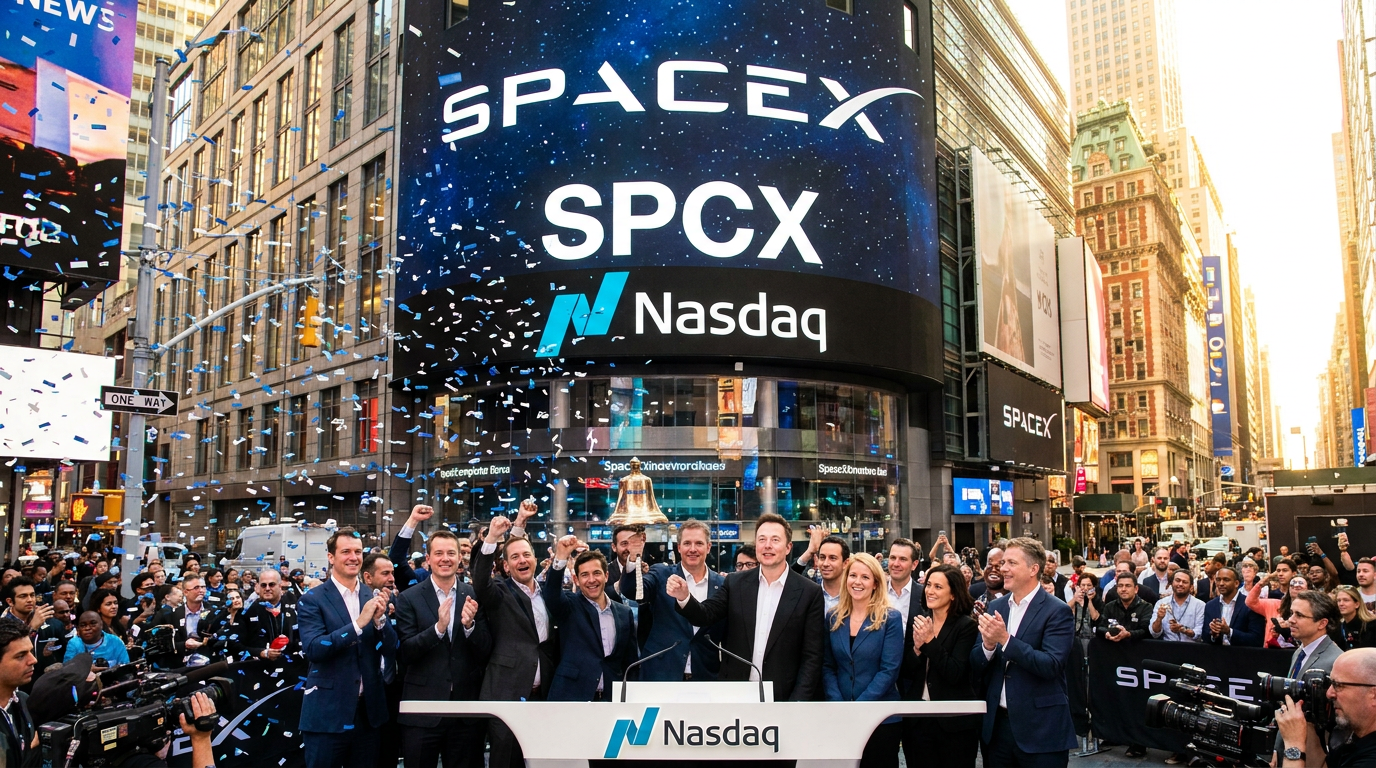
The strategy paid off immediately. When the opening bell rang at the Nasdaq, shares of SPCX opened at $150 and eventually closed at $160.95—a 19% gain from the offering price. At its intraday peak, the stock surged nearly 31%.[2]
Financial academics note that while a 19% pop is not the massive percentage jump seen in smaller tech listings, the absolute dollar value of the return is staggering. Because of the deal's immense size, the first day of trading generated more sheer dollar-value wealth for early buyers than any IPO in history.[5]
Financial academics note that while a 19% pop is not the massive percentage jump seen in smaller tech listings, the absolute dollar value of the return is staggering.
This wealth creation extends deeply into the company's own ranks. Long-term SpaceX employees, particularly those concentrated around the company's Starbase facility in Texas, saw their paper wealth explode. Market analysts estimate that the employee equity unlocked by the IPO is enough to fundamentally alter local real estate markets.[1]
Managing an offering of this magnitude requires complex financial engineering, primarily through a mechanism known as the greenshoe option. Officially termed an overallotment option, this SEC-regulated tool allows underwriters to sell up to 15% more shares than originally planned if investor demand exceeds expectations.[3][6]
In the case of SpaceX, the greenshoe option represents an additional $11.25 billion in potential capital. If the stock price begins to fall in the days following the IPO, the underwriters can buy back these extra shares on the open market, reducing supply and stabilizing the price. If the stock continues to soar, the underwriters simply purchase the extra shares directly from SpaceX at the IPO price to cover their short position.[3][6]

This stabilization mechanism is crucial for a company valued at $1.77 trillion, a figure that places SpaceX in the rarefied air of tech giants like Apple, Microsoft, and Nvidia. Justifying this valuation requires looking beyond the rockets that launch from Cape Canaveral.[2][4]
While the Falcon 9 and Starship programs capture the public imagination, Wall Street's appetite is largely driven by Starlink. The company's satellite internet constellation is already generating massive recurring revenue, effectively acting as a global telecommunications utility. Furthermore, SpaceX's plans to deploy solar-powered data centers in orbit position the company as a critical infrastructure play for the artificial intelligence boom.[2][6]
However, the unprecedented valuation is not without its skeptics. Traditional value investors point out that pricing a company at nearly 94 times its projected revenue is highly speculative, especially for a firm that continues to post multi-billion-dollar annual net losses due to heavy capital expenditures.[5][6]
Despite these concerns, the successful execution of the SpaceX IPO has injected massive optimism into the broader financial ecosystem. Investment banks are anticipating a surge in trading income, and the market is already looking ahead to the next wave of mega-listings from AI leaders.[1][2][4]

Ultimately, the SpaceX offering serves as a masterclass in modern capital markets. By leveraging immense public enthusiasm, dictating terms to Wall Street, and utilizing regulatory tools like the greenshoe option to ensure stability, the company has rewritten the playbook for how the world's most valuable enterprises transition to the public sphere.[6]
How we got here
December 2019
Saudi Aramco sets the previous global IPO record by raising $29.4 billion.
December 2025
SpaceX conducts a private tender offer valuing the company at roughly $800 billion.
May 2026
The SEC publicly discloses SpaceX's S-1 filing, revealing plans for a massive public listing.
June 11, 2026
SpaceX officially prices its shares at $135, finalizing the $75 billion raise.
June 12, 2026
SpaceX begins trading on the Nasdaq under the ticker SPCX, closing up 19% on its first day.
Viewpoints in depth
Retail Investors
Everyday buyers view the massive retail allocation as a long-overdue democratization of wealth creation.
Historically, retail investors have been locked out of the best IPO pricing, forced to buy shares on the open market only after institutional investors have already driven up the price during the initial 'pop.' SpaceX's decision to allocate 30% of its offering to retail buyers proves that highly sought-after companies can bypass investment bank gatekeepers and sell directly to their supporters, fundamentally shifting the balance of power on Wall Street.
Institutional Underwriters
Wall Street banks emphasize the necessity of stabilization mechanisms like the greenshoe option for deals of this magnitude.
While retail demand is high, institutions argue that a $1.77 trillion valuation requires the safety net of overallotment options to prevent catastrophic volatility in the early days of trading. By holding a 15% greenshoe option, underwriters can actively manage the supply of shares in the open market, ensuring that the sheer size of the SpaceX listing does not overwhelm the Nasdaq's liquidity.
Space Economy Analysts
Industry experts justify the historic valuation by pointing to Starlink's recurring revenue and future orbital infrastructure.
Analysts argue that SpaceX is not just a rocket company, but a global telecommunications utility and future AI data-center provider. They view the $135 share price as a fair premium for a company with a near-monopoly on heavy lift capabilities and satellite internet, suggesting that the capital raised will cement SpaceX's dominance in the commercialization of low Earth orbit for decades to come.
What we don't know
- Whether the retail-heavy allocation will lead to higher long-term volatility compared to institutionally dominated stocks.
- How quickly SpaceX can deploy its planned orbital AI data centers to justify the $1.77 trillion valuation.
- If other mega-cap private companies like OpenAI will adopt SpaceX's strategy of bypassing traditional price discovery.
Key terms
- Initial Public Offering (IPO)
- The first time a private company offers its shares to the general public to raise capital.
- Greenshoe Option
- A provision that allows underwriters to sell up to 15% more shares than originally planned to stabilize the stock price.
- Price Discovery
- The traditional Wall Street process of determining a stock's IPO price by gauging institutional investor demand during a roadshow.
- Retail Allocation
- The percentage of IPO shares reserved for individual, non-professional investors rather than large institutions.
Frequently asked
How much did SpaceX raise in its IPO?
SpaceX raised a record-breaking $75 billion by selling 555.6 million shares at $135 each.
Did retail investors get access to the SpaceX IPO?
Yes, SpaceX allocated an unusually high 30% of its shares to retail investors, bypassing the traditional institutional monopoly.
What is SpaceX's total valuation?
At the IPO price, SpaceX was valued at approximately $1.77 trillion, making it one of the most valuable companies in the world.
What is a greenshoe option?
It is a regulatory mechanism that allows underwriters to sell up to 15% more shares than originally planned to help stabilize the stock's price during early trading.
Sources
Source coverage
6 outlets
3 viewpoints surfaced






[1]MarketWatchRetail Investors
How Elon Musk nailed the SpaceX IPO: ‘I’m not sure that this could have gone much better’
Read on MarketWatch →[2]CBS NewsSpace Economy Analysts
SpaceX stock soars 19% on first day of trading following record-breaking $75 billion IPO
Read on CBS News →[3]SEC.govInstitutional Underwriters
Investor Bulletin: Investing in an IPO
Read on SEC.gov →[4]Renaissance CapitalSpace Economy Analysts
From Saudi Aramco to Alibaba: World's biggest IPOs
Read on Renaissance Capital →[5]University of FloridaInstitutional Underwriters
Initial Public Offerings: Updated Statistics
Read on University of Florida →[6]Factlen Editorial Team
Synthesis by Factlen editorial team
Read on Factlen Editorial Team →
Every angle. Every day.
Get finance stories with full source coverage and perspective breakdowns delivered to your inbox.