
The Impact of Zoning Reforms on Housing Costs: What the Data Actually Shows
A critical mass of data from cities like Austin and Auckland reveals that legalizing 'missing middle' housing significantly boosts supply and lowers rents, though it is not a cure-all for the lowest-income earners.
By Factlen Editorial Team
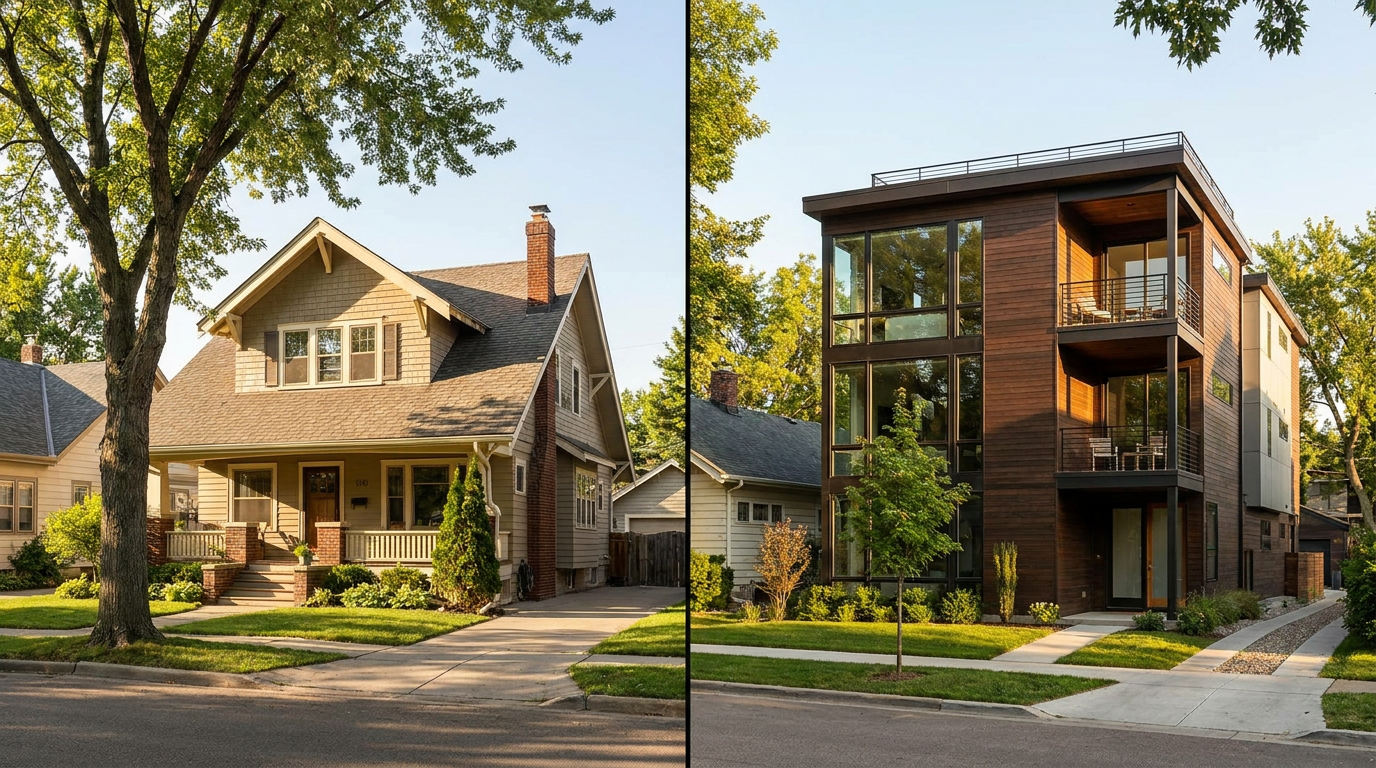
- Supply-Side Advocates
- Argue that restrictive zoning is the root cause of the housing crisis and that building more homes lowers costs.
- Anti-Displacement Advocates
- Warn that upzoning without tenant protections fuels gentrification and land speculation.
- Market Skeptics
- Highlight that rezoning increases land values, which can offset affordability gains if new housing isn't built quickly.
What's not represented
- · Long-term homeowners concerned about neighborhood character and infrastructure strain.
- · Environmental groups focused on the ecological impact of increased urban density.
Why this matters
As housing costs consume a record share of household income, zoning reform has emerged as the most hotly debated solution in local politics. Understanding whether 'upzoning' actually lowers rents—or just enriches developers—is crucial for voters deciding the future of their neighborhoods.
Key points
- Data from Austin and Auckland shows that eliminating restrictive zoning leads to massive surges in housing construction.
- This new supply successfully triggered rent declines, with Austin seeing an 11% drop in older apartment rents.
- The price drops are driven by 'filtering,' where new luxury builds absorb high-income renters, freeing up older stock.
- Critics warn that upzoning without affordability mandates can increase land speculation and displace vulnerable residents.
For decades, the American dream was synonymous with the single-family home, a vision cemented into law by restrictive zoning codes across North America and Oceania. But as housing shortages pushed rents and home prices to historic highs, a growing coalition of policymakers, economists, and urban planners began targeting those very laws.[1][8]
The proposed solution is "upzoning"—revising municipal codes to legalize "missing middle" housing like duplexes, townhomes, and small apartment buildings in neighborhoods previously reserved for single-family houses. The theory is straightforward: remove artificial caps on density, allow the private sector to build more units, and the resulting surge in supply will force prices down.[4]
Yet, as cities from Minneapolis to Auckland have implemented these sweeping reforms, the debate has shifted from theoretical models to hard data. Does upzoning actually deliver affordable housing, or does it merely enrich developers while gentrifying neighborhoods? By 2026, a critical mass of peer-reviewed research and municipal data has emerged to answer that question.[3][5]
The strongest evidence in the pack confirms the first half of the upzoning thesis: legalizing density reliably triggers a surge in housing construction. When Auckland, New Zealand, abolished single-family zoning across three-quarters of the city in 2016, the policy unlocked a massive wave of development.[2][3]

Researchers at the University of Auckland found that the city's Unitary Plan resulted in a 50 percent increase in building consents compared to what would have occurred under the old rules. The reform fundamentally altered the city's trajectory, proving that developers will readily build missing middle housing when regulatory barriers are removed.[3]
A similar story unfolded in Austin, Texas. Beginning in 2015, the city enacted a sustained package of supply-side reforms, including rezoning, reducing parking minimums, and streamlining the permitting process. The results were staggering: between 2015 and 2024, Austin added 120,000 new housing units.[2]
This represented a 30 percent increase in the city's housing stock, a growth rate more than three times the national average. In Canada, the Canada Mortgage and Housing Corporation reported in early 2026 that missing middle housing starts rose by 10 percent across major metropolitan areas, driven by cities like Calgary and Edmonton that embraced zoning flexibility.[2][4]
But the ultimate test of zoning reform is not just how many units are built, but whether those units actually reduce the cost of living. On this front, the evidence is largely positive, though highly dependent on the scale of the new supply.[1][5]
But the ultimate test of zoning reform is not just how many units are built, but whether those units actually reduce the cost of living.
In Austin, the massive influx of new apartments finally broke the fever of pandemic-era rent hikes. Rents in large apartment buildings fell by 7 percent from 2023 to 2024, the steepest decline of any major U.S. metropolitan area. Crucially, the relief was not limited to luxury units; rents in older, non-luxury buildings fell by roughly 11 percent.[2]

The Auckland data paints an even more dramatic picture of cost avoidance. While nominal prices in New Zealand remained high, researchers calculated that Auckland's upzoning reduced rents by 28 percent compared to the counterfactual scenario where the reforms had never passed.[3]
The mechanism driving these price drops is known as "filtering." When developers build new, expensive apartments, higher-income renters move into them, vacating older, more affordable units. A 2025 analysis by the Pew Charitable Trusts confirmed this dynamic nationally, finding that metros adding the most housing saw the steepest rent declines for apartments typically occupied by lower-income renters.[1][5]
However, the evidence pack also contains significant caveats, particularly regarding the short-term impacts of upzoning on land values. When a city rezones a single-family lot to allow a triplex, the land itself instantly becomes more valuable because of its increased development potential.[6]
A study of nineteen repeatedly upzoned areas in Brisbane, Australia, found that higher zoned capacity was robustly related to higher land prices, but did not automatically translate to cheaper housing if the new capacity went unbuilt. The researchers noted that only 2 percent of the newly zoned capacity was actually utilized in any five-year period, leading to a "redevelopment premium" that inflated property values without delivering the necessary supply shock.[6]
This dynamic fuels the primary critique from anti-displacement advocates: that upzoning can inadvertently accelerate gentrification. In Nashville, critics of the city's initial missing middle reforms argue that the policies encouraged investors to buy older, affordable homes, demolish them, and build expensive multi-unit properties.[5][7]

According to local analyses, this "upward filtering" process contributed to the loss of thousands of affordable units for low-income earners, replacing them with market-rate housing that existing residents could not afford. To these critics, market-rate supply is an insufficient tool for protecting vulnerable communities.[7]
Housing analysts increasingly acknowledge this limitation. While zoning reform is highly effective at lowering the median cost of housing across a metropolitan area, it cannot single-handedly house the lowest-income populations.[1][5]
The private sector cannot profitably build or operate housing for extremely low-income households because the rent those tenants can afford does not cover the hard costs of construction and maintenance. Therefore, researchers argue that zoning reform must be paired with targeted public investment, such as direct rental assistance and subsidized affordable housing bonds.[1][2]
Ultimately, the 2026 data consensus suggests that upzoning is a necessary, but not sufficient, condition for solving the housing crisis. Cities that refuse to build will inevitably see rents spiral, while those that embrace the missing middle can stabilize their markets and provide meaningful relief to the average renter.[1][8]
How we got here
2015
Austin, Texas begins enacting a sustained package of supply-side housing reforms, including rezoning and permitting streamlining.
2016
Auckland, New Zealand implements its Unitary Plan, abolishing single-family zoning across three-quarters of the city.
2024
Minneapolis eliminates single-family-only zoning citywide through its 2040 Plan, allowing triplexes on all residential lots.
Early 2026
Data confirms that cities with aggressive zoning reforms, like Austin and Auckland, experienced significant rent declines compared to restrictive markets.
Viewpoints in depth
Supply-Side Advocates
Argue that restrictive zoning is the root cause of the housing crisis and that building more homes lowers costs.
This camp, supported by extensive data from Auckland and Austin, argues that housing operates on the fundamental laws of supply and demand. By removing artificial regulatory caps like single-family zoning and parking minimums, the private sector can flood the market with new units. Even if these new units are market-rate or luxury, they trigger a 'filtering' effect: higher-income earners move into the new builds, freeing up older housing stock and relieving price pressure on lower-income renters.
Anti-Displacement Advocates
Warn that upzoning without tenant protections fuels gentrification and land speculation.
Critics of blanket upzoning point out that rezoning a neighborhood instantly increases the speculative value of the land. In hot real estate markets, this can incentivize investors to purchase older, naturally affordable homes, demolish them, and build expensive multi-unit properties. Without explicit affordability mandates or public subsidies, this 'upward filtering' can displace existing working-class residents and result in a net loss of affordable units, even as the overall housing supply increases.
What we don't know
- Whether the rent declines seen in Austin and Auckland will be sustained over the next decade as population growth continues.
- How much of the 'redevelopment premium' on land values is permanently baked into neighborhood prices versus being a temporary speculative bubble.
Key terms
- Upzoning
- The process of changing local zoning codes to allow for higher-density development, such as legalizing multi-family housing on lots previously restricted to single-family homes.
- Filtering
- The economic process by which older housing becomes relatively more affordable as higher-income residents move into newly constructed homes.
- By-right development
- A streamlined permitting process where a proposed building is automatically approved if it meets existing zoning codes, without requiring special hearings or variances.
- Counterfactual
- A baseline estimate used by researchers to model what would have happened to prices or supply if a specific policy, like zoning reform, had never been implemented.
Frequently asked
What is 'missing middle' housing?
Missing middle housing refers to multi-unit structures like duplexes, triplexes, townhomes, and low-rise apartment buildings. They are denser than single-family homes but smaller than large high-rises, allowing them to blend into existing residential neighborhoods.
Does building luxury apartments help lower-income renters?
Evidence suggests it does through a process called 'filtering.' When higher-income earners move into newly built luxury units, they vacate older apartments, reducing competition and price pressure on the existing housing stock.
Why do some studies show upzoning increases property prices?
Upzoning increases the development potential of a lot, which instantly raises the underlying land value. If developers do not build enough new supply to offset this 'redevelopment premium,' overall neighborhood prices can temporarily rise.
Sources
Source coverage
8 outlets
3 viewpoints surfaced








[1]Pew Charitable TrustsSupply-Side Advocates
Homeowners, Renters, and Households of All Incomes Back Housing Reforms
Read on Pew Charitable Trusts →[2]Economic Security ProjectSupply-Side Advocates
Housing Supply and the Impact of Zoning Reforms
Read on Economic Security Project →[3]University of AucklandSupply-Side Advocates
Can zoning reform reduce housing costs? Evidence from rents in Auckland
Read on University of Auckland →[4]Canada Mortgage and Housing CorporationSupply-Side Advocates
Missing middle housing continues to expand its footprint in 2025
Read on Canada Mortgage and Housing Corporation →[5]Davis VanguardAnti-Displacement Advocates
Debate over Zoning Reform and Housing Affordability
Read on Davis Vanguard →[6]Urban Policy and ResearchMarket Skeptics
We Zoned for Density and Got Higher House Prices: Supply and Price Effects of Upzoning
Read on Urban Policy and Research →[7]Substack (Local Housing Commentary)Anti-Displacement Advocates
The Missing Middle Swindle: How Nashville Lost 27,000 Affordable Homes
Read on Substack (Local Housing Commentary) →[8]Factlen Editorial TeamMarket Skeptics
Synthesis by Factlen editorial team
Read on Factlen Editorial Team →
Every angle. Every day.
Get real estate stories with full source coverage and perspective breakdowns delivered to your inbox.