
The Evidence Is In: 'Missing Middle' Zoning Reforms Successfully Lower Rent Growth
Years of data from pioneering cities like Auckland and Minneapolis reveal that legalizing duplexes and small apartment buildings reliably increases housing supply and significantly moderates rent prices.
By Factlen Editorial Team
- Zoning Reform Advocates
- Urban planners and economists who argue that restrictive zoning artificially limits supply, driving up housing costs and exacerbating inequality.
- Affordable Housing Advocates
- Groups that support upzoning but emphasize it must be paired with direct subsidies, as the private market will not build for the lowest-income earners.
- Neighborhood Preservationists
- Residents who oppose upzoning due to concerns over neighborhood character, infrastructure strain, and the belief that new development only benefits wealthy developers.
What's not represented
- · Local municipal politicians facing voter backlash
- · Construction industry labor unions
Why this matters
For decades, the housing affordability crisis has felt intractable, locking younger generations out of homeownership and driving up homelessness. The empirical proof that zoning reform works offers a scalable, proven blueprint for cities to finally reverse the housing shortage.
Key points
- Exclusionary zoning laws have historically banned duplexes and small apartments in most residential neighborhoods.
- Auckland's 2016 upzoning led to 22,000 new homes that wouldn't have otherwise been built.
- Rents for family homes in Auckland are 26% to 33% lower than they would have been without reform.
- Minneapolis saw rent growth flatten to 1% over five years after eliminating single-family-only zoning.
- Upzoning reduces the 'zoning tax' by allowing the high cost of land to be split among multiple households.
- While upzoning moderates median rents, subsidies are still required to house the lowest-income populations.
For decades, the American housing market has been defined by a growing affordability crisis, driven by a severe shortage of available homes. At the heart of this shortage is a century-old regulatory framework: exclusionary zoning laws that mandate single-family homes on large lots, effectively banning duplexes, triplexes, and small apartment buildings in most residential neighborhoods.[1]
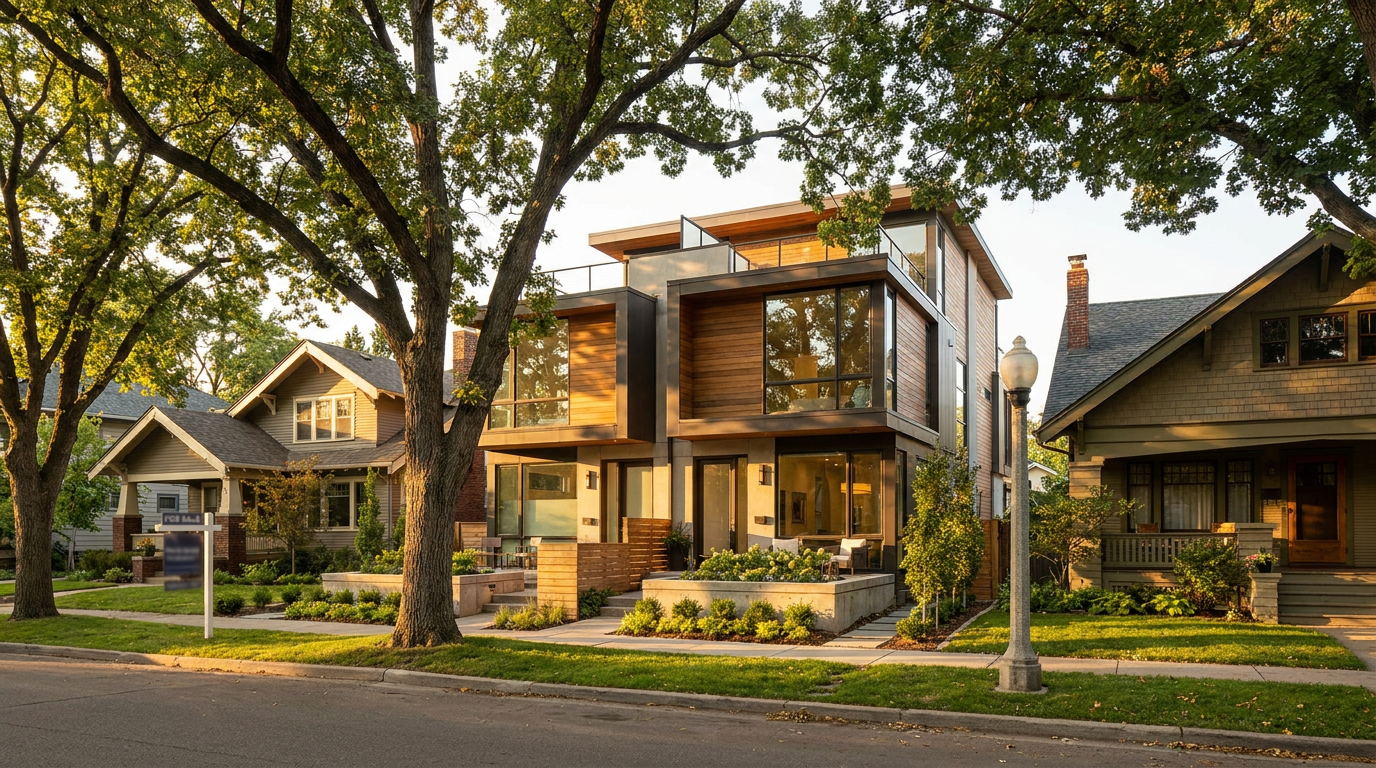
This banned category of housing is often called the "missing middle." It represents the scale of housing that bridges the gap between detached single-family homes and mid-rise apartment complexes, offering naturally more affordable options that fit seamlessly into existing communities.[1]
Until recently, the argument that legalizing missing middle housing would lower rents was largely theoretical, debated fiercely in city halls between pro-housing advocates and neighborhood preservationists. But as pioneering cities reach the five- and eight-year marks of their zoning reforms, the debate is shifting from economic theory to hard empirical evidence.[1]

The data is now arriving from major policy experiments in cities like Auckland, New Zealand, and Minneapolis, Minnesota. The consensus emerging from peer-reviewed economic studies and agency reports is clear: broad upzoning reliably increases housing supply and significantly moderates rent growth.[2][4]
Claim 1: Broad upzoning directly triggers a surge in housing construction. The most robust evidence comes from Auckland, which implemented its Unitary Plan in 2016, upzoning approximately three-quarters of its residential land to allow medium- and high-density housing.[2][6]
Research from the University of Auckland demonstrates that this policy shift was the direct catalyst for a historic building boom. Between 2016 and 2021, the city consented 22,000 new homes that would not have been built under the old zoning rules. This represented a 50% increase in permitted dwellings compared to the counterfactual scenario, proving that developers will rapidly build missing middle housing when legally permitted.[2][6]
Minneapolis saw a similar, albeit smaller-scale, supply response after its 2040 Plan took effect, which eliminated single-family-only zoning citywide and reduced parking mandates. From 2017 to 2022, Minneapolis increased its total housing stock by 12%, vastly outpacing the 4% growth seen in the rest of Minnesota.[3][7]
Claim 2: Increased supply from upzoning substantially slows rent growth. The central promise of zoning reform is affordability, and the empirical data strongly supports this mechanism. In Minneapolis, the 12% expansion in housing supply was accompanied by a remarkably flat rental market.[3]

According to data analyzed by The Pew Charitable Trusts, rents in Minneapolis grew by just 1% between 2017 and 2022. During that exact same period, rents in the rest of Minnesota surged by 14%. By building enough housing to meet demand, Minneapolis effectively decoupled its rental market from the statewide inflation trend, saving the average renter an estimated $1,700 annually.[3]
According to data analyzed by The Pew Charitable Trusts, rents in Minneapolis grew by just 1% between 2017 and 2022.
The Auckland data provides even more rigorous causal proof. Using a "synthetic control" method—a statistical technique that compares Auckland to a weighted average of similar cities that did not upzone—economists found profound price effects.[2]
Six years after the reforms, rents for three-bedroom family homes in Auckland were 26% to 33% lower than they would have been in the absence of upzoning. While absolute rents did not plummet to zero, the reform successfully bent the cost curve downward, preventing the severe price spikes experienced by other New Zealand cities.[2][6]

Claim 3: The mechanism works by reducing the "zoning tax" on land. Economic analyses, including working papers from the National Bureau of Economic Research (NBER), indicate that in high-cost areas, the physical cost of construction is not the primary driver of home prices.[5]
Instead, the premium is driven by the artificial scarcity of buildable land created by regulation—a phenomenon economists call the "zoning tax." By allowing multiple units on a single lot, missing middle reforms distribute the high cost of land across several households, making the final units inherently more affordable than a single luxury home on the same parcel.[1][5]
Uncertainty and Limitations: Upzoning is necessary but not sufficient for extreme low-income affordability. While the evidence is strong that zoning reform moderates median rents, researchers caution against viewing it as a standalone cure for all housing woes.[3]
Affordable housing advocates note that the private market, even when deregulated, cannot profitably build new units for households earning below the poverty line. Upzoning must be paired with direct subsidies, housing vouchers, or public housing investments to reach the most vulnerable populations and meaningfully reduce severe homelessness.[3]
Furthermore, the speed of the price effect depends heavily on the macroeconomic environment. High interest rates and elevated construction material costs can temporarily suppress the building booms that upzoning is designed to unleash, delaying the affordability benefits.[4]
Claim 4: Zoning reform enjoys broad, cross-coalition public support. Despite the loud opposition often seen at local city council meetings, national polling reveals a quiet consensus in favor of building more homes.[3]

A comprehensive survey by Pew found that 86% of Americans support expediting building permits, and 58% support allowing townhouses or small multifamily homes on any residential lot. Crucially, this support remains consistent across income levels, with majorities of both renters and homeowners backing pro-supply policies.[3]
How we got here
2016
Auckland implements the Unitary Plan, upzoning approximately 75% of its residential land to allow medium- and high-density housing.
2018
Minneapolis passes the 2040 Plan, becoming the first major U.S. city to eliminate single-family-only zoning citywide.
2021
Auckland experiences a historic surge in housing consents, directly attributed by economists to the 2016 zoning changes.
2023
Data reveals Minneapolis rent growth flattened to 1% over a five-year period, compared to 14% statewide.
2024
Multiple peer-reviewed economic studies confirm that upzoning in pilot cities successfully moderated housing costs relative to counterfactual scenarios.
Viewpoints in depth
Zoning Reform Advocates
Economists and urban planners who argue that housing markets obey the laws of supply and demand.
This camp points to the overwhelming empirical evidence from Auckland and Minneapolis as proof that restrictive zoning is the primary driver of the housing crisis. They argue that by artificially capping the number of homes that can be built on a plot of land, local governments create a scarcity that drives up prices and enriches existing landowners at the expense of renters and younger generations. Their solution is broad deregulation of land use to allow the private market to meet housing demand.
Affordable Housing Advocates
Groups that support upzoning but emphasize the need for direct government intervention for the lowest earners.
While generally supportive of eliminating exclusionary zoning, this perspective cautions that the private market will never profitably build housing for people living below the poverty line. They argue that while upzoning successfully moderates median rents and helps the middle class, it is insufficient on its own to solve severe homelessness. They advocate pairing zoning reform with robust public housing investments, rent subsidies, and tenant protections to ensure vulnerable populations are not left behind during redevelopment.
Neighborhood Preservationists
Residents and local groups concerned about the rapid transformation of their communities.
Often labeled 'NIMBYs' (Not In My Backyard) by critics, this camp argues that blanket upzoning destroys the character of historic single-family neighborhoods and places undue strain on local infrastructure like parking, schools, and sewer systems. They frequently express skepticism that developers will pass cost savings onto renters, arguing instead that upzoning simply increases land values and developer profits without delivering genuinely affordable units to the community.
What we don't know
- How quickly upzoning will lower rents in cities with less available construction labor or higher material costs.
- Whether the political will to pass zoning reform can survive the localized backlash from neighborhood preservation groups in other major cities.
- The exact threshold of new supply required to transition a city from merely slowing rent growth to actually reducing absolute rental prices.
Key terms
- Upzoning
- Changing local zoning codes to allow for higher-density land use, such as permitting duplexes in areas previously restricted to single-family homes.
- Synthetic Control Method
- A statistical technique used by economists to evaluate policy effects by comparing a treated area (like Auckland) to a weighted combination of untreated areas that mimic what would have happened without the policy.
- Zoning Tax
- The premium added to the cost of housing caused by artificial land scarcity resulting from strict land-use regulations.
- Filtering
- The economic process where aging housing stock gradually becomes more affordable as wealthier residents move into newly constructed homes.
Frequently asked
What is 'missing middle' housing?
It refers to multi-unit housing types like duplexes, triplexes, townhomes, and courtyard apartments that fall between detached single-family homes and large mid-rise apartment buildings.
Does upzoning mean single-family homes will be banned?
No. Upzoning simply legalizes other types of housing to be built on residential lots; it does not mandate the demolition of existing single-family homes or ban new ones from being built.
Why doesn't upzoning immediately make housing cheap?
Upzoning bends the cost curve over time by slowing rent growth relative to what it would have been. However, new construction takes years, and developers still face high costs for materials, labor, and financing.
Does building luxury apartments help lower-income renters?
Yes, through a process called 'filtering.' When higher-income earners move into new luxury units, they vacate older housing stock, which then becomes available and more affordable for middle- and lower-income renters.
Sources
Source coverage
7 outlets
3 viewpoints surfaced






[1]Factlen Editorial Team
Synthesis by Factlen editorial team
Read on Factlen Editorial Team →[2]University of AucklandZoning Reform Advocates
Can Zoning Reform Reduce Housing Costs? Evidence from Rents in Auckland
Read on University of Auckland →[3]The Pew Charitable TrustsAffordable Housing Advocates
More Flexible Zoning Helps Contain Rising Rents
Read on The Pew Charitable Trusts →[4]SSRNZoning Reform Advocates
Zoning Reforms and Housing Affordability: Evidence from the Minneapolis 2040 Plan
Read on SSRN →[5]National Bureau of Economic ResearchZoning Reform Advocates
The Impact of Zoning and Land Use Controls on Housing Costs
Read on National Bureau of Economic Research →[6]Auckland CouncilZoning Reform Advocates
Auckland upzoning sparks more homes and improved affordability
Read on Auckland Council →[7]The Century FoundationAffordable Housing Advocates
Minneapolis's Zoning Reforms Are Associated with Larger Increases in Housing Supply
Read on The Century Foundation →
Every angle. Every day.
Get real estate stories with full source coverage and perspective breakdowns delivered to your inbox.