
The Science of the Reverse Sear: Why Low-and-Slow Before High-Heat is the Ultimate Grilling Technique
By flipping the traditional order of cooking, the reverse sear method leverages thermodynamics and chemistry to eliminate overcooked gray bands and guarantee a perfect crust.
By Factlen Editorial Team
- Modern Culinary Practitioners
- Chefs and pitmasters who prioritize precision, consistency, and optimal texture.
- Food Science Academics
- Researchers who study the molecular and thermodynamic changes in meat during cooking.
- Culinary Educators
- Instructors focusing on teaching the fundamentals of flavor development and temperature control.
What's not represented
- · Vegetarian/Vegan Culinary Scientists
- · Commercial Steakhouse Operators
Why this matters
Understanding the chemistry of heat transfer and the Maillard reaction empowers home cooks to abandon outdated myths and consistently achieve restaurant-quality, edge-to-edge perfection on the grill.
Key points
- The reverse sear method cooks meat at a low temperature before finishing with a high-heat sear, eliminating the overcooked 'bullseye effect'.
- Gentle heating allows natural enzymes to tenderize the meat and prevents muscle fibers from violently constricting.
- The slow-roasting phase dehydrates the meat's surface, creating the perfect dry conditions for a rapid, flawless sear.
- A dry surface allows the Maillard reaction to trigger instantly at 350°F, developing complex flavor compounds without overcooking the interior.
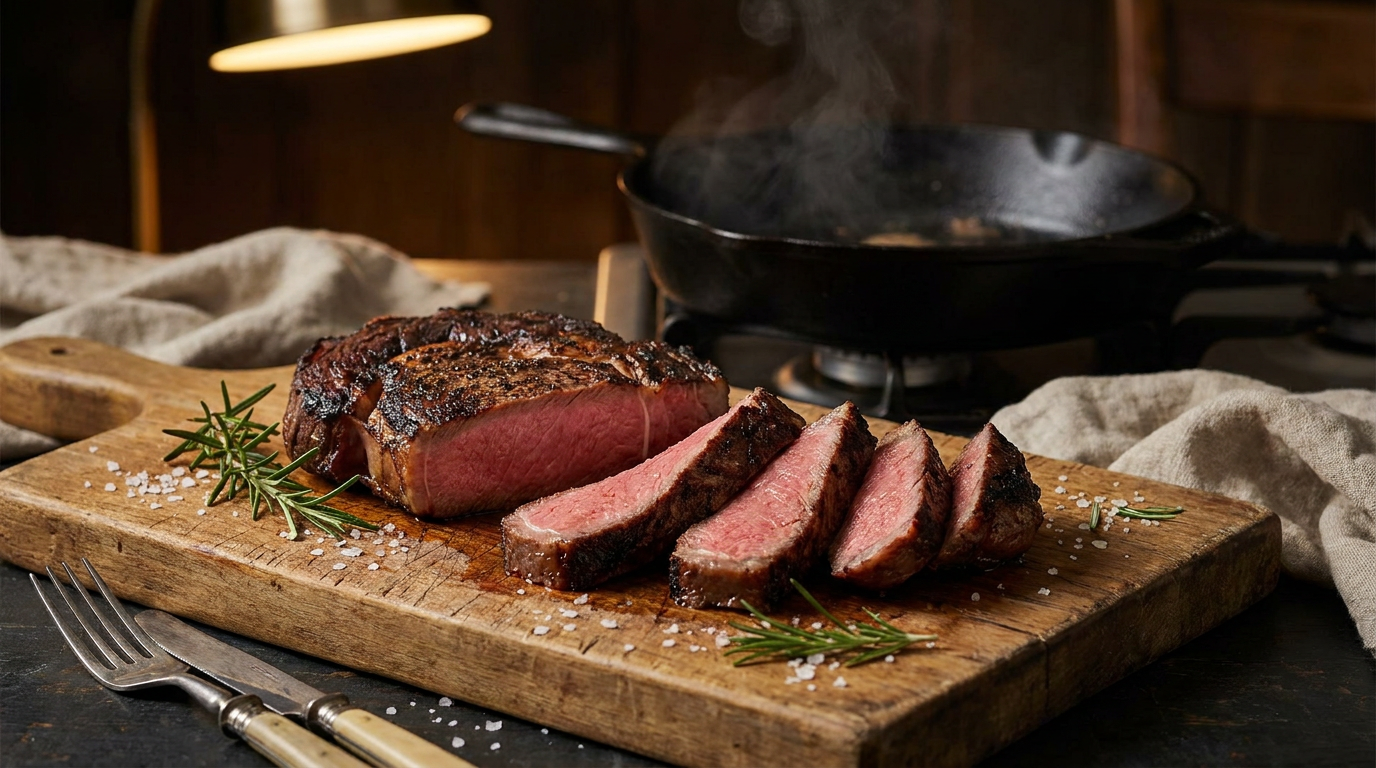
For generations, backyard grillers and professional chefs alike adhered to a culinary commandment: sear meat over blistering heat first to "lock in the juices," then move it to a cooler zone to finish cooking. It was a technique passed down as gospel, accompanied by the satisfying sizzle of meat hitting hot metal. But modern culinary science has thoroughly debunked the juice-locking myth. In its place, a counterintuitive method has taken over the barbecue world: the reverse sear. The reverse sear flips the traditional script entirely. Instead of starting with high heat, the meat is first cooked at a very low temperature—usually in an oven or the indirect zone of a smoker between 225°F and 275°F—until it reaches just a few degrees below the desired internal doneness. Only then is it subjected to a rapid, blistering sear over direct flames or in a smoking-hot skillet. The result is a steak or roast with edge-to-edge perfection, a superior, deeply browned crust, and a remarkably tender texture that traditional methods struggle to replicate.[3][4][7]
To understand exactly why the reverse sear works so effectively, one must first understand the thermodynamic flaws of the traditional method. When a cold, raw steak is thrown directly onto a 500°F grill grate, the intense heat rushes from the exterior toward the center. Because meat is a relatively poor conductor of heat, the outside cooks rapidly while the inside remains cold. By the time the very center of the steak finally reaches a perfect medium-rare temperature of 130°F, the outer layers have been exposed to extreme heat for far too long. This steep temperature gradient creates what meat scientists and culinary experts call the "bullseye effect." Laboratory tests and cross-sectional analyses show that traditional high-heat searing can create zones of overcooked, tough, gray meat that are 5 to 10 millimeters thick just beneath the crust. In stark contrast, steaks cooked using the gentle heat of the reverse sear method maintain a uniform, edge-to-edge pink doneness through 85% to 90% of their entire cross-section, maximizing the amount of perfectly cooked meat on the plate.[4]

The magic of the reverse sear begins in its prolonged low-and-slow phase. By gradually bringing the meat up to temperature over a longer period, the connective tissues within the muscle fibers are less likely to violently constrict and squeeze out their natural juices. Furthermore, this gentle heating process allows enzymes naturally present in the meat, specifically calpains and cathepsins, significantly more time to break down tough muscle proteins, naturally tenderizing the cut from the inside out before the high heat is ever applied. For larger barbecue cuts like brisket or pork butt, this prolonged exposure to gentle heat is absolutely essential for converting tough collagen into silky gelatin, a chemical process that requires internal temperatures to slowly climb toward 185°F to 195°F. While a standard steak doesn't need to reach those extreme temperatures, the underlying principle of gentle heat preserving cellular structure and maximizing tenderness remains exactly the same across all cuts of meat.[2][4]
But the most crucial benefit of the low-temperature start is what happens to the exterior surface of the meat. A raw steak contains a significant amount of surface moisture. When cooking traditionally, that moisture must completely evaporate before the meat can begin to brown, because water cannot exceed 212°F (100°C) before turning into steam. As the culinary maxim dictates, "nothing can brown in the presence of steam." This evaporative cooling actively fights the searing process, forcing the cook to leave the meat on the high heat longer. During the slow-roasting phase of a reverse sear, the warm, circulating air of the oven or grill acts as a gentle dehydrator. As the meat slowly cooks, it naturally releases some moisture, and the exterior gradually dries out and "sets." By the time the steak reaches its target internal temperature and is ready for its final high-heat sear, the surface is completely devoid of liquid water, creating the perfect canvas for complex chemical reactions.[1][3][7]

But the most crucial benefit of the low-temperature start is what happens to the exterior surface of the meat.
This perfectly dry surface is the ultimate prerequisite for the holy grail of cooking chemistry: the Maillard reaction. Named after French chemist Louis-Camille Maillard, who first described the phenomenon in 1912 while researching diabetes, this non-enzymatic browning process is the engine of flavor in the kitchen. It is responsible for the tantalizing aromas, deep brown colors, and complex savory flavors found in roasted coffee beans, baked bread crusts, and, most importantly, perfectly grilled meat. The Maillard reaction occurs when intense heat causes amino acids—the fundamental building blocks of proteins—to react with reducing sugars. In the case of beef and other high-protein meats, the muscle tissue contains glycogen, a form of stored energy made of long chains of sugars. When exposed to the right temperatures, these protein and sugar molecules break down and recombine into a highly unstable chemical compound known as glycosylamine, kicking off a cascade of flavor development.[1][3]
As the heat persists, the unstable glycosylamine quickly rearranges itself into more stable compounds called ketosamines. These ketosamines then undergo further complex reactions, cascading into hundreds of new, highly flavorful chemical byproducts. Compounds like pyrazines, furans, and thiophenes emerge, delivering the distinctively nutty, meaty, and caramel-like notes that define a steakhouse-quality meal. Simultaneously, the reaction produces melanoidins, the large pigment molecules that are entirely responsible for the dark, appetizing crust on the outside of the meat. Temperature acts as the master switch for this intricate chemical symphony. While the Maillard reaction technically begins at around 140°F (60°C), it happens agonizingly slowly at that low threshold. To achieve a rapid, hard sear without giving the internal temperature time to rise and overcook the inside of the meat, surface temperatures need to soar past 350°F (175°C). At this high heat, the Maillard reaction occurs efficiently and violently, creating flavor in a matter of seconds.[1][3][6]

Because the reverse-seared steak already possesses a perfectly dry surface from its time in the low-temperature zone, the Maillard reaction triggers almost instantaneously when the meat finally hits a smoking-hot cast-iron pan or a blazing grill grate. There is no surface water left to cause evaporative cooling and hold the temperature down. Consequently, the crust forms in less than a minute per side, ensuring the delicate, perfectly cooked interior remains completely untouched by the extreme heat. Interestingly, the reverse sear also challenges and updates another long-held grilling rule: the mandatory resting period. Traditionally, a steak must rest for 10 to 15 minutes after cooking to allow the violently constricted muscle fibers to relax and redistribute their internal juices. If a traditionally cooked steak is sliced too soon, the pressure inside the meat causes the juices to bleed out rapidly onto the cutting board, leaving the steak dry and unappetizing.[1][2][4][7]

However, because the reverse sear utilizes such gentle heat for the vast majority of the cooking process, the muscle fibers never experience that extreme thermal shock. The temperature gradient from the outer edge to the center of the meat is minimal. As a result, a reverse-seared steak requires only a fraction of the traditional resting time—often just a brief five-minute pause under loose foil—before it is perfectly stable and ready to be sliced and served. While some traditionalist purists argue that high-heat searing retains slightly more overall moisture—one rigorous test showed that reverse-seared steaks lost 12.78% of their original weight compared to 10.19% for traditional searing—the difference is practically imperceptible on the human palate. The overwhelming consensus among food scientists and modern pitmasters is that the vastly superior texture, edge-to-edge doneness, and intense flavor profile easily outweigh a negligible two-percent difference in water weight. Ultimately, the widespread adoption of the reverse sear represents a triumph of applying rigorous scientific principles to everyday home cooking. By understanding the thermodynamics of heat transfer, the mechanics of enzyme activity, and the precise environmental conditions required for the Maillard reaction, home cooks can consistently achieve steakhouse-quality results. It transforms the art of grilling from a game of high-stakes guesswork and timing into a predictable, repeatable, and highly rewarding culinary science.[4][5][7]
Viewpoints in depth
Food Science Academics
Researchers who study the molecular and thermodynamic changes in meat during cooking.
For food scientists, grilling is an exercise in applied chemistry. Researchers focus heavily on the Maillard reaction, tracking how amino acids and glycogen break down into complex flavor compounds like pyrazines and furans. They emphasize that cooking is fundamentally about moisture management and temperature gradients. By analyzing the conversion of collagen to gelatin and the behavior of muscle enzymes under gentle heat, academics provide the empirical data that debunks long-held culinary myths, proving that controlled, low-temperature cooking preserves cellular structure better than immediate high heat.
Modern Culinary Practitioners
Chefs and pitmasters who prioritize precision, consistency, and optimal texture.
Modern practitioners have enthusiastically adopted the reverse sear as the gold standard for thick cuts of meat. Their primary goal is eliminating the 'bullseye effect'—the thick bands of overcooked gray meat that plague traditional grilling. By separating the cooking process into two distinct phases (internal temperature management followed by exterior crust formation), they achieve edge-to-edge uniform doneness. For this camp, the slight increase in preparation time is a necessary trade-off for restaurant-quality results, predictable resting times, and a superior, moisture-free crust.
What we don't know
- Whether new hybrid cooking technologies will eventually automate the reverse sear process entirely.
- The exact threshold at which the Maillard reaction's carcinogenic byproducts become a significant health risk in home cooking.
Key terms
- Maillard Reaction
- A chemical reaction between amino acids and reducing sugars that gives browned food its distinctive flavor.
- Bullseye Effect
- The uneven cooking pattern in traditionally seared meat, characterized by a pink center surrounded by thick bands of overcooked gray meat.
- Melanoidins
- Brown, high molecular weight polymers formed during the Maillard reaction that give seared meat its dark crust.
- Glycosylamine
- An unstable chemical compound formed in the first stage of the Maillard reaction when sugars and proteins combine.
- Evaporative Cooling
- The process where evaporating surface moisture lowers the temperature of the meat, preventing it from browning.
Frequently asked
Does searing meat lock in the juices?
No. Scientific tests have repeatedly shown that searing does not seal in moisture. In fact, high-heat searing can cause muscle fibers to contract violently, squeezing out juices.
What temperature should I use for the slow phase of a reverse sear?
Most culinary experts recommend setting your oven or the indirect side of your grill between 225°F and 275°F for the gentle cooking phase.
Can I reverse sear a thin steak?
The reverse sear is best suited for thick cuts of meat (at least 1.5 inches thick). Thin steaks cook too quickly in the low-heat phase, making it difficult to achieve a good sear without overcooking the center.
Why does my steak need to be dry before searing?
Moisture creates steam when it hits a hot pan, which prevents the temperature from exceeding 212°F. The Maillard reaction requires temperatures above 350°F to occur rapidly, so a dry surface is essential for a good crust.
Sources
Source coverage
7 outlets
3 viewpoints surfaced







[1]NC State UniversityFood Science Academics
The Science of the Sizzle: The Maillard Reaction
Read on NC State University →[2]Texas A&M UniversityFood Science Academics
The Science of Barbecuing
Read on Texas A&M University →[3]GrillioCulinary Educators
The Science of Grilling: The Maillard Reaction
Read on Grillio →[4]Booth Creek WagyuModern Culinary Practitioners
The Science Behind the Reverse Sear Method
Read on Booth Creek Wagyu →[5]Complete CarnivoreModern Culinary Practitioners
Reverse Sear vs Traditional Sear
Read on Complete Carnivore →[6]The Flying ButcherCulinary Educators
Mastering the Maillard Reaction
Read on The Flying Butcher →[7]Factlen Editorial TeamModern Culinary Practitioners
Synthesis by Factlen editorial team
Read on Factlen Editorial Team →

Every angle. Every day.
Get food drink stories with full source coverage and perspective breakdowns delivered to your inbox.