
SpaceX Completes Historic IPO, Reaching $2 Trillion Market Valuation on First Day of Trading
SpaceX successfully debuted on the Nasdaq, achieving a $2 trillion market capitalization in one of the most anticipated initial public offerings in history.
By Factlen Editorial Team
- Retail & Institutional Bulls
- View the valuation as justified by SpaceX's absolute dominance in launch cadence and the recurring revenue engine of Starlink.
- Market Skeptics & Valuation Analysts
- Caution that the company's current revenue is a fraction of other megacaps, meaning the stock price relies heavily on flawless future execution.
- Aerospace Industry Watchers
- Focus on how the massive influx of public capital will accelerate deep-space infrastructure and pressure legacy aerospace competitors.
What's not represented
- · Traditional aerospace competitors
- · Environmental advocacy groups
Why this matters
The transition of the world's dominant space company to public markets allows retail investors and mutual funds to directly participate in the aerospace economy for the first time. It also sets a massive new benchmark for deep-tech valuations, paving the way for other capital-intensive ventures to seek public funding.
Key points
- SpaceX successfully debuted on the Nasdaq, achieving a $2 trillion market capitalization on its first day of trading.
- The offering saw massive participation from both institutional and retail investors, with moderate volatility despite the high volume.
- The valuation makes SpaceX the sixth most-valuable U.S. company, though its current revenue is lower than its megacap peers.
- The IPO paves the way for SpaceX stock to be included in mutual funds and 401(k) retirement plans.
- Market analysts view the successful debut as a positive indicator for other highly valued private tech companies considering going public.
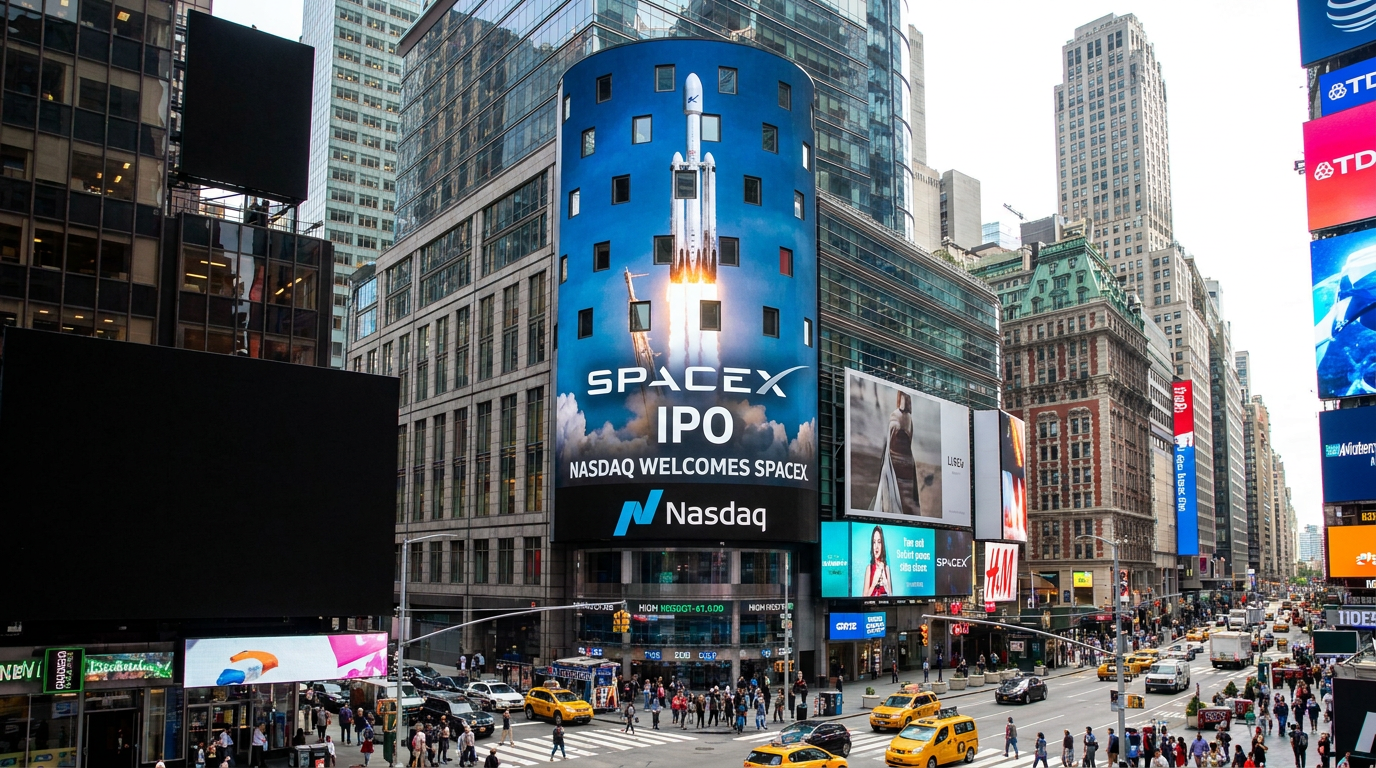
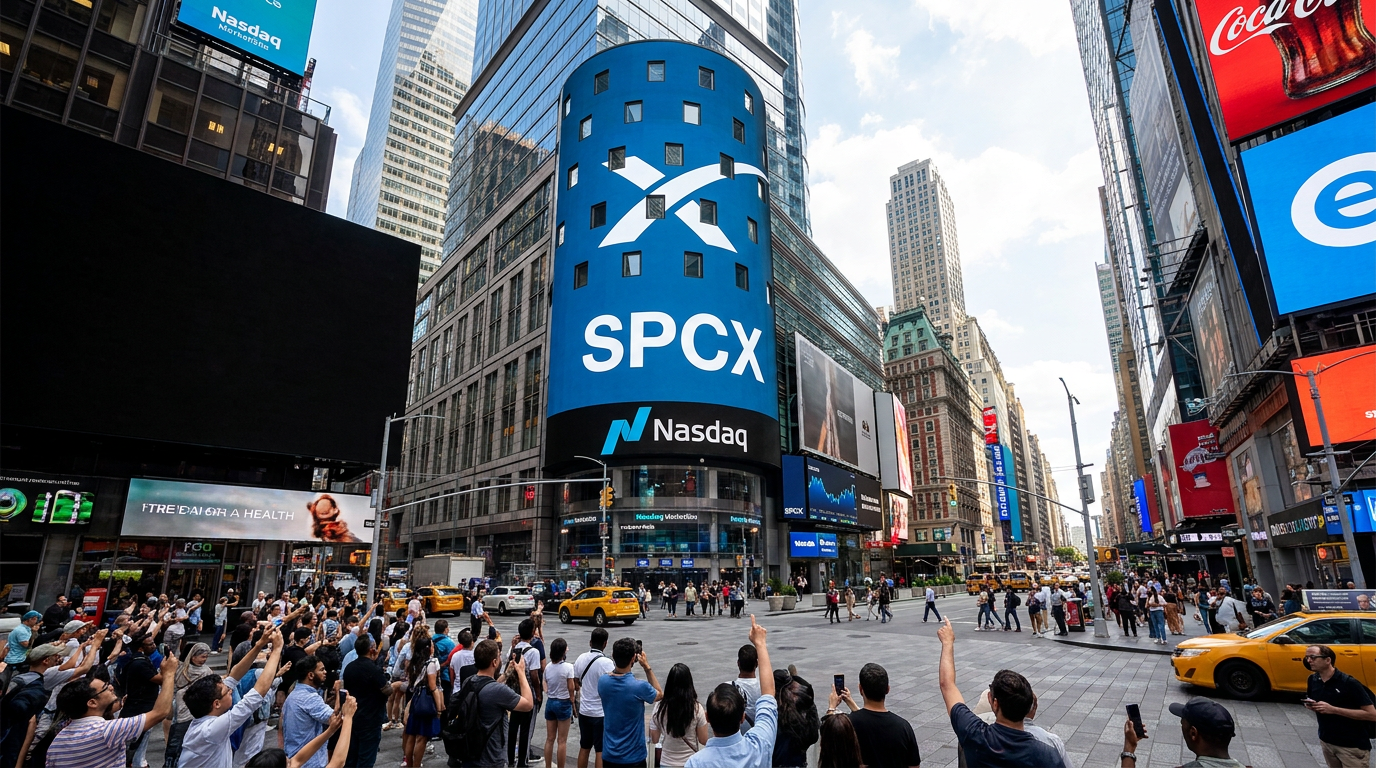
SpaceX officially entered the public markets on Friday, executing a flawless debut on the Nasdaq that immediately propelled the aerospace manufacturer to a $2 trillion market capitalization. The highly anticipated initial public offering marks a watershed moment for the commercial space industry, transforming a company that once teetered on the edge of bankruptcy into one of the most valuable publicly traded entities on the planet. As the opening bell rang, the sheer volume of buy orders briefly tested the exchange's infrastructure, but the stock ultimately settled into a steady upward trajectory, closing the day with what market analysts described as a remarkably stable performance for an offering of its unprecedented size.[1][3]
The $2 trillion valuation places SpaceX in elite company, instantly making it the sixth most-valuable U.S. corporation. The milestone stands in stark contrast to the company's precarious early days. Founder Elon Musk has frequently noted that he initially estimated SpaceX had only a 10% chance of success when he founded it in 2002. Today, the company dominates global launch cadence, operates the world's largest satellite internet constellation in Starlink, and serves as the primary crew transport provider for NASA's operations in low Earth orbit.[1][6]
Despite the massive scale of the offering, the first day of trading was characterized by moderate volatility. A significant portion of the shares was allocated to retail investors, a move that democratized access to a company previously locked behind private equity and venture capital gates. Financial analysts noted that the retail enthusiasm was matched by heavy institutional buying, creating a robust floor for the stock price. The ability of the market to absorb such a massive influx of new equity without destabilizing broader indices was seen as a major victory for the underwriters.[1][5]

The sheer scale of the SpaceX IPO is testing the limits of modern capital markets. Raising capital at a $2 trillion valuation requires an unprecedented mobilization of funds, drawing liquidity from across the global financial system. Market historians point out that no company has ever debuted at such a high valuation, skipping the traditional growth phases of public markets entirely. This "mega-IPO" strategy reflects a growing trend where dominant tech companies remain private for decades, capturing the bulk of their exponential growth before allowing public market participation.[2][4]
For the average investor, the most immediate impact of the IPO is the "Starship Elon" effect. SpaceX stock is now rapidly being integrated into mutual funds, index trackers, and 401(k) retirement plans across the country. Millions of workers whose retirement savings are tied to broad market indices will now have indirect exposure to the commercial space economy. This main-street integration represents a profound cultural shift, turning the high-risk, high-reward business of rocket launches and satellite deployment into a staple of everyday financial planning.[2]
For the average investor, the most immediate impact of the IPO is the "Starship Elon" effect.
Within the aerospace sector, the successful public offering sends a powerful signal about the viability of the commercial space economy. Competitors and legacy aerospace contractors are now forced to reckon with a rival that has access to virtually unlimited public capital. The funds raised are expected to accelerate SpaceX's most ambitious projects, including the rapid iteration of its Starship megarocket and the expansion of the Starlink network, which already generates the lion's share of the company's recurring revenue.[7]

However, the astronomical valuation has sparked intense debate among financial analysts. SpaceX's current revenue, while growing rapidly, is only a fraction of the revenue generated by other megacap technology giants like Apple, Microsoft, or Alphabet. Skeptics argue that the $2 trillion price tag relies heavily on pricing in future monopolies—specifically, the assumption that Starship will dramatically lower the cost of access to space and that Starlink will become a dominant global telecommunications provider. Investors are effectively paying a massive premium for Elon Musk's long-term vision of Mars colonization and deep-space infrastructure.[1][4]
The IPO has also reignited broader conversations about concentration in the technology sector. With a handful of companies now commanding multi-trillion-dollar valuations, some economists worry that capital is becoming too concentrated at the very top of the market. There are concerns that the massive gravitational pull of a SpaceX IPO could crowd out funding for smaller, innovative startups in the aerospace and deep-tech sectors, as institutional investors allocate outsized portions of their portfolios to the new megacap entrant.[8]

Looking ahead, Wall Street is treating the SpaceX debut as a critical bellwether for other highly valued private technology companies. Artificial intelligence leaders like OpenAI and Anthropic, which have also reached massive private valuations, are reportedly watching the market's reception of SpaceX closely. The ability of public markets to digest a $2 trillion deep-tech company suggests that the appetite for transformative, capital-intensive technologies remains robust, potentially clearing the runway for a new wave of mega-IPOs in the coming years.[2]
Ultimately, the transition of SpaceX from a scrappy, privately funded disruptor to a publicly traded titan marks the end of one era and the beginning of another. The commercialization of space is no longer a speculative venture reserved for billionaires and venture capitalists; it is now a foundational pillar of the public equities market. As the company prepares for its next phase of growth under the scrutiny of quarterly earnings reports, the world will be watching to see if it can maintain its rapid pace of innovation while satisfying the demands of Wall Street.[3][7]
How we got here
2002
Elon Musk founds Space Exploration Technologies Corp. with the goal of reducing space transportation costs.
2008
SpaceX successfully launches the Falcon 1, becoming the first privately developed liquid-fueled rocket to reach orbit.
2015
The company achieves the first successful vertical landing of an orbital rocket booster with the Falcon 9.
2020
SpaceX becomes the first private company to send human astronauts to the International Space Station.
June 2026
SpaceX completes its initial public offering on the Nasdaq, reaching a $2 trillion valuation.
Viewpoints in depth
Retail & Institutional Bulls
Investors who believe the $2 trillion valuation is fully justified by the company's technological moat and recurring revenue streams.
Bullish investors argue that traditional valuation metrics fail to capture SpaceX's true potential. They point to the company's absolute monopoly on reusable medium-to-heavy lift launch vehicles and the rapidly expanding Starlink network, which provides high-margin, recurring telecommunications revenue. For these investors, SpaceX is not just an aerospace manufacturer, but the foundational infrastructure provider for the entire future space economy, making its current premium a bargain for long-term holders.
Market Skeptics & Valuation Analysts
Financial analysts who caution that the stock price relies too heavily on flawless future execution and unprecedented growth.
Skeptics do not doubt SpaceX's engineering prowess, but they question the math behind a $2 trillion valuation. They highlight that the company's current revenue is only a fraction of what other megacap tech giants generate. To justify its price tag, SpaceX must not only succeed in deploying its next-generation Starship vehicle but also capture a massive share of the global telecommunications market with Starlink. Any significant delays in development or launch failures could severely punish the stock price, as the current valuation leaves little room for error.
Aerospace Industry Watchers
Industry experts focused on how the influx of public capital will alter the competitive landscape of space exploration.
For aerospace insiders, the IPO is less about the stock price and more about the war chest it provides. With access to virtually unlimited public capital, SpaceX can aggressively accelerate its most ambitious projects, including lunar landers and Mars infrastructure. Industry watchers note that this puts immense pressure on legacy contractors like Boeing and Lockheed Martin, as well as international space agencies, who must now compete against a fully capitalized, publicly traded juggernaut that can outspend them on research and development.
What we don't know
- How the pressure of quarterly earnings reports will affect SpaceX's long-term, high-risk development timelines.
- Whether retail investors will hold the stock through the inevitable volatility of experimental rocket launch failures.
- How quickly the company can scale Starship operations to justify the massive revenue multiples priced into the stock.
Key terms
- Market Capitalization
- The total value of a publicly traded company's outstanding shares of stock, calculated by multiplying the current share price by the total number of shares.
- Initial Public Offering (IPO)
- The process of offering shares of a private corporation to the public in a new stock issuance, allowing the company to raise capital from public investors.
- Megacap
- A designation for the largest publicly traded companies, typically those with a market capitalization exceeding $200 billion.
Frequently asked
Why did SpaceX wait so long to go public?
The company preferred to remain private while developing high-risk technologies like reusable rockets and the Starship vehicle, avoiding the pressure of quarterly earnings expectations until its core business models were proven.
How does SpaceX's revenue compare to other $2 trillion companies?
SpaceX's current revenue is significantly lower than tech giants like Apple or Microsoft; investors are paying a premium based on the company's rapid growth and expected future dominance in space infrastructure.
Can anyone buy SpaceX stock now?
Yes, following the IPO on the Nasdaq, retail investors can purchase shares of SpaceX through standard brokerage accounts, just like any other publicly traded company.
Sources
Source coverage
8 outlets
3 viewpoints surfaced








[1]CNBCRetail & Institutional Bulls
From 10% chance of success to $2 trillion market cap: SpaceX's historic IPO
Read on CNBC →[2]BloombergAerospace Industry Watchers
We’re All on Starship Elon Now
Read on Bloomberg →[3]ReutersAerospace Industry Watchers
SpaceX debuts on Nasdaq, rockets to $2 trillion valuation in historic IPO
Read on Reuters →[4]Wall Street JournalMarket Skeptics & Valuation Analysts
SpaceX IPO Tests Wall Street's Appetite for Trillion-Dollar Tech
Read on Wall Street Journal →[5]Financial TimesRetail & Institutional Bulls
Retail investors flock to SpaceX in record-breaking public debut
Read on Financial Times →[6]Fox BusinessRetail & Institutional Bulls
Elon Musk's SpaceX makes historic market debut, defying early skeptics
Read on Fox Business →[7]TechCrunchAerospace Industry Watchers
SpaceX goes public: What the $2T valuation means for the space economy
Read on TechCrunch →[8]The New York TimesMarket Skeptics & Valuation Analysts
SpaceX's Blockbuster IPO Raises Questions About Tech Concentration
Read on The New York Times →
Every angle. Every day.
Get business stories with full source coverage and perspective breakdowns delivered to your inbox.